Democrat, Sat 25 Mar 1916 1
WAS HE DISLOYAL.
————
THE MAGISTRATE SAYS HE WAS LUCKY
————
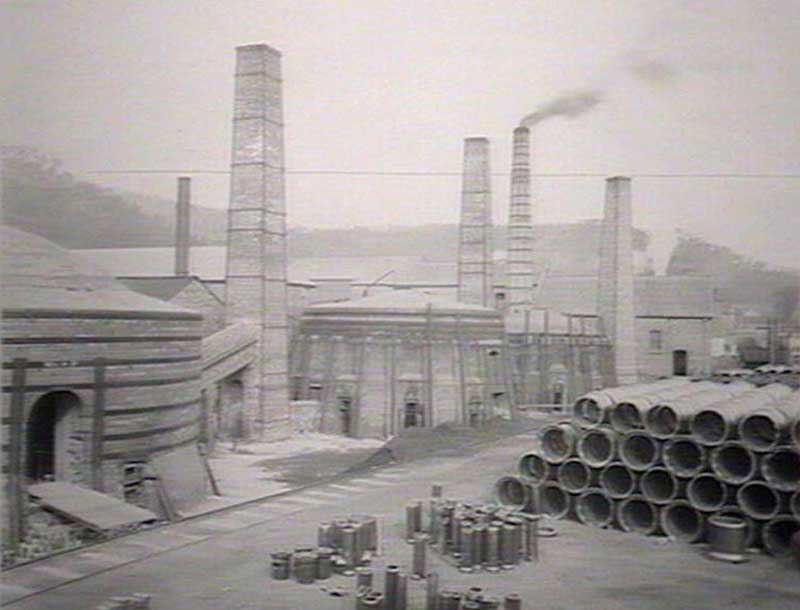
Image: NSW State Library collection. Reproduction: Peter de Waal
Andrew McQuade, evidently looked upon the wine when it was red, for he said that was the cause of his trouble. He was charged with obscene language in the Grand Central Hotel on the 25th February. He pleaded not guilty, but the evidence was dead against him. The language was something like the following:—“I don’t give a b — for the King and his business. I’d like to see England beaten—she ought to be beaten.” Lieut Pettit heard him use these words and remonstrated with him, but seeing Mac would not listen to reason, left it at that.
Fred Lane, a dealer, gave corroborative evidence, and said that Mac made the remarks to him.
Andrew McQuade, the accused, is a laborer living in the brick kilns of the old Silica Brick Works, which, he said, were better than many of the houses in Lithgow, said he knew nothing whatever of the occurrence. He had been worried physically and mentally since the recept [sic] of the summons, and had happened in court the previous week. It was absurd to say he was disloyal. He had two brothers and two nephews at the front. Anyway, if he did say it, he was very sorry, and said he would take the pledge and never [d]rink again. It would be a lesson to him.
Mac was fined £5 and 8/- costs of Court, besides 6/- witness expences. [sic]
The PM said that McQuade was lucky. If he had been brought up under another charge he would have got six months.
~ ~ ~ ~ ~
Leader, Mon 27 Mar 1916 2
A BEAUTY.
Andrew McQuade was summoned at the Lithgow court on Wednesday for making use of indecent language in the bar of the Grand Central Hotel on February 25, to wit, “I don’t give a b—– for the King of England; I would like to see England beat. She ought to beat.” The PM said the defendant was lucky not to have been charged with a more serious offence, whereby he could be sentenced to prison for a considerable term. He would be fined £5, 8/costs of court, and 12/ witness’ expenses; or two months. McQuade was allowed two months in which to pay, provided a surety was forthcoming. Defendant, inter alia, said he lived at the old brickworks, and paid rent. The kilns were better than some of the houses in Lithgow. He was removed in custody.
~ ~ ~ ~ ~
The Bathurst Times, Thu 5 Oct 1916 3
SERIOUS CHARGE
———
INDECENT ASSAULT.
——
CASE FOR LITHGOW.
——
ACCUSED DISCHARGED.
At the Bathurst Quarter Sessions yesterday, before His Honor, Judge Scholes and a jury, an elderly man named Andrew McQuade was charged with committing an indecent assault. The accused pleaded not guilty.
Mr JN Mason was the Crown Prosecutor.
Mr FB Kenny appeared for the accused.
Constable John Costello stated that about 8 pm on the 16th September he went to an old brick kiln in which accused lived, and which had a padlock on the door. Accused was sitting over the fire, asleep, and partly under the influence of drink. When asked if he knew of the boy Ray Atkinson , accused said he never saw him before. The boy said that accused was the person who committed the assault on him. Witness took the boy to the Government medical officer who examined him. He later arrested accused and charged him. He said the charge was false.
When the boy was called, his Honor questioned him, and as he was only eight years of age the judge refused to administer the oath, but he said that he was sufficiently intelligent to make a statement.
The Crown Prosecutor said that he had no further evidence to offer, as there were only the boy and the accused present.
The Judge directed the jury to bring in a verdict of not guilty as there was no evidence to corroborate the boy’s statement.
The jury returned a verdict accordingly. And accused was discharged.
~ ~ ~ ~ ~
The National Advocate, Thu 5 Oct 1916 4
ALLEGED INDECENT ASSAULT.
At the Bathurst General Sessions yesterday, presided over by Judge Scholes, Andrew McQuade, an elderly man, was charged with having indecently assaulted Ray Atkinson, a boy eight years of age, at Lithgow on September 3rd. After hearing a number of witnesses. His Honor advised the jury to return a verdict of not guilty, as the case had failed legally, owing to the lack of corroborative evidence. A verdict was returned accordingly. The prosecution was conducted by Mr Jn Mason, and Mr FB Kenny defended.
~ ~ ~ ~ ~
The Dubbo Liberal and Macquarie Advocate, Fri 13 Oct 1916 5
REFORMATORY VERSUS GAOL.
Judge Scholes expressed a desire when sentencing a youth at Bathurst Quarter Sessions last week, that there should be a place for first offenders, where, after they had served their sentence and had been educated in discipline, they would not carry the stigma of having been in gaol. He asked the authorities to note that he wished the name of the Goulburn Gaol to be altered from that of “gaol” to “reformatory.”