John Couche, 1888
Below also see: Francis Williams, 1889,
Francis Williams, 1892,
John Frank Palmer Couche, 1896 – Sodomy,
John Frank Palmer Couche, 1900 – Indecent assault,
John Frank Palmer Couche, 1907 – Indecent assault
Newcastle Morning Herald and Miners’ Advocate, Tue 26 Jun 1888 1
NEWCASTLE POLICE COURT.
———◦———
Monday, June 25th, 1888.
(Before Messrs J Mair, PM, D
Ludlow, and D Murray, JsP.)
…
A KLEPTOMANIAC.
John Couche, a seaman, was charged with stealing from a bedroom in Mrs Irwin’s restaurant, in Hunter-street, one pair of trousers, one pair of braces, and one steel chain, valued at 18s 6d, the property of Theodore Perill, on or about the 21st inst.
Detective McHattie stated that between 8 and 9 o’clock the previous night he, in company with Senior-constable Thompson and a man named Theodore Perill, were looking for accused. From something the latter said, witness went into Dunn’s boarding-house in Newcomen-street, [sic] where he saw accused. Perill looked at the trousers accused was wearing, and said they were his. He then gave accused into custody. Accused said if witness would let him go he would give back the trousers. Witness brought accused to the lockup, and charged him with stealing a pair of trousers, a pair of braces, and a steel chain. Accused made no reply.
Theodore Perill, the prosecutor identified the property as his and valued the articles as 18s. He had been living in the same room with accused.
Accused pleaded guilty, and elected to be summarily dealt with. He said he was subject to attacks of kleptomania, and one of the fits took him when he took the trousers.
The Bench sentenced him to two months’ hard labour in Maitland gaol.
Francis Williams, 1889
Evening News, Tue 8 Jan 1889 2
YESTERDAYS’ POLICE COURTS.
————
CENTRAL.
…
A sulky-looking individual named Francis Williams went into Mr Pasquale Messina’s shop in Park-street on Saturday night and asked to look at some watches. These were shown to him, and the proprietor alleges that Williams suddenly decamped with a silver one, valued at £1 14s. He was chased by the owner, and caught in Pitt-street, so it is alleged, with the “ticker” in his pocket. The accused elected, in the face of this evidence, to go to a jury, and was accordingly committed to take his trial at the forthcoming Quarter Sessions, bail being allowed.
~ ~ ~ ~ ~
The Sydney Morning Herald, Tue 8 Jan 1889 3
POLICE.
———◦———
Mr Johnson, SM, disposed of the business in the Charge Division of the CENTRAL POLICE COURT yesterday morning.
Francis Williams [aka Frank John Couche], 23, no occupation, was charged with stealing a silver watch, valued at £4 14s, the property of Pasque Messina. The prisoner, who preferred to be tried by a jury, was committed for trial at the next Court of Quarter Sessions. Bail allowed.
~ ~ ~ ~ ~
The Sydney Morning Herald, Fri 1 Feb 1889 4
METROPOLITAN QUARTER SESSIONS.—
(Before his Honor Acting-Judge FITZHARDINGE.)
The sittings of the Metropolitan Court of Quarter Sessions were commenced yesterday, at the Courthouse, Darlinghurst. On taking his seat his Honor Acting Judge Fitzhardinge administered to himself the judicial oath as chairman of the Court of Quarter Sessions.
Mr WL Merewether prosecuted on behalf of the Crown.
JURORS FINED.
The following were find for non-attendance as jurors:—Frederick Stuart, cordial manufacturer, 8, Craigend-street; John Meeks, contractor, 176, Hereford-street, Glebe; Matthew Bayfield, grocer, 402, Oxford-street, Paddington.
PLEADED GUILTY.
The following prisoners pleaded guilty, and were remanded for sentence:—
…
Francis Williams, larceny.
~ ~ ~ ~ ~
Evening News, Sat 2 Feb 1889 5
QUARTER SESSIONS.
————
(Before his Honor Acting Judge Fitzhardinge.)
Mr WL Merewether conducted the prosecutions on behalf of the Crown.
…
Francis Williams, who had pleaded guilty to an indictment charging him with stealing a watch, was sentenced to twelve months’ hard labor.
…
PLEASE OF GUILTY.—The following prisoners pleaded guilty and were remanded for sentence:
…
Francis Williams, larceny.
~ ~ ~ ~ ~
The Sydney Morning Herald, Sat 2 Feb 1889 6
METROPOLITAN QUARTER SESSIONS.—
(Before his Honor Acting-Judge Fitzhardinge.)
The sittings of the Metropolitan Court of Quarter Sessions were continued at the Courthouse, Darlinghurst, yesterday.
Mr WL Merewether prosecuted on behalf or the Crown.
His Honor remitted the fines imposed on the previous day upon John Meeks, Frederick Stuart and Matthew Bayfield, they having given a satisfactory explanation regarding their non-attendance as jurors.
SENTENCES.
…
Francis Williams pleaded guilty to a charge of stealing a watch. It being his first offence 7 he was sentenced to 12 months’ imprisonment with hard labour in Maitland gaol.
~ ~ ~ ~ ~
Francis Williams, Gaol photo sheet 8
![SRNSW: NRS2138, [3/6050], Darlinghurst Gaol photographic description book, 1888-89, No. 4371, p. 121, R5103.](../../images/trials/1896-Couche-6050-gaol-photo-4371-Francis-Williams.jpg "SRNSW: NRS2138, [3/6050], Darlinghurst Gaol photographic description book, 1888-89, No. 4371, p. 121, R5103.") |
Gaol Photo Sheet - Transcribed Details
No. 4371
Date when Portrait was taken: 9-1-1889
Name: Fraser Francis Williams
|
Native place: BC Melbourne Year of birth: 1866 Arrived Ship: – Trade or occupation Religion: C of E Education, degree of: R & W Height: 5' 0¼" Weight On committal: 138 Colour of hair: Dark brown Colour of eyes: Grey Marks or special features: Bracelet on left wrist. F.G. anchor & three spots on junction of thumb and forefinger left hand — |
Where and when tried: Sydney Q.S. Offence: Stealing Sentence: 12 months HL Maitland Gaol Remarks:—Plead Guilty |
|
(No. of previous Portrait ... ) PREVIOUS CONVICTIONS |
|||||
| Where and When | Offence. | Sentence | |||
|
|
|
|
Nil |
|
|
|
Inquire Maitland |
|||||
~ ~ ~ ~ ~
Francis Williams, Gaol photo sheet 9
![SRNSW: NRS2326, [3/14127], Maitland Gaol Photograph description sheets, 1873-1922, No. 4371, p. 57, R5128.](../../images/trials/1896-Couche-14127-gaol-photo-4371-Francis-Williams.jpg "SRNSW: NRS2326, [3/14127], Maitland Gaol Photograph description sheets, 1873-1922, No. 4371, p. 57, R5128.") |
Gaol Photo Sheet - Transcribed Details
No. 4371
BS England 1866
Thiraposa 1877
Date when Portrait was taken: 9-1-1889
Name: Francis Williams
(aka Francis Couch)
|
Native place: BC Melbourne Year of birth: 1866 Arrived Ship: Trade or occupation Religion: C of E Education, degree of: R & W Height: 5' 4" Weight On committal: 138 Colour of hair: Dark brown Colour of eyes: Grey Marks or special features: Bracelet on left wrist F.G. anchor & three spots in junction of thumb & forefinger left hand |
Where and when tried: Sydney Q.S Offence: Stealing Sentence: 12 months HL Maitland Gaol Remarks:—Plead Guilty |
|
(No. of previous Portrait ... ) PREVIOUS CONVICTIONS |
|||||
| Where and When | Offence. | Sentence | |||
|
Newcastle PC ditto * Newcastle Q.S Sydney GD |
25 26 9 20 |
6 4 6 2 |
1888 1892 1892 1896 |
Stealing ditto ditto Buggery |
2 years H.L. 4 months H.L. 2 years H.L. 4 years HL |
|
* Serving the 8 months sentence when convicted and sentenced to the 2 years HL. Discharged 9-2-1894 |
|||||
~
Francis Williams, 1892
Newcastle Morning Herald and Miners’ Advocate, Tue 26 Apr 1892 10
LOCAL AND GENERAL.
———◦———
…
A cook named Francis Williams was arrested at Hamilton yesterday afternoon, and will appear at the Police Court this morning on five different charges of petty larceny.
~ ~ ~ ~ ~
Newcastle Morning Herald and Miners’ Advocate, Wed 27 Apr 1892 11
NEWCASTLE POLICE COURT.
———◦———
Tuesday, April 26.
————
(Before Messrs Mair, PM, and
Thorn, JP.)
————
…
A PETTY THIEF.
Francis Williams, 29, cook, was charged with stealing a regatta shirt and a necktie, the property of James Edwards.
Constable Holmes stated that about 4 o’clock the previous afternoon he and Constable McKellar saw the accused in Tudor-street, Hamilton. They stopped him, and witness asked where he got the shirt he was wearing. He hesitated for some little time, and then said he purchased it at a shop in Hunter-street. They then took him to Mr Edward’s’ shop in Union-street, where a Mrs Stinson recognised him as the man who had stolen a shirt and necktie from the shop on Saturday.
Wynn Stinson said that the accused came to Mr Edwards’ shop on Saturday evening and asked to be shown some shirts and ties. She complied, and he selected those produced, which she made into a parcel for him. He then asked to see some cretonne, and upon being shown a sample, said it was too dark in colour. She then reached some a lighter hue, and when she returned to the counter he had disappeared, and the parcel was missing.
This concluded the evidence, and the accused pleaded guilty.
He was then charged with stealing a pair of shoes, valued at 10s 6d, the property of Stanley Baker.
Constable Holmes produced a pair of shoes that the accused was wearing when arrested.
Stanley Baker, a warehouseman carrying on business in Hunter-street, said that on Friday evening the accused came to his shop and selected a pair of shoes, which witness wrapped up for him. He then said he wanted a pair of girl’s boots, and he pointed to a pair that were hanging at the front of the shop. Witness made theses into a parcel, and upon turning to hand them to the accused found that he had disappeared with the shoes.
This concluded the evidence, and the accused pleaded not guilty, and elected to be tried by jury.
He was therefore committed for trial to the Newcastle Quarter Sessions, and on the first charge was sentenced to four months’ hard labour in Maitland Gaol.
On three further charges the accused was remanded till Friday.
~ ~ ~ ~ ~
Newcastle Morning Herald and Miners’ Advocate, Sat 30 Apr 1892 12
NEWCASTLE POLICE COURT.
———◦———
Friday, April 29.
————
(Before Mr Mair, PM, and Messrs Thorn
and Asher, JsP.)
…
THE RECENT SHOP-LIFTING CASES.
Francis Williams, 29, cook, was charged, on remand from the 26th instant, with having stolen a tin of salmon, a tin of herrings, and a loaf of bread, the property of William Lightfoot, on the 21st instant. There were two other charges preferred against the accused, namely, stealing a tin of herrings from Edward Eager, and a bottle of port wine, valued at 3s 6d, the property of William McGrevy.
Mrs Lightfoot, wife of William Lightfoot, shopkeeper, Cook’s Hill, stated that on the 21st instant the accused entered the shop and asked for a loaf of bread and two tins of fish. She supplied him, and then he asked the price of some lollies which were in the window. He ordered 4oz, and while in the act of getting them the accused snatched the parcel containing the bread and fish and ran away as hard as he could. When the accused was in the shop witness noticed that he wore a gold ring very much like the one produced.
The accused elected to be tried by the Bench, and said he was “not guilty.” The police stated that the accused was under a sentence of four months, and was also committed for trial on another charge. The other two charges on the sheet against the accused would not be gone into. The accused was a bad character, and had only recently been liberated after serving a sentence of two years for stealing a watch.
The man was then sentenced to four months’ hard labour in addition to the previous sentence.
John Frank Palmer Couche, 1896
Evening News, Mon 3 Feb 1896 13
WATER POLICE COURT.
————
TO-DAY’s CASES.
Captain Fisher, SM, presided in the charge court.
…
John Frank Palmer Couche, 26, seaman, was charged with assaulting one John Clayton on board the ship Samanco on the high seas on December 21, and committing a serious offence. He was remanded till Thursday; bail refused.
~ ~ ~ ~ ~
The Daily Telegraph, Fri 7 Feb 1896 14
POLICE COURTS.
…
At the Water Police Court yesterday, before Mr [Arthur Money] Fisher, SM., John Frank Palmer Couche, the second officer of the ship Samanco, was proceeded against for an abominable outrage upon an apprentice. Couche was committed for trial, bail being refused.
~ ~ ~ ~ ~
The Sydney Morning Herald, Fri 7 Feb 1896 15
POLICE COURTS.
———◦———
…
At the Water Police Court yesterday, before Captain Fisher, SM.
…
COMMITTED FOR TRIAL.
John Frank Palmer Couche was committed for trial to the court of gaol delivery at the Water Police Court yesterday on a charge of committing an unlawful offence.
~ ~ ~ ~ ~
Depositions for John Frank Palmer Couche 20 Feb 1896 Sydney trial 16
(a) Town. |
Letter from Bench of Magistrates at (a) Water Police Office Sydney |
|
|
|
transmitting Depositions |
|
|
(b) Name in full of accused. |
in the case Regina v. (b) John Frank Palmer Couche |
|
|
(c) Offence. |
(c) Buggery |
|
|
(d) Town. |
Water Police Office, (d) Sydney |
|
|
|
7th February 1896 |
|
|
|
Sir, |
|
|
(e) Name of accused |
case of (e) John Frank Palmer Couche |
|
|
(f) “His” or “her” |
who has been committed to take (f) his |
|
|
(g) “Circuit Court,” or |
trial at the (g) Gaol Delivery |
|
|
to be held at (h) Darlinghurst |
on Monday |
|
|
(h) Town where Court |
the 17th day of February 1896 |
|
|
The accused is (i) confined in the gaol at Darlinghurst |
||
|
(i) “Is confined in the |
||
|
(k) As in Recognizance, both for Crown and defence, specifying also what witnesses gave evidence but were not bound over, with reason for omission. |
The Witnesses bound over are (k) Harry Richard Scott, John William Clayton, George Williamson, Albert Evans. (Dr Paton has been warned to attend to be bound over.)
|
|
|
(l) Short description to enable identification. |
The Exhibits enclosed are (l) marked “A” “B” “C” “D” “E” and “F” respectively. |
|
|
|
I have the honor to be, |
|
|
|
[Signed] C[harles] N[ewton] Payten |
|
|
The Secretary, |
||
|
N.B.– When a Police Constable acts as Clerk of Petty Sessions, this letter should be signed by one of the Committing Magistrates |
||
|
4g 201-90 |
||
~ ~ ~ ~ ~
NEW SOUTH WALES POLICE.
Metropolitan District,
Water Police Station.
7th February 1896.
Report relative to antecedents of:–
Name: John Frank Palmer Couche
Offence: Buggery
Committed for trial at: Sydney Gaol Delivery 17 February 96.
Date: 7th February 1896.
Senior Constable Harry R Scott reports:– that as fas as he the Senior Constable can ascertain nothing is known relative to the antecedents of Couche. He having only arrived in Port Jackson on the first instant as Second Officer of the British Registered Barque Samanco on board of which vessel when upon the high seas the alleged offence was committed.
The Master of the Samanco George Williamson informs the Senior Constable that as soon as the ship’s inward cargo is discharged she will proceed to Newcastle to load coals for the West Coast of South America.
[Signed] Harry R Scott, Senior Constable.
~ ~ ~ ~ ~
Water Police Station
13 February, 1896
George Read Esquire JP, Superintendent
The Queen versus Couche
Sodomy.
Sir,
I respectfully beg to report that subpoenas have been served in Hugh Ernest Roberts 1st Mate and Joseph Esket, Carpenter on the barque Samanco and the original with Affidavit of Service returned. Statements have been obtained from Hugh Ernest Roberts and Joseph Esket and herewith submitted.
Olaf Edward Ostman an Apprentice on board has also made a statement in writing which is attached. Perhaps it might be advisable to obtain a subpoena for him.
[Signed] Geo H Hyem, Inspector.
~ ~ ~ ~ ~
Crown Solicitor’s Office,
Sydney, 12th July 1896
The Inspector General of Police, Sydney
Urgent
Memo
Reg versus Couche Central Criminal Court.
Herewith original subpoena and copies for service on the 1st Mate and Carpenter of the ship Samanco. Originally with Affidavit of Service endorsed to be returned immediately. Statements should be obtained from these witnesses and submitted.
The names of the two witnesses must be filled in and also date of trial.
The Crown Prosecutor states that the trial can be fixed for 20th instant if that will suit all the witnesses.
[Signed] Geo Colquhoun.
Crown Solicitor.
1
Sydney New South Wales BB Samanco
February 14th 1896
I Hugh Ernest Roberts (Chief Officer) of the British registered barque Samanco beg to state for the guidance of the Crown Solicitor the following statement concerning our Second Officer John Frank Palmer Couche and the boy John Clayton.
According to the usual way, the boy being on his first voyage was placed in my watch. The Second and myself had bought some cocoa for our own use and when about two months out he often asked my permission to take the boy to his room and give him some cocoa, which I granted. Some time whilst off Cape Horn about the middle of September I heard that the boy had been swearing about the deck. I gave him a severe talking to and threatened to acquaint his father of such. He said that if I told his father he would also say that I had been the ruination of him. Being surprised to hear such an expression from a boy, I demanded to know what he meant when he said he heard me swearing occasionally so I ordered him away.
When relieved by the 2nd Officer I told him what the boy said but he took little or no notice of it.
The following day from 6 to 8 pm it being my watch on deck the boy was down the 2nd Mate’s room so I ordered him out and told to keep on deck.
On being relieved 8 o’clock the Second asked me quite indignant if I called the boy out I
2
answered “Yes” and that I meant to do so when he said “I suppose you think I am doing something wrong with him.” I said “I wouldn’t suspect such a thing of a dog, leaving alone a man,” and I also said that the best thing for the sake of peace between him and I would be for him to get the boy transferred over to his watch, as I meant to keep him in his place, whether to it pleased him or not.
The following day he made a complaint to the Captain that he could not agree with one of the boys in his watch, and requested from the Captain for the sake of peace, to have Frank Steventon put in my watch and John Clayton in his. Which request was granted.
A few days after that Mr Couche was laid up sick for some days and had the boy attending on him.
And all the time, up to the time, those letters were written, they were always together. The boy even used to sleep in his room, sometimes in his watch below and several times in his watch on deck. Mr Couche had holes bored in the partition that separated his bunk from the boy’s, and also had the keyhole in his room door locked with paper.
And between hearing the boy crying many times, and overheard some queer conversations between them in the room, my suspicions were naturally aroused and I acquainted the Captain of all I heard and seen.
On the night of November 21st the Captain gave the 2nd mate a severe talking for having the boy so much in his room, and ordered the boy not to go there any more, as the boy was watchman in
3
port, but was hardly ever to be seen on deck up to the time that I went to bed, unless he was ordered out of the second mate’s room.
About 11 am December 15th the Captain sent the boy out Mr Couche’s room. He also said for the first time that the boy was a cousin of his.
On December 22nd Captain turned out and found no-one on deck about 2 am. The Captain ordered OE Ostman to go in search of the 2nd mate. Ostman went to the second’s room and found him there.
When the Captain had a talk to the 2nd mate he went to Couche’s room and pulled the boy out his bunk and sent him on deck.
When the letters were written, the 2nd mate suspected the boy had exposed him, and seemed to be fretting very much, and told me that he was heartless sorry, that he did not take my advice and not to make so free with him.
As I was told that he threatened the boy’s life and in regards to such, I never told him what I had heard or seen, as he was not aware of these letters being in existence.
And I also requested of the Captain to put the boy over in my watch in case of something happening, the boy often insulted the 2nd mate and called him all sorts of names.
The 2nd mate had also a quantity of jam, preserved fruit and milk etc which he bought at Caleta Buena and which he used to give to the boy.
And I must consciously admit that it was quite an unnatural proceedings throughout.
[Signed] Hugh Ernest Roberts, Chief Officer.
1
Bark Samanco of Liverpool now in Sydney.
I Joseph Esket carpenter of the said vessel beg to state for the information of the Crown Solicitor, the undermentioned statement which is the truth as near as I can recollect of this case between John Frank Palmer Couche and John William Clayton. We had not been many weeks out from England when the 2nd mate began to fool around with the boy, who was in the chief mate’s watch. When it was the 2nd mate’s watch below he would stay up an hour or two always to talk and many a time they were to be seen kissing and fondling each other and never seemed to care who saw them. Now as I have a family myself I know something about showing a natural affection for youngsters, but when I used to see the sickening way they used to carry on and as to the boy was anything but a nice boy, for there was not a man or boy on board except the 2nd mate had the slightest use for him. It seemed altogether too unnatural. Well, when we began to get down towards Cape Horn the 2nd mate began to be quite jealous of the boy and couldn’t bear to have him out of his sight, or to speak to anyone, and he began to spend hours in the 2nd mate’s room. One night when I was keeping watch in the chief mate’s watch the mate called the boy up out of the 2nd mate’s room and he did not like it and it caused a few words between the officers when the 2nd mate came on deck at eight bells and just about the same time the mate had reasons
2
to speak to the boy when he gave some cheek and said the mate had been the ruination of him. The mate asked me what I thought he meant by it. Well I said the only thing that I can tell that would mean ruin to a boy would be the same thing that would mean ruin to a girl. Afterwards the 2nd mate had a few words about it and there was an exchange of boys made; the 2nd mate getting Clayton into his watch and this was just what he had been working for. From this time forward the [boy] spent all his spare time in the 2nd mate’s room. It was just after this as the boy informed us afterwards that the 2nd mate committed the first offence on his person. Just after this the 2nd mate laid up sick and the boy stayed in his room altogether and as he informed us on one occasion he had him handling his penis until he ejected his nature. After this the boy began to be afraid, but the 2nd mate told him it was all right and no harm in it as long as they were friends, but he must never tell anyone. But the boy still being afraid and wanted to stop the thing then, the 2nd mate began to threaten him and many a night I have lain in my bunk which is separated from the 2nd mate’s room by a thin partition, and heard the boy crying to be away from him. I have heard the 2nd mate say to him “Lay down there. Goddamn you, lay down. Lay down or I’ll kill you. Goddamn you,” when the boy would exclaim “Oh Mr Couche, let me get up. Oh you’re hurting me, Mr Couche. Oh let me go out, Mr Couche.” Then he would say “Shut up Goddamn you. Shut up or I’ll kill.” When I used to talk these things over with
3
the mate we didn’t really think things were really going so far as they were, and as the mate used to remark we didn’t like to think him guilty of such a thing. When we arrived in Caleta Buena the boy was made night watchman as he was too small to be of any use at the cargo. Then the 2nd mate used to spend the best part of the night with him. One night in a fit of passion he threw his overcoat overboard and had to lower a boat to pick it up. Another time he threw his watch overboard. At this time the boy used to cheek him all the time in front of everyone, and one Sunday afternoon the boy wanted to go forward beside the men to fish. When the 2nd mate wouldn’t allow him and give him a couple of licks with a rope’s end when the boy called him all the dirty curse he could mention and came down the half deck no-one being down there, I was lying reading in the sail room and could look right into the half deck. The 2nd mate came to the ladder and begged and prayed of the boy to forgive him and come down into his room and he would make it all right. The boy wouldn’t go so at last he came down beside him when after a lot of kissing and fooling around the boy at last went down with him. On another occasion the boy was at the galley door after his tea when the cook was showing him the native money. When the 2nd mate left the stage and rushed along to see where the boy was and took him aft and says to the boy “Now the Cook was offering you money to do something to you.” The boy denied it and
4
told the Cook. When the cook at once tasked the 2nd mate with paying it when he denied having said so. That night the cook and I told the 2nd mate the best thing he could do was to leave the boy alone and let him find his own level or he would be getting into trouble, which he agreed was the best thing he could do. We all went aboard of another ship that night and as soon as we were gone he was down the half deck with the boy at once. On another occasion the mate had had a visitor and came up to see him off between 11 and 12. I came on deck too and the mate and I were having a quiet talk when we heard the 2nd mate and the boy on the sail which had been left on the (?). In a few minutes the boy began to cry out “Oh Mr Couche, you are hurting me. Oh, let me go up. Oh oh oh Mr Couche, let me get up.” The 2nd mate replied “All right Jack, all right Jack, keep quiet Jack, only a minute Jack.” When the boy said “Oh no, no, let me get up.” Then there was a sound as if the boy’s windpipe was being compressed. Then in a minute or two more all was quiet. On Sundays generally he used to take the boy away in the boat fishing to keep him out of the road. They didn’t come back until 9 o’clock. On one occasion and on the Sunday the 2nd mate went ashore. He took the boy with him for the day and he spent somewhere about nine pounds in tinned stuff for the boy to eat. After we left Caleta Buena the crew began to frighten the boy about being put into gaol until at last the boy confessed everything. I at once went down and acquainted the Captain with the facts and asked him if I should bring the boy down
5
to him, but he said “Never mind, I believe what you say, and we must keep it quiet if we can, for if he finds out he will make away with the boy.” Then the mate Stewart Cook and myself talked the thing over and came to the conclusion the boy had better write out a statement in case of accidents, which he did. The Captain had ordered the boy out of the room on more than one occasion, but the 2nd mate would have him down in spite of anything until at last the Captain, finding him asleep in his room, he put a final stop to it. Then he began to write those letters which you will have seen and used to pass them through the ports from his room to ours and bored several holes through the partition. The boy (stopped ?) one of them up when he came down with a knife in his hand and knocked him about and threatened to kill him. As soon as vessel was anchored I came ashore with the letter and reported the matter to the Police.
Your obedient Servant
[Signed] Joseph Esket, Carpenter Bk Samanco.
1
Barque Samanco, Sydney, New South Wales
February 13/95
I Olaf Edward Ostman senior apprentice of the barque Samanco state for the information of the Crown Prosecutor all that I know concerning JFP Couche’s unlawful relations with the boy John Clayton of the aforesaid vessel. At the beginning of our voyage from Sunderland to Caleta Buena the 2nd mate, namely the before mentioned JFP Couche did take a strange liking to the boy John Clayton who is of a disagreeable nature, and soon became very little liked either fore or aft. The boy was in the first mate’s watch at first, but one evening the young rascal told the chief mate that he (the chief mate) had ruined him. This seemed a strange and unaccountable thing for a boy to say, and we guessed that he had been put up to it, by the 2nd mate, who we saw hated the chief mate. The boy told us afterwards our conclusions were right. This caused the chief mate to send him out of the watch, and of course the second mate fairly jumped to have the boy. Well after that the boy was seldom in his own quarters; but continually closeted with the 2nd mate, and they made themselves look ridiculous by the way they used to sweetheart each other, for all the world like true lovers one day, and the next squabbling and fighting. And what made matters suspicious looking, the 2nd mate used to watch the boy whenever he was speaking to anybody. When we got to Cape
2
Horn where it was pretty cold outside; the 2nd mate reckoned he had fits and laid up where it was more comfortable. The boy seemed almost to have disappeared into that room to tend the sick man who we are certain was shamming; as the boy told us long afterwards, that he caused him to play with his penis and other disgusting deeds of shame while he was lying “sick” till we rounded the Horn. In Caleta Buena they were inseparable, and the boy being made night watchman used to sleep in his 2nd mate’s room during the day, and slip down every evening. Sometimes we could hear the boy crying and screaming, as though he had a towel or something in his mouth, to drown his cries. One night those down our half deck which is next his, the 2nd mate’s room, heard him saying in a passionate voice “Lie down, Goddamn you, lie down, or I’ll kill you.” The boy screamed out in a muffled voice “Oh Mr Couche, let me alone. Go away, you’re hurting me,” but the boy never owned up to anything, when asked, he denied anything improper. Well after we left Caleta Buena bound for here we had beautiful weather of which the 2nd mate used to take advantage of and go below to his room where the boy was instead of being on deck. When I have been at the wheel they have not shown their faces on deck till my two hours were up. The others in his watch used to tell him the same thing and we watched him and the boy pretty closely but they had too many conveniences for us and could never catch them. Well one night I came from the look out and being tired
3
lay down and slept till I heard the Captain calling. He asked where the 2nd mate was. I said that he would be most likely down his room. He, the Captain, sent me down to fetch him up. I made a noise in going down so when I opened the door the 2nd mate was standing up, and the boy lying in the 2nd mate’s bunk. I went up and told the Captain who went down. Then the 2nd mate slunk along the (poops ?) as though afraid of being seen and fairly ran into the w.c. forward. He had hid himself when he heard the Captain coming and slipped on deck, while the Captain hauled the boy out of the bunk and chased him on deck. Then the 2nd mate came aft and the Captain came up and opened out on him and asked what he was doing with the boy in his bunk. He denied that the boy was in his bunk and didn’t say a word to the Captain when he told the boy never to dare to show his face down there again. Well after that they used to sit together under the skids on the main deck, and the 2nd mate who had bought about £4 worth of tinned stuff used to fetch one tin up and they used to eat it there. The boy one Sunday for a wonder was turned in after a tiff with the 2nd mate who had been asking him to leave in Sydney. I thought it would be a good chance to sound the boy, so I said to him as if I knew all about it. “Jack, what would your father and mother, your sisters and brother think of you if they knew your carryings on with the 2nd mate. He started to weep and said that he didn’t know it was wicked to do so. I asked him how the 2nd mate did it first. He said that he was sleeping down the room one night and he was awakened by the 2nd mate pushing against him. The 2nd mate’s penis was up his posterior and he asked him why he had it there. The 2nd mate told him that it was a
4
past time reserved for friends. Well we made the boy write us a confession for fear he would let matters slide and we all, the carpenter, steward, cook and I signed it. A week or so after this the 2nd mate saw from the boy’s behaviour that something was amiss and he watched the boy closer than ever, and whispered frequently with him and threatened him often. One morning when me and the boy were lying in our bunks, the 2nd mate came down. I pretended to be asleep, and the 2nd mate and the boy had a long whispered conference, during which he squeezed the boy’s neck pretty often and threatened him. The 2nd mate was going up on deck again when the boy said something I did not catch. He came flying downstairs again with a large clasp knife in his hand, and he struck at the boy in his bunk but missed him, and cut into his pillow. He went on deck then fell out with the boy of whom we then kept out of his way as much as possible till we arrived here and got him arrested. This is a true if not a very condemning statement but I hope it will help to bring him to justice.
[Signed] Olaf Edward Ostman.
1
(M., 11 and 12 Vict., Cap. 42.)
Depositions of Witnesses.
New South Wales, Sydney
TO WIT. }
The examination of Harry Richard Scott of Sydney in the Colony of New South Wales, Constable of Police; Robert Thomas Paton of Sydney, Government Medical Officer; John William Clayton of barque Samanco – boy on probation; George Williamson, Master of the said ship and Albert Evans, Steward of the said ship now lying at Sydney in the said Colony, taken on oath this 6th day of February in the year of Our Lord one thousand eight hundred and ninety six at Sydney in the Colony aforesaid, before the undersigned, one of Her Majesty’s Justices of the Peace for the said Colony, in the presence and hearing of John Frank Palmer Couche who is charged this day before me for that he the said John Frank Palmer Couche on or about the 21st day of December 1895 on the high seas off Pitcairn Island on board the British registered ship Samanco did assault John William Clayton then wickedly and against the order of nature carnally knew the said John Clayton and did commit with the said John Clayton the abominable crime of buggery.
2
John Frank Palmer Couche, aged 26.
On or about the 21st day of December 1895 on board the ship Samanco registered in the United Kingdom, when on the high seas did assault one John Clayton and then wickedly and against the order of nature carnally know the said John Clayton and did commit the abominable crime of buggery. 1:2:96.
Mr WJ Hill Solicitor for the accused.
Remanded till Thursday next on the application of the Police for the production of evidence. Accused not objecting. Bail refused.
Sydney. 3:2:96.
[Signed] A Money Fisher, SM.
3
This deponent Harry Richard Scott on his oath saith as follows:– about 8 pm on the 1st instant (1st February) I went on board the British registered ship Samanco which was then lying at the back of Garden Island in Port Jackson. I saw the Master George Williamson and from something he told me I saw the complainant John Clayton. He told me in the presence of the accused that on several occasions accused had assaulted him and committed the crime of buggery upon him and that he was in fear of his life and wished to give him into custody. I brought the accused to the Water Police Station and charged him with wickedly and against the order of nature carnally knowing John Clayton and committing the abominable crime of buggery. He said “I emphatically deny the charge.” The three letters [see below] produced 17 I then showed accused and
4
asked him if he wrote them to the boy John Clayton and he said “Yes.” He said “I have two others written [see below] by Clayton to me which I will give to you.” He then handed me the two other letters produced. 18 Accused also handed me the paper [see below] produced 19 and said “That is written out for my defence, will it be handed to my lawyer?”, and I said “Probably it will.” I am a Constable of the Water Police. The ship had just arrived in Sydney from Caleta Buena.
[Signed] Harry R Scott Senior Constable.
Taken and sworn at Water Police Office, Sydney, this 6th day of February 1896 before me.
[Signed] A Money Fisher, SM.
5
This deponent Robert Thomson Paton on his oath saith as follows:– I am a duly qualified Medical Practitioner and Government Medical Officer at Sydney.
On the 3rd instant at 9.30 am at the Water Police Station at the request of the Police and with his consent I examined the person of John William Clayton. I found no marks on [sic] injury on his anus. He had a scar of a healed wound on his left forearm about half an inch in extent.
[Signed] Robt T Paton.
Taken and sworn at Water Police Office, Sydney, this 6th day of February 1896 before me.
[Signed] A Money Fisher, SM.
6
This deponent John William Clayton on his oath saith as follows:– I am an apprentice on board the British ship Samanco. I was 14 years of age in November last and this is my first voyage to sea. When off Pitcairn Island on Sunday in December I went down to the room of the accused to learn navigation. Accused was second mate on the ship and used to teach me navigation. I was standing up writing and he took my waist belt off and he said “Let me do it again as there is no harm in it.” He then took my pants down and he – undid his own trousers and he placed his person against the back part of me. This was the last time he did it to me. He had done it many times before since we had rounded Cape Horn. I commenced to shout because he hurt. His person penetrated me and hurt me. He then locked the door.
7
While I was shouting he told me he would cut me if I continued to shout and he did cut me in the arm and made a wound causing the scar I now bear.
The Captain then came and called out “What is the matter with the boy” and the second mate sung out that he was correcting me in navigation, and that I was singing out because I did not like to be corrected. Accused then said to me “You will leave me forever” and I left the room. I received the three letters shown me from accused. I know his writing. I sent the two letters produced in reply. On the 5th January I made certain statements to the carpenter and steward. One of the letters was passed by accused to me through the port in his room into mine and the others he gave me when I went on deck. I made a complaint to the steward and he gave me some
8
ointment to put on my bottom it was so sore. The last assault on me made me sore. The steward examined me. After I spoke to the steward the accused used to come down to me in the half deck where my room was to teach me navigation. Accused made a hole through the partition into my room to speak to me and see me through. I was then in the second mate’s watch by was afterwards put into the first mate’s watch. The letters were given to me by accused after the 5th January.
To Mr Hill: I never reported the matter to the Captain. We rounded Cape Horn between October and November. That was when the first assault took place and it continued till off Pitcairn Island towards the end of December. When he did it the first time I did not know it was wrong. I first knew it was wrong when they told
9
me. It never occurred after they told me it was wrong. I told the steward on Sunday afternoon. Accused’s name is Frank. He was always very kind to me. He was so after the last affair. I did not mean what is in the letter it is false. I wrote it about the 4th January. I wrote another letter on 12th January. That was false also. I made no complaints to the Chief Mate about this. I did not know the Master could put him in irons for it. I swear a little. Accused did chastise me for using bad language. He took me to the Captain once not for bad language but for refusing to go on the main yard. The Captain said he had spoiled me by being too kind to me. I did state the first mate had ruined me. The accused told me to say so as he was a bad man and he wanted me out of his watch into his (the second mate’s) watch.
10
My father did speak to the second mate. I told the first mate the carpenter tried to get into my bunk and I pushed him off. That was a month after we left Sunderland. He was playing with me and tried to jump into my bunk. He had no right to get in my bunk. He did not get in. I never said anyone else wanted to have to do with me. I don’t remember stating I would not turn into my bunk till the cook came. Osmund [sic–should read Ostman] is the senior apprentice. I never made a complaint about him. He never behaved indecently to me. I never complained of his as far as I know. The cook’s name is Richardson. I don’t know if he complained to the mate about my filthy language. I was not spoken to about it. I went to the galley and the cook asked me to come and warm myself and I said “I don’t like to because you might do something to me.
11
I did not say no. I am afraid he will fuck me. The cook told the mate about it and the mate told me not to use the expression any more. I did not tell the mate the reason I said so to the cook was because I was afraid he would do something to me. I did not ask the second mate to get me out of the first mate’s watch into the second mate’s. He told me he would like me to go into his watch. He said he would treat me very kindly. The second mate did not ask me how the mate had ruined me. He told him the mate said bad words to me. I did not give him that as a reason why I wanted to go into the second mate’s watch. The mate swore about the deck a little. The second mate did not give me good advice till I came into his watch. He told me not to go with the carpenter as he was a bad man. That was after the carpenter tried to jump into my bunk.
12
When the second mate was laid up the carpenter took his watch. First time for 4 days. He is not friendly to the accused. He is not here today to give evidence. I can’t remember asking the accused to allow me to sleep in his room. He was always asking me to do so. I did ask him while he was ill and he said I could do so. He only asked me to do so once and then while he was ill He did not ask me while he was ill but he did at other times. I never used most disgusting language in the presence of Osmund [sic] and the accused was not going to report me for it and I did not beg myself off. I threw my coat and cap overboard because the accused wanted me to go to sleep amidships near the after hatch water cask and I did not want to do so. I used to sleep there when I wanted to sleep on my watch. There was a man at the wheel and one on the look out.
13
The other three men were on the main hatch. The man at the wheel could not have seen me if I had laid down where he wanted me to do near the water casks.
To the Bench: When the accused put his person into me he used to put oil on it and sometimes he spat on it. He put oil on it about 4 times.
To Mr Hill: I did tell the carpenter that accused used oil out of a sardine tin. I did not tell him how many times. I did tell the carpenter that accused used oil out of a sardine tin once. Accused heard that I had been talking about the things and he asked how I could say such things and I told him I had not done so. I was told it was wrong to do this thing after the last time accused did it. I knew that before I wrote the letters. I was told to write those letters by the steward,
14
the cook and the carpenter. They told me also to write a letter to the Captain and give it to them and they would give it to him. I did write that letter. They told me that if he attempted to do it again he could be put in irons.
[Signed] JW Clayton.
Taken and sworn at Water Police Office, Sydney, this 6th day of February 1896 before me.
[Signed] A Money Fisher, SM.
15
This deponent George Williamson on his oath saith as follows:– I am Master of the British registered ship Samanco. Accused was second mate on board and the lad is an apprentice, on trial. Some time in December when in the neighbourhood of Pitcairn Island I was sitting in the cabin and heard the boy crying and making a noise in the second mate’s room. I went to the room and tried to open the door and could not. It appeared to be locked. I asked him what he was doing to the boy to make him cry and he said he was only simply pushing him to one side because he had not done something he wanted him to do in the way of navigation. He did not open the door and I called out to him that he had no right to ill-use the boy and that I was responsible to his father for him and that he dared not take him into his room again.
16
Shortly after that he opened the door and the boy went on deck. Accused came to me shortly after on the same day and told me that the boy was his cousin, a thing I had not heard before and told him that I did not care whether he was his cousin or even his brother that I would not allow him to take the boy into his room. I have frequently told the accused that he had better no associate with the boy as he was doing as the boy would take liberties with him. I told him that for the purpose of maintaining discipline on my ship, I had no other reason.
To Mr Hill: Apart from this charge I have found the accused a good officer and a respectable man. I don’t know if the door was locked but I could not open it. It was stopped some how. When the boy came out there was nothing
17
to prevent him speaking to me if he wished. He made no complaint, of any kind. There is no entry in the log in respect of this charge.
[Signed] Geo Williamson.
Taken and sworn at Water Police Office, Sydney, this 6th day of February 1896 before me.
[Signed] A Money Fisher, SM.
18
This deponent Albert Evans on his oath saith as follows:– I am steward on the barque Samanco. The boy Clayton made a statement to me and I examined him and found a small sore on the anus. I supplied him with some ointment. That was about the 6th January last.
[Signed] Albert Evans.
Taken and sworn at Water Police Office, Sydney, this 6th day of February 1896 before me.
[Signed] A Money Fisher, SM.
19
(N., 11 & 12 Vic., Cap. 42.)
Statement of the Accused.
New South Wales, Sydney
TO WIT. }
John Frank Palmer Couche stands charged before the undersigned, one of Her Majesty’s Justices of the Peace in and for the Colony aforesaid, this 6th day of February in the year of Our Lord one thousand eight hundred and ninety six for that he, the said John Frank Palmer Couche on or about the 21st day of December 1895 on the high seas off Pitcairn Island on board the British registered ship Samanco did assault John Clayton and then wickedly and against the order of nature carnally knew the said John Clayton and did commit with the said John Clayton the abominable crime of buggery and the examination of all the witnesses on the part of the prosecution having been completed, and the depositions taken against the accused having been caused to be read to him by me, the said Justice, (by/or) before whom such examination has been so completed; and I, the said Justice, having also stated to the accused and given him clearly to understand that he has nothing to hope from any promise of favour, and nothing to fear from any threat which may have been holden out to him to induce him to make any admission or confession of his guilt, but that whatever he shall say may be given in evidence against him upon his trial, notwithstanding such promise or threat; and the said charge being read to the said John Frank Palmer Couche, and the witnesses for the prosecution Harry Richard Scott; Robert Thomas Paton; John William Clayton; George Williamson; Albert Evans being severally examined in his presence, the said John Frank Palmer Couche is now addressed by me as follows:– “Having heard the evidence, do you wish to say anything in answer to the charge? You are not obliged to say anything unless you desire to do so; but whatever you say will be taken down in writing and may be given in evidence against you upon your trial;” whereupon the said John Frank Palmer Couche saith as follows:– “I reserve my defence.”
Taken before me, at Sydney, in the said Colony, the day and year first above mentioned.
[Signed] A Money Fisher, SM.
20
G. 190.
REGINA.
versus
John Frank Palmer Couche
Offence,— Buggery
The accused stands committed to take his trial at the next Court of Gaol Delivery to be holden at Darlinghurst, on the 17th day of February 1896. Bail allowed the accused in £ and two sureties in £ each, or one in £ refused
[Signed] A Money Fisher, SM
JP.
Dated at Water Police
Office, Sydney
this sixth
day of February
AD 1896
4g 416 - 88
21
(O. 1, 11 & 12 Vic., Cap. 42.)
Recognizance to give Evidence.
New South Wales, Sydney
TO WIT. }
Be it remembered, that on the 6th day of February in the year of Our Lord one thousand eight hundred and ninety six Harry Richard Scott a Senior Constable of the Police Force, George Williamson of the barque Samanco Port Jackson in the Colony of New South Wales, Master Mariner, John Clayton of the barque Samanco Port Jackson, Apprentice Ship’s Boy and Albert Evans of the barque Samanco Port Jackson in the said Colony, Ship’s Steward personally came before the undersigned, one of Her Majesty’s Justices of the Peace for the Colony of New South Wales, and acknowledged themselves to owe Our Sovereign Lady the Queen the sum of
FORTY POUNDS EACH,
of good and lawful money of Great Britain, to be made and levied on their Goods and Chattels, Lands and Tenements, to the use of our said Lady the Queen, her Heirs and Successors, if they the said before mentioned persons shall fail in the condition indorsed.
[Signed] Harry R Scott, Geo Williamson, John William Clayton, Albert Evans.
Taken and acknowledged, the day and year first abovementioned, at Sydney in the said Colony, before me.
[Signed] CN Payten, JP.
The condition of the within written Recognizance is such, that whereas John Frank Palmer Couche was this day charged before A Money Fisher Esquire, one of Her Majesty’s Stipendiary Magistrates and a Justice of the Peace for the said Colony, with buggery.
If therefore, they the before mentioned persons shall appear at the next Court of Gaol Delivery to be holden at Darlinghurst in and for the Colony of New South Wales, on the 17th day of February 1896 next, at nine of the clock in the forenoon, and then and there give such evidence as they know, upon and information to be then and there preferred against the said John Frank Palmer Couche for the offence aforesaid, to the jurors who shall pass upon the trial of the said John Frank Palmer Couche.
Then the said Recognizance to be void, or else to stand in full force and virtue.
[Signed] CN Payten JP.
~ ~ ~ ~ ~
[undated]
Exhibit A: [written by Couche]
My dear Jack, my heart pain bleeds for the way in which you are treating me. You little know that my blood is oozing out drop by drop and when we reach Sydney I think I will be no more. If so, God’s will be done. Never retract your words to me, my lad. One time you said they might kill you if ever you spoke about it and you asked me if I thought you a fool when I kept telling you not to. Never mind, Jack, perhaps some day you may alter your bad opinion of me into the good one of former days. Whenever you want anything even now or even in after years and I am able to help you. Do not be afraid to ask me for you will always find me your one and only true friend for they say “A friend in need is a friend indeed” and you will find that the case before you reach home again. Jack I must ask you again to come with me in Sydney. Take no notice of what others say to you. Believe me, I would look after you as well as your own father could do. Don’t think for one moment that I would do away with you, nor even leave you to your own resources. No, my darling boy, it will come that I would pay your way home in a passage steamer also telegraph home to your father to look out for you on arrival at your destination and I’m sure he would be proud to have such a guardian and caretaker of his own son. Take my advice, my son. Give up smoking. It is a curse. Give up cursing, it is very wrong. You will never rise in the world in the place of two such awful sins which will lead to the greatest curse of all, drink, which will ruin you altogether and which all of this ship and trying to do to take this warning and be advised by your true and loving brother in love. Believe me to remain ever true, John Frank Palmer Couche.
PS Send an answer back the same way Frank xxxxxxxxxx
~ ~ ~ ~ ~
[undated]
Exhibit B: [written by Couche]
My dear friend and loving Jack,
You have made me feel quite happy again, more than i have been, be removing that bag. i will make the hole larger, but you must never forget to put the bag back in its place. You perhaps will not feel the parting in Sydney very much but it will almost break my heart, for I shall be parting from the only one I love in the whole world. But God protect you from all harm, never let anyone do that to you, do not say that the carpenter is proving true to you and acting as a father because he is only doing this to find out things if he possibly can. I must tell you, Jack, that if it was to come out fully nothing in this wide world would shield you or I – we would both get put into gaol for it; so don’t let them say they will get you off, for it is an impossibility. That is my reason for asking you for God’s sake say “No”. Dear Jack, a snap of the fingers for myself, it is my dear and darling loving Jack that I think of, bringing shame and despair upon you in your young life, but your father shall not be ashamed of the character which I shall give him when i go home to your house. And again, my boy, remember fully what you are doing. Don’t let shame stare you in the face. Be upright; just honest, don’t curse or don’t smoke then you will be doing justice to your father. Do things that you are not ashamed of him hearing his boy has done. My dearest son, I trust you will take this timely advice from me before I turn over to go to sleep. I shall say a prayer for your good and trust God will hear you. I am crying something bitterly whilst writing this. My eyes are plain sore, for Jack I do love you more than my own life. So now, goodbye and God bless you is my wish. So believe me, brother, ever to be your most true and devoted Frank. PS Hundred kisses for you, darling and sweet pretty one xxxxxxxxx
PS Answer this, Jack my love xxxxxxxxxxx
~ ~ ~ ~ ~
[undated]
Exhibit C: [written by Couche]
My own darling Jack, Don’t treat me like this through what other people are saying. You know all this is said merely to part you from me. They cannot know anything about it. I am fully certain they are trying to frighten you into telling, but don’t satisfy them. My heart bleeds for you now when I think what you are going to do. I will still give you things, for we have not much longer to be together. I will be as kind to you as possible, but (?) (?) my dear Jack, it won’t be for long and I hope to be able to give your father a good account of you when I arrive home. I have been crying all afternoon – don’t let your heart be so hard, but forget things and let them be no more when I leave in Sydney. If I do I shall endeavour to see you every night and fulfill my promises to you. It will not be me that will ever forget you for one moment, for I love you, love you dearly, truly, sincerely, more than mortals ever can do, as God is my judge I would not hurt one hair of your loving head. I have got some things for you. No, would to God I could have given them to you for I know you are very hungry, but I will give them to you in the First Watch. Come now, dear Jack, let us be fast and true friends forever. Never let anybody part us for one moment. I thought it would come to this when you got stopped from coming down to my room. They are all deceitful. I am the only true one amongst them. Well now, darling Jack, ever beautiful Jack, (?) (?) I will end and with most devoted love and an abundance of kisses. Believe me to remain your truest friend upon this earth, always devoted and loving to you.
[Signed] JFP Couche.
PS Please answer this and give it to me through the port tonight at 7 o’clock, Frank xxxxxxx
~ ~ ~ ~ ~
4 January 1896.
Exhibit D: [written by Clayton]
Dear Frank, I will never forget your kindness to me, I love you very dearly. As soon as I have had something to eat I am going to hang my blanket up and my pillerslips [sic] up to dry and then I will go to sleep. So I will say goodbye and God bless you. From you every loving son, John xxxxxxxxxx
PS Remember me to be a true friend.
[Signed] Jack.
~ ~ ~ ~ ~
12 January 1896.
Exhibit E: [written by Clayton]
Dear Frank, I write these few lines to tell you I am ever thinking of you and your kindness to me. Will never forget it as long as I live. I have not much to say but this is a few lines to tell you how I think of you always, so will end my letter with saying my ever true friend, darling Frank. From Jack xxxxxxxxxxxx
1
[undated]
Exhibit F: [written by Couche]
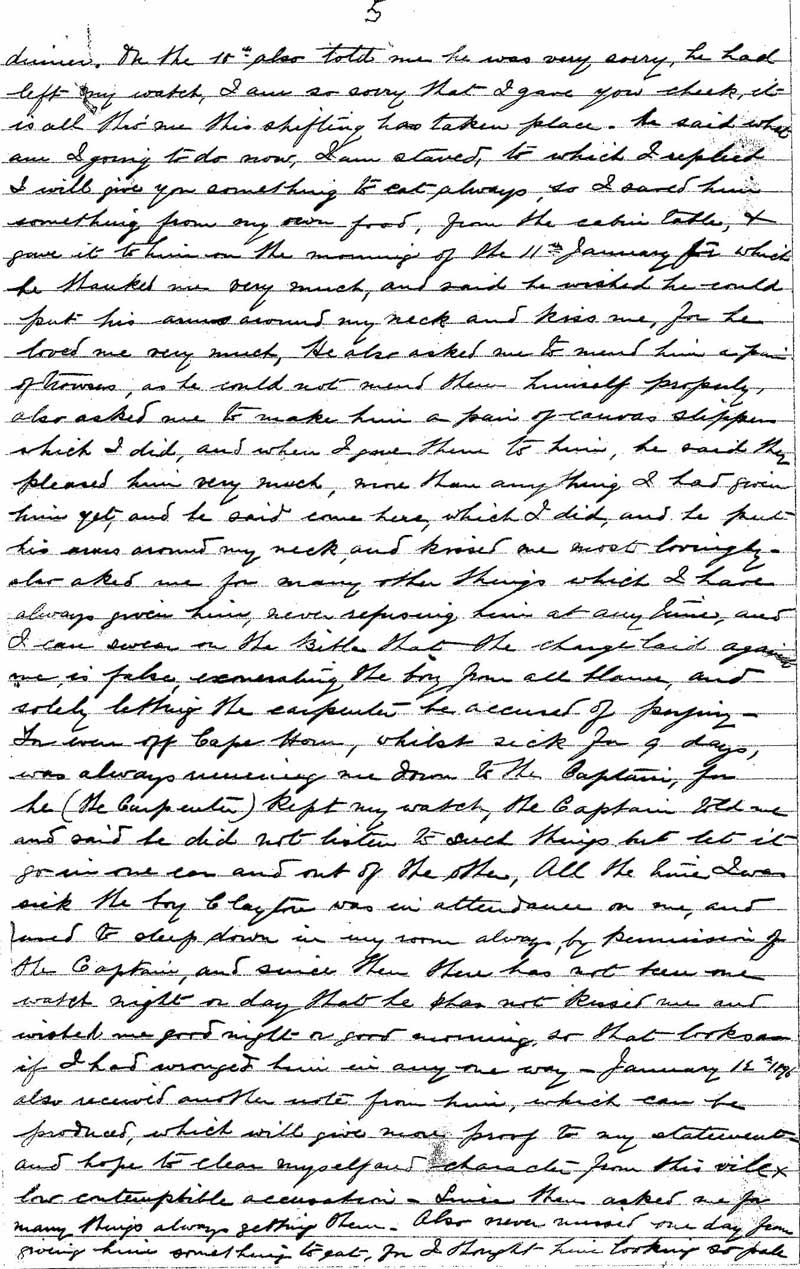
Seeing the boy Clayton was falling into bad habits, I thought I would try and be kind to him, so I promised I would get him all sorts of things in Caleta Buena, [Chile] (the port we were bound to) if he would only be good and let me be able to tell his father how good he was. He was good till I told him I had written to his father, telling him of his good behaviour. Also spent 111 dollars upon him in tinned fruits, jams, milk, salmon, chocolate, figs (etc.). There he began to fall into bad habits again, after he knew the letter had gone to his father, and the carpenter was the agitator in the whole thing through. He taught him to smoke and curse; was no name for such a thing which you may see hereafter, but still I did not give him up but still held on to him in the hopes of regaining him to his better habits, and much to my sorrow for both the Mate and the Captain told me he would turn upon me in the end, which he has done, incited to say things which are not true but confounded falsehoods by the Carpenter. On the outward passage, September 12 1895 told the Mate he had (?) him and came and begged of me to get him into my Watch which I did do and he was most impertinent several times, but each time I forgave him in the hopes he would get better. He used to cry most bitterly when corrected, and said “What would my father say if he knew” and when threatened then that I would tell his father he would go down on his bended knees and ask forgiveness and beg for me not to tell his father and I like a fool used to give in to him. Arrived in Caleta Buena October 12 1895 and true to my word I fulfilled my promises to him as afore mentioned. Left Caleta Buena November 22nd 1895 and he was good for a few days. When I told him to do something from 12 till 2 in the middle Watch and he began checking me for which I reprimanded him and he sulked. All at once he pulled off his big coat, a fine new (Mesten ?) and threw it overboard and when I stopped
2
him he told me he was going to strip himself, and throw everything overboard. He had his belt in his hand ready to throw. I was taking him to the Captain when he begged of me and cried most pitifully not to do so, after which I let him sleep the remainder of the Watch on the settee in my room and never mentioned anything to the Captain about it.
On the 21st December 1895 took him to the Captain, for giving me impertinence. I thought that might do him good. The Captain told him he ought to be ashamed of himself, you young scoundrel, after the 2nd mate being so good to you. He could not have treated you better had you been his own brother and told him never to let it occur again, or else he would take him in hand. To which he replied “All right Sir.” On the 6th June 1896 Monday changed his watch On the 3rd January whilst knotting rope yarn by the main Capstan, and men employed putting up port main ripper topsail lift, pulled his penis out and began playing with it. I told him he ought to be ashamed of himself but he took no notice until I told him I would tell the Captain, and he said I won’t do it any more, so don’t tell him, but I told the Captain and he can come forward and prove the same. On the 7th of January whilst at the wheel from 10 to 12 gave him something to eat and after that advised him on the swearing point and he deliberately told me God damn and fuck cursing, I would not knock off cursing for £50 a minute, and as he said that, he was resting his head on one of the spokes of the wheel, when she jerked and hurt his jaw a little, then he immediately said God damn and fuck the bloody wheel, and the man that made the bloody thing. Then I said, Jack, you might think that makes you a man, but it makes you lower than the beasts of the field. I will tell your Father, and she said Tell him, what do I care, after which I got disgusted and walked away.
3
On January 4th 1896, received a note from him to showing that such could not possibly be the case, which will be produced. On the 9th January watch on deck from 4 to 10 o’clock, whilst clearing the decks up at 5.30, told him to put some rigging screws and some wire down below. He immediately began giving me an awful amount of abuse, for which I hit him with my open hand knocking his hat off; the mate coming to relieve my whilst I went for my tea asked me what the boy was cheeking me for, & I told him, in reply he said, why the don’t you give him a damned good ropes ending. He said the Captain’s face turned white whilst over tea, to hear a boy giving an officer cheek. When I went to tea he also asked me what was the matter, and I told him the same as I told the mate, he then said it will be most advisable to put him into the mate’s watch again, as he knew that I would only get myself into trouble with him as my temper would not allow me to be dictated to, and also keep him (the Captain) out of trouble also from the owners. It happened then of course his watch on deck was from 6 to 8, making first watch below, and whilst he was in bed my watch on deck overheard a conversation to this effect:– Carpenter: Did the second mate hurt you much when he did it? Clayton: No. Carpenter: Did he push it up far? C: No. Carptr: Did he use anything to you? C: What do you mean? Carptr: Any ointment, sweet oil, grease, or the sort? C: Once he used some oil out of a sardine tin, but I did not see it. Carptr: Did he hurt you then? C: No. Carptr: How many times did he do it to you altogether? C: 3 times. Carptr: The damned fleas are biting me. C: And so they are me too, I can’t get to sleep at all. Then the other apprentice Frank Stephens awoke, and said the fleas were most damnable, to which Clayton remarked “Why don’t you get your bed and blankets out on [sic] the chest and sleep, or else go into the sail lockers
4
his motive being to get him out of the way whilst they finished their untruthful conversation, but he did not go but fell to sleep again. Throughout the foregoing conversation the Carpenter, (each time the boy said No) told him why in the hell don’t you say yes, and get him into trouble. It appears he makes out that it has been going on ever since he has been in my watch. It seems strange they had not told the Captain & got on put into the ship’s forecastle, which should have been done. I then had to brace the yards, and when I came back overheard their conversation again, which was C: Why does the mate lock his room now? Carptr: Because he has lost something. C: The second mate has got a chest in his room with two different locks on and a queer way to turn the key. He told me there was not a man in the ship could open it after he locked it, unless they broke it open, and that I never opened it whilst anybody was there, as long as he had been down in my room he had never seen it open. (It seems strange the hinges at the back should be broken, and yet the chest could not be opened!) On the 10th 1896 January accused Clayton of what I had overheard, He said “I never opened my mouth about those things, how could I, when I know it is not true?” To which I replied “You mean to tell me you never said it?” and he said “No, so help me God, I could swear on the Bible.” But how could I believe him? He had told so many lies? That night I told the mate about it, and he said it is ship’s yarns, it will be all forgotten, take no notice of it. There was yarns going about like that last voyage. On the 9th January 1896 at one o’clock overheard a conversation with him and the Carpenter, in the passage way of the half-deck by the mizzen mast to the effect that he wanted to go to the Captain, but I would not let him, but took the key out of the mate’s room and locked the door, which I knew to be untrue. I accused him of having said it, and he replied “I never opened my mouth to the Carpenter whilst he was down getting his
5
dinner. On the 10th also told me he was very sorry, he had left my watch. “I am very sorry that I gave you cheek, it is all thro’ me this shifting has taken place.” He said “What am I going to do now, I am starved”, to which I replied “I will give you something to eat always,” so I saved him something from my own food from the cabin table & gave it to him on the morning of the 11th January, for which he thanked me very much and said he wished he could put his arms around my neck and kiss me, for he loved me very much. He also asked me to mend him a pair of trousers, as he could not mend them himself properly. Also asked me to make him a pair of canvas slippers, which I did, and when I gave them to him he said they pleased him very much, more than anything I had given him yet, and he said “Come here,” which I did and he put his arms around my neck and kissed me most lovingly. Also asked me for many other things which I have always given him, never refusing him at any time, and I can swear on the Bible that the charge laid against me is false, exonerating the boy from all blame, and solely letting the carpenter be accused of prying. For even off Cape Horn, whilst sick for 9 days, was always running me down to the Captain, for he (the Carpenter) kept my watch, the Captain told me and said he did not listen to such things but let it go in one ear and out of the other. All the time I was sick the boy Clayton was in attendance on me, and used to sleep down in my room always, by permission of the Captain, and since then there has not been one watch night or day that he has not kissed me and wished me good night or good morning, so that looked as if I had wronged him in any one way. January 12th 1896 also received another note from him, which can be produced, which will give more proof to my statements and hope to clear myself and character from this vile, low contemptible accusation. Since then asked me for many things always getting them. Also never missed one day from giving him something to eat, for I thought him looking so pale.
~ ~ ~ ~ ~
[On the depositions’ cover sheet is the following]
Central Criminal Court
Sydney
17th February 1896
AG’s No. 35
Depositions
CS’s No. 23
Regina
v.
John Frank Palmer Couche
Sodomy
See within AG the Crown Solicitor
[initial eligible] 12.2.96
Committed at: Water Police Office, Sydney
on: 6th February 1896
~ ~ ~ ~ ~
Cor Stephen J. Plea Not guilty. Verdict guilty – strong recommendation to mercy.
20.2.96
Jury retired 5.35
Return 7.50
Sentence 4 years hard labour Darlinghurst Gaol.
~ ~ ~ ~ ~
Dec 21st/95 at Sydney on Summons
Buggery
[Initialled] J[ohn] H[enry] W[ant, QC] AG
11/2/96
C[harles] G[regory] W[ade, Crown Prosecutor]
11/2/96
~ ~ ~ ~ ~
The carpenter + 1st mate should be subpoenaed + statements obtained from them.
Subs issued 12.2.96
~ ~ ~ ~ ~
Justice MH Stephen’s notebook 20
67
Thursday 20 February 1896
John Frank Palmer Couche – Buggery
Plea not guilty
John William Clayton. Apprentice on board ship Samanca 21 – arrived about 2 weeks ago – from Sunderland. 22 14 last November – 1st trip at sea. Prisoner was the 3rd mate. Remember one Sunday at sea. I was down in prisoner’s room – he asked me to go down & teach me navigation – he then began learning me navigation. I was standing. He undone [sic] my belt. He asked me to let him on it again ‘---’ 23 there was no harm in it … & then he took my pants down. He unbuttoned his trowsers – took his person out – & put it in the back of me – it was inside me – & hurt me. I sang out. He told me to stop – he told me that if I did not stop he would kill me. The door to the room was locked. He
68
got a knife to me & cut my arm. The captain came to the door & tried to open it. He called out what was the matter with the boy. Prisoner said that he was correcting me & that I was crying. Captain sang out that he was not to hit me any more – & that I was not to go down into his room. Prisoner said now, he goes from my room for ever. He told the captain that I was his cousin. It had happened before – I can’t tell how often – first time was off Cape Horn. Prisoner bought a lot of (fish ?) & (milk ?) – salmon & sardines – he gave them to me when he gave me 2 cinglets. 24 He used to use sardine on his person – Albert Evans was the Steward – he gave me some vaseline – he looked to my back – this was 2 days after the Sunday that I spoke of. I was on the 1st mate’s watch at first – till we got to Cape Town. The prisoner said that he would get me out of the 1st mate’s watch – that he was a bad man. He told me to tell the 1st mate that he had ruined me – that he was always swearing in my presence. Prisoner told me that he would get me into his watch. I slept in prisoner’s room when
69
he was ill off Cape Horn. I used to sleep on in prisoner’s room during 2nd mate’s watch when it was raining – he told me to go down. I slept after that Sunday in the half deck – & prisoner (?) bored some holes in the wall so that he could see me. I got some letters through the port hole – 3 – that is one (produced) that is another (produced) – another (produced). I saw prisoner’s face and his hands. I wrote & gave to him those two letters produced – all written after the Sunday. He told me not to tell any one about what he had done to me – he often told me. I told him that I had found out that he had been a wicked man – this was about a week after. He said that he was the truest & best friend that I had. He asked me how I found out. I told him that the carpenter had been speaking to him about it. He told me not to tell this or that we should both be put in prison.
70
Sometimes these things happened in his room – sometimes on the poop. He hurt me once before. I remember arriving in Sydney – Police came on board. I gave the letters to the carpenter.
Cross-examined. Carpenter once tried to get into my bunk – I was in it – he was trying to hit me – it was before the 2nd mate had done anything to me. Arrived at Cape Horn 2 months after we left during which I was in the 1st mate’s watch. The first time it happened was in the prisoner’s cabin – steward’s cabin opposite – captain’s cabin 12 feet away – w.c. between the 1st & 2nd mate’s cabins. Happened first at 3 am in the middle watch – 2nd mate’s watch. I was asleep & he came down & I found him in my bunk. 1st mate & captain & steward in their cabins. I felt him shoving at me – & asked what he was doing … my pants were down – belt in the same position. I then went on deck.
71
The same thing occurred next day – 2 in afternoon – (?) watch below – in prisoner’s room. He asked me to go down & teach me navigation. I just went down. I stayed with him an hour [and a] ½ – cook in his galley – steward in pantry – 1st mate on deck. He took my pants down. He told me that there was no harm in it – as long as we were friends. The carpenter told me to use the word “person”. I gave the letters to the steward & he gave them to the carpenter – this was about 2 weeks before arrival. I told the steward the prisoner had written the letters. Can’t say how many times it was done – so often. I was talked taught to swear on the deck. The prisoner beat me for swearing – he threatened to take me before the captain. He found fault with me about 5 times for swearing. The 2nd prisoner took me before the captain for refusing to go on the main yard at night. The captain said
72
that the 2nd mate had been too kind to me. One day on the poop was the first time that it hurt me – at night – I was watchman – I began crying. I had told no one. I did not tell any body – I told after the Sunday. I first told the carpenter & the two apprentices on the Sunday I spoke of was about a month before we arrived. I told I did tell the 1st mate that he had ruined me. The 1st mate asked me how he had ruined me – I said by swearing before me. After I spoke to the 1st mate (?) it was then I told the 1st mate that it was the 2nd that had told me to say that it (?) was the 1st mate that had ruined me. This was after the Sunday. I was reported by the (?) prisoner to the captain after the offence took place at Cape Horn. Carpenter & prisoner were not friendly during the voyage –
73
mate (?) Prisoner told me to pray – not to swear (& ?) was always kind to me. The cook told me that I should be put in prison – then asked me why prisoner was buying all this food for me – that they suspected something & then I told them. I was bleeding the last time – on that day. (?) the steward I asked the steward for the ointment. I could not go to the wc. It [was] on the same Sunday that the offence was committed that I was told about going to prison. Two apprentices & the carpenter slept in my cabin. I told the 1st & 2nd mates about the carpenter trying to get into my bunk. I did not tell the prisoner that I would not give him into my bunk because they had poured 25 tea all over my privates. The 2nd mate got on to the cook about it – coffee was poured over me. Before anything happened from the prisoner the cook had asked me to go into the galley & I refused
74
saying that he would do something to you. I did not use the word. The mate did complain to me about my saying that I was afraid that the cook would do something to me. I used to go every night to the prisoner’s cabin to say good night. I know the prisoner wrote to me then after saying that I had been a good boy & that he had made me presents for being a good boy. I never asked prisoner to let me sleep in his cabin. The prisoner was putting me on the lee side – & hitting me – & I said you big coward – hit some one of your own size. It was a week after the last offence that prisoner took me to the captain … & reported me for not going on the main yard. Up to arriving in Sydney only the mate, steward, cook & apprentices knew of the (crime ?) Prisoner still remained kind. 26 I never told him that I had mentioned about it. The carpenter told me what he was going to do. He told me to write out a statement – & what to do.
75
The carpenter laid the information. I asked him if he would go into town to tell about it & he said no. The carpenter asked me what he used.
Re-examined. The carpenter told me that he was going to see the captain – came back & told me that I was to make a statement – the carpenter, the cook, the eldest apprentice & the steward – & told me what to write – how to put it – not of which to say. He often used to kiss me. Caleta Buena – when the prisoner beat me & I cried out he put his hand over my mouth – because I would not lay lie beside him. (But ?) (Colonna ?) (Close ?) – which took place on the poop was before the last offence. I told nobody of it.
George Williamson. Master of Samanco – sailing from Sunderland. I know prisoner &
76
Clayton – was on the 1st mate’s watch – changed to 2nd mate. Remember when ship was off Pitcairn’s Island – between 14th & 21 December. I heard Clayton crying – as if being beaten. I went to prisoner’s door to cabin – tried to open it – it was locked. I called to the prisoner & asked what he was doing. He said that he was only punishing the boy because he would not do something that he was teaching him. I told him that he was not to treat the boy badly in any way as I was responsible to his father – & that he had not to bring the boy into his room any more. By me it was not the prisoner’s duty to teach him. Then I went to my own table. A short time after the boy came up on the poop. He made no complaint to me at any time. Prisoner came & said that he had not told me so before but that the boy was his first cousin. I told him that it did not (matter ?), that if he was his brother I would not allow him to bring the boy into his cabin. I received a communication from the carpenter.
77
I was shown something after our arrival.
Cross-examined. Prisoner good man as far as a seaman. I had no fault to find with him. There seemed to be some little ill feeling between the prisoner & the carpenter. I never heard that the 2nd prisoner beat him.
Albert Evans. Steward on the Samanco. I know Clayton. He made a complaint to me – in (favour ?) early (part ?) – I gave him some ointment. I examined him. I noticed a small wound at the bottom of the passage to the exterior.
Hugh E Roberts. Chief officer on Samanco. Remember Clayton. Prisoner asked me 2 or 3 times for permission to take the boy to his cabin to give him some cocoa – I allowed it. He was very kind to the boy in giving him (jam ?) with cocoa. The boy was in the mate prisoner’s room
78
during my watch – he ought to have been on deck. I called him up. It was between 6 & 8. I told him to keep on deck. Prisoner asked me if I called the boy out of his room – I said yes & that I meant to do so. He said I suppose you think I was doing something wrong with him. I said that I would not suspect a dog let alone a man. I told him that the best thing to keep peace between him & I was to put the boy in his watch. I know that the boy slept in prisoner’s cabin several times – when it was their watch below. I heard the boy crying in prisoner’s room. I heard the boy tell him to leave him alone or he would tell the captain – he would shout. I remember once in port on the poop at Caleta Buena there was a sail 27 in the poop – heard it both on deck & in the cabin –
carpenter was with me. I heard the boy pass the remark that if prisoner would not leave him alone – that it would push him – that he would shout – let the captain know.
79
The key hole to the prisoner’s door was blocked up with paper. I made some statement to the captain. I read those letters between C (?) this side of Pitcairn Island – fortnight’s sail. After seeing them spoke to the captain & the cook. (?) The prisoner was very kind to the boy until after I had seen the letters. Prisoner said that he was heartily sorry that he had been so free with the boy. He & the boy were very frequently together.
Cross-examined by me. About 3 weeks sail from here the prisoner complained to the captain of the boy swearing.
By Close. The boy told me that I had ruined him. I spoke to the prisoner about it … he said nothing about … except that he could prove differently.
Joseph Eskell. 28 Carpenter. I know Clayton & prisoner. In the first beginning they were always fooling
80
together – the boy with his arm round him – kissing one another. Then the thing got more pronounced. I never saw the boy come out of the prisoner’s cabin. I remember one week at Caleta Buena – the chief mate & I heard a scuffle on the poop – & I heard the boy say let me get up Mr Couche – you are hurting. Prisoner said keep quiet Jack it’s all right. Boy said no no let me get up – you are hurting me. Sounded as if the boy was getting choked. I had a communication from the boy – & then I had a conversation with the captain – then I saw the boy write something – which was given to the police. I gave it myself. Looks at the letters. I got them from the steward. I kept them & delivered them to the police. The wall between the prisoner’s cabin & the after half deck was bored though – with a marlin spike.
Cross-examined. I was medium friendly with the prisoner – not enough to kiss one another.
81
The statement was made about a month before we arrived – can’t say whether before or after the Sunday on which it was alleged that the last offence [occurred].
Robert Thomson Paton. Government medical officer. Examined boy on the 3 February – no marks of violence.
Cross-examined. No marks that would show that the boy had been habituated to it.
Harry Richard Scott. Constable. I arrested the prisoner on board the Samanco – on the 1st. I saw first the captain, steward, apprentice & the boy – received information from each. Got some letters for the Inspector. The boy charged prisoner with the offence – & I showed him the letters – which he said were written by him – & gave me the letters that the boy had written to him. He emphatically denied the charge. He showed me a statement
82
already prepared. He said can I take anything with me? I said anything that he [sic] had in your possession on arrival at the Police Station would be taken from you. He then said I have a document here which I wish [to] give to my solicitor should I employ one – will that be given to him. I said yes I suppose it will. He then handed it to me.
Cross-examined.
Williamson recalled. Prisoner never reported to me that the cap boy had exposed his penis.
Defence
Prisoner examined. 2nd mate. The father of the boy said to me for God’s sake take care of the boy … I received the a letter from the father. I remember nothing about what the boy said about my getting into his bed – at Cape Horn … utterly untrue. The boy came frequently into my cabin – the door w catch of the door was wrong & I fastened it with a knife.
83
Captain asked what I was doing. I said to him in order to shield the boy that I was his cousin. As to the poop matter – I remember nothing about it – nothing did take place … the cut which explains that the cut was accidental & did not occur on the day of the alleged last assault. I heard rumour going about & that it. 29 I told the captain it would get the boy into trouble with it. I did not [believe] it would get me into trouble. I told the captain – & he said that it would be as well to leave it to the end of the voyage. I had some complaint with the cook & the carpenter, (being ?) a countryman who [is ?] at enmity with me. The carpenter told said that I was pretending to be sick. He told the captain that I (?) had come on board not as I really was. 30
Cross-examined. (?) I heard through the ship that there were rumours about the carpenter – also told me heard
84
rumours about myself. I heard the carpenter say how I’m going into the boy’s bunk. I reported to the captain that the carpenter was not a fit associate for the boy – the apprentice was present. I did not leave my bunk
Reply – Esket recalled. Denies prisoner’s statement that he said “now I may go into the boy’s bunk”
Verdict. Guilty. Strong recommendation to mercy on (?) account of his youth. Imprisonment with hard labour Darlinghurst Gaol for 4 years.
~ ~ ~ ~ ~
The Daily Telegraph, Fri 21 Feb 1896 31
CENTRAL CRIMINAL COURT.
(Before Mr Justice Stephen.)
This court was occupied throughout yesterday in hearing a case in which JFP Couche, late second mate of the St Michael [sic], was charged with assault on an apprentice on the high seas, during the voyage of the vessel to Sydney. Mr Wade prosecuted for the Crown, and Mr Colonna Close defended. The jury found the accused guilty, and he was sentenced to four years penal servitude.
~ ~ ~ ~ ~
The Sydney Morning Herald, Fri 21 Feb 1896 32
CENTRAL CRIMINAL COURT.–Thursday.
(Before his Honor Mr Justice Cohen and a jury of 12.)
Mr CG Wade prosecuted for the Crown.
ASSAULT.
John Frank Palmer Couche, seaman, was charged with having assaulted a boy named John Clayton when on the high seas in the ship Samanco. Mr Colonna Close, instructed by Mr WJ Hill, defended the accused. The case lasted all day, and the jury, after retirement of over two hours, returned a verdict of guilty with a recommendation to mercy on account of the prisoner’s youth. His Honor sentenced the prisoner to four years’ imprisonment with hard labour.
~ ~ ~ ~ ~
John Frank Palmer Couche, Gaol photo sheet 33
![SRNSW: NRS2138, [3/6059], Darlinghurst Gaol photographic description book, 1895-1896, No. 6575, p. 124, R5106](../../images/trials/1896-Couche-6059-gaol-photo-6575-p-124.jpg "SRNSW: NRS2138, [3/6059], Darlinghurst Gaol photographic description book, 1895-1896, No. 6575, p. 124, R5106") |
Gaol Photo Sheet - Transcribed Details
No. 6575
Date when Portrait was taken: 7-2-1896
Name: John Frank Palmer Couche
(aka Francis Williams, John Couche)
|
Native place: England Year of birth: 1870 Arrived Ship: Samanco Trade or occupation Religion: C of Eng Education, degree of: R&W Height: 5' 3¾" Weight On committal: 140 Colour of hair: Black Colour of eyes: Blue Marks or special features: Scar on top joint of right forefinger Scar on (?) left thumb – Small anchor & F.C. in bend left thumb, and forefinger |
Where and when tried: Offence: Sentence: Remarks: |
|
(No. of previous Portrait .. 4371) PREVIOUS CONVICTIONS |
|||||
| Where and When | Offence. | Sentence | |||
|
Newcastle PC Sydney ditto Newcastle Q.S Sydney GD |
25 31 26 9 20 |
6 1 4 6 2 |
1888 1889 1892 1892 1896 |
Stealing ditto ditto ditto Buggery |
2 years HL 12 months HL 4 months HL 2 years HL 4 years HL |
John Frank Palmer Couche, 1900
The Sydney Morning Herald, Tue 4 Dec 1900 34
LAW NOTICES.
…
CENTRAL CRIMINAL COURT.
Tuesday, December 4.
Robert Shaw, wounding with intent to murder; John Couche, assault with intent.
~ ~ ~ ~ ~
The Sydney Morning Herald, Thu 6 Dec 1900 35
CENTRAL CRIMINAL COURT.
(Before Mr Justice Owen and juries.)
Mr CG Wade, Crown Prosecutor.
…
POSTPONED CASES.
…
John Couche pleaded not guilty to a charge of having on November 11, at Manly, assaulted Thomas Biddell with intent wickedly to commit a serious offence. The case was ordered to stand over to the next court of Quarter Sessions, or such other court as the Attorney-General might appoint.
~ ~ ~ ~ ~
The Daily Telegraph, Tue 11 Dec 1900 36
METROPOLITAN QUARTER SESSIONS.
———
(Before Judge Rogers.)
…
ASSAULT ON A BOY.
John Couch (35) was convicted of having committed an assault upon a lad at Manly on November 11. His Honor sentenced the accused to five years penal servitude.
The Court adjourned until the following day.
~ ~ ~ ~ ~
The Sydney Morning Herald, Tue 11 Dec 1900 37
METROPOLITAN QUARTER SESSIONS.
(Before Judge Rogers and juries of 12.)
Mr WL Merewether prosecuted on behalf of the Crown.
…
SERIOUS ASSAULT.
A young man named John Couche pleaded not guilty to an indictment charging him with having assaulted a lad named Thomas Biddell, at Manly, on the 11th ultimo. There was a second count of indecent assault. The accused, who was not defended by counsel, was convicted on the second count, and was sentenced to five years’ penal servitude.
~ ~ ~ ~ ~
John Couche, Gaol photo sheet 38
![SRNSW: NRS2138, [3/6066], Darlinghurst Gaol photographic description book, 1900-1901, No. 8213, p.37, R5109.](../../images/trials/1896-Couche-6066-gaol-photo-8213-John-Couche.jpg "SRNSW: NRS2138, [3/6066], Darlinghurst Gaol photographic description book, 1900-1901, No. 8213, p.37, R5109.") |
Gaol Photo Sheet - Transcribed Details
No. 8213
E[ntry] Book 4729/00
Date when Portrait was taken: 11-12-1900
Name: John Couche
(aka John Frank Palmer Couche, Francis Williams)
|
Native place: England Year of birth: 1870 Arrived Ship: Tythonus Trade or occupation Religion: C of E Education, degree of: R W Height: 5' 4¼" Weight On committal: 142 Colour of hair: Brown Colour of eyes: Blue
|
Marks or special features: Tattoo (?) Outside right forearm. Right little finger slightly contracted. |
|
(No. of previous Portrait .. 4371, 6575) PREVIOUS CONVICTIONS |
|||||
| Where and When | Offence. | Sentence | |||
|
Newcastle PC Sydney ditto Newcastle Q.S Sydney GD Sydney Q.S |
25 31 26 9 20 10 |
6 1 4 6 2 12 |
1888 1889 1892 1892 1896 1900 |
Stealing ditto ditto ditto Buggery Indecent assault on a male person |
2 years HL 12 months HL 4 months HL 2 years HL 4 years HL 4 years HL. To Berrima 19-3-1896 |
John Frank Palmer Couche, 1907
The Daily Telegraph, Fri 7 Jun 1907 39
QUARTER SESSIONS.
———
(Before Judge Murray and juries.)
Mr Herbert Harris prosecuted for the Crown.
…
POLICE COURTS.
———
STREETS BEGGAR SENT TO GAOL.
collection. Reproduction: Peter de Waal
A widow who gave her name as Mary Jacobs pleaded guilty at the Water Court for begging alms in Oxford-street. She stopped a lady, and telling her she wanted to go to an address at North Sydney, but had lost her purse, asked for her fare. The lady gave her the fare, directed her to the address, and then watched her. The accused, after leaving the lady, accosted several others, and then went into an hotel. The lade, who had first befriended her, informed Constable Bourke, who went into the hotel and arrested her. The accused was sentenced to one month’s imprisonment.
———
AN HABITUAL CRIMINAL.
John Couche, a middle-aged man, was convicted [in Quarter Sessions and not at the Police Court as listed here] on a charge of committing a serious offence at Sydney on May 9. The prisoner’s gaol record showed that he had been frequently convicted, and the last sentence imposed upon him was five years; penal servitude. His Honor said that Couche was a dangerous person to be at large, and ordered him to five years’ penal servitude, besides pronouncing him to be an habitual criminal.
———
SELLING INDECENT POST-CARDS.
James Leahy, of Regent-street, Redfern, was summoned at the Redfern Police Court on the information of Sub-Inspector West for selling an indecent postcard, entitled a “Christmas Story,” such being an obscene publication. Defendant pleaded guilty. It was stated that the card was exhibited in the window of defendant’s shop. Mr Wilshire inflicted a fine of £5, and 6/- costs, in default, one month’s hard labour.
~ ~ ~ ~ ~
The Sydney Morning Herald, Fri 7 Jun 1907 40
QUARTER SESSIONS.
(Before Judge Murray and juries.)
Mr Herbert Harris, Crown Prosecutor.
…
John Couche, a man aged about (35 ?), of short stature and wearing a dark moustache, pleaded not guilty to a charge of having, on May 9 last, at Sydney, committed a serious [indecent] assault upon a boy [Frederick Compton ]. The jury convicted Couche, who described himself as a cook, and the prisoner’s gaol record was read. This showed that the prisoner had been frequently convicted, and his last sentence was penal servitude for five years. His Honor passed the maximum sentence of five years’ penal servitude, and pronounced the prisoner to be an habitual criminal.
The Court adjourned to the following day.
~ ~ ~ ~ ~
John Couche, Gaol photo sheet 41
![SRNSW: NRS2138, [3/6066], Darlinghurst Gaol photographic description book, 1900-1901, No. 8213, p.37, R5109.](../../images/trials/1896-Couche-6072-gaol-photo-10404-John-Couche.jpg "SRNSW: NRS2138, [3/6066], Darlinghurst Gaol photographic description book, 1900-1901, No. 8213, p.37, R5109.") |
Gaol Photo Sheet - Transcribed Details
No. 10404
Date when Portrait was taken: 7-6-1907
Name: John Couche
(aka Francis Williams, John Frank Palmer Couche)
|
Native place: England Year of birth: 2 April 1863 Arrived Ship: Tythonus Trade or occupation Religion: C of E Education, degree of: R & W Height: 5' 4" Weight On committal: 140 Colour of hair: Brown Colour of eyes: Grey
|
Marks or special features: One vaccine mark outside left upper arm. Indistinct tattoo marks and — bracelet on left forearm “T.C” and anchor between left thumb and forefingers. Hairy on forearms one vaccine on right arm. Two tattoo spots back right forearm. Right little finger contracted. Scar on first joint of right fore finger. Two scars on back of head. Three scars on forehead. Scar on left elbow. Nose appears smashed. One tooth each side missing. Chest hairy. One mole small of back. One hairy mole on small of back. One hairy mole between shoulder blades. Stomach hairy. Legs and thighs hairy. |
|
(No. of previous Portrait .. 4371, 6575, 8213) PREVIOUS CONVICTIONS |
|||||
| Where and When | Offence. | Sentence | |||
|
Newcastle PC Sydney Q.S Newcastle PC Newcastle Q.S Sydney GD Sydney Q.S Sydney Q.S |
25 31 26 9 20 10 6 |
6 1 4 6 2 12 6 |
1888 1889 1892 1892 1896 1900 1907 |
Stealing ditto ditto ditto Buggery Indecent assault on a male person Indecent assault on a male person |
2 years H.L. 12 months H.L. 4 months H.L. 2 years H.L. 4 years H.L. 5 years P.S. 5 years PS and declared to be an |
1 Newcastle Morning Herald and Miners’ Advocate, Tue 26 Jun 1888, p. 6. Emphasis added.
2 Evening News, (Sydney, NSW), Tue 8 Jan 1889, p. 6.
3 The Sydney Morning Herald, Tue 8 Jan 1889, p. 5.
4 The Sydney Morning Herald, Fri 1 Feb 1889, p. 11.
5 Evening News, (Sydney, NSW), Sat 2 Feb 1889, p. 6.
6 The Sydney Morning Herald, Sat 2 Feb 1889, p. 7.
7 According to the gaol photographic description sheet, see below, his first conviction was at Newcastle Police Court on 25 Jun 1888.
8 SRNSW: NRS2138, [3/6050], Darlinghurst Gaol photographic description book, 1888-89, No. 4371, p. 121, R5103.
9 SRNSW: NRS2326, [3/14127], Maitland Gaol Photograph description sheets, 1873-1922, No. 4371, p. 57, R5128.
10 Newcastle Morning Herald and Miners’ Advocate, Tue 26 Apr 1892, p. 4.
11 Newcastle Morning Herald and Miners’ Advocate, Wed 27 Apr 1892, p. 3. Emphasis added.
12 Newcastle Morning Herald and Miners’ Advocate, Sat 30 Apr 1892, p. 7. Emphasis added.
13 Evening News, (Sydney, NSW), Mon 3 Feb 1896, p. 4.
14 The Daily Telegraph, Fri 7 Feb 1896, p. 2.
15 The Sydney Morning Herald, Fri 7 Feb 1896, p. 3.
16 SRNSW: NRS880, [9/6915], Supreme Court, Papers and depositions, Sydney, Feb 1896, No. 35. Emphasis added.
17 Mn: Put in and marked A, B and C respectively
18 Mn: Put in and marked D & E
19 Mn: Put in and marked F
20 SRNSW: NRS7704, [2/7135], Judiciary, MH Stephen, J. Notebooks Criminal, 1886-1904, pp. 67-84. Emphasis added.
21 Samanco in transcript of depositions, and elsewhere in this document.
22 Mn: Age
23 Inference of this marking unclear.
24 Singlets.
25 Mn: coffee
26 Mn: no difference in his conduct
27 Meaning unclear.
28 Esket in transcript of depositions and elsewhere in this document.
29 Sentence incomplete.
30 Mn: I told the captain of it
31 The Daily Telegraph, Fri 21 Feb 1896, p. 2.
32 The Sydney Morning Herald, Fri 21 Feb 1896, p. 3.
33 SRNSW: NRS2138, [3/6059], Darlinghurst Gaol photographic description book, 1895-1896, No. 6575, p. 124, R5106.
34 The Sydney Morning Herald, Tue 4 Dec 1900, p. 7. Emphasis added.
35 The Sydney Morning Herald, Thu 6 Dec 1900, p. 4.
36 The Daily Telegraph, Tue 11 Dec 1900, p. 3.
37 The Sydney Morning Herald, Tue 11 Dec 1900, p. 7.
38 SRNSW: NRS2138, [3/6066], Darlinghurst Gaol photographic description book, 1900-1901, No. 8213, p.37, R5109.
39 The Daily Telegraph, Fri 7 Jun 1907, p. 8. Emphasis added.
40 The Sydney Morning Herald, Fri 7 Jun 1907, p. 7.
41 SRNSW: NRS2138, [3/6072], Darlinghurst Gaol photographic description book, 1907-1909, No. 10404, p.111, R5112.