Below also see: Richard Thomas Foster, 1898,
Richard Thomas Foster, 1904 – Indecent assault
Foster v. Foster, 1919 – Divorce
Clarence and Richmond Examiner and New England Advertiser, Tue 12 Mar 1895 1
GRAFTON QUARTER SESSIONS.
————
THIS Court was opened yesterday morning before his Honor Judge Docker; Mr Browning, Crown Prosecutor. Mr Conroy, barrister; and the local solicitors were also in attendance.
~ ~ ~ ~ ~
Clarence and Richmond Examiner and New England Advertiser, Sat 16 Mar 1895 2
…
Richard Thomas Foster was indicted for having at Coldstream, on November 7th, unlawfully and carnally known Jessie Ellen Firth, a girl of the age of 10 years and 4 months. Accused pleaded not guilty, and was defended by Mr Conroy, instructed by Mr McGuren.
Jury—Messrs John Crispin (foreman), Jas Connor, Moses C Essex, Ed Harrison, Jas Clark, W Jones, John Connor, W Boorman, Thos H Corcoran, Wm Zietsch, Jas Massie, Matthew J Connor.
Accused exercised his full right of challenge by objecting to eight jurors.
Constable Buckland stated that from information received on 7th November he searched for accused, going to his father’s place at Sweeney’s Creek, where he found him, and asked if he had been to the Coldstream that morning. He replied that he had been there about 7 am with his father, whom he left at the crossing of the swamp, and met him again an hour later at the same crossing. Asked him if he saw any girls at the crossing, and he replied that he did, but he did not speak to them as they were too far off. He said one of them was bigger than the other. He said he met no other men riding about the creek that day. He said it was about 10 o’clock when he met the girls, and was wearing the same clothes as he then had on, except that he had on his coat. Examined his shirt, and found fresh discolouration upon it, which he accounted for by stating that he had scratched himself on the thumb with the ploughshare two days previously, and that he wrapped the shirt around it. Found no recent marks of a cut on his thumb. On arresting accused he protested his innocence. Prosecutrix identified accused from a number of others as the person who had assaulted her. On the Sunday accused handed witness a letter from his father.
Mr Conroy objected to a conversation that took place between accused and witness, on the ground that any statement made after any inducement was offered was inadmissible. He held that the letter was an inducement from one in authority.
His Honor held the evidence inadmissible.
Charles Firth, father of the girl, deposed as to her age, and that she left for school as usual on the day named, but was ill when she returned. He gave information to the police.
Mrs Firth, mother of the girl, gave similar evidence, stating that Jessie left for school, 1¼ miles distant, with a seven year old sister. She returned unwell, and made a complaint. Her clothes were torn, and had blood on them.
Jessie Ellen Firth deposed that when on the way to school with her sister she met accused, and described the offence. Accused when she cried out threatened to kill her if she made any noise.
Margaret Firth, 7 years of age, gave similar evidence, and recognised accused as the man that assaulted her sister.
The extreme youth of the last two witnesses made it difficult to elicit anything like satisfactory evidence.
Miss Apsey, school teacher as [sic] the Coldstream, deposed that Jessie Firth was pale and ill the day referred to, and remained so during the day.
Alice Hughes, wife of Alfred Hughes, resided near the Public school, and remembered Miss Apsey taking the girl over to her place. She was ill and very pale, and remained so for 1½ hours.
Dr Plummer examined the girl, and described the condition in which she was found, and the injuries stated.
This was the case for the Crown.
No evidence was called for the defence. Mr Conroy pleaded for an acquittal at some length.
After a retirement of an hour the jury returned a verdict of guilty, with a recommendation to mercy on account of his youth. Accused was remanded for sentence.
…
THIRD DAY—Wednesday.
…
SENTENCES.
…
Richard F [sic] Foster for carnally knowing Jessie Ellen Firth was brought up for sentence.
Mr Conroy pleaded for leniency, and pointed out to his Honor the undesirableness of making a criminal of accused. He thought a few whippings, with a brief term of imprisonment, would meet the case.
His Honor, after reviewing the depositions, said that it might be some satisfaction to the jury to know that accused had made a confession of his guilt in this case, which was not put before them, as there was some doubt as to whether it was admissible in evidence. He found now that the confession could have been put before the jury. However, they had convicted him without it, and had recommended him to mercy, a recommendation he was always glad to entertain. His extreme youth was the ground of their recommendation for leniency, and this as well as old age should be considered in passing sentence. It was difficult for a judge to decide as to the best course to pursue in such a case. Undoubtedly, from the evidence, he could have been tried for the capital offence, and the jury could have found him guilty, and he would have been sentenced to death. Probably on account of his youth the extreme sentence would not have been carried into effect. This was very likely the reason why he had been sent to trial on the lesser though still very serious charge, that of carnally knowing a girl under 14. He must take into account the circumstances under which the offence was committed. These showed that violence had been used—in fact, that a rape had been committed. He was afraid it was only too true than an awful amount of corruption and immorality was chargeable to the rising generation of the present day. He was not speaking in regard to this or the Richmond districts only—in both districts the had cases of this kind—but those offences were common in all parts of the colony, and it was a serious consideration for those that had the welfare of the colony at heart, for there seemed to be a great amount of corruption among many boys and girls. It was an awful state of things, and it was the duty of Judges to counteract it as much as possible, and when clear cases came before them—and no case could be clearer than this—to deal severely with them. Accused had considerably injured that young girl, perhaps ruined her for life; and he had not only done this, but had brought ruin upon his own home, and marred the happiness of his family. He had a letter from accused’s mother before him, and a more pathetic one he never read, showing clearly, to his mind, that it was not the fault of the father or mother that accused stood in the position he did. So far as he could judge, his parents were respectable people. It may be that his father had not instructed him with regard to sexual intercourse. It was difficult for a father to do so. Accused said the devil prompted him to act as he did, and no doubt this was true. Whatever punishment was inflicted reflected to some extent on his parents, who had trouble enough already, but there was one thing he could be thankful for, that there was a chance to reform; and he urged him, when he completed his sentence, to retrieve his character, if only for the sake of his father and mother. It had been suggested to impose a sentence of whipping as an appropriate punishment, and so lessen the term of imprisonment. The law permitted him to pass such a sentence, and in cases of this kind this punishment seemed to have a salutary effect. But each individual case had to be considered, and whipping should be rarely inflicted, though if he imposed it in this case he did not think anyone could complain. But he doubted if this was the best thing for accused. Whether he imposed whipping or not, he must pass a sentence of imprisonment. The jury had recommended him to mercy, and he would give as much effect to that as he possibly could. But though this was done, neither accused nor anyone else must think that an offence like that must be lightly thought of. Accused was liable to a sentence of 10 years’ penal servitude, but he was not obliged to pass a sentence of penal servitude. There was an alternative of imprisonment, and in consideration of his age would not pass a sentence of penal servitude. He had no option but to pass a severe sentence, and that was that he be imprisonment in Grafton gaol for three years, with hard labor.
This concluded the business, and after his Honor thanked the jury for the patient consideration they had given the cases, the court adjourned at 11.30 am.
~ ~ ~ ~ ~
Richard Thomas Foster, Gaol photo sheet 3
![SRNSW: NRS2258, [3/5993], Grafton Gaol photographic description book, 1910-1911, No. 5, p. 6, R5125.](../../images/trials/1895-Foster-5993-gaol-photo-5.jpg "SRNSW: NRS2258, [3/5993], Grafton Gaol photographic description book, 1910-1911, No. 5, p. 6, R5125.") |
Gaol Photo Sheet - Transcribed Details
No. 5
Grafton
Date when Portrait was taken: 16 November 1894
Name: Richard Thomas Foster
|
Native place: England Year of birth: 1878 Arrived Ship: Absbury Trade or occupation Religion: Presbyterian Education, degree of: Read & write Height: 5' 7¼" Weight On committal: Colour of hair: Light brown Colour of eyes: Blue Marks or special features: Nose mouth and chin medium |
Where and when tried: Grafton Quarter Sessions Offence: Carnally knowing a girl between the age of 10 and 14 years Sentence: 3 years hard labour Grafton Gaol Remarks: |
|
(No. of previous Portrait ... ) PREVIOUS CONVICTIONS |
|||||
| Where and When | Offence. | Sentence | |||
|
|
|
|
|
None known |
|
Richard Thomas Foster, 1898
Clarence and Richmond Examiner and New England Advertiser, Sat 23 Apr 1898 4
GRAFTON CIRCUIT COURT.
————
THIS Court opened on Tuesday, before his Honor Acting-Judge Heydon. Mr Simpson acted as Crown Prosecutor, and there were also present Messrs R Browning, Gannon, Ackland, Pickburn, barristers; the local solicitors; Messrs Dowling and Clarke, Maclean; Mr Dowling, from Sydney. Mr Parkinson attended from the Crown Solicitor’s office, and Mr ER Garnsey acted as judge’s associate.
AN UNNATURAL OFFENCE.
Richard Thomas Foster was arraigned for having, at Lower Bucca, assaulted Hildred Morris on 1st March last, and committed an unnatural offence. Accused pleaded not guilty, and asked as he had no means to employ counsel, to be permitted to conduct his own case.
Jury—Joseph Clark, CF Tindal (foreman), Donald McPhee, Jas Connor, John Woods, Walter Boorman, Bradshaw Campbell, Geo D Lacey, Irwin Leonard, Thos Daley, Edward Parkinson, Wm Harrison. Accused challenged two jurors.
Hildred Morris, 11 years of age, daughter of D Morris, of Bucca Creek, deposed that on 1st March she was staying at her uncle’s place, and on that date started for school with her sister Alice. They saw accused at Michael’s butcher’s shop as they passed. Accused rode past them and spoke to them, making some remark about their teacher and rode on. After proceeding a short distance they saw him dismount near a culvert. Accused made indecent proposals to her, which she rejected, and he took out his knife and threatened her. She then described the assault, which was perpetrated notwithstanding her resistance. Accused requested her not to tell anyone what had occurred, gave her two half-pence, which she threw away. She complained to her brother and mother of what had transpired. In the presence of Constable Buckland she identified accused as the man that assaulted her. He told her she would be put in gaol if she told lies.
Accused cross-examined the witness at some length, but certainly not to the advantage of his own case.
Alice Morris, eight years of age, gave corroborative evidence.
Walter Morris, brother of prosecutrix, deposed to the latter coming home crying on the day named, and she made a complaint before going to school. A few minutes before his sister came home, he saw accused riding from the direction she had come.
Mrs Morris, mother of prosecutrix, also gave evidence.
Senior-constable Buckland stated that, from information received, he saw accused and asked him if he was at Lower Bucca that morning (1st March), and he replied he was. Asked what places he was at, and he replied at the Post-office and butcher’s shop. Asked when he left there, and he replied at 7.40. Asked if he saw anyone between the butcher’s shop and D Morris’, and he replied “no.” asked if he had seen Morris’ little girl along the road, and he replied he did not. Told him a complaint had been made that he assaulted one of Morris’ girls, and that he would have to go with him. He replied “All right,” but that he had not seen the girls. Took him to Robert Morris’ and asked Alice Morris if she knew accused, and she said that was the man that dragged her sister into the scrub. Hildred Morris came shortly after, and she identified accused as the man that assaulted her. Accused replied “Do you know, little girl, what you will get for telling lies, you will be sent to gaol.” She replied “It is no lies, and you know it.” Accused said he would have no more to say to her. Then brought him to Grafton, and at the lockup charged him with indecently assaulting Hildred Morris, with intent to commit a rape. Accused replied “Oh, not that.”
Accused cross-examined the witness for upwards of an hour, but the questions had little relevancy to the issue.
Constable Richards deposed to finding stains on accused’s clothes, which he accounted for to opening oysters on the beach.
Dr Hedley examined Hildred Morris, and found indications of violence likely to be produced from treatment as she had described.
This was the case for the Crown.
Accused stated that Constable Buckland had made certain examinations and found nothing, and Dr Hedley would not swear to anything being on the clothing of prosecutrix that would tend to incriminate him. He referred to statements made by Constable Buckland, and the tracks of a horse at the spot where the deed was committed; but these tracks could not have been his, as his horse was unshod, whereas those found were of a shod horse. Then the girl’s statement could not be true, from the fact that the times given by her would imply that she travelled 1½ miles in 20 minutes, which at her age was not possible. If he were guilty, he would not have occupied the time of the Court, but would have pleaded guilty. He was as innocent as a child unborn—as innocent as any of the jury. He had no liking to plead before strangers, nor to listen to such details, and they could understand that it was clearly in order to prove his innocence that he had refrained from pleading guilty. He endeavoured to prove discrepancies in the evidence of Constable Buckland relative to the time taken to accomplish certain distances. He exhorted the jury, for their own sake and that of justice, to do their duty; and protested his innocence. He explained that the reason he did not call evidence was that he had no means to pay for witnesses.
His Honor, in summing up, dealt on the weakness of accused’s case, and pointed out that he did not support his line of cross-examination. He also showed that there was no argument in the alleged discrepancies in the evidence as stated by accused but that the testimony of the witnesses was quite consistent with fact. He informed accused that it was not necessary to have funds to procure evidence, but had he needed witnesses, the Crown would have procured them.
The jury, after a retirement of eight minutes, returned a verdict of guilty.
In reply to his Honor, it was stated that accused had on 12th March, 1895, been sentenced to three years’ hard labour in Grafton Gaol, for indecently assaulting a little girl.
Accused, on being asked if he had anything to say why sentence should not be passed, said he could only still assert his innocence. He hoped, now that he was found guilty, his Honor would have mercy on him for the sake of his parents and others whom he need not mention. He did not ask it for his own sake. He could get no happiness in life, nor any pleasure in it; but he hoped before long to sift this case to the very bottom, and prove his innocence. He trusted his Honor would deal justly with him, and extend to him as much mercy as he possibly could.
His Honor said that accused professed to be innocent, both to the jury and to himself; but he could not pay the smallest attention to these protestations. He had not the slightest hesitation in stating that accused was telling desperate lies to try and escape the consequences of his actions. He had appealed for mercy for the sake of his parents and for the sake of others. In this case he had to consider others; he had to consider those poor little children, hundreds and thousands of whom had to attend school through the bush, and who were at the mercy of people such as accused. The latter had not considered mercy to them when he treated them as he had done. His only doubt had been whether or not he would add the punishment of whipping to imprisonment. He had already been convicted of a similar offence on a little child between 10 and 14, and within a short time after the completion of his sentence he was again convicted. However, he had decided not to inflict the whipping, but he hoped he would remember that he was liable to receive it. After he served the sentence he was about to impose, which must be a severe one, he may expect on the next occasion he was convicted to receive severe personal chastisement, and he had a very narrow escape this time. The sentence of the Court was that he be sentenced to penal servitude in Grafton gaol for five years.
Accused appeared relieved that he did not receive a heavier sentence, and thanked his Honor.
The certifying of the gaol delivery concluded the criminal business.
Richard Thomas Foster, 1904
The Grafton Argus and Clarence River General Advertiser, Mon 22 Feb 1904 5
A NEW PREPARATION.
We have to acknowledge receipt of a jar of pine apple syrup, manufactured by Mr John Bale, of Wolbin Island. The syrup is extracted from the pines in much the same manner as sugar is from cane, is of a rich amber colour, and has the consistency of thick honey. It has a strikingly delicious taste, and on that account, as well as the known medicinal value of the product, should prove a marketable commodity. Mr Bale intends manufacturing the syrup for sale, and we wish him success in his enterprise.
————
QUARTER SESSIONS.
The Grafton Quarter Sessions open at 10 am on Wednesday next.
His Honor Judge Armstrong will preside; and Mr RJ Browning will act as Crown Prosecutor.
The following cases constitute the criminal calendar:—
Maurice Murphy, indecent assault; Frank Foster, unnatural offence; John Dennis and Patrick McNamara, larceny; George Dennis and Thomas Foley, cattle stealing; William Ninnes, horse stealing; Fredk Lewis, assault with intent to commit a rape.
On the civil side there is nothing of importance.
~ ~ ~ ~ ~
The Grafton Argus and Clarence River General Advertiser, Thu 25 Feb 1904 6
QUARTER SESSIONS.
———◦———
FIRST DAY — Wednesday.
————
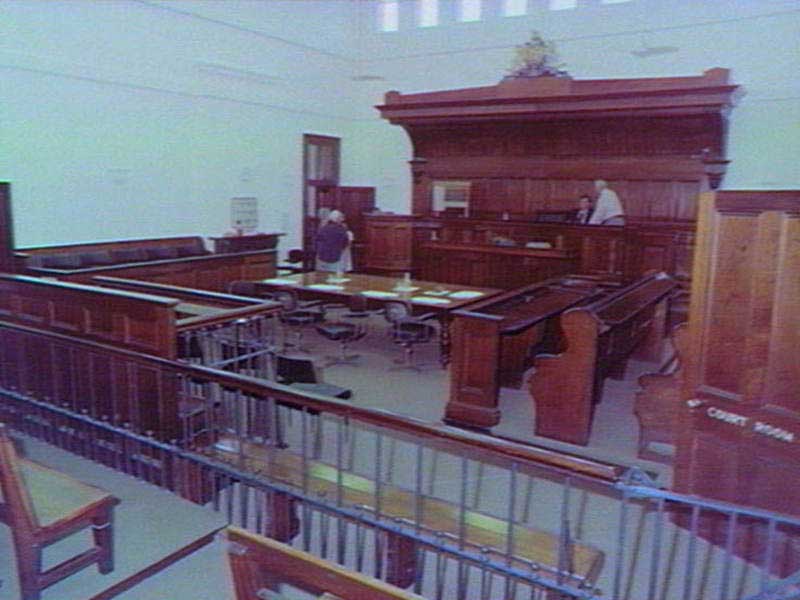
Image: NSW State Library collection. Reproduction: Peter de Waal
THE Grafton Quarter Sessions opened at 10 am yesterday, before His Honor Judge Armstrong.
Mr RJ Browning prosecuted on behalf of the Crown; and Mr W Marsh acted as Judge’s Associate.
N McSwan was excused for attendance as a juryman.
Thomas Glissan, a juryman, failed to answer when called, and was fined 40s. Mr Glissan appeared in the afternoon and stated he was instructed by his medical adviser not to attend, his health not being good. His Honor remitted the fine and excused Mr Glissan.
Thomas John Pocock was sworn in as a Justice of the Peace.
…
ALLEGED UNNATURAL OFFENCE.
Richard Thomas Foster, 25, on bail, pleaded not guilty to indecently assaulting Charles Reginald Victor Foster, [aka Charles RV Stokes], 16½, at Bucca Creek, on Nov 13, 1903.
Mr F McGuren appeared for accused.
Jury: John Donohoe, John Campbell, Albert Barnier, B Barden, Joseph Northcott, Thomas Shore, AH Spring, Ed Finn, JJ Bender, William Bailey, Jas Evans, Adolphus Kimpton.
The Crown Prosecutor curtly opened the case to the jury.
Charles Stokes stated he had been engaged by accused as a farm hand, and they had occupied the same bed. The boy’s version differed on several material points to that given at the lower [police court]. The evidence is eliminated for obvious reasons.
George Hardacre, who, with accused, is engaged farming on the halves principle, stated Stokes’ work was not satisfactory on the farm. Witness was not at home on the night the alleged offence took place.
Inspector Johnston stated that when he confronted accused with the boy, the former said, “It is only Stokes’ word against mine; but he will be believed because I have no character.”
The jury desired to hear the evidence for the defence.
The court adjourned for lunch at 1.10, and resumed an hour later.
Accused was then put in the box. He stated that the boy was untruthful, unreliable and dishonest, and his statement was a deliberate lie. He wrote two letters to the boy’s father, but neither was answered. Accused admitted having been twice convicted of indecent assault, and that he had beaten the boy with a brush-hook.
First-Class Constable Pritzler, stationed at Coramba, had known accused for the past five years. During that time he had been hard-working and industrious, and his character was good.
This concluded the evidence.
Mr McGuren, in a brief and vigorous address to the jury, stated that in every case where a man’s liberty was at stake, the Crown were bound to make out their case in such a way that any ordinary reasonable man would believe. Had this been done? Could the jury believe the evidence of a boy who had proved himself untruthful, and who had been living in Sydney in bad company, out of control of his father, who had handed him over to the Salvation Army for reformation and would now have nothing to do with him.
His Honor’s summing up occupied 10 minutes.
The jury, after 10 minutes retirement, brought in a verdict of not guilty.
Accused was then discharged.
Before the adjournment, His Honor had the boy brought before him and reprimanded him severely.
~ ~ ~ ~ ~
The Grip, Thu 25 Feb 1904 7
QUARTER SESSIONS.
———◦———
THE Quarter Sessions for the Police District of Grafton opened yesterday at 10 am before His Honor Judge Armstrong at the Court House.
Mr RJ Browning, prosecuted on behalf of the Crown.
Mr McSwan, a juryman, was excused for non-attendance. Mr T Glissan, another juryman, who did not appear when his name was called, was fined £2. Mr Glissan appeared in the afternoon with a certificate from his medical adviser, instructing that he was too ill to attend. His Honor excused Mr Glissan and remitted the fine.
…
ALLEGED INDECENT ASSAULT.
Richard Thomas Foster, 25, pleaded not guilty to indecently assaulting Charles Reginald Victor Foster, 16½ years of age, at Bucca Creek on November 13th, 1903.
Mr McGuren appeared for accused.
The following jury were empanelled:—John Donohoe, John Campbell, Albert Barnier, B Barden, Joseph Northcott, Thomas Shore, AH Spring, Ed Finn, JJ Bender, William Bailey, Jas Evans, Adolphus Kimpton.
The Crown Prosecutor briefly and concisely opened the case for the jury.
Charles Stokes stated that he had been engaged by accused as a farm hand; both he and accused occupied the same bed.
The evidence given was similar to that given in the lower Court, except that the boy’s version differed in several material points.
George Hardacre, a partner of accused in the farm, stated that Stokes’ work was not satisfactory. Witness was not at home on the night the alleged offence took place.
Inspector Johnston stated that when he confronted accused with the boy, the former said, “It is only Stokes’ word against mine; but he will be believed because I have no character.”
The jury desired to hear the evidence for the defence.
The Court adjourned for lunch at 1.10, a resumed an hour later.
Accused was then put in the box. He stated that the boy was untruthful, unreliable and dishonest, and his statement was a deliberate lie. He wrote two letters to the boy’s father, but neither was answered. Accused admitted having been twice convicted of indecent assault, and that he had beaten the boy with a brush-hook.
First-class Constable Pritzler, stationed at Coramba, had known accused for the past five years. He testified to the good reputation borne by accused during that time.
This concluded the evidence.
Mr McGuren in a brief and vigorous address to the jury, stated that in every case where a man’s liberty was at stake, the Crown were bound to make out their case in such a way that any ordinary reasonable man would believe. Had this been done? Could the jury believe the evidence of a boy who had proved himself untruthful, and who had been living in Sydney in bad company, out of control of his father, who had handed him over to the Salvation Army for reformation and would now have nothing to do with him.
His Honor’s summing up occupied ten minutes.
The jury, after 10 minutes retirement, brought in a verdict of not guilty.
Accused was then discharged.
Before the adjournment His Honor had the boy brought before him and severely reprimanded him.
~ ~ ~ ~ ~
Clarence and Richmond Examiner and New England Advertiser, Sat 27 Feb 1904 8
GRAFTON QUARTER SESSIONS.
————
THE Court opened on Wednesday, before his Honor Acting Judge Armstrong. Mr Browning acted as Crown Prosecutor.
…
INDECENT ASSAULT.
Richard Thomas Foster, on bail, was charged with indecently assaulting Charles Reginald V Stokes, at Bucca Creek on 13th November last. Accused pleaded not guilty, and was defended by Mr McGuren.
Jury—John Donohoe, John Campbell, Albert Barnier, Wright Barden, Jos Northcott, Thos Shore, Alf H Spring, Ed Finn, JJ Bender, Wm Bailey, Jas Evans, AT Kimpton.
The details of the case are unfit for publication. As put by the Crown Prosecutor to the jury, it appeared that Stokes, who is 16½ years of age, was assigned by the Salvation Army in Sydney to accused, who resided at Bucca Creek. Accused, at the time, was living at G Hardacre’s, his brother-in-law, his wife being away at the time. Accused and Stokes slept together, and while they occupied the same compartment, the alleged offence occurred.
Stokes’ evidence further stated that he complained by letter to the Salvation Army authorities of accused’s conduct, but a couple of days later wrote another at Foster’s dictation, contradicting the terms of the former. The copy of Foster’s, from which it was copied, was burned.
George Hardacre also gave evidence.
Inspector Johnston deposed to confronting accused with the boy, who stated that Foster had indecently assaulted him, describing the time. Accused made no reply, but afterwards became very excited, and said it was Stokes’ word against his, but the former would be believed as he had no character.
This was the Crown case.
Mr McGuren contended there was no case to answer, and asked the jury if they were satisfied.
The foreman (Mr Northcott) stated the jury desired to hear the defence.
Accused, in evidence, stated that Stokes did not turn out satisfactory as a labourer, and he warned him to amend his ways, or he would have to leave. He wrote Stokes’s father that the lad was worthless. He received no reply, and he sent another letter, which he registered. He positively denied the assault complained of. He did not know of the letters written by Stokes to Sydney until after his arrest, and did not dictate the contents of one.
Constable Pritzler knew accused seven years, and stated his character the past five years was good. Complaints had been made against Stokes.
His Honor, in a brief summing up, pointed out the probabilities of the case, his remarks being in the direction of an acquittal.
The jury after a retirement of 10 minutes, found a verdict of not guilty.
~ ~ ~ ~ ~
The Clarion, Wed 2 Mar 1904 9
QUARTER SESSIONS.
———◦———
FIRST DAY—Wednesday.
————
THE Grafton sittings of the above Court opened at 12.25 on Wednesday, before His Honor, Judge Armstrong.
Mr RJ Browning acted as Crown Prosecutor, and Mr W Marsh as Judge’s Associate.
N McSwan, was excused for non-attendance as a juror.
Thomas Glissan, who failed to answer to his name when called as a juror, was fined 40s. Mr Glissan appeared in the afternoon and stated he was advised not to attend, as his health was bad. The fine was remitted.
Thomas John Pocock was sworn in as a JP.
…
ALLEGED UNNATURAL OFFENCE.
Richard Thomas Foster, on bail, pleaded not guilty to indecently assaulting Charles Reginald Victor Stokes, 16½ at Bucca Creek, on 13th November, 1903.
Mr McGuren appeared for accused.
Jury: J Donohoe, J Campbell, AN Barnier, B Barden, J Northcott, T Shore, A Spring, E Finn, J Bender, W Bailey, J Evans, AT Kimpson.
Charles Stokes stated he had been engaged by accused as a farm hand, and slept in the same bed. He gave a detailed account of what took place on the night in question.
George Hardacre, who, with accused, is engaged forming on the halves principle, stated Stokes’ work was not satisfactory on the farm. Witness was not at home on the night the alleged offence took place.
Inspector Johnston stated that when he confronted accused with the boy, the former said, “It is only Stokes’ word against mine; but he will be believed because I have no character.”
After the lunch adjournment accused was put into the box.
He stated he was 25 years of age. The boy Stokes was untruthful, unreliable, and dishonest, and his statement as to the alleged offence was a deliberate lie. He wrote two letters to the boy’s father, the last one being registered, but received no reply to either. He (accused) had been twice convicted of indecent assault. He had beaten the boy with a brush-hook because he neglected his work.
First-class Constable Pritzler, stationed at Coramba, had known accused for the past five years. During that time he had been hard-working and industrious, and his character was good. Had many complaints about the conduct of the boy.
This closed the evidence.
Mr McGuren, in a vigorous but brief speech stated that in every case where a man’s liberty was at stake, the Crown were bound to make out their case in such a way that any ordinary reasonable man would believe. Had this been done? Could the jury believe the evidence of a boy who had proved himself untruthful, and who had been living in Sydney in bad company, out of control of his father, who had handed him over to the Salvation Army for reformation and would now have nothing to do with him.
His Honor summed up briefly, and the jury, after a short retirement, brought in a verdict of “not guilty,” and accused was discharged
Just prior to the adjournment his Honor had the boy brought before him, and after making reference to the large amount of perjury committed in the law courts throughout the State, said that Stokes had that day been guilty of a terrible crime which was proved by the verdict of the jury, which he agreed with. He was not in favor of sending boys to prison, but thought he should make an exception that day. However, he would give him one more chance, and trusted that he would mend his ways and become a better boy, otherwise the time was not far distant when he would find himself in the dock.
Inspector Johnston on behalf of the boy, said that his present employer gave the lad an excellent character. He was a good worker—in fact, they could not wish for a better lad.
Foster v. Foster, 1919
Foster v. Foster divorce papers 1919 10
1
In the Supreme Court of NSW
Matrimonial Causes Jurisdiction
No. 199 of 1919.
To the Honorable Alexander Gordon, Judge of
the Matrimonial Causes Court.
In re Richard Thomas Foster of Lithgow,
Machinist, and in re his wife, Amy May
Foster of Maclean.
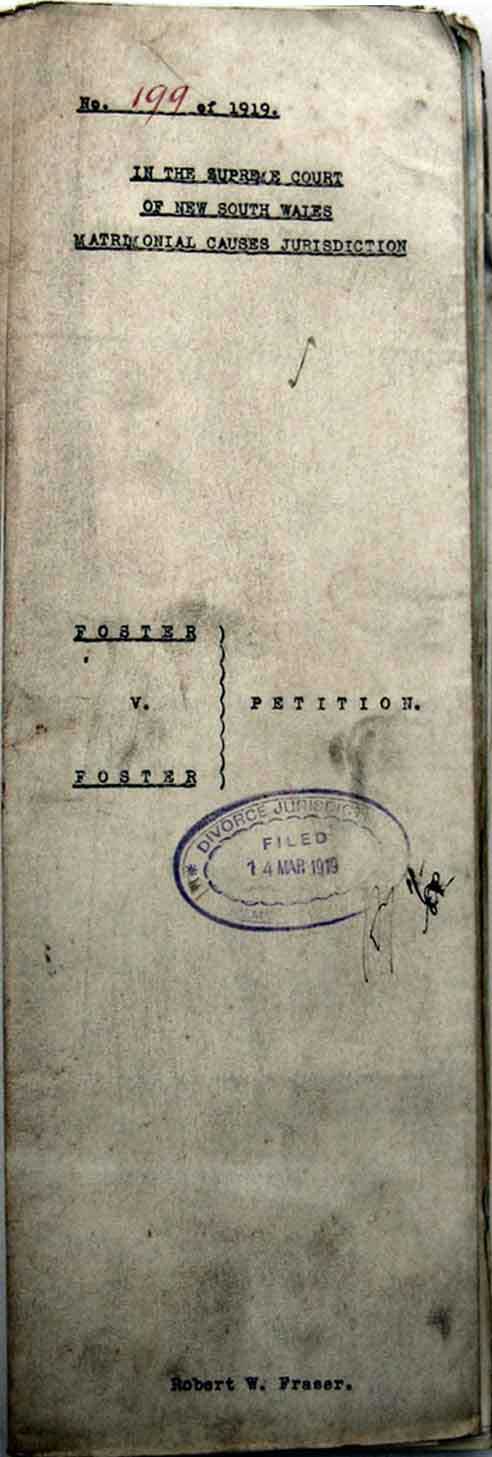
Photo: Peter de Waal
The twenty third day of January 1919
The petition of Richard Thomas Foster
SHEWETH
- That your Petitioner was on the 6th of September, 1902, married to the Respondent, then Amy May Benson, at Maclean in the State of New South Wales, according to the rites of the Church of England.
- Your Petitioner is a native of Yorkshire, England, and has for three years and upwards been domiciled in the State of New South Wales.
- The Respondent is a native of Palmers Island, Clarence River, in the said State.
- The Respondent has without just cause or excuse wilfully deserted your Petitioner and without any such cause or excuse left him continuously so deserted during three years and upwards.
YOUR PETITIONER THEREFORE HUMBLY PRAYS
- That your Honor will be pleased to decree that the marriage of your Petitioner with his said wife be dissolved.
- And that your Petitioner may have such further or other relief granted to him as to your Honor may seem meet.
[Signed] Richard Thomas Foster.
NOTE:—This Petition is filed by Robert William Fraser of Post Office Chambers, 114a Pitt Street, Sydney, in the State of New South Wales, Solicitor for the Petitioner.
~ ~ ~ ~ ~
2a
No. 199 of 1919.
IN THE SUPREME COURT
OF NEW SOUTH WALES
MATRIMONIAL CAUSES JURISDICTION
|
FOSTER v. FOSTER |
Affidavit of
|
Sworn 23rd January 1919.
Robert W Fraser
~ ~ ~ ~ ~
2b
In the Supreme Court of NSW
Matrimonial Causes Jurisdiction }
No. 199 of 1919.
BETWEEN RICHARD THOMAS FOSTER
Petitioner
and
AMY MAY FOSTER
Respondent
On this 23 January day of ... in the year one thousand nine hundred and nineteen, RICHARD THOMAS FOSTER of Lithgow, in the State of New South Wales, Machinist. Being duly sworn makes oath and says as follows:–
|
Sworn by the Deponent on the day first above mentioned at Lithgow before me
[Signed] AE Roper, JP. [Signed] Richard Thomas Foster.
~ ~ ~ ~ ~
3a
No. 199 of 1919.
IN THE SUPREME COURT
OF NEW SOUTH WALES
MATRIMONIAL CAUSES JURISDICTION
|
FOSTER v. FOSTER |
Affidavit of |
Sworn 25th March 1919.
Robert W Fraser
“A”
No. 199 of 1919.
Maclean 18th Mch 1919.
Richard Thomas Foster v Amy May Foster
In Divorce
Received copy Petition in Divorce in which I am the Respondent.
[Signed] Amy May Foster
This is the receipt marked “A” referred to in the annexed affidavit of Thomas Alfred Bateman sworn on this twenty fifth day of March, 1919 at Maclean before me
[Signed] EF Oram, JP.
~ ~ ~ ~ ~
3b
In the Supreme Court of NSW
Matrimonial Causes Jurisdiction }
No. 199 of 1919.
BETWEEN RICHARD THOMAS FOSTER
Petitioner
and
AMY MAY FOSTER
Respondent
On this twenty fifth day of March in the year one thousand nine hundred and nineteen, THOMAS ALFRED BATEMAN of Maclean in the State of New South Wales, Bailiff - - - - - - - - - - - being duly sworn makes oath and says as follows:–
[Signed] Thos A Bateman. |
Sworn by the Deponent on the day first abovementioned at Maclean before me
[Signed] EF Oram, JP.
~ ~ ~ ~ ~
4a
No. 199 of 1919.
IN THE SUPREME COURT
OF NEW SOUTH WALES
MATRIMONIAL CAUSES JURISDICTION
|
FOSTER v. FOSTER |
Affidavit of |
Sworn 24th May 1919.
Robert W Fraser
~ ~ ~ ~ ~
4b
In the Supreme Court of NSW
Matrimonial Causes Jurisdiction }
No. 199 of 1919.
BETWEEN RICHARD THOMAS FOSTER
Petitioner
and
AMY MAY FOSTER
Respondent
On this twenty fourth day of May in the year of our Lord one thousand nine hundred and nineteen, GEORGE HARDACRE of Coff’s Harbour Jetty, in the State of New South Wales, Independent Means Farmer, being duly sworn makes oath and says as follows:–
[Signed] George Hardacre. |
Sworn by the Deponent on the day first above mentioned at Coffs Harbour before me
[Signed] (?) Walsh, JP.
~ ~ ~ ~ ~
5a
No. 199 of 1919.
IN THE SUPREME COURT
OF NEW SOUTH WALES
MATRIMONIAL CAUSES JURISDICTION
|
FOSTER v. FOSTER |
Affidavit of |
Sworn 2nd June 1919.
Robert W Fraser
~ ~ ~ ~ ~
5b
In the Supreme Court of NSW
Matrimonial Causes Jurisdiction }
No. 199 of 1919.
BETWEEN RICHARD THOMAS FOSTER
Petitioner
and
AMY MAY FOSTER
Respondent
On this second day of June in the year one thousand nine hundred and nineteen, LILIAN PHILLIPS, Clerk to ROBERT WILLIAM FRASER of 114a Pitt Street, Sydney, in the State of New South Wales, Solicitor, being duly sworn makes oath and says as follows:–
[Signed] Lilian Phillips. |
Sworn by the Deponent on the day first abovementioned at Sydney before me
[Signed] G Stevenson JP.
~ ~ ~ ~ ~
6a
No. 199 of 1919.
IN THE SUPREME COURT
OF NEW SOUTH WALES
MATRIMONIAL CAUSES JURISDICTION
|
FOSTER v. FOSTER |
DFT ISSUES. |
Robert W Fraser
~ ~ ~ ~ ~
5b
In the Supreme Court of NSW
Matrimonial Causes Jurisdiction }
No. 199 of 1919.
RICHARD THOMAS FOSTER
against
AMY MAY FOSTER
Questions for the Judge.
Registrar |
Issues to be tried at Sydney at next present sittings
Settled.
[Initialled] HW
Deputy Registrar
5.6.1919
[Signed] HD Wood,
Deputy Registrar
5.6.1919
~ ~ ~ ~ ~
7a
No. 199 of 1919.
IN THE SUPREME COURT
OF NEW SOUTH WALES
MATRIMONIAL CAUSES JURISDICTION
|
FOSTER v. FOSTER |
ISSUES. |
Cor Harvey. J.
13th August 1919.
Dom (?)
Both issues in affirm
DP ret 6 mths after service on CS
[Init] CENH Associate.
Robert W Fraser
~ ~ ~ ~ ~
7b
In the Supreme Court of NSW
Matrimonial Causes Jurisdiction }
No. 199 of 1919.
RICHARD THOMAS FOSTER
against
AMY MAY FOSTER
Questions for the Judge.
[Signature illegible] |
~ ~ ~ ~ ~
8a
No. 199 of 1919.
IN THE SUPREME COURT
OF NEW SOUTH WALES
MATRIMONIAL CAUSES JURISDICTION
|
FOSTER v. FOSTER |
PRECIPE [sic] |
Robert W Fraser
~ ~ ~ ~ ~
8b
In the Supreme Court of NSW
Matrimonial Causes Jurisdiction }
No. 199 of 1919.
BETWEEN
RICHARD THOMAS FOSTER
Petitioner
and
AMY MAY FOSTER
Respondent
Enter this Cause for trial for the Present Sittings sittings [sic]
Robert William Fraser
Solicitor for the Petitioner
~ ~ ~ ~ ~
9
In the Supreme Court of NSW
Matrimonial Causes Jurisdiction }
No. 199 of 1919.
BETWEEN
RICHARD THOMAS FOSTER
Petitioner
and
AMY MAY FOSTER
Respondent
The thirteenth day of August
one thousand nine hundred and nineteen.
This cause coming on this day to be heard and the issues to be tried before the Honourable John Mulgrave Harvey Supreme Court of New South Wales sitting in the /Judge of the Matrimonial Causes Jurisdiction of the said Supreme Court, without a Jury, WHEREUPON AND UPON READING the Petition and issues, the affidavit of the Petitioner verifying the Petition, that of Thomas Alfred Bateman sworn on the 25th of March, 1919, that of Lilian Phillips sworn on the 2nd of June, 1919, and that of George Hardacre sworn on the 24th of May, 1919, all of which are filed herein and the exhibits put in evidence AND UPON HEARING the evidence given viva voce on behalf of the Petitioner AND UPON HEARING Mr Fraser Solicitor for the Petitioner, and no one appearing of behalf of the Respondent, His Honor found the following issues in favour of the Petitioner, viz:–
|
~ ~ ~ ~ ~
10a
No. 199 of 1919.
IN THE SUPREME COURT
OF NEW SOUTH WALES
MATRIMONIAL CAUSES JURISDICTION
|
FOSTER v. FOSTER |
|
TAKE NOTICE that if you marry again before this Decree shall have been made absolute you will be guilty of bigamy.
Section 28 of the Matrimonial Cases Act, 1899, provides that the respective parties to a suit for dissolution of marriage may marry again as if the marriage had been dissolved by death when but not before –
[Signed] Arthur G Laddington |
Robert W Fraser,
Solicitor,
Post Office Chambers
112a Pitt Street,
SYDNEY.
~ ~ ~ ~ ~
10b
WHEREFORE THIS COURT DOTH ORDER AND DECREE.
That the marriage of Richard Thomas Foster, The Petitioner, with Amy May Foster, the Respondent, be dissolved unless within six months from the date of the service of a copy of this Decree on the Crown Solicitor, any person shall shew cause why this Decree should not be made absolute, or the Crown Solicitor shall, under the direction of the Honourable to Attorney-General and by leave of this Honourable Court, intervene, or unless it shall otherwise appear that this Decree should not be made absolute.
By the Court,
[Signed] Arthur G Laddington.
Deputy Registrar.
~ ~ ~ ~ ~
11a
No. 199 of 1919.
IN THE SUPREME COURT
OF NEW SOUTH WALES
MATRIMONIAL CAUSES JURISDICTION
|
FOSTER v. FOSTER |
Affidavit of LILIAN PHILLIPS of
|
Sworn 10th October 1919.
Robert W Fraser.
~ ~ ~ ~ ~
11b
In the Supreme Court of NSW
Matrimonial Causes Jurisdiction }
No. 199 of 1919.
BETWEEN
RICHARD THOMAS FOSTER
Petitioner
and
AMY MAY FOSTER
Respondent
On this tenth day of October in the year one thousand nine hundred and nineteen, LILIAN PHILLIPS of “Dagworth”, Violet Street, Enfield, in the State of New South Wales, Typiste, being duly sworn makes oath and says as follows:–
|
Sworn by the Deponent on the day first abovementioned at Sydney before me
[Signed] G Stevenson, JP.
~ ~ ~ ~ ~
12a
No. 190 199 of 1919.
IN THE SUPREME COURT
OF NEW SOUTH WALES
MATRIMONIAL CAUSES JURISDICTION
|
FOSTER v. FOSTER |
REQUEST |
Robert W Fraser.
~ ~ ~ ~ ~
12b
In the Supreme Court of NSW
Matrimonial Causes Jurisdiction }
No. 190 [sic] of 1919.
BETWEEN
RICHARD THOMAS FOSTER
Petitioner
and
AMY MAY FOSTER
Respondent
I, the Petitioner in the above suit, do hereby request that the Decree Nisi made herein on the thirteenth day of August, 1919, be made absolute.
Dated this twenty fourth day of February 1920
[Signed] Richard Thomas Foster.
~ ~ ~ ~ ~
13a
IN THE SUPREME COURT OF
NEW SOUTH WALES
MATRIMONIAL CAUSES JURISDICTION
No. 190 199 of 1919
|
FOSTER v. FOSTER |
Certificate of the Register |
DN served 20-8-19
Period expired 20-2-20
Robert W Fraser.
~ ~ ~ ~ ~
13b
In the Supreme Court of NSW
Matrimonial Causes Jurisdiction }
No. 190 [sic] of 1919.
BETWEEN
RICHARD THOMAS FOSTER
Petitioner
and
AMY MAY FOSTER
Respondent
In pursuance of the 22nd Section of the “Matrimonial Causes Act 1899,” and on the request in writing by the Petitioner, I hereby submit the name of this suit to the Court for confirmation of the Decree Nisi herein, and I hereby certify that no matter in opposition to the final Decree herein is now pending.
Dated this 25th day of February 1920
[Signed] HD Wood.
Deputy Registrar.
~ ~ ~ ~ ~
14a
No. 199 of 1919.
IN THE SUPREME COURT
OF NEW SOUTH WALES
MATRIMONIAL CAUSES JURISDICTION
|
FOSTER v. FOSTER |
DECREE ABSOLUTE. |
Robert W Fraser.
Solicitor &c,
Post Office Chambers,
114a Pitt Street, Sydney.
~ ~ ~ ~ ~
14b
In the Supreme Court of NSW
Matrimonial Causes Jurisdiction }
No. 199 of 1919.
BETWEEN
RICHARD THOMAS FOSTER
Petitioner
and
AMY MAY FOSTER
Respondent
The second day of March Twenty ninth day of February one thousand nine hundred and twenty.
UPON READING the Decree Nisi herein dated the 13th of August, 1919, the affidavit of Lilian Phillips of service of the said Decree on the Crown Solicitor sworn the 10th of October, 1919, the request in writing of the Petitioner that the said Decree be made absolute, and the certificate of the Registrar of this Court that no matter in opposition to the final Decree is now pending THIS COURT DOTH ORDER AND DECREE that the Decree Nisi aforesaid be and the said is hereby made absolute and accordingly:–
The marriage of Richard Thomas Foster, the abovenamed Petitioner, with Amy May Foster, the abovenamed Respondent, is hereby dissolved.
By the Court,
[Signed] HD Wood.
Deputy Registrar.
~ ~ ~ ~ ~
Divorce court transcript Wed 13 Aug 1919 11
140
CORAM: HARVEY J.
Wednesday, 13th August, 1919.
In the Supreme Court
of NSW in Divorce. }
FOSTER V. FOSTER.
|
PETITIONER: |
RICHARD THOMAS FOSTER. |
|
RESPONDENT: |
AMY MAY FOSTER |
MR RW FRASER appeared for the Petitioner.
|
ISSUES: |
1. Marriage 6th September, 1902. 2. Desertion without just cause or excuse during three years and upwards. |
|
PETITION FILED |
14th March, 1919. |
|
SERVICE personal. |
Affidavit of TA Bateman of 25th March, 1919. Affidavit of L Phillips of 2nd June, 1919, of search and no appearance. |
141
PETITIONER,
sworn, examined, deposed:
TO MR FRASER: My name is Alfred Thomas Foster. My wife’s maiden name was Amy May Benson. I was married on the 6th September, 1902 at Maclean, Clarence River, according to the rites of the Church of England. There are no children of the marriage. I was born in Yorkshire, England. I was 9 years of age when I came to this State. I came with my father and mother. My father has lived in NSW ever since as far as I know. He is living here now. Up to the time I went to the war I continued living in NSW. I went to the war in 1916 as an infantryman. I was wounded and I had to have one leg amputated. I returned in April, 1918. Since then I have been living in Lithgow. That is my place of abode now. After the marriage I lived with my wife first at Maclean. After that we went to Central Bucka. I lived at Central Bucka up to October, 1903, when we left and went back to Maclean and lived in Maclean till May, 1904. Then I had to go away to Queensland to get work. My wife was aware that I was going away. I made provision for her to live with her mother while I was away. She raised no objection to that. After I was away I received a letter from her. I was away about 4 months when I received the letter. I destroyed all private property when I went to war. The letter was in my wife’s handwriting. She said she thought the best thing for us to do was to part.
TO HIS HONOR: She did not give me any particular reason at the time.
TO MR FRASER: I wrote back in reply to that letter and in my
Petitioner.
142
reply I asked her to think it over and come back to me and I went back to Maclean then. I did not see her when I was there but I wrote her another letter asking her again to come back.
TO HIS HONOR: Her mother lived at Maclean, Clarence River. That is where I returned. She was living with her mother, but I could not see her. She would not wait for me to see her. When she got my letter she went away to some friends.
TO MR FRASER: I got a reply to the second letter. That has been destroyed too. I destroyed all private property when I went to the war. In the second letter she said it was no use asking her any more, she would not come back to me.
TO HIS HONOR: That was in August, 1904.
TO MR FRASER: Beyond those two letters I never heard from her. I never heard from her since. I tried to get her to come back through somebody else. I saw the Wesleyan Minister at Grafton. I forget his name just now. He was not the Minister who married us. He went and saw her. He told me personally that the effort was futile.
TO HIS HONOR: I forget his name just now. I am suffering from a severe handling I got over at the other side.
TO MR FRASER: After that I lived at Bucka Creek.
TO HIS HONOR: Bucka Creek is on the North Coast, about 11 miles from Coff’s Harbour.
TO MR FRASER: I never lived at any place except at Bucka Creek from 1905. My wife knew I was living at Bucka Creek all the time. She knew where my father and mother were living. They lived in the same place alongside of me. She could have always got in touch
Petitioner.
143
with me if she wished to do so. I did not commence proceedings before because I had not the means to do so. I was doing bullock driving and fencing and timber squaring and so on then,
TO HIS HONOR: Bush working.
TO MR FRASER: George Hardacre is my brother-in-law. He is married to my sister.
TO HIS HONOR: I never heard from my wife after the last effort when I tried to get her back through the Minister.
TO MR FRASER: At one time I took up a homestead lease. I built a house there. I sold that after I came back from the war. My wife never lived in that home. I took that up in 1905. As far as I know she lived with her mother ever since. After I came back I lived in a home of my own on the selection for about 11 years – from 1905 to 1915. I had a home already for her if she came home again. It was furnished.
TO HIS HONOR: I told my solicitor that as far as I knew she was living with her mother. That information I got from my brother-in-law. As far as I know she has been going out to work etc, but she always goes back home when she is out of work. I cannot say anything for certainty.
TO MR FRASER: I am not in good health now. I am suffering from nerves as much as anything from shock I received and I have also to go into a hospital for an operation to-morrow through the artificial leg damaging the stump.
TO HIS HONOR: There was no quarrel between my wife and me – not as far as I am concerned. She would not come back after I went up to Queensland. I was willing at any time to take her back if
Petitioner.
144
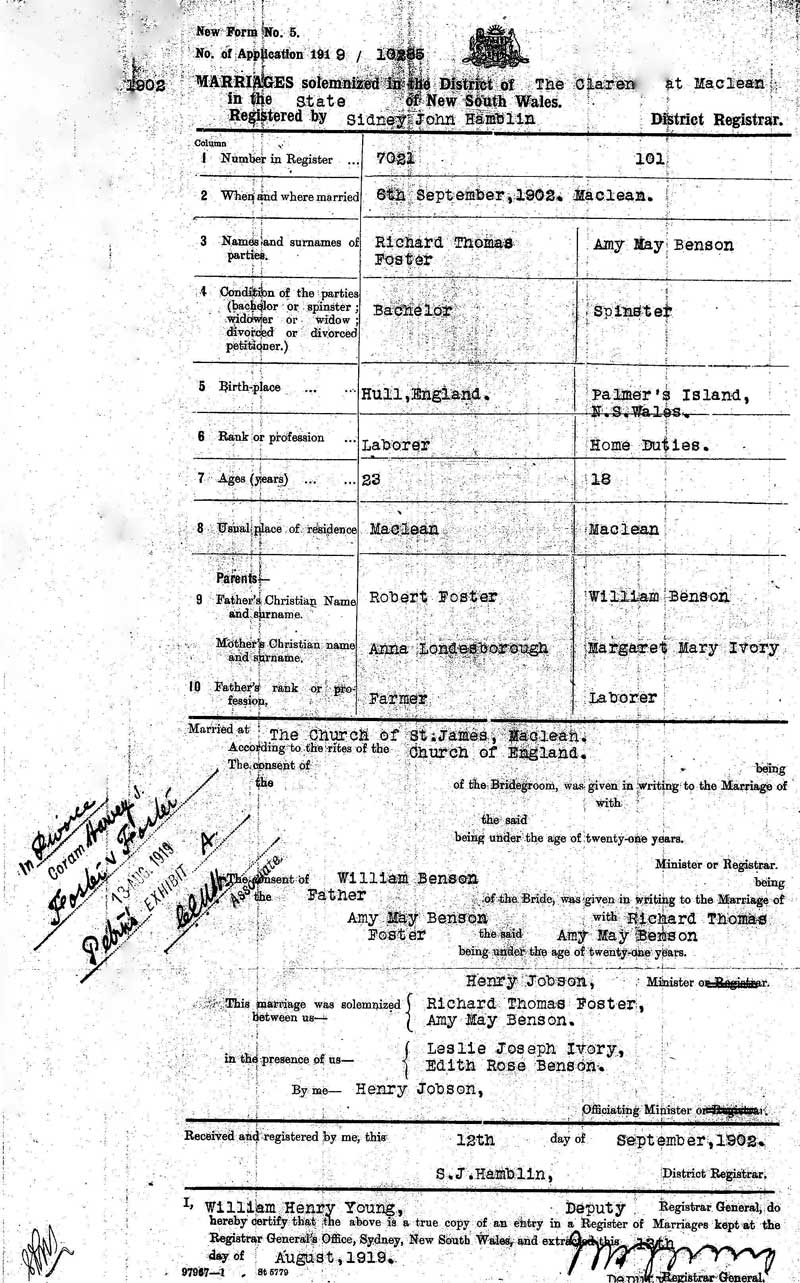
marriage certificate. Photo: Peter de Waal
she would have come.
TO MR FRASER: Should His Honor grant me a decree I want to ask His Honor for a concession about the time. From the nervous state I am in I would His Honor to reduce it and make it as small as possible so that I will be able to get the worry off my mind.
TO HIS HONOR: It is worrying me and has done all the time I ha have had the case on. It has been going ever since March. I want to be done with the case absolutely. That is the only and sole reason. There is no other reason.
(Witness retired.)
(Affidavit of G Hardacre of 24th May, 1919, ii corroboration.)
(Mr Fraser stated that he would produce a certificate copy of the marriage certificate later on.)
At 2 pm.
(Certified copy of marriage certificate marked Ex. A.)
JUDGMENT:
HIS HONOR: In this matter I find the domicile of the parties is in NSW. The first issue of marriage is proved – the parties were married on the 6th September, 1902 – and I find that the respondent has for a period of over three years prior to the presentation of the petition deserted her husband and refused to live with him, and she has no difficulty in finding him if she wished to return to him, and that there was no just cause or excuse for her not living with her husband. I find both issues in the affirmative and make a decree nisi returnable in 6 months.
~ ~ ~ ~ ~
The Sydney Morning Herald, Thu 14 Aug 1919 12
LAW REPORT.
———◦———
IN DIVORCE.
(Before Mr Justice Gordon.)
…
Foster v. Foster, 1919
This was a suit for dissolution of marriage, brought by Richard Thomas Foster, against Amy May Foster (formerly Benson), on the ground of desertion. The parties were married in the English Church, McLean, in September, 1902. Mr RW Fraser appeared for the petitioner. A decree nisi was granted, to be moved absolute in six months.
~ ~ ~ ~ ~
The Sydney Morning Herald, Fri 27 Feb 1920 13
LAW REPORT.
———◦———
IN DIVORCE.
(Before Mr Justice Gordon.)
DECREES ABSOLUTE.
Decrees absolute were pronounced and the marriages declared dissolved in the following suits:—
…
Richard Thomas Foster v. Amy May Foster.
1 Clarence and Richmond Examiner and New England Advertiser, Tue 12 Mar 1895, p. 5.
2 Clarence and Richmond Examiner and New England Advertiser, Sat 16 Mar 1895, p. 3. Emphasis added.
3 SRNSW: NRS2258, [3/5993], Grafton Gaol photographic description book, 1910-1911, No. 5, p. 6, R5125.
4 Clarence and Richmond Examiner and New England Advertiser, Sat 23 Apr 1898, p. 2. Emphasis added.
5 The Grafton Argus and Clarence River General Advertiser, Mon 22 Feb 1904, p. 2. Emphasis added.
6 The Grafton Argus and Clarence River General Advertiser, Thu 25 Feb 1904, p. 2. Emphasis added.
7 The Grip, Thu 25 Feb 1904, p. 2. Emphasis added.
8 Clarence and Richmond Examiner and New England Advertiser, Sat 27 Feb 1904, p. 2. Emphasis added.
9 The Clarion, Wed 2 Mar 1904, p. 6. Emphasis added.
10 SRNSW: NRS13495, [13/12961], Divorce and matrimonial cause case papers, No. 199, 1919.
11 SRNSW: NRS2713, [6/2884], Transcripts of evidence of the various courts, royal commissions, boards of inquiry, 1919, pp. 140-4.
12 The Sydney Morning Herald, Thu 14 Aug 1919, p. 5.
13 The Sydney Morning Herald, Fri 27 Feb 1920, p. 5.