Freeman’s Journal, Sat 11 Sep 1880 1
GOULBURN.
(From our Correspondent.)
…
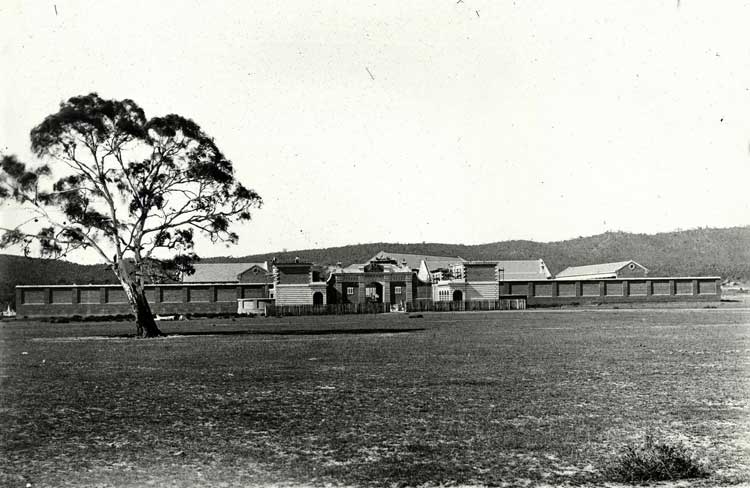
PUBLIC WORKS.—The new post-office is thanks to the energy of the contractor, Mr Horn, fast approaching completion. The tower, with which the building is surmounted, gives it a very imposing appearance, and the clock, when placed in its position, will be visible in most parts of the city. The new gaol, which in the beginning gave little hopes for being built at all, has at last been undertaken by a Sydney contractor, Mr Lemm, who is at present making preparations to carry on the work. The site is situated in the outskirts of North Goulburn, in the immediate vicinity of the cemeteries, and will certainly be a much more suitable position that at present occupied by the old prison, which is not, by any means, a marvel of architectural design or an ornament to our otherwise pleasant-looking little city.
~ ~ ~ ~ ~
Goulburn Evening Penny Post, Sat 28 May 1881 2
THE NEW GAOL, NORTH GOULBURN.
WE paid a visit to the new gaol now in course of erection at North Goulburn on Thursday last, and in order to give our readers some idea of the dimensions and the character of the buildings in connection therewith, we will state first, that the land enclosed by the wall is 450 feet by 450 feet, exclusive of the space that is occupied by the quarters of the chief gaoler and chief warder, which are in course of erection on the outside of the wall. The works going on at present comprise the erection of the boundary wall of the length above stated, and which is to be 18 feet in height from the highest portion of the ground, and two feet in thickness. Outside the wall the chief gaoler’s and chief warder’s quarters are being built of stone and brick, with stone piers and arches in front of each to form a portico, surmounted by a stone cornice.
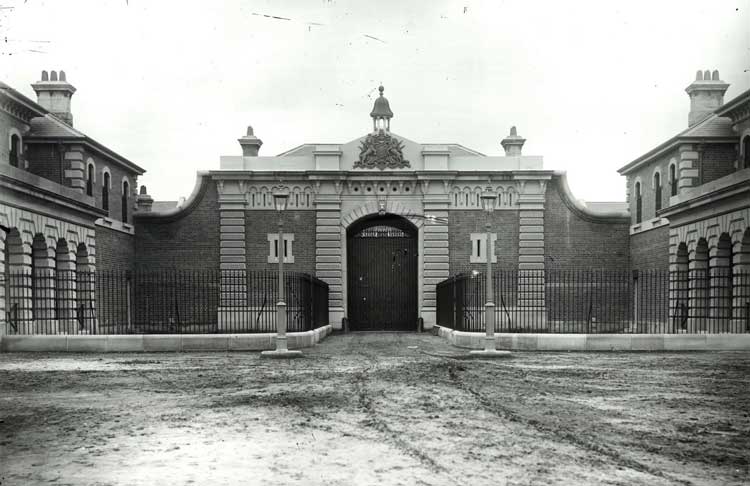
Photo ID: SRNSW 4481_a026_000668.jpg
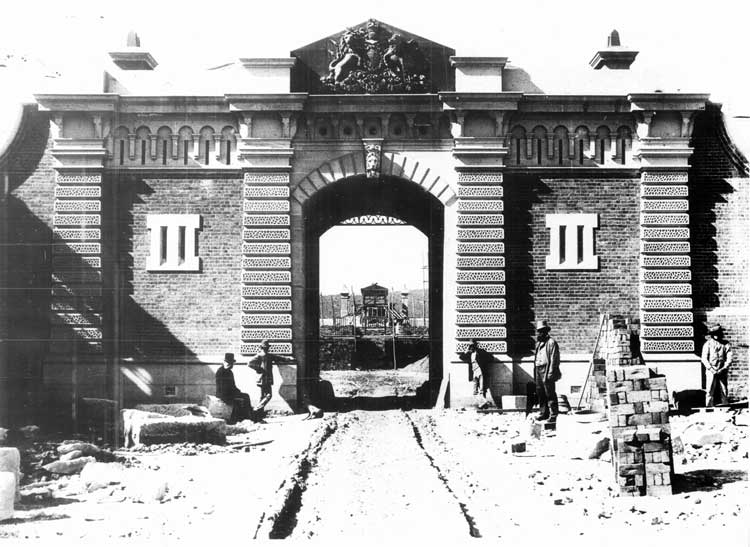
The entrance is composed of four massive stone piers, ornamented with rustic and verniculated [sic] work. From the two centre piers the stone arch forming the entrance will spring. The whole will be surmounted by stone caps and entabulature, and in the centre a royal coat of arms will be carved in stone.
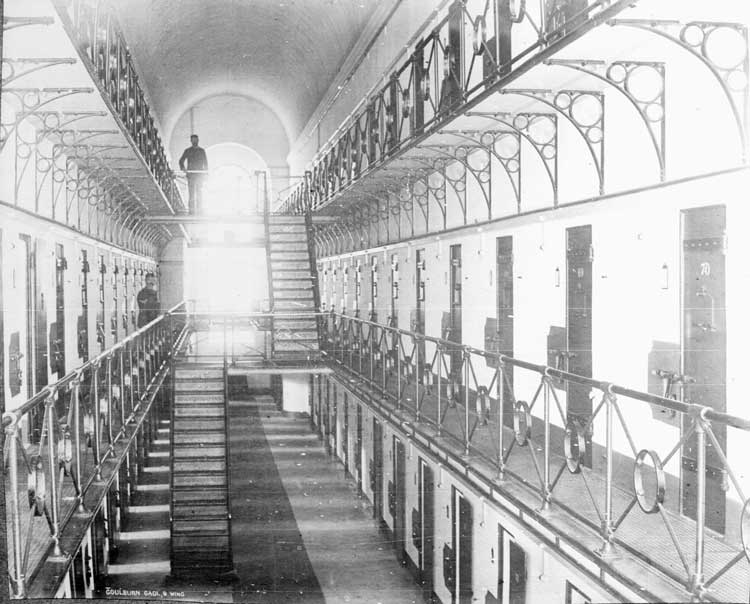
The buildings inside the enclosure will comprise a three storey range of buildings, containing 108 cells, each of which being 13 by 7 feet; 2 punishment cells and 3 cells for lunatics, a trial range containing 48 similar cells, a women’s range containing 32 cells and capable of future extensions.
A centre building, containing on the ground floor a visitor’s room and bath-room, waiting and barrister’s room. On the first floor a chapel, with a gallery provided for women, who will be kept perfectly separated from the men. A hospital for men, containing a ward 50 x 25 feet, with a dispensary, waiting-room, nurses’ room, bath-room, &c, attached.
An extensive kitchen building, with a kitchen 50 by 20 feet, women’s hospital, women’s work-room, and dining-room. A two storied building 70 feet x 22 feet in size; a men’s workshop 145 x by [sic] 22 feet. Also two storeys high; a schoolroom 50 by 20 feet, a mortuary, fumigating room, and a series of smaller buildings to be used as a residence for the gatekeeper, an office, photographic room, mess-room, armoury, store room &c.
There are two octagonal towers and a circular tower for watching purposes; the two former will be on the wall. All the yards will be enclosed and divided by stone dwarf walls with iron pallisadings. [sic] The stairs, corridors, bridges, &c, of the ranges will be of iron, and the floors of the cells will be cement supported on concrete arches. Some idea can be formed of the undertaking when we state that three and a half million bricks will be required for the works; and also to form an idea of the present stage of progress reached there are a little over 800,000 bricks laid to date.
The works were commenced in August last, [1880], and we are informed that it will take two years before the whole will be completed.
We will now ask our readers to accompany us over the works. On reaching the front or entrance, one is struck by the very imposing appearance the ornamental stone work presents. The brick work here has piers at interval [sic], the bricks in which are of a darker colour than the intermediate spaces, and are a decided improvement in causing such a variation in appearance. The wall that encloses the warder’s and gaoler’s quarters is completed. After inspecting the ornamental work we enter the gateway and turn to the right, and find that provision is made on either side for a range of officer’s rooms, &c, and facing this entrance will be the chapel building before referred to. The offices are now in readiness for roofing; and here we may state that the quarters in the front would have been much further advanced but for the time occupied in preparing the stone for the work. Passing on to the right, we notice that the foundations to the floor level are all in; and here we may state that the foundations of all these works are of stone footings, and brick in cement to floor levels. We next notice that the foundation for female warders’ room, women’s hospitals, the range of women’s cells, are all in readiness for brickwork. Continuing around the wall, we notice some workmen excavating the foundations for the men’s workshops, and, passing on we reach the school-room, which is a short distance from the north-eastern corner of the wall. This building will be roofed in a few weeks, the brickwork being all completed.
We next inspect the two tanks, of elliptic shape. In size they are each 28 x 14 x 19 feet—bricked, cemented, and domed over; one of which is now full of surplus water, which is stored for future supply and which we shall refer to in the sequel.
Continuing along the back or northern wall (which is at present nine feet in height), we next notice that the main drain, having pipes 18 inches in diameter, runs outside the wall for about 350 feet; the outlet to which being in the police paddock. The drains from the inside will be connected with the main drain anon. We notice about midway that the foundations are excavated for the circular watch-tower. The doors to each of the corner towers will be outside this building altogether. Here we notice that a large amount of filling has taken place, and on enquiry we find that, on account of the land on one side of the enclosure being so much higher than the other, the same has been cut away and the stuff carted to the lower side in order to make it level.
Proceeding around the wall, we notice the women’s hospital and range of cells for women are in course of erection, while a number of men are working at the other buildings before enumerated. A wall, distinct from the women’s apartments, divides two yards, the hospital and the women’s recreation yards. In various parts of this enclosure we notice heaps of bricks, stone, cement, timber, ironwork, gratings. The wrought iron gratings for ventilation are worth special mention; they are perforated and have reverse clips, so that once placed in position it would be impossible to remove them. The system of ventilation adopted throughout the whole of the buildings forming the subject of this notice is known as Tobin’s system. Earth closets are to be provided throughout.
The mortar is made by a Chilian mill, worked by a six-horse-power engine, and as a consequence some amount of labour is thus saved.
The water supply for these works is worthy of a more than passing notice, and we will briefly describe it. The water is raised by a pump worked by a windmill, which pumps it from the Mulwarree to a first height of 27 feet. It is then forced 700 feet, with a gradient of 70 feet, into four iron tanks, placed at such an elevated position as to be able to send the water to all parts of the works; and at the time of our visit these tanks were overflowing. Pipes are attached which contain the surplus and which is conveyed to the nearest of the two eliptic [sic] shaped tanks, and at the present time there are 48,000 gallons of water stored in this reservoir. A pump is also placed in position on the surface, so that in the event of a accident from whatever cause the works would not be stopped for the want of water for mixing mortar for the bricklayers &c. Pipes are also attached for conveying the water to all parts of the works, so the work of water carriage is dispensed with.
The Government Inspector of Works, Mr Farr, has an office on the ground, and this gentleman is represented by Mr Brown. The contractor, Mr Lemm, has also an office, in which the plans are kept.
The materials used in the construction of these gigantic works are of the very best description. The stone for dressing &c, is brought from Mr Lemm’s own quarry at Mittagong, and is considered the best between Goulburn and Sydney, while the stone for footings comes from Jordan’s crossing. The bricks are made at Mr Lemm’s brickyard, and are the same as the sample that took first prize at the late Goulburn show. The ironwork is obtained from Bradley and Sons, Sydney. The whole of the works are superintended by Mr Spencer, who has a number of working foremen under him in the various trades engaged in their construction. About 100 men have been employed in connection with the works, and so well has everything been arranged, and is now being carried out, that not a single accident has occurred. In addition to the present undertaking Mr Lemm has completed several large and important contracts, notable amongst which are the artillery barracks at South Head; also other extensive works at the Callan Park Lunatic Asylum. With such a supervisor as Mr Thomas Spencer, who is a thorough practical builder, Mr Lemm can hardly fail in his efforts to carry out a job of any dimensions. The total contract price of the works now in progress here amount to 58,700. The workmen labour 48 hours per week, and receive the highest rate of remuneration for this labour. The plans &c, for the work were prepared by the Government Architect, Mr Barnett, and so far as we are competent to judge from present appearances, we consider that space has been well and judiciously economised.
In conclusion we beg to tender our thanks to Mr Spencer for the courtesy shown us on our visit, and trust that the same rate of progress may be continued till the whole work is completed, which will always remain a monument of skill and dexterity; and we think we can safely predict that when completed they will compare favourably with any works of a similar nature in any part of the world.
~ ~ ~ ~ ~
Goulburn Evening Penny Post, Tue 2 Aug 1881 3
THE GOULBURN GAOL.
VERY few of our readers being aware of the internal workings of the gaol in our midst, or having even a slight conception of its dimensions or management, we, in order that such information might be conveyed, paid a visit of inspection, on Thursday last, and purpose giving the result of our visit. The gaol itself is surrounded by a wall about twenty feet in height, and is situated in about the centre of the city. On the wall are two watch-towers from which the sentries have a full view of the yards, and the prisoners that are daily employed, and which we refer to in detail below.
Government Printing Office Glass Negatives, photo 1373
The entrance to the gaol is by means of a pair of huge wooden gates with a knocker and grating. At these gates a warder or guard is always on duty to answer a summons. Entering the gateway we find on our right a guard room, in size 3 x 12 feet, having a fire place, &c, and here we notice all kinds of firearms, swords, handcuffs, and other articles that offenders against society are often causing the use of. On the opposite side is a very neat office the same size as the guard-room; at the time of our visit this place was undergoing the process of painting; it seemed to us to be well fitted up and scrupulously clean. In the corner of the wall in the portico we notice a speaking trumpet and a bell handle which leads to the gaoler’s quarters overhead. Having noted all we find worthy of record in this portico, we pass through a pair of iron gates and find ourselves inside the gaol. Prisoners were working away breaking up the road between this gate and the gaol and re-forming it at the time of our visit, and the way they wielded the pick led us to the conclusion that they were working with vengeance worthy of men that were free. Owing to lengthened wear and traffic the stops of these gates had worn away, and, with the roads, were about to be relaid; we turn to the left after passing through the gates before mentioned, and find that the gaoler’s quarters occupies the front part of the building which is separated from the gaol by about thirty feet of space, the wall forming a portion of the same. The quarters appear commodious and comprise three bed-rooms, sitting-room and kitchen, with a tank for a supply of water in a handy position; here we notice a sure mark of civilisation in the shape of pot plants, which tends to relieve the otherwise monotonous appearance the place presents. Continuing our walk on the left we notice first the cook-house where the prisoners’ food is prepared, and find that to facilitate cooking operations, there are three boilers of 40 gallons each, one boiler of 50 gallons capacity fitted with patent flues set in brickwork and covered with lead; a large and handy stove by Slee of Sydney, and a brick oven. The system adopted in this department is worthy of notice; a man is told off every day as a kind of delegate to see that every prisoner gets his proper weight of rations; and here the contractor for the supply of provisions has his weight of such supply tested. The usual conveniences are found here, and we should be wanting in duty were e not to record the fact that everything, including the cook himself, was in such a state of cleanliness that could hardly be surpassed anywhere. Leave the cookhouse we reach No. 1 post; here we find a warder on sentry who has charge of the prisoners at the workshop. We notice a beam and scales, and on inquiry learn that all the wood for fuel is weighed, and 1800 pounds is daily consumed. Each shop is allowed a fire by the regulations, and the gaoler and office are only allowed a limited supply; five prisoners find employment about this post, and are in charge of the warder. The wood heap occupies a space between the workshop and No. 5 post, and since the present gaoler has been in charge, a footpath has been formed between the wall and the work-shop. A locker, in which iron &c, is kept, has been placed in a convenient place; a lamp to afford light at night time has also been placed on the back of the workshop. The scullery works of the establishment is also done in this part, and several minor jobs are executed since this space was utilised. We next observe a lamp at the corner of the workshop which lights the main footpath or road between the main building and the workshops. These latter are of wood construction, having an iron roof and a loft; over one of the shops a patent gallows is kept. We take the shops in rotation and enter first, the shoemaker’s shop, which is 20 x 14 feet, and find three tradesmen and three learners at work. Three windows admit the light, and a stove heats the building. Leaving this we next enter the carpenter’s shop the dimensions being 14 x 14 fee4t; here we find two tradesmen and one assistant. We find the place completely fitted up with bench in the middle and a very good and handy system for tools, a case containing many compartments in which all kinds of tools are ready for use. The prisoners at work here seem happy and contented, and if one can judge from the manner they handle the tools their work is worthy of a better cause.
We next enter the bookbinders and printers’ shop; we find it to be in size 24 x 14 and the men employed here are three bookbinders and a printer; all the gaol “forms” are printed in this place by a lever press; a table is placed round this shop which contains full set of tools, inluding [sic] a standing press and cutting press. The shop is lighted with four windows. We inspected some of the work which was very creditable. Leaving this place, which has been considerably enlarged recently, we enter the blacksmith and tinsmith shop, 16 x 14 feet. Here we find a portable forge and dies for bolts and nuts; all the tools that are used have been made in the place. The tinsmith’s machinery consists of rollers, wiring machine, burring machine, and folders. A number of manufactured articles are turned out of this part of the establishment. Two men find employment here. A tool house and paint shop is next inspected. Here we find hammers for stone breakers, picks, shovels, crowbars, &c. In this place paints are mixed ready for use. On the window-cill [sic] outside are more pot plants. We next enter the schoolroom and library, and must express our surprise at the progress made by the prisoners. In their writing improvement is noticeable in almost every case. The size of the building devoted to instruction is 20 x 14, and at the present time 8 prisoners attend. It is proposed, however, to put up three new desks, when 21 prisoners will be accommodated. The fittings of the schoolroom are very fair. The library contains 450 volumes, and can be summarised as comprising works on science, History, Biography, Magazines, Tales, and Educational works, including J Popular Educator, Napier’s Peninsular War, Prescott’s Historical Works, Johnson’s Lives of the Poets, Carlyle’s Frederick the Great in 10 volumes, Leisure Hour, Cassell, Cornhill and Blackwood’s Magazines, &c. The rules of the library are that each prisoner is allowed one volume for a week only, but can retain it for a similar period by request. We now come to a pair of wooden gates, that admits us to No. 3, or what is known as the store yard. A huge lamp lights this place. An iron tank is noticeable, and turning to the left we enter first a bathroom, which contains two plunge baths, and two shower baths. This room is 14 x 8 feet. A barber’s shop is also attached to this. The water is plentifully supplied from the tank just noticed. The towels and everything about this place were in a state of cleanliness that was pleasing. Each prisoner has to bathe, and to shave once a week. Continuing round to the left we arrive at the washing yard, 30 x 10 feet, and divided from the footpath, before referred to, between the rear of the shops and the wall, by means of a fence. We find that all the washing for the gaol and hospital is done here, and occupies the labour of four men. We find every convenience in the shape of a large boiler of 60 gallons built in with bricks. The work of washing is performed under a verandah; and we will here state the system of water supply, which is from an underground tank near the entrance to the gaol, filled from the roof; also from a well 55 feet in depth, and containing about 30 feet of water. The water from this well is forced by means of a pump, worked by manual labor, and is in use now on account of the dry weather. For drinking purposes water has to be supplied from outside the premises. The water from the well is only fit for washing purposes. Many of our readers will remember the well when we state it is the one that proved so serviceable some years ago when the bank was burnt down. In the labour yard, where we find ourselves after passing through the gates just mentioned, we notice a long bench containing twenty four basins, placed along the rack, with hooks to hang towels, &c. This is the place where the prisoners perform their duties of ablution. In this labour yard, which is under the charge of Mr Warden Tinson, are posts for clothes lines, a guard box, and two 400 gallon tanks for water. We next notice a large number of prisoners at work stone breaking. On the wall in each corner are the sentry towers, with an armed sentry on each; these have full view of all that is going on below, and can exercise a cross fire if necessary. We failed to notice anything unpleasant in this yard. We next inspect a dining or mess room, having a locker for each man. This shed is 40 x 15, and the front facing the yard is open; tables are placed across, having a seat at each side. Mr Tinson has charge of this department in addition to the yard, and serves out the food to the prisoners in messes of six; a plate, pannikin, and knife and fork is allowed to each man, besides a bag having his number thereon. A door leads to the main building from this mess-room, which we will refer to lower down. Everything in this place was scrupulously clean, and deserves being placed on record; and here we will state the general diet, as allowed, which consists of soup, beef and potatoes for dinner, and on Sunday mutton is allowed. Provision is made in this yard for a plentiful supply of water for washing and drinking purposes. A high screen hides the closet accommodation from view from the new post-office, which overlooks this part. The closet accommodation is ample, and is on the patent earth principle; and is another of the improvements carried out by the present head of the department. Not the least offensive smell is perceptible about this part of the yard, which—considering that there are about 100 male prisoners—speaks well for the management. An iron fence runs across the yard at this place, and has a pair of wooden gates, through which we enter, and notice a really neat garden, containing a plentiful supply of vegetables, and a good number of fruit trees (well pruned and healthy). A small picket fence running the side of the walk [sic] has grape vines neatly trained; while a border along the main building is neatly edged with rosemary. The plants are mostly herbaceous, and we think when the department at Sydney are aware that this garden is in such first-class order they should at least order a few good shrubs to be planted, if only to encourage the industry of the officers; and we hope they will take the hint, for we can positively assert that there are few neater garden plots in Goulburn than at the gaol, where it is least expected to find one. The officers’ closets are built in this enclosed land. We next inspect the day quarters of the female prisoners, which we find are constructed of wood. The female warder quarters lead into the garden, attached to which is the female hospital ward. We enter the prisoners’ quarters through a wooden door in the fence, and inspect the lavatory, which is fitted up with four basins, a hot and cold water bath, the hot water being supplied from a boiler in the dining-room. Every convenience is noticed here, and the cleanliness is creditable to all. The floor of this bathroom or lavatory is of cement, with the centre hollowed, in which is a grating leading to a drain. The dining-room contains a fireplace, and the tables were in a cleanly condition. A sentry box is placed in a convenient part of the yard, and the female warder (Miss Hopwood) appears to have great command over her charges. A washing bench, washing the clothes, is conveniently situated in this part of the day quarters. Retracing our steps, we inspect a frame situated in the corner of the yard, which is used for photographing prisoners. Near this is the well before referred to, and the force pump which forces the water over the premises, and also to the top of the building to a tank placed at an elevation of about 80 feet. Prior to Mr Herbert taking charge, the water from this well was carried over the premises by the prisoners; and it used to occupy two men over a half-day. Sufficient is now supplied by three-quarters of an hour’s pumping; thus a saving of labor is gained.
Having noticed briefly the works and building outside, we will now ask our readers to accompany us over the main building, which we find is of brick, and three storeys in height, and is 150 x 40 feet in size. We enter on the right hand side, and after ascending five stone steps we enter a corridor, on the left of which is the hospital and the doctors’ consulting room. Leading from this are two hospital wards, both supplied with the requisite necessaries, fireplaces, and good ventilation, besides being very clean. We next pass through a gate, and find ourselves in the main corridor, having cells on each side—31 in number, and 8 x 5 feel each. A portion of this corridor—23 x 15 feet—is used for a chapel, and piles of seats are noticed covered with green baize. To make the chapel complete, we notice a table and harmonium. In addition to the cells in this corridor we notice a cupboard, in which the private property of the prisoners is kept, a paint store, a photographic room well stocked with chemicals, a clothing store belonging to the female warder, &c. A dispensary, also resembling a huge druggist shop. The corridor where the cells commence is divided from this by a barrier running to the top of the building, egress and ingress through which is by means of a gate which is always kept locked. This corridor is lighted by means of a swinging lamp, and here we must notice a system of safety. The occupied cells have the locks facing outwards, whilst the unoccupied ones are reversed. Continuing along this corridor we notice two cells for refractory prisoners.
Printing Office Glass Negatives, photo 1938
Near these are the stairs leading to the middle landing, underneath which we notice all the apparatus used in twisting horsehair and mattrass [sic] making. We next enter a cell, the door of which leads to the men’s mess room. As we shall have to speak of this anon, we will now inspect the dead cell No. 5, where we expected to find some foul effluvia; but the only smell we found was that of carbolic acid, and cleanliness was very noticeable in all the cells that we peeped into, not only on this basement corridor, but the upper ones. We next ascend a winding staircase of 17 stairs, and reach the middle landing, which is surrounded by a screen balustrade, and lighted by a window in the end of the building. On the top of this landing is the iron tank, before referred to; on this landing at either side are cells sixteen in number, 12 x 9 feet in size, we understand that three prisoners occupy each cell. A barrier runs through this corridor, and separates the female prisoners’ cells from the males’. On the left of this landing is the staircase used by the male prisoners to reach the top landing, and after ascending 17 steps we find ourselves on the uppermost landing, on either wide of which are cells sixteen in number, and each one 12 x 9 feet in size, similar to the middle landing. A portion of this landing, extending to the barrier, 23 x 15 feet is used for the stores for the light overseer of trades, and office, and here we notice four tailors at work, two sewing-machines, a stove with irons, a store literally packed with tinware, from a pannikin to a watering-can, a grindery store, iron store, tools and stationery store. All the entrances to the landing are through iron gates, so that it would be almost an impossibility for a prisoner to escape.
We now descend to the bottom landing and witness the muster of the female prisoners. The matron, Mrs Herbert, at the sound of the bell took up her position on the bottom landing. Miss Hopwood, the female warder, marched the female prisoners in, each one of whom making a curtesy [sic] to the matron and gaoler as they passed. The names were then called over by the female warder, and Mrs Herbert counted them, and they were afterwards dismissed to their several cells, accompanied by the two ladies, where, we believe, they were searched.
Being now half-past four the bell rings for the muster of the male prisoners. To witness this interesting work we proceed to the mess-room before alluded to, and take up our station with Mr Herbert. Mr Lawliss, [sic] the chief warder, calls out the names of the prisoners, and as each one answers they pass through the door so often referred to, and up to the landing on which their cells are situated, as they pass through Mr Herbert counts them. They are then ranged in rows, and searched by the chief warder and his assistants, after which they retire to their cells, which are afterwards locked; the locks are then inspected, and the work of the day terminates so far as the prisoners are concerned. The hours of labor at this gaol are from seven to half-past four, out of which an hour is allowed for schooling. The mustering, owing to the number, is divided into two parts, but the real mannual [sic] work of the day may be said to commence at eight o’clock.
Before concluding our hurried notice of the work performed by the prisoners, we must state the average number of female prisoners is about fifteen, their labour consists in washing and sewing. During the last three months, owing to the condition of the drains of the premises, Mr Herbert has had them taken up and re-laid, when it was found that many pipes were broken and choaked [sic]. New pipes have taken the place of these, surface drains have been laid also in places where no drains were before, and these are now really worth inspecting; they are clean and must be kept so for we noticed they had been coloured with raddle, and looked very nice. All the roads have been re-formed and rolled. The discipline of the gaol is worthy of special mention; and the respect that even the worst prisoners shewed in our presence to Mr Lawless, the Chief-warder, and to Mr Herbert, the Superintendent, was of such a character that reminded us of the custom in the ranks of the military, and tended to show the high estimation in which Mr Herbert is held. Several of the officers appear to us to be past active service through age; some of whom have served the public for upwards of 30 years. In such cases the want of some retiring fund is keenly felt and had there been any superannuation fund in existence, such as the police superannuation fund, these old worn out officers would have contributed sufficient towards it to permit of them being pensioned off on full salary; and then in all human probability they would not live to draw as much as they had contributed. It appears to be the same in all branches of the Civil Service; worthy, but worn out officers are compelled to work until death calls them, in consequence of the powers that be not initiating any scheme to meet such cases. It is not yet too late to commence a system; we are not finding any fault with these officers, but we think it hard that they should be compelled to work for their miserable pittance at their age, when a little forethought on the part of the authorities might have made a wise provision against it. Our readers, we are sure, will agree with us in reference to this subject. At the time of our visit there were 104 males and 12 females in gaol, and from the look and manner of all, we are inclined to think that the gaol to the majority of them, is not such a place of punishment as it is thought to be.
The amount of money saved to the Government be prison labour during the past year, is £1190 6s 1d, and the actual amount returned to the Treasury last year by the Goulburn gaol, amounted to no less a sum than £828 8s 4d, made up as follows:—
| £ | s | d. | |
| Bookbinders............. | 64 | 1 | 10 |
| Shoemakers............. | 233 | 5 | 8 |
| Tinsmiths.................. | 71 | 7 | 4 |
| Carpenters............... | 66 | 11 | 5 |
| Tailors...................... | 48 | 10 | 7 |
| For road metal......... | 344 | 11 | 6 |
| Total......................... | 828 | 8 | 4 |
This amount is actual profit after cost of material is taken out of the gross amount received. We think that very few gaols in the colony can show a proportionate larger amount than this.
We now give the names of the local authorities—Visiting justice, HH Voss, JP, Church of England Chaplain, Rev Archdeacon Puddicombe; Roman Catholic Chaplain, Rev Father Walsh; Visiting Surgeon, Dr Gentle; Acting Gaoler, P Herbert; Acting Matron, A Herbert; Chief Warder, Lawless; Clerk and Schoolmaster, Mr Mason; Senior Warder, Bennet. Trades foreman, Messrs Tinson, and 10 ordinary warders, and female warder.
In concluding this notice, we take this opportunity of congratulating the Department of Prisons on their possessing such a superintendent–one who has proved so zealous in the discharge of his duties, and so earnest in originating reforms; and we tender our best thanks for the courtesy extended to us during our visit to the gaol, which forms the subject of this article.
~ ~ ~ ~ ~
The Southern Argus, Tue 25 Oct 1881 4
THE NEW GOULBURN GAOL.
We paid a visit yesterday to the large building being erected at the North end of this town, and were well paid for our trouble by a careful inspection of the works now in progress there. It is some fifteen months since a start was made, and altogether very fair results have been so far accomplished. The whole contract for the gaol was £57,000, and the time allowed to finish it was 2½ years. Some idea of the large nature of the undertaking may be formed when we state that the amount expended on iron fittings alone is over £10,000. When completed the gaol will afford accommodation for 200 prisoners, including 32 females. The buildings now in forward state are—the officers’ quarters, the females’ side, and the workshop. One wing for trial men is also pretty forward. In looking over the various plans of the Government Architect one cannot but be struck with the elaborate care that has been taken to insure the safe keeping of the prisoners. The very latest bolts and bars, are all found here, and it is at once apparent that escape by his own agency only is for a prisoner impossible. The cells are single ones, 13ft by 7ft, and 9ft 6in in height, with 3-quarter inch iron doors, and are sufficiently lighted and well ventilated. With regard to the latter item, the ventilators are so constructed that they cannot be seen through, the one plate being placed to the left of the other, though attached to it nevertheless. Two watch towers, one at each corner, and a central one in the middle, will ensure the whole gaol being under the eyes of the officers, and two sentries will be on guard night and day outside the main entrance. Perhaps the most striking feature within the building, apart from the particularly handsome front, will be the church, which immediately faces one on entering. Large bath-rooms insure cleanliness, whilst there are hospitals for both males and females. Attached to the mortuary is a room for fumigating the prisoners’ clothes on admission. The water-supply is insured by two huge underground tanks, each containing 50,000 gallons, and another placed on the top of the central tower of observation. This will supply the gaol by gravitation, prison labour being used to pump the water up to the necessary height. The water is drawn in the first instance from the river by a windmill. There are fifty men employed on the works at present, besides fifteen in the contractor’s own brickfield, who are kept constantly at work. The mortar is made on the works by machinery driven by steam. From the large workshops allotted to the prisoners, it is evidently the intention of the authorities to employ all of them within the gaol walls. When finished, this building will undoubtedly be the most complete of its kind in the Australian colonies; but it is somewhat unfortunate that so picturesque a site should be occupied by a public institution of the kind. Our thanks are due for the courteous information so readily afforded by the foreman of the works on the occasion of the visit.
~ ~ ~ ~ ~
Goulburn Evening Penny Post, Tue 7 Aug 1883 5
GOULBURN NEW GAOL.
LAST Saturday afternoon the new gaol presented a pleasing and, when viewed in connection with the purpose for which it is being built, an incongruous sight. Across the entrance flags were flying, and inside the square bunting was suspended from lines connecting some of the building. A few trees and shrubs, temporarily fixed in barrels, were also introduced, and the large workshop, on the upper storey of which a banquet was held, was tastefully decorated on the outside (the interior is described below) with greenery. Altogether the place wore a holiday appearance, and the decorations enlivened the sombre outlines of the buildings considerably.
The occasion for all this display was the celebration of the near completion of the last roof in the contract. Mr F Lemm, the contractor, with that liberality which has always characterised him, thought that such an event should be duly recognised, and accordingly invited all the workmen and a large number of guests to attend at the building last Saturday afternoon. In all, 198 invitations were issued, and of these only some twelve or fourteen declined. The guests included besides Sydney visitors, Mr Teece, member for Goulburn, and Mr JT Gannon, member for Argyle, some of the most prominent and wealthy residents of the city and district. The Colonial Architect’s office was represented by Mr Farr (visiting Clerk of Works), Mr Wilkie (resident Clerk of Works), Mr Brown, Mr Purkis, and Mr Telfer. The Colonial Architect himself (Mr Barnett), and Mr Coles, the second in command, were unable to attend. The other Sydney visitors were—Mr Harold McLean, Comptroller-General of Prisons; Mr Macleod, contractor; Mr Buchanan, architect; Mr A Kethel, timber merchant; Mr J Noble, contractor, Mr W Coleman, contractor; and Mr Tornaghi, the contractor for the town clock. Mr Byrnes, of Marulen, was also a visitor.
At 2 o’clock the guests commence to arrive and distribute themselves about the works; and for the nonce there was the novel sight of a prison in the possession of a large party of pleasure-seekers. They invaded it in numbers, and could be seen in every part—examining the hospital, walking through the kitchen and other buildings, and traversing the long ranges of cells, peering into these latter cheerless places with curiosity, and now and then a half-suppressed shudder of horror. On all hands could be heard the passing of encomiums 6 on the work—not by the inexperienced, but by practical men; and coming from that quarter, the praise must have been highly acceptable to all concerned in the erection of this magnificent prison.
Of the progress of the building we have not much to say at present, as a short time ago we went into the matter in detail, and, if permitted, we intend, before it is handed over to the Government, describing it at length. Suffice it to say that satisfactory progress is being made everywhere. The last roof—the chapel—is now being slated. It is surmounted by a bell tower of ornamental design, which gives a pleasant effect to the whole place. Mr Byrnes, of the Caours Steam Saw-mills, supplied all the hardwood timber used in the contract, and we understand that Mr JW Macgraw, the foreman of the brickmakers in the employment of Mr Lemm, has turned out from the yards something like five millions of bricks.
At 3 o’clock the Premier Band arrived on the scene of festivities, playing, and during the remainder of the afternoon and at the banquet, they discoursed selections of music.
At half-past 3 o’clock the company, numbering about 180, sat down to dinner. Mr Gordon of Auburn-street, was the caterer, and Mr Smith of Clinton-street, supplied the liquors, which were there in abundance. The dinner consisted of cold meats such as poultry, tongue, etc, and there was a second course of pastry. We believe there were vegetables there; but we were not afforded the chance of tasting them. To the quality of the articles supplied exception cannot be taken—it was good; but the waiting was sadly deficient. Next time Mr Gordon undertakes to get up a banquet he should, if he wishes to maintain a good reputation, provide an efficient staff of waiters. As mentioned before the tables were laid in the upper storey of the commodiously workshop; and notwithstanding the large crowd that partook of the feast there was room for all. The place was splendidly decorated. On the wall in front of the entrance door, the word “Welcome” was tastefully worked out in green letters. Below this was a banner on which was represented a thistle with the motto—“Vigilante et Audax”—underneath. At one end of the room against the wall was arranged a trophy of tools used by bricklayers, carpenters, painters, and labourers; and above them a banner with the inscription—“Labor Omnia Vincit”. At the other end of the room was a similar trophy, only that plastering and carpentering tools were the only ones represented; above this collection was the English significance of the Latin motto at the other end—“Labour Conquers Everything.” A more novel or appropriate decoration than these trophies could not be managed, and they were both arranged in a neat and tasteful manner.
After the guests had seated themselves, and before the viands were touched, a very interesting event took place, viz, a—
PRESENTATION TO MR TW SPENCER.
This took the form of an illuminated address, done in Mr WF Geach’s usual artistic style, with an accompanying gift of a gold albert and pendant and a diamond ring. Both articles were very valuable and acceptable; the chain is of the fetter link pattern, with a beautiful pendant attached, and the ring was also a magnificent piece of workmanship. Mr Spencer is, as nearly everyone knows, Mr Lemm’s foreman. To him is owing much of the credit for the manner in which the contract has been, up to the present, carried out. He is very popular amongst his friends, and this presentation, which was from the employees at the gaol, shows how much he is appreciated by them.
The Mayor (Mr W Davies) read the address, which was couched in the following language:—
To Thomas Edward Spencer, Esq.
Dear Sir,—We, the employees engaged upon the Goulburn New Gaol buildings, desire to express our high appreciation of your constant courtesy and kindness to us while in your service.
In your capacity as manager you have always been a most considerate and obliging master, and this, combined with your straightforward and manly conduct, has gained our warmest attachment.
Under your able superintendence these large and extensive buildings have been satisfactorily erected, which redounds to your credit as proof of your thorough knowledge and practical skill, and further shows that the confidence and responsibility vested in you were not misplaced.
Owing to the care and foresight exercised by you during progress of these works it is extremely gratifying to state that no accident to any workman nor unnecessary delay retarded their successful completion.
In matters respecting the promotion of the moral and well-being of the community you have ever taken a prominent part, while your consistent and exemplary life has deservedly won the highest esteem of your fellow-citizens.
In conclusion, we beg your acceptance of the accompanying gold albert and pendant as a small token of our regard, and trust both you and your amiable wife (who has endeared herself to many) may long be spared, wherever your lot is cast, to enjoy continued health and prosperity.
Signed on behalf of the employees,
JW MACGRAW, foreman of brickmakers
WILLIAM HOWE, foreman of bricklayers
JOHN RENWICK, foreman of masons
WILLIAM MCLEAN, foreman of carpenters
JL MARSHALL, foreman of plasterers
HENRY WILLIAMS, foreman of painters
WE KINGSELL, foreman of plumbers
Goulburn, 4th August, 1883.
The Mayor said he had much pleasure in presenting Mr Spencer with the tokens of esteem. He was exceedingly pleased that the duty had fallen to him; he esteemed it an honour. The words in the address, he was assured, were directly true from the standpoint of the labourers, and he took that opportunity of saying that as Mayor of Goulburn—he might say on behalf of the citizens of Goulburn—he could personally testify to Mr Spencer’s worth as a citizen. (Great applause.)
Mr Spencer said there were times in a man’s life when he would wish to appear at his best and when he felt less able to do so than at any other time. He was taken quite unprepared for the event. Anything that he had done to gain the esteem and confidence of the men it was gratifying to think had been a pleasure, and he might say that on the building they had a fine lot, as good a lot of mechanics as they could reasonably expect or hope to retain on a job of that kind. He thanked them more for their good will than for their gifts. (Cheers.)
THE DINNER
The chair was occupied by Mr F Lemm, the host, and round him at a small table, facing the larger ones that were erected down the length of the room, were the most prominent guests of the evening. The Comptroller-General of Prisons and Messrs Kethel and Macleod occupied seats on his right hand, and Messrs Teece and Gannon on his left. Mr WT Spencer filled the vice-chair.
A reasonable time having been allowed all present to appease the cravings of appetite, the chairman proposed the first toast—“The Queen and the Royal Family,” which was drunk with cheers, the band playing the National Anthem.
“The Governor,” proposed by the chairman, was next drunk, the band giving “The Fine Old English Gentleman.”
The chairman then asked those present to drink the health of “The Parliament,” the request being acceded to with the accompaniment of cheers and “Hearts of Oak” from the band.
Mr Teece, who was received with the utmost enthusiasm responded, and in doing so said: In thanking you I may be pardoned for remarking that in my opinion the Parliament is not altogether undeserving of high compliments. Parliament is as it has been created by the people, and it maintains its existence only by your will and pleasure. Should it occur that unworthy representatives are returned to Parliament, the frequency of our general elections affords ample opportunities for the electors to remedy the mistake they have committed. But I have always found in the case of a representative who faithfully discharges his duty to his constituents, that his actions generally meet with public esteem and approval. The framers of the constitution under which we live, when they came to this country came determined to be free; and they endeavoured, and successfully I think, to frame a constitution which should as nearly as possible assimilate to the constitution of Great Britain, which is the admiration of the world. In England they have the Sovereign, the Lords, and the Commons. So in this colony have we the representative of the Queen, the Legislative Council, and the Legislative Assembly; and under these institutions the people of this country enjoy as large, if not a larger measure of freedom, than is allotted to subjects in other portions of her Majesty’s dominions. With regard to prison accommodation this building clearly demonstrates that the Parliament of this country is determined to vindicate the law and to protect society. I don’t suppose we shall ever reach that happy period when we shall be without our criminal classes; but still much may be done to diminish their number, by wise treatment, by strict discipline, and by making the prisoners diligent, in order that they may become honest. I presume that this gaol has been erected because we had throughout this country so many small gaols where there could not be efficient means to maintain anything like strict discipline, or which could not be carried on on [sic] an economic system. In this gaol, the near completion of which we are this day celebrating, we shall be able to observe a proper system of Sir Walter Crofton in Ireland—progressive classification. We may hope for a reformation in our criminal class, and for an economic system of management by making the gaol, as I infer this gaol will be, to a certain degree self-supporting, and by this means we can accomplish this important good—a less drain upon the pockets of that supreme class in our community, the industrious tax-payer. If without doing any serious injury to the public interests, and whilst carrying out a proper system of prison discipline, we can make our penal establishments to a certain degree self supporting, I think we should do so. The erection of a large establishment like this, intended to receive prisoners from all parts of the colony, is productive of some good in employing a large amount of labour in its construction. It has cost a great deal of money, and I hope in passing through the fingers of Mr Lemm a fair proportion of it has managed to stick. I beg to thank you for the warm and enthusiastic manner in which you have received the toast.
Loud calls were made for Mr JT Gannon, who also responded. He said: After the manner in which my friend, Mr Teece, has spoken of Parliament it is hardly necessary to ask me to say anything before talking of Parliament I should like to say a few words in reference to our worthy chairman for his kindness in inviting us to-day to an excellent banquet. He is not one of the greedy men who like to profit alone. He has set a good example to his men, and he has shown that master and men can work in harmony. This is the largest gathering of the sort that has ever taken place in Goulburn to my recollection, and I have lived here twenty-five years. I hope to still live to see many more of the same kind. With reference to Parliament, I tell you that a member of Parliament has a great deal of work to do, and it is a great pleasure to us to be as we are now, having a holiday. We have just as much pleasure when an adjournment takes place as boys getting their summer holidays. There are a large number of persons (130) in the House of all classes of politics, and consequently all having different opinions. It is not to be supposed that such a large body of men that you shall not have a great deal of time wasted by some members who are anxious to air their eloquence and to see their names figuring in the papers every morning. There is no necessity for members to be continually speaking. Mr Teece and I speak very seldom, because we don’t think it is necessary. We do our work, and I think we have done it well, when we tell you that during the last two years £200,000 have been expended in the city of Goulburn and county of Argyle. If there was an election to-morrow I have no doubt but that the two of us would be opposed—(cries of: “No,” and “You’d go in”). At the present time we are waiting for a land bill. I have given this Ministry a fair support; I don’t mean to support any Ministry or Opposition through thick and thin. It depends on this Ministry to give us such a land bill that will be just and honest to the free selectors on the one side and the squatters on the other. If they don’t do that this Ministry will have a very short life. I thank you for the manner in which you have drunk the toast.
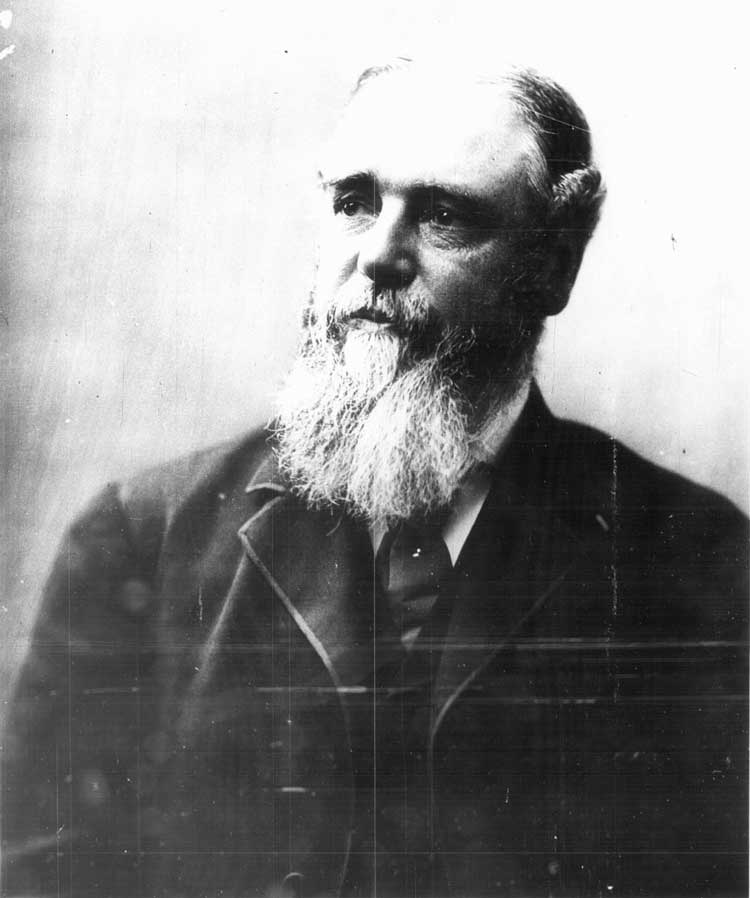
Government Printing Office Glass Negatives, photo 1427
Mr Lemm proposed the health of the Colonial Architect and the officers of his department. He regretted that Mr Barnett, Colonial Architect, and Mr Coles, the assistant, could not possibly attend. He had always got on well with the department, and he could say from experience that it was the most efficiently conducted of any of the government departments. They had to study the manner in which the people’s money was spent, and there was not the slightest doubt it was spent judiciously, and the country obtained the worth of the department’s services.
The toast was drunk with musical honours.
Mr Farr, clerk of Works, responded on behalf of Mr Barnett and Mr Coles, and said it was gratifying to be on such good terms with Mr Lemm. He never experienced any trouble with Mr Lemm in carrying out the instructions of the department. The work was a credit to the contractor and his employees. Mr Farr bore testimony to the ability of Mr Coles, the senior clerk of works, under whose charge the gaol had been erected. He also wished to thank Mr Wilkie for the efficient manner in which he had overlooked the work during his (Mr Farr’s) absence through illness.
Mr Wilkie, clerk of works, also responded, bearing testimony of Mr Lemm’s efficiency as a contractor.
Mr Brown, of the Colonial Architect’s office was at a loss to know why he was called on, seeing so many senior officers present. However, he had something to do with the work, having prepared some of the original plans and most of the detailed drawings, and also in part superintended the construction of the building. He might say his term of superintendence was a pleasant one, Mr Lemm being always ready to comply with wishes expressed. He had not seen the building for a long time; but he could now say that the execution of the work was in full accordance with the drawing supplied and the ideas conceived. He thanked them for the hearty manner in which they had drunk the toast.
Mr Telfer, clerk of works, said he had not much to do with the erection of this gaol, having had more to do with other gaols in the colony, but he had to confess the new Goulburn gaol was the premier gaol. The best mechanics had been employed on the works, and their work spoke for itself. So long as men who were able to work were willing, gaols would not be filled, but if they continued to import men who were too lazy to work, but who were not afraid to steal, they would have to increase the accommodation in their gaols. He thought the Government did not allow the principles of the gaols enough power in controlling them. He could not bestow too much praise on the quality of the work in the gaol.
Mr Lemm proposed the health of Mr Maclean [sic],, Comptroller of Prisons. Mr Maclean had visited the place several times, and many alterations had been made, which would be carried out and be of very great benefit.
Mr McLean said that really the honour done him in drinking his health was not expected, and had taken him by surprise. He could not be expected to be so readily charged of speech as his parliamentary friends on his left, but he would endeavour to say a few words on the occasion. The present occasion was more significant of a fresh departure in their administration than would occur to the casual observer. It was the first large building that had been in his time plotted and constructed from first to finish with thoughtful design for the working out of the accepted principles of prison administration, and the design had been well and truly carried out by Mr Lemm. From the commencement the building had the most thoughtful care of his able friend the colonial architect and himself; Mr Barnett plotting for the science of the inanimate, while he for the animate, which perhaps was not the least perplexing and difficult. If the administration of this important prison were not a success, the failure would lie not with the constructor, but the administrator. There was much misconception in respect to prison administration, and condemnatory opinions were frequently given with little consideration of its many sides and difficulties. By some it was said that he pampered the prisoners, by others that he ground them with tyranny. He endeavoured and he believed succeeded in steering midway. He was not a humanitarian, and he certainly was not a slave-driver. People spoke of this building as an extravagance. It was on the contrary a well-sketched economy. He was informed that the cost was within £80,000. He felt considerable responsibility, as with him had rested the ideal of the class of prison to be constructed. A large prison meant economy in staff and maintenance, as well as advantage in discipline. His friends in parliament did not think much of voting £6000 or £7000 for small gaols to meet local demands for circuit and quarter-sessions courts. Such a building as this was worth more that all such small prisons, where neither discipline nor labour could be satisfactorily worked out. One word further he would say as to the pleasant gathering, somewhat anomalous as it was to the purpose of the place. It had never been his fortune to see a more happy illustration of good 11 relations between employer and employed, to ensure which there must have been much merit on both sides, as was now witnessed between their friend Mr Lemm and those he had employed.
Alderman Buchanan, of Balmain, proposed the health of the Mayor and Aldermen of Goulburn, coupled with the Municipal Institutions of the colony. He had been deputed quite unexpectedly to propose the toast, and wished it had fallen into better hands. He had not the pleasure of the Mayor’s personal acquaintance, but knew some of the aldermen who had filled the chair, and he thought the people of Goulburn had reason to be proud of their councillors. He thought that next to parliament the municipal institutions were most important, having to attend to matters which parliament could not look after. They eased the labors of the parliament, and he regretted that parliament did not allow corporations fuller scope for governing their various districts. While government had to erect gaols for the correction of the criminal class, corporations were the means of erecting other and more congenial buildings, such as town halls, schools of art, &c. He was glad to know the council was backed up by two such energetic members, who had secured a large amount of money for the district, for what benefited the district must increase the municipal revenue. Goulburn was well laid out, and in time would be a model municipality. He well remembered visiting Goulburn with Mr Lemm for the first time some four years ago, and they then had a job to find the site for the new gaol. The hopes then raised had been more than realised, and he was gratified with the results.
The Mayor, in responding said: The subject is a very large one indeed. The proposer said the truth when he said that next to parliamentary institutions municipal institutions were the most important. I am not quite sure whether I ought not to think that municipal institutions are the more important. I almost think that if every town of a suitable size had a first-class body to govern it we might manage to dispense with the parliament altogether. It has been my lot to have been associated with the municipal institution having its home in Goulburn for a great many years. For 30 years I have been intimately connected with this town, and I need scarcely say that its dimensions were exceedingly small at the commencement of that time as compared with what they are now. I hope to live long enough to see the time when the Goulburn municipality will be second to none in the colony. The prosperity and progress of a country may be judged by its postal requirements. People who are better educated exchange a great many more letters than those who are low down in the scale. I took the trouble to go through the Postmaster-General’s report and compare the towns where the number of letters exceeded 100,000. I got the following result:— Singleton, 105,000 and odd; Albury 203,000 and odd; Grafton 259,000; West Maitland, 316,000; Bathurst, 340,000; and Goulburn, 480,000. After that we need no longer hide our diminished heads. I could give a few figures in connection with our railways, but will not do so at the present time. I will, however, say that any one who observes the enormous increase in the facilities for traffic at the railway station and the increased number of engines to be seen there must be convinced the progress of Goulburn has been very considerable indeed. About 40 years ago land in Sydney fetched £50 a foot; but you will see land in Goulburn now worth more than twice that amount, which will convince you that Goulburn is progressing with the colony. 96 years ago the first crop of wheat was reaped in Parramatta, and those who have read of the colony in the time of Governor Phillip in 1788 will not require to exercise their imagination much to find a different state of things at the time of the centenary of the colony in 1888. The colony has progressed as a whole, and we of Goulburn should be very sorry to find that we were going down whilst every other part went up. I know a little of the way in which the contract of this very magnificent building was given to Mr Lemm, and I am aware of this fact, that it was the knowledge this department had of his honesty and ability to carry out a contract of this kind by which he got it. There was no political influence brought to bear to get it for him. I trust he will have many buildings to erect for the public; for I know the work will be faithfully and honestly performed. I remember riding out with the comptroller-General and Alderman Ball to select a site for the new gaol, and I don’t [know] whether there is a better site in the whole country.
The Chairman proposed “The Pastoral and Agricultural Interests of the Colony,” which having been drunk to the accompaniment of “The Farmer’s Boy” from the band, was responded to by Mr John Chisholm.
The Chairman next gave “The Commercial, Financial, and Manufacturing Interests of the Colony,” which was duly received.
Mr Kethel responded for the commercial, Mr Deacon (manager of the Goulburn branch of the Bank of New South Wales) for the financial, and Mr C Rogers for the manufacturing interests.
Mr Rogers in his speech made special mention of the manufacture of bricks and boots. He said he had travelled in nearly all parts of New South Wales, and he believed they could produce as good if not better bricks in Goulburn than in any other place. In Parkes and other towns he had seen signs announcing “Goulburn boots sold here,” thus showing that Goulburn boots were valued more than Sydney. [sic]
Mr Gannon, MP, rose and said it seemed to him that in the midst of their festivities they had forgotten one important matter. He had particular pleasure in proposing the health of their host and worthy chairman, Mr 12 Lemm. He supposed it was his modesty that dictated the omission of this item from the programme, but he thought they would neglect their duty if they did not at this time show their hearty appreciation of Mr Lemm as a business man and as a friend. He was a most worthy citizen and an exemplary master, and as he had said before Mr Lemm never kept his men waiting for money or materials, and he being a perfect stranger when he came to Goulburn had many difficulties to surmount, and his determination was exhibited in passing through all so cheerfully that Mr Lemm had endeared himself to all in Goulburn. He asked them to drink the health in bumpers.
The toast was enthusiastically received, the band playing and company singing “For He’s a Jolly Good Fellow.”
Mr Lemm rose and said he could scarcely find words good enough to express his feelings in thanking them for all the good opinions and kind words they had uttered on his behalf. At any time he was a bad speaker, not having the English tongue, and being more used to work than speech-making; however, as he always tried to do his best, he would reply in his best manner. It was now over three years since he came to Goulburn to perform the contract he had entered into. He had been over his contract time, but that was an unavoidable circumstance. In the first place the colonial architect had seen fit to increase the amount of work in the original contract, and secondly he could not control the labour market. There were times when it was impossible to do as you wished, owing to the state of the labour market. He had often, in carrying out works for the government, handed over the same in three months under contract time, and he could not be blamed for not completing the jail in the two and a half years. It was true that when he arrived in Goulburn to start this job he was a perfect stranger to Goulburn and its people, and some of the gentlemen who had to-day said so much in his favour then looked upon him doubtfully; but he told them that before he had completed his contract they would know him better and hear more of him. Force of circumstances had caused him to make himself felt and known amongst them. He had to overcome a great deal of opposition and prejudice from local people, but now things were reversed. At that time he possessed not an inch of land in Goulburn, and now he had a good stake in the town. As an instance of the difficulties which beset him at the start, he mentioned that when he wanted to buy bricks from the local brickmakers they at once raised the price from the current rate of £2 per 1000 up to £2 16s per 1000. He thought it was an unfair treatment to give to any man, because he believed that, being a wholesale buyer, and wanting from three to four millions of bricks, they should have dealt more liberally with him. However, he had now the opportunity to thank those brickmakers who had sharpened his intellect by adopting such a blindfold policy, and forming themselves into adversaries. They were the means of causing him to purchase brick-ground and importing his men from Sydney to make bricks. He believed his success in carrying out the jail works was mainly owing to the fact that he could command his own bricks, and was now in the happy position of being able to supply Goulburn with them. He attributed the success of the brickworks to his foreman Mr McGraw, who thoroughly understood his business, and who could make bricks to compete with any in the colony. At the same time that he was benefiting himself in making his own bricks he thought he was doing good to the community by competing with local brickmakers and employing labour, and thereby establishing more homes in their midst; for the men who filled the various positions in building were the backbone and sinew of the country. During the whole progress of the gaol works he had been only an outsider, having simply marked out the outline at starting and then placed Mr Spencer in full charge to carry out the full meaning of the plans and specifications, and he would be unjust if he did not give Mr Spencer the due he deserved in adhering to his duties, and moreover in promoting the social standing of the workmen on the job. They all knew the great good Mr Spencer had done to the temperance cause during his stay in Goulburn, and in so doing he had all the men on the job run into his temperance lodge, which he had not the slightest doubt was a source of profit to him as a contractor through his men being always fit for their work. He must confess they had not been able to run him in, for he liked his little wee drop, but that was all. He was temperate without a lodge, but at the same time he believed the lodges did a large amount of good. Mr Gannon had said he had never been to the police court, but of course they knew it would be unwise policy for Mr Gannon to give Mr Lemm a bad character. Well, he had to inform them he was brought before a police-court, and for stealing. Yes, he was a thief. He stole some magpies. (Laughter.) If they would bear with him he would show them how he was treated. Being a civilized man and wishing to extend civilization he thought fit to catch a magpie and civilize it, but though Mr Gannon pleaded hard for him he was fined £2. Beyond this he believed Mr Gannon was true in his remarks. His position now was different, as he had charge of the gaol, and having a good many prisoners inside, unless they were well conducted, he would order the gates to be closed and set about administering his gaol discipline. In reference to the works, he had at all times striven to give satisfaction, that being the motto he laboured under. It was ample satisfaction for him to know that no fault was found with his work or his workmen. Though he had only been an outsider, he was always near enough with the almighty 13 dollar, and though the whole was not quite complete, he could see the completion near at hand. He had made many pleasant associations in Goulburn amongst all classes, and he might remain amongst them. As he previously remarked, circumstances rule matters. He could not decide, but they could rest assured that while he remained he was always be the same—trying to live in peace with his fellow-men. No one like to see others prosper more than he. In conclusion he asked then to charge their glasses and drink the health of Mr Spencer, Mr McGraw, and the other employes. [sic] he never wished to work with better mechanics, and he hoped they would still work together.
Mr Spencer, who was received with acclamation, responded. He said if any one had reason to be thankful they had met that day to celebrate the event they were doing, he had. From the time the first peg was driven in to the present time there had not been a brick laid, or a stone fixed, or a nail driven, but what had been done under his immediate superintendence. They had good mechanics, but he thought any man in the room, even though he might be thoroughly acquainted with the building trade, would admit that a man to understand every little detail must have devoted considerable study to the various branches. That study he had endeavoured to devote to his trade. It had given him great pleasure to hear that day the complimentary remarks passed by gentlemen who were so well qualified to understand the nature of the work. Mr Lemm supplied the money and the material, and had never kept him short of either of them, and had given him throughout the whole of the contract most kind and considerate assistance. Mr Lemm had assisted him most by leaving him alone. A man placed in his position could understand what he meant. Whilst he placed on him the responsibility of carrying out the work, he also gave him the privilege of using his own brains and his own means of carrying it on. He had received great assistance from the various foremen, and the men always carried out his suggestions in a most willing and satisfactory manner. They had had on the job, and had at the present time, as good mechanics as they could find in the length and breadth of this colony, and Goulburn gaol was as good a job as there was in the colony. He hoped they might all meet again at some future time.
Mr Macgraw, [sic] foreman of the brickmakers, also responded. He said he and Mr Lemm had got on very well together, and if his employer had been his own father he could not have tried to have carried on his business more successfully than he had. He had always endeavoured to do his little best to reward him for the confidence he had placed in him. He could say with Mr Spencer that he had never been deprived of anything that money could procure.
The toast of “The Ladies,” proposed by the chairman, was suitably honored, and responded to by Mr Purkis.
“The Press,” proposed by the chairman, was drunk with musical honors. The representatives of the local journals responded.
Cheers all round and the National Anthem by the band concluded the proceedings.
(In the above report it will be noticed that some of the speeches have not been gone into at all. This was owing to the circumstance that the reporters were seated at such a distance from the chairman that they could not at all times hear what was said—in fact, they found it impossible to sometimes catch a single sentence.)
~~~~~
Goulburn Evening Penny Post, Thu 29 May 1884 7
THE NEW GAOL.
ON Tuesday morning the first steps were taken towards the occupation of the new gaol, the stores being removed from the old gaol. It is intended to remove to the new prison all th stores, &c, that are not absolutely required at the present one, and probably, in a fornight [sic] or three weeks, the prisoners will be inducted into their new quarters, which, by that time, will have been prepared for their occupation. The openings in the cells are to be glazed, it having been found that without that the temperature in winter would be much too low. Mr Lemm has been entrusted with the work.
~~~~~
Goulburn Evening Penny Post, Thu 26 June 1884 8
THE NEW GAOL.
FOR the last few days Chief Warder Graham and the staff that arrived from Sydney on Monday, have been busily engaged preparing the new gaol for occupation. The gaol was lighted up with gas on Monday. The necessary gas fitting arrangements, which proved very satisfactory, were carried out by Mr W Kingsell, of Auburn-street. On Tuesday next the prisoners will be removed to their new quarters. They will be conveyed in busses provided by Mr Moran.
~~~~~
Goulburn Evening Penny Post, Tue 1 Jul 1884 9
REMOVAL OF PRISONERS TO NEW GAOL.
THIS morning quite a crowd assembled in the vicinity of the court house and gaol to witness the departure of the prisoners for their “new home.” Two buses belonging to Messrs Moran had been chartered to convey the “pilgrims” to North Goulburn. It took four journeys to remove the prisoners from the city to the commodious gaol which is now ready for their reception at the northern end. Only a few were left in the old gaol. Theses, we understand, were detained for the purposes of cleaning up, &c. Many of the prisoners do not like the system of classification which is enforced, we believe, at the new gaol. By this system, those who had hitherto been “chumming” together are now separated, and this they do not at all relish. The number of prisoners removed this morning was 125. The reminder, a dozen, were taken down in the afternoon.
1 Freeman’s Journal, (Syd, NSW), Sat 11 Sep 1880, p. 9. Emphasis added.
2 Goulburn Evening Penny Post, Sat 28 May 1881, p. 5.
3 Goulburn Evening Penny Post, Tue 2 Aug 1881, p. 4.
4 The Southern Argus, (Goulburn, NSW), Tue 25 Oct 1881, p. 2.
5 Goulburn Evening Penny Post, Tue 7 Aug 1883, p. 2.
6 Macquarie Dictionary, 3rd ed, 1997, defines this as “a formal expression of praise; a eulogy.”
7 Goulburn Evening Penny Post, Thu 29 May 1884, p. 2.
8 Goulburn Evening Penny Post, Thu 26 Jun 1884, p. 2.
9 Goulburn Evening Penny Post, Tue 1 Jul 1884, p. 2.