Australian Town and Country Journal, Sat 18 Mar 1876 1
MOREE.
March 11.
The country about here is parched and bare to an extent almost incredible. Rain, in the right meaning of the word, we have had none for the past year, although at intervals we have been blessed with a chance drivelling shower or two—the last such was experienced some ten days since.
Mr W Acheson has completed the bridge over the Broadwater Creek, and a strong and lasting structure it is. It is turned out of hand in as workmanlike a manner as would do no discredit to individuals who are inclined to “blow” about such affairs. Considering the many—almost insuperable— difficulties which have chanced in his way, Mr Acheson cannot be too highly complimented for finishing as he has done.
We received a flying visit from the Rev Dr Spooner, DD, of Inverell, on Thursday. He visited most of the parishioners; was surprised at the progress of the township, &c, &c. He paid a visit to the provisional school and inspected the pupils, of whom he spoke in favourable terms, but expressed unequivocal astonishment at the small number at present attending—thirteen. He intends holding divine service here in April.
An infant daughter of Mr D McKenzie, storekeeper, of this town, accidentally fell from its nurse’s arms, some few days since, and broke its collar-bone. The little sufferer is progressing favourably.
Affairs pastoral are in a frightful state on the Mehi: I know of several stations on it with scarcely more grass and herbage on the runs than is to be found on a fairly beaten road. If rain holds aloof another month many a run will be literally stockless.
Material for erecting the court-house and lock-up is being rapidly brought in.
A builder accidentally fell from some internal part of a building he was completing, this morning, and broke his collar-bone. I understand he is en route to Narrabri, to place himself under the care of Dr [CM] de Lepervanche.
It is rumoured that the teacher of the provisional school here (Mr Kalse) intends, shortly, relinquishing his situation, if there is not a speedy increase on the present average number of pupils attending the school, which he informs me is but something slightly over thirteen.
~ ~ ~ ~ ~
The Maitland Mercury and Hunter River General Advertiser, Tue 4 Jul 1876 2
NEW SOUTH WALES
PARLIAMENT.
————
(From the SM Herald.)
————
THURSDAY, JUNE 29, 1876.
————
LEGISLATIVE COUNCIL.
…
FRIDAY, JUNE 30, 1876.
————
LEGISLATIVE ASSEMLBY.
COURT HOUSE AT MOREE.
MR LACKEY said in answer to Mr TG Dangar, that plans for a brick court house for Moree would be ready in a fortnight, when fresh tenders would be invited.
~ ~ ~ ~ ~
Australian Town and Country Journal, Sat 6 Jan 1877 3
GOVERNMENT GAZETTE.
————
FRIDAY, 29th DECEMBER.
…
ACCEPTED TENDERS.—The following tenders have been accepted by the Government, viz:—
…
Mr C Grace, erection and completion of court-house, Moree;
~ ~ ~ ~ ~
The Maitland Mercury and Hunter River General Advertiser, Thu 25 Apr 1878 4
DISTRICT NEWS.
————
(From Various Correspondents.)
…
MOREE.
(From an occasional correspondent.)
Considering the great circulation the Mercury has throughout the greater part of the Colony, as well as in this district, we find it is the best channel for conveying to our distant friends, and sister towns of greater fame, information of the rapid stride we have accomplished towards civilisation, and in exalting our motto “Advance Australia.”
We are far out of sight of our eldest sister, Sydney, and cannot enjoy many of her luxuries, or even partake of the necessaries she keeps in store for us, without considerable trouble and expense; but we are constantly sending her tokens of our increasing growth and prosperity, and probably she receives more visits from our Bovine Princes than from any other part of the country. Apparently, she is fully cognizant of all this, and in acknowledgment thereof she is year by year endeavouring to give us a preeminence to many of our elder sister towns.
About two years ago we received two safety purses for our money, registered respectively, the Bank of New South Wales, and the Bank of Australasia, Moree. Those establishments have overcome what is commonly called their days of trial, and our anticipations of their success are more than fulfilled. To a great extent the business of a Country Bank depends upon an affable and winning manager; in this respect we have been fortunate in both instances, for whoever knows the representatives of our respective Banks, cannot fail to admire their courteous and business like manners.
The inhabitants of Moree, however, are of a more enterprising nature than to keep their silver and gold clasped in purses, or carefully stowed in safes, when their country and fellow men might be benefited thereby; and the lynx eyed speculators already take advantage of the grand future of Moree. It does not resemble towns famous for their flourishing prosperity during the time they happen to be the temporary terminus of the railway, but in which no sooner the fiery messenger puffs beyond their domains, than the inhabitants put up the shutters, and flee to a better land? Neither is our prospective city like towns depending upon mining operations, which rise with great pomp at the outset, but after a brief period vanish like the grass. We claim no connection with such illusions, or migrating source of help; being placed in perhaps the best grazing district in the colony, we rely upon the fat of the land, and good substantial bona fide owners thereof; and are ready to give our concurrence that the prospects of Moree becoming a manufacturing town of no mean consequence will soon be realised, and that many items for which we now pay heavy carriage duty can soon be procured from ourselves.
In fact the first attempt is just being made. Its success is certain, and will contribute not only in forwarding our interest, but in encouraging other prospective works–the propriety of which we understand is at present being mooted. Among such is a flour mill. We hail the proposal with gratitude, and we are confident that this desideratum is sure of success. It has already been proved that the qualifications of the soil in this district for wheat growing are superlative, and that wheat and other cereal crops can be grown to advantage. Doubtless, therefore, many selectors will utilise a great portion of their land for agricultural purposes when the railway is constructed further in this direction, and Moree becomes more of a marketing town. Our neighbours ardently desire to have a land office and a cattle market established here, but we must not seek to bloom during budding time. The Government, through the ceaseless energy of our faithful MP, has granted to us a telegraph station, and sites for a court-house school buildings, hospital, and Mechanics’ Institute; and has also dedicated four sites for building of respective places of public worship.
We are not in a position at present to explain how or why the Gwydir people are so fond of litigation; at any rate, it would appear that they are determined to have their rights, together with the other good things they own; and this is indicated by the fact that on an average upwards of twenty cases are tried at the police court here every month. The existing court-house somewhat resembles an old backhouse, 8ft x 8ft, with a small opening for an oven opposite the bench, and where our worthy magistrates occasionally retire to mature their judgments to perfection, for we outsiders generally hear an admission of sound judgment, if not satisfaction, by all concerned. We therefore feel bound to stand up for those who administer justice so strictly and faithfully, and frequently under trying circumstances, through their seats being made too hot for them, or their decisions endangered of being obliterated from record by the heavens weeping over the labours of such good men; and we would enquire of those interested what causes the dilatoriness connected with the erection of a new court-house? It is alleged that the buildings were contracted for two years ago, and the ground for the foundation excavated on or about the 14th of January last. A few days afterwards the foundation was laid, and ready for the inspector, who, according to the contract, is bound to inspect the work before further progress can be made. The foundation, however, I still uninspected, and further delay will cause the work executed and paid for to be done over again; besides the requisite bricks, carted to the spot, are daily deteriorating. We earnestly hope that whoever is at fault for the procrastination will consider the inconvenience it creates.
In reference to our prospective places of public worship, we have made little progress. We are of one mind in things pertaining to this world, but when our business happens to trench on topics regarding holy things, and unknown realms, one I am of Paul and another I am of Apollos. Seeing, however, that a subscription list for the erection of a tabernacle for those who still adhere to the good Presbyterian sect is signed by persons of all denominations, it may be supposed that they believe that the edifice will be for the good of all.
The extension of the railway to Narrabri is a matter great importance to us. Some are already contemplating to what extent the completion of the additional communication will add to their annual income; others. Less selfish, think more of the comforts it will confer upon them; while we all wish it God speed. And as we glory in our lot being cast in a land of freedom, to the Press we look to agitate our cause in denouncing preposterous claims made by railway contractors, when proper fines are imposed, and should be enacted, for the non-fulfilment of their contract.
Moree, April 19.
~ ~ ~ ~ ~
The Maitland Mercury and Hunter River General Advertiser, Sat 17 May 1879 5
DISTRICT NEWS.
————
(From Various Correspondents.)
…
MOREE.
NOTES BY AN ITINERANT PED
The present telegraph office is situated in Herbert-street, in a building belonging to Mr McCabe. As far as the position is concerned it could not be more central, but the approach to it in wet weather could not be worse; it is no exageration [sic] to say that you would be up to your middle in mud and water, and those who have business to transact generally secure the service of a horse. The building requires no patent ventilation-daylight appears from all quarters, and the rooms are not big enough to whip a cat in. The gentleman in charge is Mr John Munro, who has gained the respect, confidence, and good wishes of all by his urbanity, affability, and his obliging manner at all times. A great many mails arrive by night, so he is up at all kinds of unreasonable hours. No one envies his position at the present time, and it has been very cold, and in his domicile it must be particularly so. The new office has been a bone of contention for some months past between the inhabitants of the west and those of north and south. Each party petitioned the Postmaster-general to have it in their locality, without any consideration as to which was most suitable. Their only wish being that it would enhance the value of their property or business. At last the Frome-street residence came off victorious, and it was decided to have it alongside the Court-house. When the Court-house was first commenced (now nearly two years), the ground upon which it is being built, and that adjacent, was apparently sound enough, and would have remained so if one of the officers of the Government had not caused a drain to be made through the allotment for the purpose of drawing the water from the street; that drain is now a gully some twenty feet, with various branches, that tend ultimately not only to swallow the telegraph office, but also the court-house. In fact it is within eight or ten feet of the foundations of the office, and about one hundred from the court-house. The ground is of that nature that in dry weather it opens into large fissures, that seem to be bottomless; and in wet weather lumps weighing some ten tons are carried away. And if the winter is wet, which is anticipated, the chances are the court-house will be a thing of the past, if this dyke is not filled up or otherwise made secure. The last inspector who was here to pass the foundation of the office stopped all work, and it is reported recommended the site in Herbert-street selected by the West-enders. Now this is generally considered by those who have no interest, except that of seeing it in the driest and most central place, to be jumping out of the frying-pan into the fire. The Herbert-street site is situated in a perfect marsh; it is a natural watercourse, and a perfect stream in wet weather. It is doubted whether they will get anything like a sound bottom in it for a foundation, and if it is built there they will have hard work to keep a officer in it for any length of time. Dear knows, the present office is a miserable thing to house any man in, but the new one in Herbert-street would be a thousand times worse. The officer of inspection could not have troubled himself much, as there are many sites far more suitable than either, and perfectly dry and sound. Again, would it not be better to carry it on in the present position, and kill two birds with the one stone, by fixing the drain in such a manner that it and the court-house would be secure, and not wait until a telegram is received stating the court-house is undermined; for as sure as eggs are eggs that will be the case it we have rain like the last. One gentleman connected with the Government, on being shown the site in Herbert-street, remarked that “no one would be ass enough to place it in that bog.” He was a stranger. It is to be hoped that Mr Danger will stir himself a little, and not let it be another school or court-house, two or three years in course of erection. The residents are beginning to think they are left very much out in the cold.
Sergeant Brennan, who has been in charge of the district for the last five years, has been removed to Narrabri, to fill a higher appointment. Whilst all are glad to hear of his well-deserved promotion, every one regrets his loss to this town and district. He was an active vigilant officer, a terror to evil doers, and respected by all as a goog citizen. The Bench, district, and town are subscribing towards an address and purse to be sent after him. Even the young ladies are canvassing for him, two went the rounds of the town the other evening; they evidently voted the men connected with the matter to slow. He was a favourite with all. His successor will have a hard matter to fill the position as worthily, and most people are grumbling already, saying they have been treated badly by the authorities in this matter. They think they should have had a married man of experience, and not a mere youth; and it is the intention of some to call Mr Dangar’s attention to it, and not let Narrabri have all the good things.
Our townsman Mr Cameron, Host of the Royal, has sent a cart to Inverell for a hundred pairs of pigeons, for the shooting match on Queen’s Birthday. The local peds. have gone into training for the athletic sports, to take place on the same day. The shooting cracks are playing havoc among th swallows and ground parrots, both in town and on the stations. It is to be hoped we will have Queen’s weather on the occasion.
It is now raining heaven’s hardest, and from reports a flood is anticipated; if so, we will be shut out from all communication, as our roads are in a frightful state, and no bridge, not even a boat; and even in dry weather the river is dangerous to cross. I do not believe a penny was ever laid out on the approaches. The road even passes through private property, and if it was to be shut up traffic would have to be stopped. This has been pointed out before, but no notice was taken of it. People have got tired of writing to Mr Dangar. An inspector of roads seldom comes this way. It is now three months since they commenced to gravel one of our streets, and wagers are laid it will be three years before it is finished. In fact all Government works here are carried out alike—three seems to be no definite time mentioned, and no proper supervision. Who has charge of this Department, and where does he live? It is to be hoped that somebody will cause him to move a little quicker, I only wish he had to trudge the streets to-night, arm and arm with the member—we would soon hear of a reformation in matters.
Mr Robert Watson, commercial, has returned after attempting to reach the Barwon; he was only able to go as far as Gerarh, as the country was in a state of sea. He reports everything as looking very green, and too watery. As a winter season there has been nothing like it for the last seven years. Every squatter you meet has a most genial smile, and I believe if stock were anything near the mark they could not help asking a man to have a glass of “fiz.”
The members of the Jockey Club held a meeting last week, and rose the membership to five guineas, so as to have two meetings a year. Long may their purses contain an extra fiver for the good old sport. The members principally live in the country, and they want the town to second them in their efforts; it is to be hoped they will do so, and not stand in their own light.
The meeting convened to agitate the railway policy was adjourned until the 27th instant, owing to the wet weather. It is expected there will be a large muster from the country on the occasion.
The gentleman who acted as doctor here has left for Europe: he was only a chemist; but notwithstanding did a good practice. There is a fine opening for a qualified medical man, if at all steady; the district is large and the people wealthy. I also imagine a limb of the law would have a good opening.
Moree, May 9.
~ ~ ~ ~ ~
Evening News, Fri 17 Jan 1902 6
MOREE MATTERS.
————
…
The new Moree Courthouse is now nearing completion, and the contractor, Mr Grant, expects to be able to hand it over within a few weeks, when operations will be commenced to remove the old structure.
~ ~ ~ ~ ~
Australian Town and Country Journal, Wed 12 Jul 1905 7
IN AND AROUND MOREE—A NORTHERN
TOWNSHIP IN NEW SOUTH WALES.
(By C. H. T.)
After an all-night journey, in an over-crowded carriage, from Sydney to Narrabri, where one arrives for an 8 o’clock breakfast, the passenger—perhaps not in the best of humour—who continues on to Moree, 60 miles further, is apt to chafe at the rate of speed, viz, 15 miles an hour. Four hours to travel 60 miles over a plain as level as the proverbial billiard table! The reason for this is soon learnt, when the train begins to slow down, and the engine to emit a series of short sharp whistles, which are kept up at intervals during the greater part of the journey. The railway, for most of the distance being unfenced, the object of the above whistling is to scare the sheep from the line. As far as I could judge, however, from the carriage window, it seemed often to have exactly the opposite effect from that desired. The sheep seemed to simply immolate themselves under the juggernaut. The loss to the department, besides the inconvenience to the public, resulting from this delay speaks for itself.
How glorious the country looked in the morning air! Its thick carpet of verdure, how calculated to rejoice the heart of the pastoralists after his experience of a little while back. To the right, and some 30 miles distant, one notices the Terry Hie Hie ranges, the only change of colour and conformation in a sea of green.
The principal pastoral properties traversed by the line between Narrabri and Moree are Killarney, Edgeroi, Dobikin, Gurley, Tycannah, and Weebollabolla. I understand the people of Narrabri are agitating for the first-named to be cut up for closer settlement.
Moree is essentially a pastoral town—the town of the squatter. It would not be necessary for a stranger, who knows his Australia, to go beyond Balo, Frome, or Heber streets to identify it as such. It is situated at the junction of the Broadwater and Mehi Rivers, 413 miles, a little to the west of north, from Sydney. The Mehi River, which is spanned by a substantial wooden bridge, separates Moree from East Moree, which is the terminus of the railway. A good ’bus and cab service attends the trains. Amongst the ’buses, a Sydney man will recognise a friend or two.
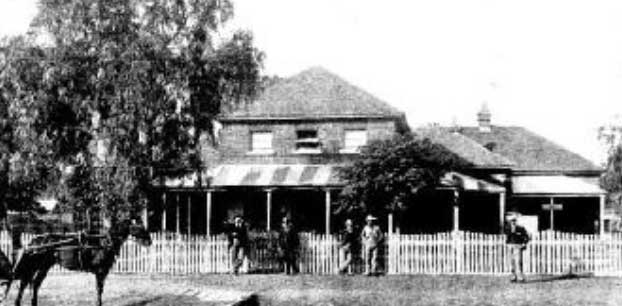
Sat 15 Aug 1896, p.342. Reproduction: Peter de Waal
The town, which has a population of about 2300, was incorporated in 1890. The present council comprises the following gentlemen. Messrs JT Crane (Mayor), JD Askin, John Cameron, H Dobbie, DM Hickey, John Morgan, HML Pike, AC Weston, and ABF Zlotkowski, with Mr Joseph Cameron as council clerk. To show the progress of the town, since its incorporation, the following figures are worth quoting: In 1891, the capital value of rateable property was £106,695, with a municipal rate of £434; in the present year it amounts to £208,910, the rate being £780. The waterworks, of which Mr JC Lawrence is the engineer-in-charge, were installed in 1901. These comprise 5 miles 52 chains of mains; a well 80ft deep, 12ft in diameter, and an elevated reservoir, 50ft high, with a capacity of 33,000 gal. The latter will be noticed in my view of the council chambers. The water rates amount to £600 per annum.
The importance of Moree as a postal centre is plainly evidenced every Wednesday and Saturday, when seven or eight, or more, mail vehicles are to be seen outside the post office, awaiting their loads, preparatory to departure. Amongst their various destinations are Boggabilla, Goodiwindi, Mungindi, Terry Hie Hie, Cobbedah, Eulouerie, Telerago, Taimoi, and Bullerah. Besides these, there are, of course, the railway (Inverell and Sydney lines) mails. From the above it will be seen that Mr A Bray, the postmaster, and his senior telegraph operator, Mr TA Pryke, with eight others, have not too much spare time on their hands. I am informed that the business transacted here is as large as any on the north-west, and appears to be on the increase. Mr Bray came here from Braidwood about 18 months ago, and has been in the department for 33 years.
The streets of Moree are well kept and planted with ornamental shade trees. Concrete gutters line the footpaths, but these have not proved an unqualified success, owing to their subsidence, which allows the water to accumulate. In summer the streets are watered three times a week. I was, unfortunately, there in winter. Perhaps the most imposing thoroughfare in the town is Frome-street, where are located the principal buildings, including the council chambers, lands office, post office, court house, and a bank or two. Nor is Moree deficient in substantial business premises and hotel buildings. The sanitary condition of the town is said to be excellent.
An institution worthy of note is the local School of Arts, which possesses a fine hall, a comfortable reading-room, and a fine circulating library. The committee some time ago introduced a billiard table, which, I believe, paid for itself in less than twelve months. A debating society has existed for about eighteen months in connection with the above, and appears to be a “live” affair. Meetings are held weekly, the members including several ladies.
Among other adjuncts to civilisation which Moree possesses are four churches; a well-conducted hospital; a Superior Public School, under the supervision of Mr J Broome, a gentleman most highly spoken of as an instructor of the young; a telephone service; two bi-weekly newspapers; a town band, whose repertoire, however, is somewhat limited; and a fire brigade, an active organisation, with a complete outfit, uniforms, and recently-erected premises. Near the centre of the town is the park, with a handsome pavilion; here, football, cricket, and tennis are played. The show ground, which possesses a commodious grandstand, a trotting track, and accommodation for all kinds of stock, is enclosed with iron, exceedingly well kept, and planted with ornamental trees. A caretaker resides on the ground. The racecourse is situated nearly three miles from the town, has a very fine grandstand for a country course, and is said to be in every way admirable. There is no Salvation Army here to liven up the streets at night with its band and torches. For a town of its population Moree is almost unique in this respect, as far as my experience goes.
A peculiarity, full of pathos, is to be noted in regard to the local cemetery. By far the greater proportion of its graves, I am told, are those of children of tender years, many of whom have succumbed to the extreme heat of the summer months. This could, indeed, be made the text for a discourse on the necessity—not to say humanity—of cheap, even nominal, train fares to Sydney or the tableland being granted during the summer months to those families who would otherwise be unable to escape from the blighting heat. The lives of many little ones would thus be saved, there is not a doubt.
One of the first questions asked the visitor to Moree is, “Have you been to the bore bath?” This is situated at East Moree. The bore itself is 2900ft in depth, and supplies a regular flow of water, viz, 837,000gal daily, at a temperature of 114deg Fah, and a pressure of 90lb per square inch. The following is the analysis of the water in grains per gallon; bear in mind in grains, otherwise the figures might be misleading: Carb soda, 39.25; potash, 1,101; lime, 0.642; magnesia, 2.96; sodium chloride, 7.29; silica, 1.456. A small bathing house has been erected by the Government lesses. In spite, however, of the crudity of the surroundings, the sensation of a bath here is worth going far to experience. The water is said to be curative, especially in cases of rheumatism. Some of our public men, who pay regular visits here, compare this bath more than favourably with some of the New Zealand ones. My own idea is—may, my own knowledge, is—that many a huge sanatorium and hydropathic establishment has been formed with a much smaller raison d’etre than the aforesaid “bore bath.”
In connection with the bore is the Moree irrigation farm, locally known as the “Bore Farm.” This is under the supervision of Mr WR Fry, a graduate of the Hawkesbury Agricultural College, who was transferred here last year from the Bathurst Experimental Orchard. The farm embraces 200 acres, only 80 of which are used as an experimental farm, the remainder being cut up into blocks of from 13 to 15 acres, and leased to various settlers at £10 per year per block. These settlers are each entitled to 18,000gal of water daily, but do not go in extensively for cultivation, preferring to flood the natural herbage. Mr Fry hopes that future experiments will demonstrate the practicability of growing more profitable crops. The soil, which is a heavy black clay, is typical of hundreds of thousands of acres of western plains. The results, therefore, obtained, should have a wide application. During the big drought an enormous amount of fodder was sold from this farm, which is said to have been a veritable oasis in the desert. An area of 25 acres has been set apart for testing the suitability to the district of various descriptions of wheat. The orchard is a feature of the farm of which Mr Fry is justly proud. Both cotton and tobacco have been experimented in, the former with most encouraging results. A yield of 1500lb of raw cotton was taken from one acre, the return being estimated at over £16 per acre.
There is no doubt about one being in the veritable “blacksoil plains” when one comes to Moree. A short drive after a shower will remove any doubt on that question, if any existed. As I previously stated, the district, which possesses many fine station properties, is almost purely a pastoral one. The Pastures Protection Board, I understand, assessed the land here at one sheep to 4 acres. After a good rain, however, the country can easily carry one bullock to the acre; in fact, at times, the grass cannot be eaten down. The general impression one gets in travelling round the district is that the country could be utilised much more profitable if the Bathurst burr and other noxious weeds were kept under control. Such a pest has the former become on portions of the travelling stock reserves that it has often to be cut down before the sheep can get through.
Although sheep-chiefly merinos—are the mainstay of the district, locally bred horses and cattle have made names for themselves throughout the Commonwealth. For instance, the Shorthorns of Mr AGF Munro, of Weebollabolla, are known to all stock-breeders, and are constant prize-winners. Then might be mentioned the splendid breed of trotting horses of which Mr John Cameron’s Chieftain is the sire; Mr HR Murray’s draughts, bloods, and trotters, and Mr JR Smith’s (Tucka Tucka) stud of blood horses.
Instead of producing it itself, Moree imports nearly everything it consumes, with the exception of its beef and mutton, which is unsurpassed in Australia, and its green vegetables, which are grown by Chinamen. There is not a white grower of vegetables in the district, I am informed. Its bacon and cheese come from Bodalla; its butter from Inverell and Singleton; its corn and eggs from the North Coast, via Sydney; its potatoes and fruit from goodness knows where, and so on. Fish is plentiful in the rivers, but regular consignments come up by train. Most of the above could be produced locally; the bends of the river, which consist of black, sandy loam, being said to be eminently suitable for small dairy farms, green crops, and fruit growing. Another factor in favour of this contention is that good water can be procured almost anywhere by sinking about 45ft, the volume increasing as depth is attained.
A description of this district would be incomplete without mention being made of its attractions for the sportsman. Last year the number of quail was simply phenomenal—they were almost an epidemic. These small birds were sent from here into Sydney by tons. Black dusk, wood duck, and teal, also abound in the rivers and lagoons.
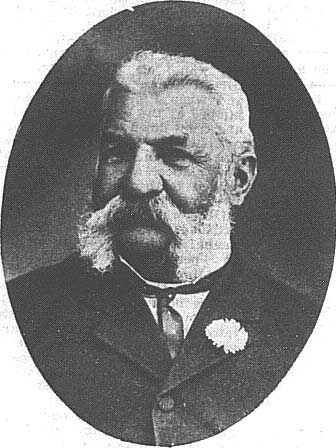
Image: Australian Town and Country Journal, Wed 12 Jul 1905,
p. 30. Reproduction: Peter de Waal
Many old friends, far and wide, will no doubt be pleased to see among my illustrations the “counterfeit presentment” of Mr Walterus Brown, who fills the position of police magistrate. No man is better known in the western portion of the State, and, I might add, better liked and respected, than the above gentleman.
Amongst some of the leading business places of Moree might be mentioned the following:—
ASKING AND COMPANY, GENERAL STORE-
KEEPERS.
This old-established business is under the management of Mr John D Askin, the proprietor, a gentleman who, whilst conducting his business with profit to himself and satisfaction to his numerous customers, can always find time to spare for anything conducive to the welfare of the community in general. The main retail store occupies one of the best sites in Moree, at the corner of Heber and Balo streets; the bulk store being located at the west end of the town. The shop is fitted up with all the latest appliances, and customers can rely upon purchasing articles at very little over Sydney prices. A cellar occupies the full extent of the building. In proximity to the bulk store, Mr Askin “runs” a bakery, with a first-class plant, and newly-erected furnace oven, capable of turning out 300 loaves at a batch. The illustration of the date palm appearing in the Moree views is taken from Mr Askin’s garden. This palm is said to be nearly 50 years old, and is a heavy bearer, although the fruit lacks stones. Perhaps some botanist might be able to explain the reason of this.
EVERINGHAM’S IMPERIAL HOTEL.
This house (of which I append an illustration), and its genial hostess, are so well and favourably known in the North-west that anything I could say in their favour would be merely a work of supererogation. Mrs Everingham is having large additions made to the establishment, comprising seventeen new rooms, and three well lighted and ventilated brick sample-rooms. When these additions are completed, there is no doubt the Imperial will hold the premier position as a hostelry in Moree, whilst its proximity to the stores, its unrivalled sample-rooms—and, may I add, the hostess herself, should make it irresistible to commercial travellers. Mrs Everingham is sole agent in Moree for Schweppe’s waters.
MR LEWIS, TAILOR, TOBACCONIST, Etc.
Recently Mr Lewis, who has been established in Moree as a tailor for thirteen years, took over the adjoining tobacconist, stationery, hairdressing, and newsagency business. During show week one could not fail to notice many a stalwart figure doing reciprocal justice to Mr Lewis’ handiwork. Me Lewis has sat as an alderman in the local town council for three years.
FREDERISCK JOHN TONKIN, TOBACCONIST,
FANCY GOODS, Etc.
The above business occupies a central position in Balo-street, and has been established six and a half years. The stock is varied and choice, and ranges from a sixpenny novel to a piece of jewellery, and from a packet of cigarettes to a Bible. The newsagency, a hairdressing saloon, and a billiard-room are all adjuncts to the above business. Mr Tonkin contemplates bringing out a service of local illustrated postcards.
~ ~ ~ ~ ~
The Sydney Morning Herald, Fri 22 May 1925 8
OPOSSUMS.
———◦———
OVERRUNNING THE MOREE
DISTRICT.
———
Moree, Thursday.
At a meeting of the Moree Municipal Council, Alderman McElhone said that the district was over-run with opossums. He had encountered one running downstairs at an hotel. They were very plentiful on the showground, and where getting into the houses.
The petty sessions clerk said that the top of the Moree Court House was full of them. He asked that the council apply for an open session.
The Mayor (Alderman Cummins) said he would make enquiries from the Chief Secretary’s Department as to what the council could do.
1 Australian Town and Country Journal, Sat 18 mar 1876, p. 451. Emphasis added.
2 The Maitland Mercury and Hunter River General Advertiser, Tue 4 Jul 1876, p. 3.
3 Australian Town and Country Journal, Sat 6 Jan 1877, p. 12.
4 The Maitland Mercury and Hunter River General Advertiser, Thu 25 Apr 1878, p. 6. Emphasis added.
5 The Maitland Mercury and Hunter River General Advertiser, Sat 17 May 1879, p. 16. Emphasis added.
6 Evening News, (Sydney, NSW), Fri 17 Jan 1902, p. 7.
7 Australian Town and Country Journal, Wed 12 Jul 1905, pp. 30-3. Emphasis added.
8 The Sydney Morning Herald, Fri 22 May 1925, p. 14. Emphasis added.