The Sydney Morning Herald, Tue 22 Feb 1898 1
PUBLIC TENDERS.
———◦———
Tenders have been accepted for the following public works:—
…
The following tenders were opened by the Tender Board of the Public Works Department yesterday:—Erection of courthouse and lockup, at Bowraville, 10 tenders, WR Ibbotson lowest, £1569;
~ ~ ~ ~ ~
Evening News, Tue 8 Mar 1898 2
NEW PUBLIC WORKS.
————
Tenders have been accepted for the following public works:—
…
Courthouse, lockup, etc, at Bowraville, WR Ibbotson, Goulburn, £1569;
~ ~ ~ ~ ~
Evening News, Wed 8 Feb 1899 3
BOWRAVILLE ITEMS.
————
BOWRAVILLE, Wednesday.—The new police station and court-house, which is being erected on the Police Reserve at Bowraville, is nearly completed. A picnic on the ground and a banquet at night are to be held on the 16th instant to celebrate the opening of the building. Mr John McLaughlin, MLA, will be present, and probably Mr Barton, MLA, who represents the adjoining electorate of the Hastings and Macleay. An invitation has been sent to Mr CA Lee, Minister for Justice, to accompany Mr McLaughlin; but so far no reply has been received. The affair promises to be a great success.
The establishment of a licensing court here has given satisfaction.
~ ~ ~ ~ ~
The Raleigh Sun, Fri 24 Feb 1899 4
BOWRA CELEBRATIONS.
————
THE NEW COURTHOUSE OPENED.
————
THURSDAY, February 9, will long be remembered by the Upper Nambucca people as a red-letter day in the annals of “The Buccra”. Preparations had been going on for some time for celebrating the opening of the new Courthouse and police quarters in a manner befitting the occasion. For years the Bowra people had asked for these buildings, and the fact that the officer (Mr Constable Reynolds) and his family were living in a rookery helped to induce the residents to keep the agitation alive. The untiring efforts of the Bowra Progress Committee, backed up by energy and influence of the member for the district, Mr John McLaughlin, MP, resulted in the money being placed on the estimates a couple of years ago. Tenders were called about the beginning of last year, and the contract fell to Mr WR Ibbotson, of Goulburn, who has done his work—and done it well—two months within contract time. The foundation block of the new building was laid by the oldest pioneer, Mr WF Sullivan, on July 9 last, when he was presented with an address by Mr P Lamph, on behalf of the residents, to commemorate the occasion and the esteem in which he is held by Bowra people. That address was afterwards sent to Mr Brown, of Kempsey, to be illuminated and framed. The cost of this was borne by Mr Ibbotson, who handed the address back to the residents to be presented to Mr Sullivan. The address was beautifully finished and framed, and was handed to Mr Sullivan at the banquet on Thursday night last. When it was proposed to mark the opening of the buildings, the Progress Committee took the matter in hand, and the following gentlemen worked hard as a committee to ensure a successful day,— Messrs W Barry, JP, P McHugh, JP, A Graham, P Ryan, WF Sullivan, SJ Raymond, T Mooney, GF May, Con Sullivan, and P Lamph as secretary. The secretary was especially energetic, and the committee worked in harmony. Numerous invitations were sent out, but Mr McLaughlin, MP, and others were unable to be present and sent apologies.
THE OPENING.
The opening ceremonies attracted a great number of people, about 400 being present during the day, and visitors from other districts being on the ground. An energetic canvass by school children, their friends, and the committee, enabled the committee to entertain the pupils from the various schools during the day, the gathering being a sort of big picnic. About £5 was divided amongst the juveniles in prizes for footracing, etc, and the refreshments and sweets dear to the youthful taste were liberally provided. Unfortunately showers fell at intervals during the day, but between them the weather was beautifully bright and fine, and the gathering refused to be uncomfortable. The official opening ceremony took place during the afternoon. The keys were handed by the contractor, Mr Ibbotson, to Mr P Lamph, secretary to the Progress Committee, who in turn handed them, with a few appropriate remarks, to Mr Inspector Baker, of Kempsey. Mr Baker then formally unlocked the doors and formally declared the building open. Mr Baker congratulated the Bowra people and the district upon the opening of the fine new buildings, and added other suitable remarks. An adjournment was then made to the court-room, where Mr. W Barry, JP, presided over the “toasts.” The chairman proposed the health of Mr Inspector Baker, Mr T Mooney proposed “The Contractor,” and Mr GF May proposed “The Bowraville Progress Association.” These toasts were honored [sic] in full glasses and were neatly responded to be those honored. Messrs WF Sullivan, P Lamph, and A Graham responded on behalf of the Progress Association, and the toast of “The Chairman” having been honored and responded to, the opening ceremony was over, and visitors proceeded to inspect the new building.
THE BANQUET.
In the evening a banquet in honor of the occasion was held in Barry’s Assembly hall, kindly lent free of charge. The arrangements for the evening had been carefully carried out by the committee, and the result was the most successful banquet held in Bowra for years. The catering was done by Mr and Mrs DJ Brouggy, and the spread they provided would have done credit to any community. The tables were nicely arranged, the edibles were of the best, and there was nothing wanting to ensure the enjoyment of the evening. Mr and Mrs Brouggy deserved all the compliments paid them during the night. About 60 sat down to the spread, and 21 others were unable to find seating accommodation. A banquet usually attracts 30 or 40 at the outside, so that seats were not provided for more than 60. Mr Barry, JP, presided and had the guests of the evening on either side, Senior-constable Reynolds on his right, and Mr WR Ibbotson on his left. Amongst the invited visitors were Mr Baker, inspector of police, and the Rev PW Ahern. The hall had been nicely decorated for the occasion, and the gathering was a very pleasant one. Mr GF May was in the vice-chair. After a couple of hours had been spent in doing justice to the edibles, the toast list was begun by the chairman proposing “The Queen.”
The toast of “Our Guests” was next was next [sic] proposed by the chairman, who said that he had known Mr Reynolds for eight years and he could speak with all confidence of him as an officer and as a citizen. Senior-constable Reynolds always did his duty fearlessly, and was also always ready and willing to assist in anything for the good of the place. Mr Ibbotson had proved himself a gentleman worthy of their esteem; and had always been an active helper in any sports.
Mr WF Sullivan, in supporting the toast, said he had known Mr Reynolds for 18 years as a man who carried out his duties without fear or favor, and who was always a good citizen also. Mr Ibbotson was a new man amongst them, but he was all there in their sports. As a mechanic Mr Ibbotson could not be beaten in the country.
The toast having been drunk with musical honors, Senior-constable Reynolds, who was received with applause and cheering, responded. He said he felt very much flattered by the honor conferred upon him that evening as one of their guests. The invitation was a pleasant surprise, and he felt grateful and proud of the occasion. He was the first constable stationed at Bowra, and he had grown with the district and the people. He had always endeavored [sic] to do his duty to the best of his ability, and while he remained amongst them he earnestly hoped that it would never be his lot to do anything which would discredit him in their eyes. When he left them he trusted they would regret his departure, and that they would be able to say he had continued to do his duty as an officer and a citizen. At any rate he would never forget the kindness and honor they had conferred upon him that night, and he thanked them sincerely. As he was not a public speaker, and he felt overcome by their kindness, he would say no more except to again express his gratitude. (Applause.)
Mr WR Ibbotson on rising to respond was heartily received. He said he felt honored by being their guest, though he could not tell why they would have been so kind as to ask him. He came amongst them a stranger, and he had learned that if a man acted honestly towards Bowra people they treated him honestly as a man. He had tried to do his best while amongst them and he would carry away with him pleasant memories of Bowra and its people. That evening would long be to him something to look back to in kindly remembrance. He could say no more but thanked them earnestly. (Applause.)
Miss Brophy (piano) and Master E Ibbotson (violin) rendered a musical selection, “Il Trovatore,” in very pleasing style.
Mr P Lamphe proposed “The Progress and Advancement of the Bowra District.” In the course of an interesting speech, Mr Lamph dealt with the district from the time when he first knew it. He said he would not draw upon imagination for any elaborate picture, but would stick to facts. Bowra had been steadfastly going ahead, through the indomitable courage and perseverance of the people. Ten years ago the population was but 600; to-day it was 1200. The population had thus doubled within 10 years, which spoke volumes for the district. Ten years ago the area of land under cultivation was 1200 acres; to-day 3700 acres were cultivated. In the face of these facts, would any man dare to say that the district was not going ahead or that it was not destined to go still further ahead. Ten years ago they had no police station here; their esteemed officer (whom he was glad to see with them that night) lived in two small rooms; now they had a new Courthouse. He presumed they deserved it or they would not have got it. He would be a bold man who would venture to predict the Bowra of 20 years hence. They had that day celebrated the opening of a Courthouse and police quarters; 20 years ago such an event would not have been thought of. In proposing the toast he had much pleasure in coupling with it the name of Mr WF Sullivan. That gentleman had placed the first brick in position, and was at the time presented with an address by the people of Bowra. The address was placed in the cavity under the brick, and would remain there when they were all dead and gone. A copy of the address had been obtained by Mr Ibbotson, the contractor, who had it illuminated and framed. Mr Ibbotson then gave it free of cost to the people of Bowra for presentation to Mr Sullivan. The address was as follows,—
Bowraville, July 9, 1898.
To WF Sullivan, Esq,
Sir.—We, the residents of Bowraville and surrounding district, beg that you will do us the honor of laying the first brick in the new police quarters in course of erection in our township. We do not wish to enlarge on your claim to this distinction; suffice it to say that you are the oldest resident here, and during your long and honorable career you have identified yourself with every public movement for the welfare of the place. You have seen the place grow from an uninhabited wilderness, with yourself as the only settler to lay claim. The progress has been duly recognised by the Government, and they have decided to have a substantial brick building erected, which, in the capable hands to which it has been entrusted, will be a credit alike to the town and its inhabitants. We hope you will accept this honor, which is a spontaneous tribute to the esteem in which you are held by your fellow citizens.
Signed on behalf of the residents.
That address showed the generosity of the contractor towards the people of Bowra. He would point out that the address was a splendid piece of work, and on either were photographs of Mr and Mrs WF Sullivan. He (Mr Lamph) had much pleasure in presenting Mr Sullivan with the address, and he asked them to drink to the toast heartily.
There was much applause as the address was read, and the toast was honored musically and with cheering.
Mr WF Sullivan, who was heartily received, said in replying that he could scarcely find words to express his feelings towards them for their magnificent gift. It “filled him up.” It would be a memento while he lived of their generous esteem; and when he was gone it would be a memento for those who lived after him. He felt that all the troubles, the hardships, the losses, of pioneering had not gone for nothing. Their gift rewarded him for all. No one present that night was on the river when he came to it. In those days no one knew anything of the Nambucca. He came from the Macleay, and found a road; others followed, because they reasoned that he knew what was good land and that they would be all right to go after him. They obtained a post office, and he was their first postmaster. The first road they had granted them was the Missabotti road, for which the first grant of money spent in the district was obtained. He (Mr Sullivan) brought a vessel here, and he blew the first steam whistle heard in Bowra. Since the cedar days the district had progressed, and he saw many old residents present who could tell stories of that progress, who could take up the story where he left off. He was pleased to be present at the celebrations that day, and he hoped the district would continue to prosper when he was dead and gone. He thanked them again, and wished them all health, happiness, and prosperity.
Mr WR Ibbotson sang, “I’ll take you Home again, Kathleen,” and in response to an encore gave “Some Day I’ll Wander Back Again.” Miss Brophy accompanied on the piano.
Mr A Graham proposed “The Agricultural and Mining Interests.” He said he had spent 14 years in the district at farming, and might fairly add “MA” (Master of Agriculture) to his name. When he came very little farming was being done, but the district had progressed since then, and had doubled its population within the last 10 years. When he came to Bowra there was much talk of the prosperity of Goulburn and other places, and Goulburn was the chief topic of conversation. But Goulburn had gone back after booming for a few of years. Not so with Nambucca; it had gone ahead. Dairying had helped the district of late. Maize was a very good product, but it was not all in all. It only brought in money once a year, and this meant running debts for twelve months, which was a bad system. Dairying brought quick returns, and at present a ton of butter was leaving the district every week. More money would be made by dairying than by maize-growing during the next 10 years, and if they stuck to the co-operative system they would do better than by having anything to do with the proprietary system. Dairying meant cash returns every month and maize but once a year. He could speak of mining as being even more in his line than farming. He had done a lot of mining, and had in him the speculative spirit of the miner. They had a good district, rich in the possession of the baser metals, but there was not much gold. He did not think they would ever get very much gold unless they sank deep; but the district was the home of antimony, and it was a poor man’s field; where every stream carried antimony it must be in the hills also. But until they got quicker communication and cheaper freights, and until wages were more in accordance with the prices obtained, mining for antimony would not pay. Wages were too high for the present market prices of antimony. He felt that the new works at Dapto for treating such minerals would give antimony mining a fresh start. He hoped yet to see Bowra a city and he might be its first mayor. He asked them to drink to the toast.
The toast having been honored, Mr T Mooney responded. He said he came to the district in 1869, and then it was a small place indeed. To-day it showed signs of the great progress which had been made. Of late years they had done better because they had not been hampered by floods.
Mr GF May sang. “Sweethearts and Wives,” and as an encore he repeated a verse.
Professor St Clair recited “Banjo” Patterson’s “The Man from Snowy River,” and did it vividly. He was recalled, and recited “The Little Hero.”
Mr GF May proposed “The Shipping and Commercial Interests.” He agreed with previous speakers as to the progress of the district, and recalled the time when they had been two months without a steamer, while now they had one and sometimes two in a week, besides sailing vessels.
Mr F Notley responded, and said that shipping had improved wonderfully during the brief time he had been there. The great drawback to the district was the trans-shipping and the high freights of the past. The farmers had suffered most damage by the trans-shipping, goods being damaged or lost. Even if freights were not reduced, direct communication would have helped them to prosper. He was glad to see the spirit of competition—it was not opposition—in their shipping trade. Both ship-owners deserved support. He did not believe in a monopoly in anything, and in Bowra he might point out that they had plenty of competition in store-keeping. When Bowra became a city, with Mr Graham as mayor and himself as town clerk they would be able to stand as many more stores. If farmers and others competed with each other why should not store-keepers.
Mr E Dalley also responded, and said he knew something of shipping as he was a sailor born. Going to sea now was rather different to what it was when he first came to Bowra. He agreed with Mr Notley that the competition in shipping was a good thing, and that it should not be called opposition.
Miss Brophy and Master E Ibbotson rendered another musical selection; and Mr E Hitchins, with Miss Hitchins as accompanist, sang “Born but not Buried.” In response to an encore, Mr Hitchins sang, “Twelve months ago To-night.”
Mr W Hicks proposed “The Ladies” in a humorous speech, and Messrs P Maloney, A Terry, and Duck responded.
Mr Angus McKay sang “Little Mickey,” and Mr E Dalley gave a couple of songs, the second being in response to an encore.
Mr SJ Raymond proposed “The Visitors” in a brief and appropriate speech, in which he said that they were always glad to welcome visitors to Bowra.
Mr E Hitchins, JP, (Macksville), responded, and said he felt honored at being invited to be present at the celebrations that day. He had always done his duty as a magistrate, and he came to do his duty as a citizen when invited. He trusted that the magistrates would always act conscientiously in their new courthouse. Referring to Senior-constable Reynolds, he could say he was one of the most conscientious officers in the colony, and they could be proud of him. He thanked them for the hearty way in which they honored the toast.
Mr Baker (Kempsey) also responded, and thanked the Bowra people for their courteous reception. He was pleased to see the harmony which existed at that gathering, as it was good evidence of the respect for law and order which prevailed amongst them.
Mr H Boultwood, JP, (Fernmount), also responded, and congratulated Mr Reynolds on getting new and better quarters. He hoped, however, when Mr Graham became mayor his first speech would announce that no one had ever been locked up in the new cells.
Mr J Hoffmann gave a song, and Mr A Knott was AI in a clog dance.
Mr P Lamph proposed “Absent Friends.” In doing so he read letters and telegrams of apology from Mr McLaughlin, MP, Mr Fitzgerald (clerk of works), and others. Mr Lamph referred to the great things Mr McLaughlin had done for the district, and said he had represented them in the best way. If Mr McLaughlin had not succeeded in obtaining everything they asked for, he had at least done his best in trying, and they would be wanting in principle and gratitude if they let the occasion pass without paying him a tribute. Mr McLaughlin had promised to come, but at the last a client who could not spare him had prevented his coming, and Mr McLaughlin had written to that effect. Mr Lee (Minister for Justice) had also written, thanking them for an invitation and wishing them prosperity. He asked them to drink to “Absent Friends.”
Mr A Terry and Mr WR Ibbotson rendered songs.
Mr P Ryan proposed “The Press,” in quite an eloquent speech, which was supported by the Rev PW Ahern, who said the Press was a powerful organ for good when properly used. Archimedes professed to be able to shift the earth with a lever, but the modern Press was the most powerful lever they had. Father Ahern referred in complimentary terms to Mr McLaughlin, MP, and to the progress of the district. He congratulated Senior-constable Reynolds on his promotion and his better quarters, and complimented him as a fearless officer.
Representatives of The Raleigh Sun and Northern Courier responded, and the toasts of “The Host and Hostess,” responded to be Mr DJ Brouggy, and the “Chairman and Vice-Chairman” having been honored, the pleasant gathering broke up with cheers for Mr Barry for the free use of his hall for the occasion.
THE NEW BUILDINGS.
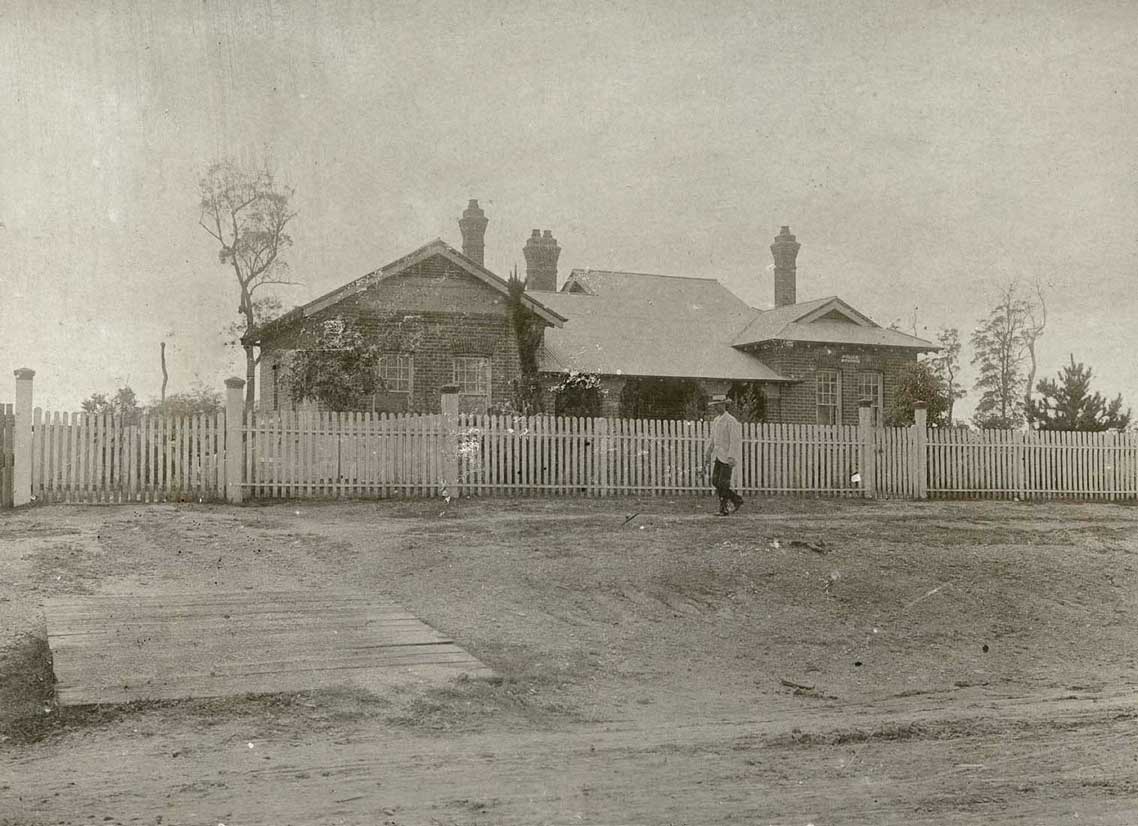
Photo ID: SRNSW 4346_a020_a020000136.jpg
The new buildings are situated in High-street, near the public school, and are a decided ornament to the town. Being in a high and suitable position, they command a view of the “city,” and are more conveniently placed than the old buildings. The contract was signed by Mr Ibbotson in the early part of last year, and the work was begun in May. Although rain accounted for at least three months of lost time, the work has been completed before contract time, which ends on March 4. And the work has been well done, too; it is unnecessary to boast of it; Mr Ibbotson’s work and that of his men stands the keenest inspection, and is the admiration of both the skilled and the unskilled critics. So pleased are Bowra people with Mr Ibbotson as a citizen, and with his work, that over £5 was collected by Mr A Graham on the ground at the picnic on Thursday for the purpose of presenting Mr Ibbotson with some souvenir before he leaves the district. But to return to the buildings. The amount of the contract was £1569, but extras carried the total to about £1600. The foundations are of cement concrete, 3ft x 1ft; the walls of brick, built in cement to the level of the floor. All the external walls are hollow, having a two-inch cavity, which ensures the inside wall being always dry. The top part of the brick-work is also in cement. The chimneys are of brick, with terra-cotta chimney pots. The stables are also of brick, the total number of bricks used in the buildings being 113,000. These were all made locally by Messrs A and H Knott, and were of very good quality. The brick-work in the building was in charge of Mr Fred Kennedy, late of Goulburn, while the cement and the plastering were in the hands of Mr E Cook, of Newcastle. The plastering is well done, and is finished dead white in shell lime. Mr R Davis, of Goulburn, had charge of the stone work, and Mr AH Lansdowne, of Goulburn, looked after the wood-work. All the timbers used were obtained locally, and the contractor and the inspector were astonished and delighted with the splendid quality of the woods. They say that the timbers of these districts are very fine and that the residents do not apparently recognised the wealth by which they are surrounded. Tallow-wood and red mahogany supply the framework and flooring, the lining and ceiling are of beech, the mouldings, angles, margins, are all of cedar. The dais is of beautifully panelled and polished cedar; and under the iron roof is a second roof of ¾-inch beech sheeting. All the eaves are open with perforated zinc, ensuring a cool roof. Besides the court-room, the officer’s quarters consist of six fine rooms, also a bath-room, and a kitchen with water laid on, coppers, drains, sinks, and every convenience. There are two cells, stables, yard, etc. The court-room is rather small, being only 22 feet by 16 feet, with 12 feet walls. The outside work is well finished, the front piers being of bull-nosed bricks finished in carved cobble-stone on top, to carry a panelled verandah plate. The whole of the work was personally superintended by Mr Ibbotson, Mr Francis looking after it on behalf of the department. The work is creditable alike to the contractor and to the department.
————
Mr P McHugh, JP, was absent from the celebrations owing to illness.
1 The Sydney Morning Herald, Tue 22 Feb 1898, p. 7.
2 Evening News, (Sydney, NSW), Tue 8 Mar 1898, p. 5.
3 Evening News, (Sydney, NSW), Wed 8 Feb 1899, p. 3.