Newcastle Morning Herald and Miners’ Advocate, Wed 17 Dec 1884 1
THE MINISTER FOR JUSTICE IN
NEWCASTLE.
———◦———
THE PROPOSED NEW
COURT-HOUSE
———
YESTERDAY morning the Hon HE Cohen, Minister for Justice, accompanied by the Mayor of Newcastle (Mr Stewart Keighley), Messrs Ellis and Fletcher, MsLA, together with the Police Magistrate (Mr Mair) and a number of local Justices of the Peace, visited the proposed site for a new Court-house, Police Offices, etc, on the Government reserve at the top of Bolton-street. The Minister expressed himself as being very favourable to the site which had been recommended by the Government officials, and deprecated altogether the expenditure of a large sum of public money in attempting to alter the existing Court-house, so as to meet the growing requirements of the city. He especially considered this to be inadvisable, in view of the fact that there was an intention to establish Courts of Quarter Sessions and Circuit Courts at Newcastle, in addition to the periodical sittings of the District Court Judges. The Minister then visited the lockup, and expressed his surprise at the very insufficient accommodation afforded for the great numbers of prisoners who every week passed through the hands of the Newcastle police. He considered that the building was altogether unsuitable for the demands made upon it. Mr Cohen was then shewn over the Court-house, and there again he referred to the lack of accommodation. The hon gentleman having presided on more than one occasion as Judge in the same building at Courts of Quarter Sessions, has necessarily been in a position to notice and speak authoritatively upon many drawbacks which are periodically felt alike by judge, jury, litigants, barristers, and the public generally. On the last Estimates a sum of £7000 was voted for the alterations and additions to the existing Court-house. This amount the Minister is determined shall be expended towards the commencement of erecting new buildings altogether, as he considers that any attempt to patch up the old one would merely amount to useless expenditure. We have reason to believe the hon Minister will take steps to give practical effect to his recommendations immediately upon returning to Sydney. Mr Cohen is to be congratulated upon the liberal manner in which he has expressed himself with respect to the requirements of Newcastle; and as he is well known as a gentleman who says only what he means, the citizens may expect in a very short time to see realised a long-felt want and necessity.
…
NEWCASTLE BOROUGH COUNCIL.
————
THE fortnightly meeting of the Borough Council was held last Monday night. Present: The Mayor, Aldermen Webb, Laing, Moore, Thorn, Creer, Dart, Morgan. The minutes of the previous meeting were read and confirmed.
CORRESPONDENCE.
Inward correspondence was dealt with as follows:—
From Department of Public Works, stating that no trace could be found of any promise having been made of a temporary water supply for Newcastle.—Received.
Letter enclosed from Mr JC Ellis, MLA, from Minister for Justice, re erection of a Court House, at the cost of £7000, as follows:—
“Department of Justice,
“Sydney, 3rd December, 1884.
“Gentlemen,—With reference to the sum of £7000, which has been voted on the Estimates for 1885 for the erection of a new court-house at Newcastle, I have the honour, by direction of the Minister of Justice, to inform you that the Colonial Architect has been moved to prepared the requisite plans, etc, for the new building with the least possible delay, and the Sheriff has been asked to furnish a report as to the accommodation required in the court-house for the Quarter Sessions purposes.—I have, etc,
“WE Plunket, Under-Secretary.
JC Ellis and J Fletcher, Esq’s, MsP, Newcastle.”
Received; and the Sheriff’s attention to be called to the rapidly increasing state of the local population, for guidance when preparing his plans.
~ ~ ~ ~ ~
The Maitland Mercury and Hunter River General Advertiser, Thu 18 Dec 1884 2
DISTRICT NEWS.
———
(FROM OUR VARIOUS CORRESPONDENTS.)
———
…
NEWCASTLE.
(Newcastle Herald of yesterday.)
On his way to Maitland the Hon HE Cohen stayed for some little time in Newcastle, and visited the site for the proposed new courthouse, etc, in Bolton-street. The £7000 voted on the Estimates for next year for courthouse purposes in Newcastle will be expended, according to Mr Cohen’s decision in making a beginning with the new buildings. For, in his view, patching the old premises would cause wasteful outlay.
A caretaker has been appointed to the ladies’ bathing place in Newcastle, and a small scale of fees fixed for her remuneration. Police oversight has also been arranged for, so that bathing may be enjoyed with some degree of pleasure and comfort.
~ ~ ~ ~ ~
The Sydney Morning Herald, Wed 8 Jun 1887 3
COURT OF QUARTER SESSIONS FOR
NEWCASTLE.
———◦———
(By Telegraph.)
(FROM OUR CORRESPONDENT.)
———
Newcastle, Tuesday.
A deputation, consisting of the Mayor and aldermen of Newcastle, will meet Judge Dowling at the Courthouse to-morrow morning to consider the advisability of having a Court of Quarter Sessions held at Newcastle without further delay. Judge Dowling’s inexpensive scheme of the large courtroom will probably be adopted by the council and the Minister for Justice.
~ ~ ~ ~ ~
Newcastle Morning Herald and Miners’ Advocate, Thu 9 Jun 1887 4
QUARTER SESSIONS FOR
NEWCASTLE.
———◦———
DEPUTATION TO JUDGE DOWLING.
————
A DEPUTATION from the Borough Council waited upon His Honor Judge Dowling at the local Court-house yesterday morning, to request his assistance in having a Court of Quarter Sessions established in Newcastle. The deputation consisted of the Mayor (Alderman Webb), and Aldermen Buchanan, Christie, Moroney, Moore, and Thorn, and Mr ES Holland (Town Clerk). A few members of the legal profession were also present, including Messrs CW Readett, HJ Brown, W Sparke, and WH Baker.
Mr CW READETT introduced the deputation in a few well-chosen words, pointing out the necessity for the establishment of Quarter Sessions in a city of the size and importance of Newcastle.
The MAYOR said they had come to His Honor to ask him to assist them in their action with regard to this important matter of Quarter Sessions. For many years the public of Newcastle had had to travel to Maitland at much inconvenience and waste of time. A great expense, too, was entailed upon the Government for the cost of travelling for jurors and witnesses. Quarter Sessions would be imperative shortly, and they had now come to ask His Honor to help them in their endeavour to obtain them.
His HONOR asked why it was they wanted the court held in Newcastle. Was it for the money it would bring into the town?
The MAYOR replied that the chief point of objection to the court being held in Maitland was the great inconvenience entailed upon business men of Newcastle.
His HONOR, having certain statistics supplied to him, then said there was no doubt they ought to have Quarter Sessions in this city, but the present building could not be utilised for that purpose without considerable alteration. They would not, however, get a new Court-house during (His Honor’s) lifetime. He had always been favourable to the sessions being held in Newcastle. His Honor then walked down the body of the court, and pointed out to the deputation how the present building could be altered in such a manner as to serve as a court for Quarter Sessions. He advocated that the court should be divided by a brick wall where the rail at present is, and that a gallery capable of accommodating 200 or 300 persons should be erected. The windows at the north end at either side of the Judge’s seat would be blocked up, for in summer the light came streaming in in such a way as to almost blind the Judge, and it would be advisable to have a central sunlight in the roof. He also spoke of several other alterations, which would considerably improve the court.
Alderman MORONEY stated that he had prepared statistics on the matter, which showed that no less than 88 offenders had been committed from Newcastle for trial at Maitland. The cost for jurors and witnesses’ expenses at the last sessions could not have been less than £500.
His HONOR then advised that the Government should be again applied to, and that the Mayor should attach his name to the application. In course of time the matter would be referred to His Honor, and he would back up the application when it came before him.
His HONOR and the deputation then visited the site in Church-street, where it had been proposed to erect the new Court-house; and after closely inspecting the place, His Honor considered that it was not suitable for such a purpose.
The deputation then walked with Judge Dowling down Watt-street, and the Mayor invited His Honor to partake of some light refreshments at the Council Chambers; but he pleaded excess of business as an excuse.
The members of the deputation and the solicitors then bade farewell to the Judge, and adjourned to the Mayor’s office, where champagne was opened. The Mayor thanked the lawyers for coming forward to help the Council to get the Quarter Sessions, and Mr HJ Brown, who occupies a leading place in the profession in Newcastle, replied.
The proceedings then concluded.
~ ~ ~ ~ ~
Newcastle Morning Herald and Miners’ Advocate, Mon 7 Nov 1887 5
THE MINISTER OF JUSTICE IN
NEWCASTLE.
———◦———
THE HON the Minister of Justice (Mr W Clarke) arrived in Newcastle on Saturday morning by the steamer Namoi, from Sydney, en route to Tenterfield. He is on an official tour of the Northern district, and will visit and inspect all the buildings belonging to his department at the different towns on the way north. After landing, Mr Clarke proceeded to the Great Northern Hotel, where, about 10 o’clock, he was waited on by Mr J Creer, MLA, the Mayor (Alderman GW Webb, JP), and Aldermen Buchanan and Christie, and after a conversation with these gentlemen upon the most important topics concerning the city, the party proceeded to the court-house, where they were joined by Aldermen Moroney and Rodgers, and Messrs ES Holland (Town Clerk), HJ Brown, WH Baker, and Inspector Brennan. Before proceeding into the building, Mr HJ Brown gave the Minister some valuable information with regard to the inconvenience of the present structure, speaking at some length of its bad acoustic properties, as well as the deficiency of light and the superabundance of noise. Several other gentlemen endorsed Mr Brown’s views, and the Minister then inspected the building minutely. In the office occupied by Mr Lewis, Government Architect, Mr Clarke was shown the plans of the proposed additions to the edifice, which, however, did not entirely meet with his satisfaction. The party seemed to be of the opinion that the plan proposed by his Honor Judge Dowling some months ago would be the best way of dealing with the matter. Mr Brown also drew attention to the fact that at either side of the court, in a line with the solicitors’ table, were two doors through which a regular tempest rushed.
The MINISTER Minister then enquired what was the estimated cost of the repairs and additions, and was informed that the approximate sum would be about £1200 or £1400. The hon gentleman said the worst feature about the court was that it was too large, and that it would be better to wait for a time and have a new building erected than to throw money away upon repairs to a building which had been in existence for a very long time, and which when it was renovated would not give satisfaction. In reply to a question asked by Alderman Moroney, the Minister said he could not see why Quarter Sessions could not at present be held in Newcastle, as the existing building would be ample for all requirements. The great trouble and inconvenience occasioned by the present system of holding the courts at Maitland, with its accompanying difficulties with regard to the conveyance of prisoners to and from Maitland, and the delay caused by the journeying of witnesses and jurors, was also explained, and it was stated by far the greater bulk of the persons concerned belonged to this city. Mr Clarke considered it was rather unusual that the people of a city of the size of Newcastle should be put to the inconvenience of travelling 20 miles to attend Quarter Sessions.
Mr J CREER told the Minister that if he would make the necessary order the citizens would soon make the present court suitable.
Mr CLARKE recognised the fact that a city of the importance of Newcastle was entitled to have Quarter Sessions held in it. He had never been of any other opinion, and he thought as a temporary matter the present building would do. He could see at a glance that there were certain repairs necessary to the court-house, and these, at their own estimate, would cost about £1400, and that sum would, to his idea, go a long way towards providing a new court-house. (Hear, hear.) He believed that after the building had been repaired it would be found that it had cost between £3000 and £4000. With reference as to how the site of the present building was to be disposed of, it was stated that the frontage of the edifice was about 110 feet, which at the present price of land in Newcastle would fetch about £11,000. It was suggested that the Borough Council should make an offer for it for a Town Hall. Mr Brown thought it would be advisable to sell half of the land, which could be easily disposed of, and give the remainder to the Corporation.
The MINISTER then said that he had in his department plans of a good and suitable court-house, which had just been approved of by the Judges, for one of the eastern suburbs of Sydney, at a cost of about £5000 or £6000, and such a court-house would give ample accommodation for Newcastle.
Mr CREER was of opinion that the least the Government could expend upon a court-house in Newcastle would be £8000 or £9000, when they had just given Balmain a building [see Balmain courthouse, 1887] costing £14,000. There was a sum of £7000 placed on the estimates for a new court-house in this city, and that was not gone yet.
The party then repaired to the back of the court-house, where the site of the proposed additions was pointed out to the Minister, and subsequently Mr Clarke proceeded to the police station, which he minutely inspected, complimenting Inspector Brennan upon its clean and orderly condition. An adjournment was then made to the proposed site of the new court-house in Church-street, near the top of Bolton-street; and here the Minister of Justice reiterated his opinion as to the advisability of going on with the new court-house in preference to repairing the old one. The party, which had by this time dwindled down to a municipal deputation, then proceeded by omnibus to Darby-street for the purpose of allowing Mr Clarke to inspect the sand-drift. En route, city matters were discussed, and Mr Creer spoke of the long stretch of Government land in Blane-street, which he pointed out. The vehicle stopped at the lockup in Darby-street, which was inspected, the inconvenience caused by the limited available space being dealt with. Mr Clarke agreed that the building was insufficiently large, but stated that the matter was more in the Colonial Secretary’s department than his own, and advised the aldermen to bring the matter before Sir Henry Parkes upon his probable visit to Newcastle. The party, having been driven a short distance, alighted to get a good view of the sand-drift.
Mr CREER said the drift was now better than he had ever known it, thanks to the Corporation, but he remembered the time when the road was entirely blocked, and no traffic could take place. The land consisted of 70 acres upon the eastern side of the street, and 25 acres upon the western side. The idea was to fill in the 25 acres as a public park, and to lay out the remaining portion as building sites, and the improvement would bring in far more money than the cost of the land to the Government. One great point in favour of the arguments of the Council was that all the property in the neighbourhood was being ruined by the drift of the sand. The road was only being kept open by the perseverance of the Corporation, who charged 6d per load for the sand, and the proceeds helped in a small way to compensate them for removing the sand. They might as well charge for removing the sand as allow it to accumulate. The road was the leading thoroughfare to Lake Macquarie, and over there (Mr Creer here pointed in the direction of Burwood) was an immense population, all of whom were interested in the removal of the sand-drift.
The MINISTER: They want £140,000 for the land?
Mr CREER: That is merely the nominal value.
Alderman BUCHANAN pointed out that the land had been valued at £500 per acre, but the company had sworn one year that it was not worth more than £100 per acre. If the land was improved the Government would soon be recouped for their outlay. There was no power to deal with the drift but the Government.
Alderman CHRISTIE said the road was often in a dangerous state from the rate of 10 or 12 yards per month in the north-westerly direction, with certain winds. The way to deal with the nuisance was to build a wall at the water.
Mr CREER said the cost of preventing the drift would be small, but the Council dare not do anything in the matter.
In answer to Mr CLARKE, it was stated that the cost of stopping the accumulation would be about £3000: “but then,” said Mr Creer, “Newcastle would lose the benefit of a park.”
Alderman MORONEY (to Mr Clarke): I suppose the necessity of Newcastle having a park is admitted?
Mr CLARKE: Have you no park?
Alderman MORONEY: No; and all the available sites, with the exception of these 25 acres, are in the hands of the A[ustralian] A[gricultural] Company. They only had a piece of hill-land, and that was only a reserve, and not a park. There was not a single piece of public land in the city available for the holding of public sports.
Mr CREER said he did not know if any overtures had been made to the Minister of Mines by the AA Company; but, if any had been made, there was one motive which could be put down for their action, and that was that they had just sunk a shaft close at hand.
Mr CLARKE: What would prevent legislation making the owners abate the nuisance? An Act of Parliament could be passed, forcing them to do it.
Mr CREER: The land could be given back to the Company, and they could be forced to do something. That would stop the accumulation, but they would also have to take the existing nuisance away. That would save the purchase of the 70 acres.
The MINISTER considered that would be a very fair plan.
Mr CREER: Yes; if the matter of a park is not forgotten.
Mr CLARKE thought Mr Abigail might be persuaded to modify his scheme, so as to meet the views of the citizens with regard to a park. He was glad of having the opportunity of inspecting the sand-drift. He would see Mr Abigail upon his return to Sydney, and, without telling him his opinion he would represent their views to him. Of course, he could not interfere with the administration of Mr Abigail’s department; but, in his opinion, the views seemed to be a solution to the problem.
Alderman CHRISTIE stated that at a meeting held in this city to organise a reception to Sir Henry Parkes, it had been suggested that Mr Abigail should be invited with the Premier.
Mr CLARKE thought Mr Abigail would be very glad to come to Newcastle, even if Sir Henry was unable to do so.
Mr CREER: You can see, Mr Clarke, that the perseverance of the Council and the members in this matter has not been unreasonable.
Mr CLARKE thought their perseverance was far from being unreasonable. The company could be compelled by legislation to abate the nuisance, and to remove the existing difficulty. He believed this would be a better plan than to resume the land.
Mr CREER said every Government that had been applied to had given as its opinion that the only way to deal with the drift would be to resume the land.
Mr CLARKE knew Mr Abigail was reasonable enough, if he saw a better proposition than the one he suggested, to accept it; and the best way would be to have that gentleman down to see the drift for himself. He was of opinion that the importance of Newcastle demanded a park, and he believed the Government would have no objection to granting it. He would not say that he was in favour of the resumption of the whole of the land, but he thought their views might solve the problem.
After some further unimportant conversation the party returned to the city and proceeded to the Upper Reserve for the purpose of giving the Minister an opportunity of inspecting the nightsoil depôt. At the foot of the shaft Mr Clarke said he could see no possible objection to the scheme, especially as it involved no expenditure of public money. He considered the plan a very good one. The mouth of the shaft was then visited, when the Minister said he thought the Council had solved a very great difficulty, fr he could perceive nothing offensive. He thought he could tell them the Government would stand by them in the matter, but they had better see what the Premier’s views were when he came up, for he was, of course, the captain of the ship.
Mr CLARKE then returned to his hotel, which he left in the afternoon to proceed by the 3.20 pm train to Maitland.
~ ~ ~ ~ ~
The Sydney Morning Herald, Mon 7 Nov 1887 6
THE MINISTER FOR JUSTICE
IN THE NORTH.
———◦———
(BY TELEGRAPH.)
(FROM OUR OWN CORRESPONDENTS.)
———
Newcastle, Saturday.
The Hon W Clarke, the Minister for Justice, inspected the courthouse to-day, but after hearing the probable cost of repairs, viz, from £1200 to £1400, he was of opinion that it would be better to build a new one on a site recommended near the Hospital for the Insane, in Church-street, at a cost of £6000, which site he afterwards visited. With regard to holding quarter sessions in Newcastle, he quite approved of it. Mr Creer said if the Minister would give the necessary order it could be done.
~ ~ ~ ~ ~
Newcastle Morning Herald and Miners’ Advocate, Sat 6 Apr 1889 7
HAMILTON REQUIREMENTS.
———◦———
DEPUTATIONS TO MINSTERS.
————
THE RESERVE.
————
THE MAIN ROADS.
————
(By Telegraph.)
(FROM OUR OWN CORRESPONDENTS.)
Sydney, Friday Night.
A DEPUTATION was introduced by Mr James Fletcher, MLA, to the Minister for Lands, at 11 o’clock this morning, with the object of requesting an endowment of £500 towards the cost of fencing a public reserve at Hamilton. Mr John Arkins (Mayor of Hamilton) pointed out that a grant of nine acres had been given by the A[ustralian] A[gricultural] Co for a reserve some six years ago, and that according to the terms of such grant it was necessary that the ground should be fenced. There was a population of over 4500, and there was not a foot of ground which could be used as a park. The council could not afford the expenditure of fencing the reserve. They had had only £273 out of £2200 to spend on the municipality.
Mr Brunker said he knew the population of Hamilton was increasing every day, and that land could only be procured at a great price. It was the duty of the Government to assist under such circumstances for the benefit of the health of the people. He would assist them to the utmost in the matter, and as soon as the estimates were passed he would take action, and if he could not get the £500, he would give them as much as was consistent.
The deputation then waited upon the Minster for Works to ask for a grant for repairing the three main roads of the municipality. The deputation was introduced by Mr Fletcher, MP, and accompanied by Mr Creer, MP; and it was explained that there were about six miles of roads which required to be repaired and put in a sound, safe condition. An estimate was handed to the Minister, which showed that the cost of repairing these roads would be £1900, and, as the council was at the present time about £2200 in debt they were unable to undertake the work. The amount asked for was £400. Mr Bruce Smith promised to have the roads reported upon, and if, on receipt of the report, he found that the facts stated by the deputation were borne out, he would recommend the Government to afford the municipality some assistance.
————————
THE PROPOSED COURT-HOUSE.
———◦———
TO BE REPORTED UPON.
————
PROPOSED BUILDING TOO GOOD.
————
(FROM OUR OWN CORRESPONDENT.)
Sydney, Friday Night.
AFTER a deputation from Hamilton had interviewed the Minister for Works this morning, Mr Fletcher, MLA, asked the Minister the present position of the proposed Newcastle Court-house for Newcastle.
Mr Bruce Smith said that he had arranged with the Minister of Justice for that gentleman to obtain a report from a District Court Judge and a Justice of the Peace as to the requisite accommodation required at Newcastle. He might mention that he would never sanction the erection of such a building as one the plans of which had been shown to him, which would be infinitely superior to the Supreme Court in Sydney.
————————
THE GIRL AND THE GUM.
She was apt in conversation,
She could point each constellation,
And in many mathematics she could do the hardest sum.
She could versify in jingle
That would make your ear-drum tingle,
She could sing, she danced divinely, but she would chew gum.—Merchant Traveller.
~ ~ ~ ~ ~
The Sydney Morning Herald, Sat 6 Apr 1889 8
DEPUTATIONS.
———◦———
…
ROADS AT HAMILTON.
A deputation of inhabitants of the district of Hamilton, introduced by Messrs Fletcher and Creer, MsLA, waited upon the Minister for Works yesterday,
…
the deputation took the opportunity to ask the Minister what steps had been taken with regard to the Courthouse for Newcastle.
Mr BRUCE SMITH said he fully agreed in the necessity for a new Courthouse at Newcastle, but he could not adopt the unnecessarily extravagant plans which had been prepared. He had consulted his colleague, Mr Gould, upon the matter, and that gentleman was taking the opinion of a District Court Judge and a Magistrate as to what would be required. They might depend that a new Courthouse would be constructed.
~ ~ ~ ~ ~
The Sydney Morning Herald, Wed 12 Jun 1889 9
NEW COURTHOUSE AT NEWCASTLE.
———◦———
(By Telegraph.)
(FROM OUR CORRESPONDENT.)
———
Newcastle, Tuesday.
In response to a requisition, the Mayor of Newcastle has convened a public meeting of citizens for Saturday night, for the purpose of urging upon the Government the necessity of carrying out the original plans and specifications for a new courthouse here.
~ ~ ~ ~ ~
Newcastle Morning Herald and Miners’ Advocate, Mon 17 Jun 1889 10
THE PROPOSED COURT-HOUSE.
———◦———
THE public meeting held in Newcastle on Saturday night would not have been held if the Government had exhibited the slightest sign of doing justice to the city and district, in the way of providing suitable Court-house accommodation. On every occasion when simple justice has been asked by the inhabitants the Government have exhibited the same stolid indifference to their representations, and the public have had to bear contemptuous rebuffs, instead of the treatment that persons should receive who have a good cause to represent to their stony-hearted stepmother. In the matter of affording suitable accommodation for the administration of justice, the Government have been unable any longer to ignore the fact that they cannot persistently stave off the inevitable. Judge after Judge has represented in the most condemnatory terms the present position of affairs in that respect, and at last the Government have very unwillingly admitted that “something must be done.” Instead, however, of adopting the plans which had been drawn up for the erection of a Court-house that would have been not only fully sufficient for the present wants of the place, but would be ample, for some time to come, for the requirements of our rapidly-increasing population, the Government have been at the trouble to call for fresh plans of an edifice which, from the first, must be found small and inconvenient, thus perpetuating in a new building the evils so much complained of in the present Court-house.
Newcastle requires not only Police and District Courts, but an Assize Court. The public of Newcastle are utterly wearied of attending, as witnesses or jurymen, the courts at Maitland. They should not be required to do so for one day longer. We warn the Government that the public feeling is so strong in this matter that difficulties may arise if the attendance of large sections of the population of this city are compelled to attend at every Assize Court in Maitland, as has been the case in the past. Our people are a patient and law-abiding folk, but the worm will turn sometime on the foot that treads it, and the Government hoof has been pressed down upon us far too heavily already. If there was any great and compelling reason why portion of a population of 60,000 people in the second city of the colony should proceed regularly to a sleepy hamlet 18 miles away from their homes, and spend day after day in being roasted during summer and frozen in winter in the precincts of a Court-house there till the cases in which they are to appear as witnesses, jurymen or otherwise, are called on, no one would for a moment contend but that it was a public duty to hie away at Her Majesty’s call, and perform the duties laid upon them. But no such paramount reason exists.
If Government, for motives of economy, decide that there shall only be one Assize Court for Maitland and Newcastle, why should not that Court be held at Newcastle instead of at Maitland? Why should the population of the greater town proceed to the lesser to have justice meted out to them, or do their public duty as witnesses or jurymen? The present system, so long and doggedly persisted in, has not the virtue of necessity to recommend it, and stands universally self-condemned. When the next batch of subpœnas are served it might not be amiss for those called upon to attend to Her Majesty’s service in the Assize Court at Maitland to meet together, and present a humble petition and prayer to the representatives of Her Majesty, showing the disabilities under which they labour so long as the present system is continued, and asking for such relief in the premises as to them may seem meet. Year after year the lamb-like people of this city talk of their grievances and ask for redress. Ample promises are made that relief will be granted, and some marble or fossil man is written to about the matter. The showman who works the marble or fossil man writes a little note to a clerk in the Colonial Secretary’s department that effectually puts a spoke in the wheel of Newcastle for some considerable time, and, when a fresh spurt of enthusiasm is evoked, the process is repeated time after time, until young men get grey in their endeavours to remove the incubus of red tapeism and delay that checks every movement for the benefit of the community. Supposing, for the sake of argument, that the people of Newcastle had got so thoroughly tired of serving as jurymen and witnesses at Maitland, although they would willingly perform the same service at Newcastle, that they would find it impossible to do so any longer, would the Judges, in defiance of the well-known and openly expressed feeling in Newcastle and district, go directly in face of that statement, and meet the case by imposing fines or imprisonment? We sincerely hope that there never will be occasion to do so, and that the Government will take, without loss of time, the necessary steps for preventing any disagreeableness between the public and the Department of Justice in a question of this kind. Whatever might be the result, the public opinion of the colony would be with the people of Newcastle in any action to assert their rights that an Assize Court should be in Newcastle, and not in Maitland, which is practically a day’s journey distant from them.
Newcastle does not want a palace of justice like that at Bathurst, which cost about £35,000. But it is absurd to erect a building here which will be found useless for its intended purpose from the first day of its opening. In erecting a building which is to stand for many years it is folly to begrudge the few additional thousands necessary to make the Court-house thoroughly fit for the purpose for which it is built. To spend £17,000 now, and not to have to spend any more on Court-house accommodation for the next twenty years, is far truer money than to spend £12,000 now, and £17,000 in four or five years hence. The speakers at the meeting on Saturday were not of the type of men who are, in season and out of season, “agin’ the Government.” Their utterances are, therefore, in the highest degree deserving of attention. The question is one, fortunately, which is outside the scope of party politics. It is one of many subjects of a similar non-party kind, in which the general population of Newcastle are interested. The public neither want a Protectionist Court-house nor a Freetrade Assize Court. Saturday’s meeting may be taken as a true expression of public feeling on the matters discussed. There is a prevalent sentiment that in regard to the alteration of plans Newcastle has, to use a common expression, been “sat upon” by the Minister for Works. Mr BRUCE SMITH should not have made such a mistake, and no one whose opinion is worth having will say that if he reconsiders his decision he will have made a weak concession to mere idle clamour. He is a wise man who knows when to be firm and when to yield. Let Mr BRUCE SMITH be wise in conceding to Newcastle the bare justice that has been accorded to other places not one tithe in importance and population.
~ ~ ~ ~ ~
The Sydney Morning Herald, Mon 17 Jun 1889 11
THE NEW COURTHOUSE AT NEWCASTLE.
———◦———
(By Telegraph.)
(FROM OUR CORRESPONDENT.)
———
Newcastle, Sunday.
An open air meeting was held last night opposite the Criterion Hotel, the Mayor of Newcastle in the chair. The object was to discuss the proposed new courthouse. The first resolution was proposed by Mr HJ Brown, seconded by Mr T Cox, JP, and supported by Mr H Stokes and Mr WB Sharp. It was,—“That this meeting considers the amended plans submitted by the Newcastle police magistrate for the new courthouse at Newcastle will not provide sufficient accommodation, and that the Minister for Justice will be pleased to cause the original plans to be carried out, so that the courthouse may be erected suitable for holding an assize court as well as the district court.” The resolution was carried unanimously, as was also another, moved by Mr P Bennett, Mayor of Wickham, to the effect that the members in Parliament for the city and county, with all the Mayors of Newcastle and the surrounding municipalities, wait upon the Minister for Justice to explain the necessity for carrying out the original plans.
~ ~ ~ ~ ~
The Maitland Mercury and Hunter River General Advertiser, Tue 18 Jun 1889 12
OUR NEWCASTLE LETTER.
————
Monday.
A public meeting, convened by the Mayor of Newcastle, Mr Hy Buchanan, on the requisition of a number of influential citizens, was held on Saturday evening at the corner of Bolton-street, for the purpose if urging on the Government the necessity of carrying out the original plans for a new court-house in this city. There was a fair attendance, the cold wind no doubt preventing a very large one. The Mayor opened the proceedings by reading the requisition, etc. Mr HJ Brown, in a pointed speech, moved the first resolution: “That this meeting considers that the amended plans submitted to the Newcastle police magistrate for a new court-house in Newcastle will not provide sufficient accommodation, and trusts that the Hon Minister for Justice will be pleased to cause the original plans to be carried out, so that a court-house may be erected suitable for the holding of an Assize Court in Newcastle as well as a District Court.” Mr Thos Cox, JP, seconded, and the resolution was spoken to by Messrs H Stokes and Croudace. Mr Buchanan then read the resolution, and it was carried unanimously. Mr Bennett, Mayor of Wickham, then moved—“That the members of Parliament for Newcastle and Northumberland, with the Mayors of Newcastle and the surrounding municipalities, wait upon the Hon Minister for Justice and represent to him the necessity of carrying out the original plans.” Mr WB Sharp seconded the resolution, and it was carried without dissent. A vote of thanks and three cheers for the Mayor concluded the proceedings.
~ ~ ~ ~ ~
Newcastle Morning Herald and Miners’ Advocate, Fri 21 Jun 1889 13
NEWCASTLE COURT-HOUSE.
———◦———
DEPUTATION TO THE GOVERNMENT.
————
THE MINISTER’S REPLY.
——
(By Telegraph.)
(FROM OUR OWN CORRESPONDENT.)
SYDNEY, Thursday Night.—A deputation; consisting of Messrs Creer, MLA, Buchanan (Mayor of Newcastle), Bennett (Mayor of Wickham), Case (Mayor of Merewether), Croudace (Mayor of New Lambton), Rushton (Mayor of Wallsend), and HJ Brown, was introduced this morning to the Minister for Justice, by Mr Fletcher, MLA, with reference to the erection of a new Court-house at Newcastle.
Mr FLETCHER explained that the object of the deputation was not only to bring under the notice of the Minister the necessity for the erection of a Court-house, but the necessity for having the work proceeded with at once. For years past the people of Newcastle had been promised a court-house affording accommodation for a Court of Assizes, and when the last Parkes’ Ministry went out of power, he ascertained that the plans were all ready, but that the official estimates of the cost of the work set it down as £20,000, which, under the new law, necessitated the approval of the Public Works Committee before anything could be done. It was then decided by the Ministry in power to call tenders for the work, which, it was thereby found, could be carried out for something under the sum stated, and operations would have been commenced had the Government not been thrown out. The present Minister for Works thought the place too elaborate; but the deputation wished to point out that it would be a waste of money to do anything at all, if it was not done thoroughly, in such a rapidly-growing district.
Mr BUCHANAN said the deputation was appointed at a meeting held in Newcastle on June 15, and the objects were as explained by Mr Fletcher. There was no community in the colony suffering so much for want of a Court-house as Newcastle, where there was a resident population of about 70,000, and a floating population of some 2000 persons. From this latter there was a certain amount of crime, into which the residents were more or less drawn as witnesses or prosecutors, and therefore he thought the people of Newcastle had good reason to ask the Government to do something for them. What they wanted was something to last for a length of time and meet the requirements, not a building that would be useless in the course of a year or two. They wanted a Court-house in which could be held a Court of Assizes, Quarter Sessions, and in which other ordinary court business might be transacted. In nine other districts with a total population of 33,000 persons, £136,000 had been spent, whereas with Newcastle it was only proposed to lay out between £19,000 and £20,000 for 70,000 persons. In asking for the building to be erected according to the original plans he did not think the people sought too much and he was certain they would all be very grateful when the work was undertaken.
Mr BROWN said he had seen the plans for which tenders had been called, and also those which had been modified, and in adopting the latter the Government would be practising a false economy, and, although there would be a certain amount of accommodation afforded, there would be nothing provided for the Quarter Sessions. He wished to call particular attention to the urgent necessity for the erection of a suitable Court-house. There was at least one Court of Petty Sessions at Newcastle every day, and sometimes two. The room in which this Court of Petty Sessions was held was only about the size of an ordinary drawing-room, and the space was so inadequate, that it was often difficult in the crowded state of the room to tell who was the prisoner or the professional gentlemen or the clerk of the court. If, with the rapidly increasing business, the magistrate had to sit there for a long time every day, they would soon be found on the sick list. The amended plans did not show any accommodation for witnesses attending court, and rooms were only provided for the clerk of petty sessions and one assistant, a staff which it would be absolutely necessary to increase very shortly. It was proposed to increase the jurisdiction of the local District Court office, which was urgently wanted for many reasons. The present arrangements for the conduct of District Court business were productive of the utmost inconvenience, delay, and annoyance, and that matter alone demanded immediate attention. They would like the building to be ornamental, but if it was to be in keeping with the other public buildings of the city they could not complain. He had turned up statistics to show that such buildings as the one sought after were not a loss to the country, and he found that during last year the income at Newcastle for fines amounted to about £1500, while for the first five months of this year £500 had been received from the same source. In 1888 the proceeds of the District Court exceeded £300, and, in addition to these items, there was money coming in from lands and other sources.
Mr BENNET said he did not think there was anything for him to add; the subject had been fairly treated and everything clearly shown. All he could ask for was that the original plan might be carried out.
Mr CROUDACE endorsed the remarks of the other speakers, and strongly impressed upon the Minister that the people wanted a building which would be useful in the future and not merely at the present date.
Mr BUCHANAN added that about five sixths of the cases which went to Maitland for trial were from Newcastle and district, and the jurymen, witnesses and others consequently had to travel there—whereas, if the courts were held in Newcastle, there would be a great saving to the Government.
Mr CREER, MLA, warmly advocated the cause, and gave personal experiences of the very great inconvenience arising from the want of better accommodation at the present Court-house. He did not think £19,000 was a penny too much to be spent on a city such as Newcastle, more especially when the great and rapidly increasing importance of the place was considered. No district in the colony was advancing more rapidly than Newcastle.
Mr GOULD, in reply, said he was very glad he had met the deputation, because, where there was any misunderstanding between a Minister and a section of the people, it was always easier for settlement if the parties were brought together. He wished them to thoroughly understand that he did not for one moment underrate the importance, and daily increasing importance, of their city, and, so far as he was concerned, the metropolis should never be aggrandised at the expense of the country towns. He understood they wanted an Assize Court and Quarter Sessions in Newcastle, in addition to the courts already there. The plans which they did not think afforded sufficient accommodation had been very carefully considered, and had been submitted to the Chief Justice and the Sheriff for their opinions. Both considered the provision ample for the requirements, and the former, who was opposed to making Newcastle an assize town, said that if there must be an Assize Court he would suggest that the court-room shown on the plans should be made smaller, as the dimensions proposed would render it too large to be comfortable or convenient. The difficulty about holding an Assize Court or Quarter Sessions Court at Newcastle was that the prisoners would all have to be taken to and from the gaol at Maitland. It was impossible to compare the court business done in Sydney and Newcastle, the former being so very much greater than the latter. The Government had determined not to spend large sums of money on country court houses unless it was absolutely necessary, when everything possible would be done to provide fitting and proper accommodation. He could at least promise them that the building should be an ornament to the city, but with regard to the other matters in connection therewith he could only say he would bear their arguments well in mind, although they must not forget that everything had been previously very carefully considered by the Government.
The deputation after thanking the Minister withdrew.
~ ~ ~ ~ ~
The Sydney Morning Herald, Fri 21 Jun 1889 14
DEPUTATIONS.
———◦———
…
NEWCASTLE COURTHOUSE.
Yesterday morning Mr Fletcher, MLA, accompanied by Mr Creer, MLA introduced a deputation to the Minister for Justice, for the purpose of bringing under his notice the necessity for a new courthouse being erected at Newcastle immediately. Amongst the deputation were the Mayors of Newcastle, Merryweather, Wickham, Wallsend, and Lambton, together with Mr Brown, a solicitor, of Newcastle.
Messrs Fletcher, Creer, Buchanan, Brown, Bennett, Croudace, and Case addressed the Minister, pointing out that for several years various Ministries had promised a new courthouse which would give sufficient accommodation for an Assize Court and thus obviate the inconvenience attendant upon the Newcastle business being transacted at Maitland. Plans had been prepared and tenders had been called for the erection of a building which would cost £20,000, and if it had not been for the change of Government which placed the present Ministry in office, the court at Newcastle, built on plans prepared, would have been a fact. The deputation desired that the courthouse should be built on the original plan instead of the modified one which the present Government intended to adopt. Each member of the deputation urged the necessity for their desire being granted, and also explained the many inconveniences now suffered for want of more accommodation.
Mr GOULD, in replying, said he was pleased to have met the deputation, as he believed that where any misunderstanding existed between a department and an influential district the better settlement of differences could be arrived at by a personal interview. He did not for one moment underrate the importance of Newcastle and district, nor did he lose sight of its rapid growth in population. Their desire was for an Assize Court and Quarter Sessions; but after careful consideration with the sheriff and other officials he forwarded the present plans to the Chief Justice, who did not believe in having an Assize Court at Newcastle. The proposed buildings would be sufficient for all purposes, except perhaps that the courtroom would be inconveniently large. There was no courtroom in the United Kingdom of such dimensions, and in such a large room it would be impossible for witnesses to be heard. Such was the opinion of the Chief Justice and the consensus of opinion amongst the officials, and his own was that the courthouse proposed to be erected would meet all the present, and also the requirements of Newcastle for many years to come. The Government had firmly decided not to expend large sums of money on courthouses, but at the same time they would provide necessary accommodation. He would consider their representations, and if he believed it were desirable or necessary to give additional accommodation to that proposed in the plans, he would give it.
~ ~ ~ ~ ~
Newcastle Morning Herald and Miners’ Advocate, Wed 12 Feb 1890 15
THE NEW COURT-HOUSE.
———◦———
The present court-house, which commands one of the principal sites of the city, has done duty as the local temple of justice for nearly fifty years. The court-room is one of the largest in the colony, but the inadequate accommodation attached to it has precluded the holding of Quarter Sessions. It could not be converted into a structure suitable for the holding of the higher courts, without going to considerable expense. Probably a greater drawback, however, has been the want of a local gaol, with the necessary cell accommodation, and yet it is a singular fact that half a century ago Newcastle boasted of a goal, the remains of which may now be seen on Gaol Hill, at the end of Scott-street. The erection of the large gaol at Maitland, and the sitting of the superior courts there has no doubt been the means of giving that town considerable prominence to the detriment of Newcastle; but this, it is to be hoped, will soon be a thing of the past. Some 20 years ago the late Mr Hannell, MP for Northumberland, agitated by public meetings in the district and addresses in the House for the holding of the sessions here. Times out of number question has been dealt with in the local press, and innumerable deputations have interviewed the various Government. Every effort has been made by the people of this district, and they have been rewarded with pie-crust promises, which were forgotten as soon as uttered. The interests of the Maitland people have been diverted in an opposite direction, and their influence has been so strong that the boon was never granted. About three years ago the Newcastle people awoke to this fact, and insisted upon their town having its just rights in the administration of justice as the second city in the colony. The Government of the day were approached in such a manner that they were compelled to recognise that the population of this district was rapidly increasing, and that it was, moreover, the wealthiest town in the colony outside of Sydney. The Government were notified that the strongest inducement for the holding of the sessions here was the fact that three-fourths of the cases heard at Maitland came from Newcastle, and that most of the witnesses, jurymen, and police had to leave Newcastle for some days during each sitting at very great loss of time and heavy expense. It was also shown that by holding the sessions here the Government would save several hundred pounds per annum in witnesses’ expenses alone, besides expediting the administration of justice. During the time Mr Fletcher was in power he had plans prepared for a handsome courthouse on the Government ground at the top of Bolton-street. This building would have been one of the most imposing character, and would have cost about £20,000. It was to have been adorned by a colossal tower, but the plans admitted of the omission of this tower until a more opportune time, thereby saving a large proportion of the sum mentioned. The incoming Government condemned Mr Fletcher’s scheme, and recommended that something at a very much smaller cost should be built; in fact, they proposed a sum which was much less than that which has been spent upon each of the court-houses at Newtown, Goulburn, and Bathurst. The fact that Newcastle was a great seaport with inexhaustible mineral wealth, which is the cause of annual increases in its population by some thousands, was and still is lost sight of. In other words, Newcastle was expected to play second fiddle to towns with nothing to recommend them but their indefatigable representatives. A fresh scheme was proposed, and efforts were made to have the present building so transformed as to meet the requirements of a high court. The municipal authorities made strenuous exertions in the matter, and deputation waited upon the Government. This had the effect of causing the Minister to call for reports from the District Court judges. These gentlemen reported favourable as to the holding of the sessions at Newcastle, and ex-Judge Dowling recommended that a gallery should be constructed, and that additional rooms should be erected on the land adjoining. This occurred some 18 months ago, and it was thought then that action would be taken without any further delay. This has not been the cas e, however; but, nothing daunted by the vexatious delays, the municipal authorities have continued their operations, and have at last succeeded in inducing the Government to so alter the building that the sessions may be held in it during the present year. These alterations will comprise several additional jury rooms at the rear, and the construction of eight or 10 cells at the lock-up. It is not known when Quarter Sessions will be commenced, but it is anticipated that the first court will sit in June next at the present court-house, pending the erection of the new building at the top of Bolton street. The new edifice will be one of a very imposing character, and will command an extensive view of the city. On one side there will be a Church of England parsonage, and on the other the police barracks. The position is one of the healthiest that could have been chosen, and will answer its purposes admirably. The front elevation of the building will be of Grecian design, with Corinthian pillars. The central building will be very similar to that of the present court-house, with the exception of the side windows. The building will be of brick, and will contain assize and occasional court rooms, a portico, vestibules, corridors, passages, retiring rooms, caretaker’s quarters, etc. it will be entered by a portico with tesselated [sic] pavements, which will lead to a large vestibule of very extensive dimensions, suitable for witnesses in waiting. From it a staircase will lead to the gallery of the principal court-room. Passing from the vestibule into the assize court, there are arranged a number of boxes reserved for jurors in waiting. These boxes are immediately under the public gallery. The principal court-room will contain the dock in its centre, from which an underground passage will lead to the prisoner’s cells. In front of the dock there will be the barristers’ table and clerk’s desk, and behind that again the judge’s dais. The back of the dias will be beautifully moulded with panel framing, and the canopy will be supported on richly carved trusses. It will be surmounted by a carved coat of arms. On the right side will be the jury boxes, and on the left the officials’ boxes. The witness stand will be between the dais and the jury boxes, and the full width of the room from the press box. The actual size of the court-room will be 45 x 32 feet. On each side there will be wide corridors, leading to the rooms reserved for the Attorney-General, the Crown Solicitor, the legal profession, and witnesses, magistrates, and the CPS. At the rear there will be passages leading to rooms reserved for the Judge, gaol officials, jurymen, and the Colonial Architect. Behind these rooms there will be no less than six yards, with conveniences. On the right side of the main building will be the occasional court-room, supplied with the usual fittings. This will be 25 x 35 feet. The basement under the court will comprise quarters for the caretaker on one side, and on the other guard-rooms, cells, and exercise chambers. It is to be hoped that the building will be pushed on as soon as possible, and that the tenders, when accepted, will not meet with the same fate that the last ones did.
~ ~ ~ ~ ~
Newcastle Morning Herald and Miners’ Advocate, Sat 15 Feb 1890 16
THE NEW COURT-HOUSE.
————
TO THE EDITOR.
SIR,—In your issue of the 12th inst in an article under the above heading appears the following statement:—“During the time Mr Fletcher was in power he had plans prepared for a handsome court-house on the Government ground at the top of Bolton-street. This building would have been of a most imposing character, and would have cost about £20,000.”
Without desiring to detract from the merits or energies of Mr Fletcher, I beg to say you are in error. When Mr Fletcher took office he found the plans prepared and approved by the late Parkes Government. Which, member had the most to do with the matter up to that point, the correspondence in the Department for Justice will show.—Yours, &c.
February, 13th.
JC ELLIS.
~ ~ ~ ~ ~
The Maitland Mercury and Hunter River General Advertiser, Sat 19 Apr 1890 17
The Courthouse At Newcastle.
———
(Herald.)
The Newcastle Courthouse question has been once more brought before Mr Bruce Smith, the Minister of Works, who, by the way, it may be said, is very desirous that the erection of the building shall be no longer delayed. A conference between the Minister of Justice, the Minister of Works, and the Colonial Architect has taken place, at which Mr Bruce Smith expressed an opinion to the effect that the front elevation of the proposed building is not (according to the designs) as imposing as the importance of Newcastle demands. The Colonial Architect has been directed to prepare a plan giving additions to the building which will improve its external appearance, but which at the same time shall not involve any large additional cost. Several of the lower tenderers for erecting the building will be asked to quote prices for these additions, after which the erection of the new courthouse will be immediately proceeded with.
~ ~ ~ ~ ~
Newcastle Morning Herald and Miners’ Advocate, Fri 18 Apr 1890 18
THE PROPOSED COURTHOUSE.
———◦———
THE people of Newcastle are glad to learn from semi-official sources that the Minister for Works is very desirous that no further delay should take place in proceeding with the erection of the Newcastle courthouse. It is exceedingly difficult for merely ordinary and non-official minds to understand why there should have been so much delay in carrying out a work which is neither surrounded with tremendous technical difficulties now requires a vast amount of public expenditure. Fifteen months ago plans were in readiness for the work, and although Mr BRUCE SMITH, on coming into office, upset the arrangements of his predecessor, Mr FLETCHER, there has been ample time to have the work begun since the advent of the present Ministry to office. There has been no valid reason why the courthouse should not have been completed by this time, and the administration of justice begun. Nevertheless it appears that even now the preliminaries have not been settled. The Minister for Works, being of opinion that the front elevation of the building was not so imposing as the importance of Newcastle demands, has ordered the preparation of a plan which will allow of some additions in the way of ornament without any very great expense. In other words, although on a dado bent, the Government has a frugal mind. People in this quarter were not, however, prepared for another change of plans or additions of carvings of the post-office order. But there is no use in fretting, so they must possess their souls in patience, satisfied that something will be done if they only wait long enough.
~ ~ ~ ~ ~
Newcastle Morning Herald and Miners’ Advocate, Mon 29 Feb 1892 19
THE NEW COURTHOUSE.
———◦———
ALTHOUGH the opening of a new courthouse is not a matter which should cause much jubilation, yet it is an event in the history of a place the annals of which have not many great or brilliant pages. There is a story that a shipwrecked seaman of the olden time was once cast ashore on a strange and unknown coast, and was much exercised in mind as to the nature of the location into which he had been so involuntarily cast. Fearing the attack of cannibals at every turn of the sea beach, he proceeded on his way tremblingly, but his fears were dispersed and his hopes revived by the sight of a grim something on the horizon. It was that ultimate engine of the law—a gallows, and the mariner knew that he was in a settled country. On the same principle, the fact that Newcastle has now got two courthouses may be regarded as another step in the path of civilization. That is, the civilization that we know, in which judges and lawyers have ever been numerous. It might be argued that the absence of these would constitute higher evidence of a more satisfactory standard of morals than their presence, but as matters go in this imperfect world, it is satisfactory that society calls upon a judge to settle its differences with offenders, and that people go to law rather than at each other with lethal weapons. Much as is said regarding the imperfections of the legal code of New South Wales and its administration, the personage called Judge Lynch is never called in to aid or supplement the regular judges, and when people have a difference of opinion regarding personal or business affairs it is not usual to proclaim a vendetta. In another respect this country is before others of which more is heard, in that the fountain of justice remains unpolluted. It is to be hoped that this condition of affairs will never be altered, and that all attempts at innovations regarding the present system of appointing judges will meet with the strongest opposition and the most marked defeat.
The history of the old courthouse has yet to be written, but if its walls could, like the records of a telephone, speak, what strange stories could they tell. The old building, thought not an antique edifice, is a link with the distant past, and was erected at a time when criminal law was, to a considerable portion of the inhabitants of New South Wales, a much more personal matter than it is to the same proportion of the people now-a-days. For a long time past the inconveniences of the building have been seriously felt, owing to the fact that traffic has immensely increased both in the public street and on the railway, and that the noise was frequently sufficient to drown the voices of those engaged in the business of the court. The new temple of justice, although situated in a convenient position, is nevertheless in a part of the city where the roar of traffic is never likely to inconvenience those who have to do business within its walls. In this respect Newcastle will now be in a much better position than Sydney, where the Supreme Court judges have to discharge their most important duties amidst the most distracting sounds, are deafened by the rattle of tramcars, and swelter in a temperature which gives a certain inappropriateness to the relationship commonly alleged to exist between the forensic gentlemen and a certain fallen angel whose false representations were the cause of the issue of the first write of ejectment. As a matter of fact the country towns are better provided than the metropolis with buildings suitable for the administration of justice; and the wonder is that the judges do not, in some exceptional summer, positively refuse to go on with work under such trying circumstances as those which at present surround them. It is high time therefore that Sydney were in this respect placed on a similar footing to that of many country towns, so that the judges may cease to regard the metropolitan work as almost purgatorial in character.
The new courthouse to-day will be opened by his Honor Judge BACKHOUSE, whose duty it was some time ago, in the old courthouse, to open the first Court of Quarter Sessions held in Newcastle since half a century prior to that date. The necessity for fixing the holding of Quarter Sessions at Newcastle as well as at Maitland is made abundantly clear by the heavy calendar of cases to be tried. Some time ago we pointed out some reasons why Courts of Assize should be held at Newcastle, and the time will undoubtedly arrive when arrangements will be made for the trial of cases by the Supreme Court judges on circuit. The proposition of the Mayor and aldermen that they should formally be present when the court opens in order to welcome Judge BACKHOUSE on his appointment to the northern district is a commendable one. For the occupant of the bench is a gentleman who has shown himself to be worthy of congratulation, and the wonder is that the country for so long a period endured the personal peculiarities of certain of his predecessors who might be named. Mr BACKHOUSE has shown himself to be a lawyer who is not encumbered by the mere technicalities of his profession, but who, in the cases, whether civil or criminal, submitted to his adjudication, strives earnestly to place the essential principle of justice before minor considerations. Considering how absolutely life and property are in the hands of the occupants of the judicial benches, it is satisfactory to find that the public of the second centre of population in the colony consider His Honor Judge BACKHOUSE an ornament to his profession and to the high position which he has been appointed to fill.
…
THE QUARTER SESSIONS.
———◦———
OPENING DAY.
———
THE Quarter Sessions commence in the new courthouse, Church-street, at 10 o’clock this morning before his Honor Judge Backhouse. The city council have decided to receive his Honor in recognition of his recent permanent appointment as a Judge of the Northern circuit. The aldermen will proceed to the courthouse shortly before the opening of the cases, and welcome his Honor to the city. During last year Judge Backhouse presided at two of the quarterly higher courts, but his appointment to this circuit was at that time only temporary. The formalities in connection with opening the new courthouse will be very short, and will consist of speeches from the members of the bar, and a reply from the Bench.
~ ~ ~ ~ ~
Newcastle Morning Herald and Miners’ Advocate, Tue 1 Mar 1892 20
LOCAL AND GENERAL.
———◦———
…
THE public turned up in large numbers at the Quarter Sessions yesterday, but only about 150 could gain admission to the courtroom.
…
THE QUARTER SESSIONS.
———◦———
THE OPENING DAY.
———
(Before His Honor Judge Backhouse.)
————
THE Quarter Sessions commenced in the new Courthouse yesterday morning at 10 o’clock. Long before the appointed hour the large courtroom was filled, and a great many people were unable to gain admission. The gallery, the only part of the court open to the public, was too small to accommodate the hundreds who wished to witness the opening proceedings. The Mayor of the city, Alderman Rogers, with Alderman Gibb and Mr D Scott, MP, were provided with seats on the bench, while Aldermen Sharp, Grant, Smith, Asher, Buchanan, Webb, Alcock, Moroney, and the town clerk were placed in the jury box. Mrs Backhouse, Mrs Shand, and Mrs Slattery were seated on the bench on the right hand of his Honor, the sheriff, Mr C Cowper, being immediate to the Judge. The barristers present were: Messrs JH Want, QC, W Blacket, CG Heydon, AB Shand, G Wallace, Jun, C Delohery, and J Moriarty. The solicitors were: Messrs HJ Brown, George Wallace, JA Gorrick, CW Readett, T Slattery, MP, WH Baker, W Sparke, JC McLachlan, GW Mitchell, RW Thompson, T Cronin, WA Reid, and W Dart.
On his Honor taking his seat, the Mayor of the city, who was attired in his robes, stood up, and on behalf of the citizens and the council congratulated his Honor on having been appointed a permanent judge of this circuit.
Mr JH Want, on behalf of the Bar, also congratulated his Honor, and in doing so said that it was a strange coincidence that the first time his Honor should preside as one of the judges of the circuit should be in the new courthouse of Newcastle.
Mr HJ Brown, on behalf of the local members of the bar, also welcomed his Honor, and wished him every success as a judge of this circuit. He alluded to the new courthouse, and said that for many years it had been badly wanted.
His Honor, in reply, thanked them for their kind expressions, and said that he was hardly prepared to find that his appointment as one of the permanent judges of the circuit would be placed before the opening of the courthouse. He congratulated the people of Newcastle on (?) Having a courthouse worthy of the (?), and thanked Mr HJ Brown for his very kind expressions.
The business of the court then commenced, and on the jury list being called, it was found that nearly all the jurors were present. Jenkin Williams was fined 40s for non-attendance as a juror, but he put in an appearance later on, and the fine was remitted.
~ ~ ~ ~ ~
The Sydney Morning Herald, Tue 1 Mar 1892 21
THE NEWCASTLE QUARTER
SESSIONS.
———◦———
OPENING OF THE NEW COURTHOUSE.
———
THE NORTHUMBERLAND BANKING CASE.
———
(By Telegraph.)
(From Our Correspondent.)
Newcastle, Monday.
The Newcastle Quarter Sessions at the new court-house commenced to-day. The Sydney Bar was well represented. On the Bench were his Honor Judge Backhouse, Sherif Cowper, Alderman JR Rodgers, (Mayor of Newcastle). Mr WT Gibb (the late Mayor), and several ladies. There was a large attendance in the gallery. Shortly before 10 o’clock the Mayor of Newcastle rose to congratulate his Honor upon opening a courthouse for Newcastle. Mr JH Want, QC, followed, and, as representing the metropolitan Bar, expressed the pleasure of all its members at his Honor’s promotion to a position which all members of the legal profession knew he was so worthy of filling. Mr HJ Brown, solicitor, representing the other branch of the legal profession in Newcastle, joined with Mr Want in congratulating his Honor. His Honor replied in very complimentary terms.
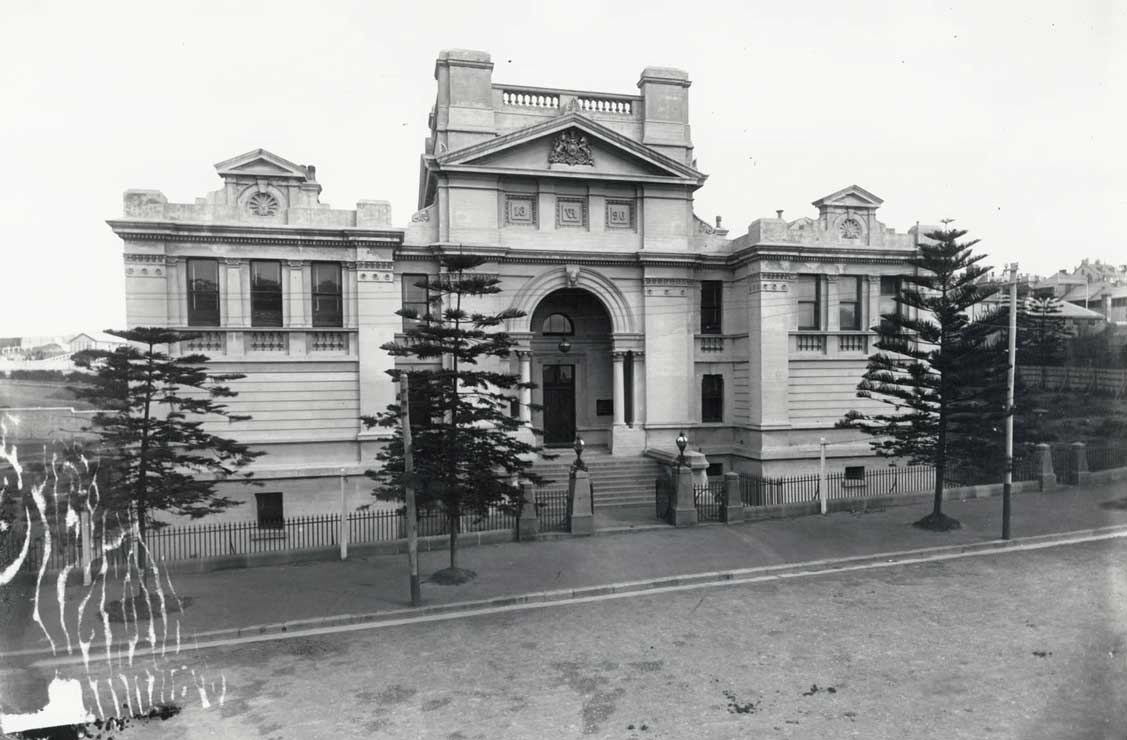
Photo ID: SRNSW 4481_ a026_000536.jpg
The Court being then duly opened, the first case called upon was that of the Northumberland Banking Company, in which so many parties in this district are interested. This case has created a great amount of interest, most of the losers in the collapse being simply working miners in the district. Out of the jury panelled, 50 in number, 38 were challenged, and the following were at last sworn in to act as jurymen: Messrs James Fletcher (manager of the Wickham and Bullock Island Colliery) foreman, Matthew Copeland, Evan Reid, John Gulliver, John Finlayson, John O’Thomas, Patrick Murray, FS Ash, Robert McEwan, Richard Lynn, Charles Rendell, and John Reid.
The case against George Samuel Hadfield (late manager), Chas low, Chas O’Neill, and Walter Sidney, directors of the Northumberland Banking Company, was proceeded with till 6.30 this evening. The main particulars of this case have already been published. Mr Blacket prosecuted on behalf of the Crown, assisted by Mr CG Heydon. The only witness for the prosecution was H Priestly, accountant for the liquidation, who made a detailed examination of the books and accounts &c.—first Hadfield’s, then Lowe’s, O’Neill’s, and Sidney’s respectively. Mr Want, who appeared for Sidney, commenced his cross-examination of the witness, and was followed by Mr Slattery for O’Neill, and Messrs Gorrick and McLachlan for Lowe and Hadfield. The examination of Priestly had not finished when the Court rose at 6.30 pm until to-morrow. The case will probably finish to-morrow evening.
The new courthouse in Newcastle, which was opened officially to-day, will give an additional pleasing feature to the architecture of the city. The general outline of the building is of the Tuscan order, with which is mingled a few details of the Corinthian and the Doric. The new building faces the outlet from the Great Northern Railway Station, leading from the station up Bolton-street to Church-street, presenting rather an imposing frontage to the termination of the latter street, which was formerly bounded by a high stone wall. The whole frontage of the building facing Bolton-street is 106ft, and the depth is 160ft. This, it must be remembered, has been taken off the ground formerly set apart for the Newcastle Police Barracks. The building itself, which is partly two and three stories high, with basement underneath, contains 29 apartments, which are thus allotted: On the ground floor is a vestibule approached, under a portico, by a flight of steps, from which the large courtroom is entered, and which vestibule also leads to a passage from which the rest of the apartments are arrived at. The courtroom for holding Quarter Sessions, District and Circuit Court is a lofty apartment 45ft x 32ft x 30ft, containing a gallery for the public, the latter not being admitted into the body of the court. It will be illuminated by large lanterns from the roof in daytime and at night by gas standard-lights. The police court is 35ft x 25ft x 28ft in the western wing. Both these courts contain ample provision for court officials, reporters, &c, and each apparently possesses full acoustic possibilities. Rooms are also provided for his Honor the Judge, his associate and the sheriff, also for the jury, and in case of prolonged sittings a dormitory has been set apart for the latter. Each of the above apartments has a spacious yard attached. Special rooms have been set apart on the ground floor for the Attorney-General, Crown Prosecutor, and Crown Solicitor, legal profession, police and female witnesses. On the first floor in the eastern wing are the Government architect’s offices. In the basement, which is approached by a rather precipitous flight of steps on the left of the main entrance rooms have been set apart for the district registrar, inspector of police, and also quarters for the court-keeper. The design is by the late Colonial Architect, Mr Jas Barnett, the tender for the execution of the of which was carried out by the contractor, Mr C Cogill, under the supervision of the officers of the Government Architect’s Branch at Newcastle, at a cost altogether of £14,500. The building is mainly composed of brickwork and cement. On the basement are four spacious cells for the detention of accused persons awaiting trial. Special attention has been given to sanitary matters, and ample ventilation in both courts has been provided. Water has been plentifully laid on throughout the building.
~ ~ ~ ~ ~
later became the Newcastle Technological Museum.
Photo ID: SRNSW 4481_a026_ 000535.jpg
Queanbeyan Age, 2 Mar 1892 22
Latest Telegrams.
————————
(From the Federal Press Agency.)
…
NEWCASTLE COURTHOUSE.
Sydney, Tuesday—The new courthouse at Newcastle was opened yesterday. Complimentary speeches were made by the Mayor, Judge Backhouse, and members of the branches of the legal profession. The first case called upon was the charge against the manager and others connected with the Northumberland Banking Company.
~ ~ ~ ~ ~
The Sydney Morning Herald, Mon 6 Nov 1893 23
COUNTRY NEWS.
———◦———
(FROM OUR CORRESPONDENTS.)
———
…
NEWCASTLE TECHNOLOGICAL MUSEUM.
————
Newcastle, Saturday.
The Newcastle Technological Museum (an offshoot of the Sydney Technological Museum), which has until recently been located in a room at the School of Arts, has been removed to the old courthouse, the large hall of which is admirably suited for the purpose. Mr Maiden, the Curator of the Sydney Museum, inspected the new arrangements to-day, and is very well satisfied with the accommodation, lighting of the room, &c. it will be opened in a few days.
~ ~ ~ ~ ~
Newcastle Morning Herald and Miners’ Advocate, Thu 9 Nov 1893 24
TECHNOLOGICAL MUSEUM.
———◦———
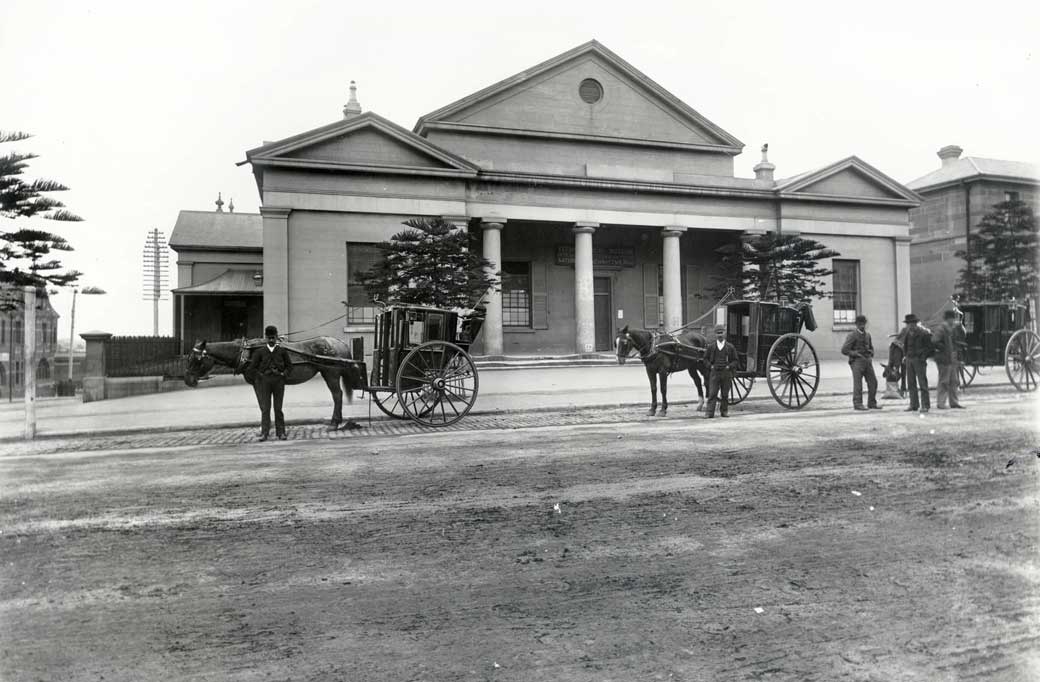
THE question as to what should be done with the old courthouse has been set at rest, as the building has been placed at the service of the Minister for Public Instruction for use as a Technological Museum. The exhibits have been removed from the old museum in the School of Arts buildings, and Mr JH Maiden Curator of the Technological Museum, Sydney, reached Newcastle yesterday morning with the object of arranging the exhibits. He says there is in the museum the nucleus of a very excellent collection, and that several hundred miscellaneous exhibits will be sent from Sydney now that there is room to show them. So far no alterations have been made in the interior of the old courthouse, but the glass cases and rows of exhibits give it a bright appearance. The adjoining rooms will be used for the technical classes.
1 Newcastle Morning Herald and Miners’ Advocate, Wed 17 Dec 1884, pp. 2, 3.
2 The Maitland Mercury and Hunter River General Advertiser, Thu 18 Dec 1884, p. 3.
3 The Sydney Morning Herald, Wed 8 Jun 1887, p. 7.
4 Newcastle Morning Herald and Miners’ Advocate, Thu 9 Jun 1887, p. 3.
5 Newcastle Morning Herald and Miners’ Advocate, Mon 7 Nov 1887, p. 6.
6 The Sydney Morning Herald, Mon 7 Nov 1887, p. 7.
7 Newcastle Morning Herald and Miners’ Advocate, Sat 6 Apr 1889, p. 5. Emphasis added.
8 The Sydney Morning Herald, Sat 6 Apr 1889, p. 8.
9 The Sydney Morning Herald, Wed 12 Jun 1889, p. 8.
10 Newcastle Morning Herald and Miners’ Advocate, Mon 17 Jun 1889, p. 4.
11 The Sydney Morning Herald, Mon 17 Jun 1889, p. 8.
12 The Maitland Mercury and Hunter River General Advertiser, Tue 18 Jun 1889, p. 4.
13 Newcastle Morning Herald and Miners’ Advocate, Fri 21 Jun 1889, p. 5.
14 The Sydney Morning Herald, Fri 21 Jun 1889, p. 9.
15 Newcastle Morning Herald and Miners’ Advocate, Wed 12 Feb 1890, p. 6.
16 Newcastle Morning Herald and Miners’ Advocate, Sat 15 Feb 1890, p. 5.
17 The Maitland Mercury and Hunter River General Advertiser, Sat 19 Apr 1890, p. 8s.
18 Newcastle Morning Herald and Miners’ Advocate, Fri 18 Apr 1890, p. 4.
19 Newcastle Morning Herald and Miners’ Advocate, Mon 29 Feb 1892, pp. 4, 5.
20 Newcastle Morning Herald and Miners’ Advocate, Tue 1 Mar 1892, pp. 4, 6.
21 The Sydney Morning Herald, Tue 1 Mar 1892, p. 8.
22 Queanbeyan Age, Wed 2 Mar 1892, p. 2.
23 The Sydney Morning Herald, Mon 6 Nov 1893, p. 6.
24 Newcastle Morning Herald and Miners’ Advocate, Thu 9 Nov 1893, p. 5.