The Sydney Morning Herald, Sat 2 Jul 1881 1
COUNTRY NEWS.
(By Telegraph.)
(FROM OUR OWN CORRESPONDENTS.)
————
…
Wilcannia, Friday
Great indignation is expressed here on account of the Minister for Justice refusing the Court-house for an amateur concert in aid of the building fund of the Public Library. No other suitable hall is available. An influential meeting has been held here to advocate building a Public Library, there being no institution of the kind here. It is proposed to erect a stone building at a cost o £2000. The Government has given a site. There is £350 now on hand for the purpose.
~ ~ ~ ~ ~
Australian Town and Country Journal, Sat 8 Oct 1881 2
WILCANNIA and VICINITY.
————
BY THE RAVEN.
————
(SEE ILLUSTRATIONS.)
WHILST the little town of Menindie was still sunk in slumber, that is at half-past 4 in the morning, the coach for Wilcannia had started, and was now whirling its passengers—a Chinaman and myself—towards that “gay city,” where, after journeying through 100 miles of the same old description of country as heretofore—saltbush plains, box flats, and sand hills—we arrived at 9 pm, cold, but happy, having dined half way on the road at a place called the Rocky Waterholes, where there is a hostelries kept by one Paddy O’Brien, an Irishman I fancy; and having, four miles from our destination, drawn up at the camp of the workmen employed by Messrs Burton Bros, the contractors for the erection of a bridge over Weychunga Creek, where some hot “billy tea” and a warm at the great box-wood fire once more sent us on our way rejoicing.
“Meat or fruit pies! All hot, all hot! Buy! Buy! Buy!” were the first words that fell upon my ears, as, after delivering the mail at the post-office, we drove through the darkness up the main street of Wilcannia to O’Leary’s hotel. Here all seemed bustle and excitement, for what reason I can’t tell; but the hum of many voices, the clink of glasses, the rattle of billiard balls, and the above energetic and persevering, but discordant cry of some enterprising pieman, accompanied by the distant jingling of a consumptive piano, forms a “harmonious whole,” which was far from unpleasant after the quiet of the last few weeks, and was, in fact, the nearest approach to city life experienced since leaving Sydney.
I hear, too, upon the most undeniable authority, that some time ago, a real live shoe-black was in the habit of parading the streets of Wilcannia and accosting the passers-by with the familiar words, “Clean your boots, sir?” Another instance of advanced civilisation! But the shoe-black shades into insignificance, when I tell you that there is actually a hairdresser in the town, who comes from Paris, yes, my friends! from Paris! a Parisian hairdresser! I have seen him myself, and seeing’s believing. After these evidences of such a high state of civilisation, no one will again imagine that the inhabitants of Wilcannia live in a state of semi-barbarism, and I think also that the day has gone in which anyone will be heard to say, “Wilcannia, Wilcannia? I’ve heard the name somewhere, it’s on the Gulf of Carpentaria, isn’t it?”
The population of Wilcannia is about 1000, but besides these there are always a great many passing through on their way to the various districts of which it is the centre, not the least important of these being the diggings at Mount Browne. I am told that before the rain fell, the town was crammed with men waiting to go out to the rush, and that the streets were very much after the style of George-street on a Saturday night. During this time the proprietors of billiard rooms in the town did a roaring trade, it being quite a common thing for the diggers to play a game for £50 a side; even now the billiard markers are never idle, as the balls are kept rolling the whole day long, and in the evening one experiences a good deal of difficulty, sometimes, in finding even standing room. This is very different from most of the Riverina towns through which I have passed, where the game, as a rule, is not commenced until evening.
The town is mainly composed of one long street, although there are several private residences round about, and is exceedingly fortunate in the possession of some splendid stone quarries, situated some three miles away; this tone, of which all the public buildings, as well as some of the business premises, are built, thereby lending a handsome and substantial appearance to the town, is almost a pure white, and is undoubtedly of as fine a quality, both as regards appearance and durability, as it to be found in the colonies; it is said that whilst being worked it can almost be cut with a knife, but that after a short exposure to the atmosphere it hardens in a remarkable manner. In addition to this there are, between Wilcannia and Mount Manara, large quantities of gypsum to be obtained; as this makes a cement not easily to be surpassed. I have no doubt that before long an extensive industry will be carried on in the manufacturing of this material.
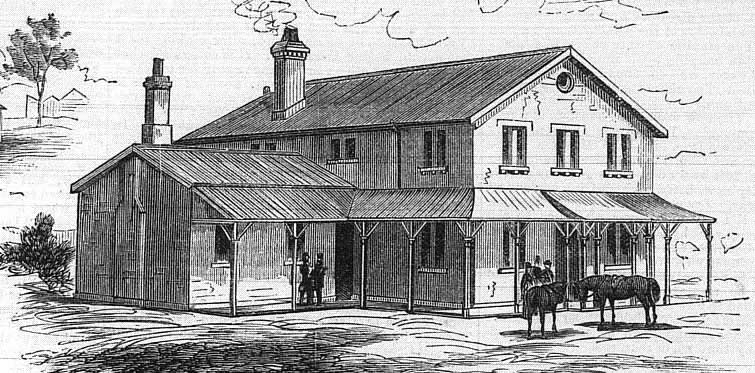
Sat 8 Oct 1881, p. 696. Reproduction: Peter de Waal
To give an idea of the centrality which Wilcannia occupies, I cannot do better than mention the various lines of coaches which make it their terminus, viz, Charters Bros, the mail contractors, run a bi-weekly, and Cobb and Co, a tri-weekly coach, between here and Deniliquin; Burton Bros, a weekly coach to Wentworth; D and M Morrison, same, to Bourke via Cobar, also to Mount Browne; F Crews and Co, same, via the Barrier Ranges to Terowie, the terminus of the SA main north line; W Hammet, same, to Hungerford Queensland; Cobb and Co also run a weekly coach to Mount Browne.
I send you a sketch of the hospital. This institution, which is a credit to the town, was only opened last year, and was built at a cost of £3000, the Government having granted five acres of land for the purpose. At the time of my visit it contained 20 inmates, all of whom were progressing favourably under the care of Dr McLean, who has only recently succeeded Dr Sibley. I ought also to add, in justice to Mr FC Summerlees, the wards man, that the order and cleanliness observed in the internal workings of the institution do not belie its external appearance.
There is a handsome stone Church of England in course of construction here, but when it will be completed remains to be proved in the dim vista of the future, as its promoters have not taken the precaution of cutting their coat according to their cloth, which simply means that they have not “the wherewithal” to complete what they have begun. The service is at present held by the Rev JH Price, in the court house. The Presbyterian denomination is also represented here, the Rev Wm Walker being its pastor.
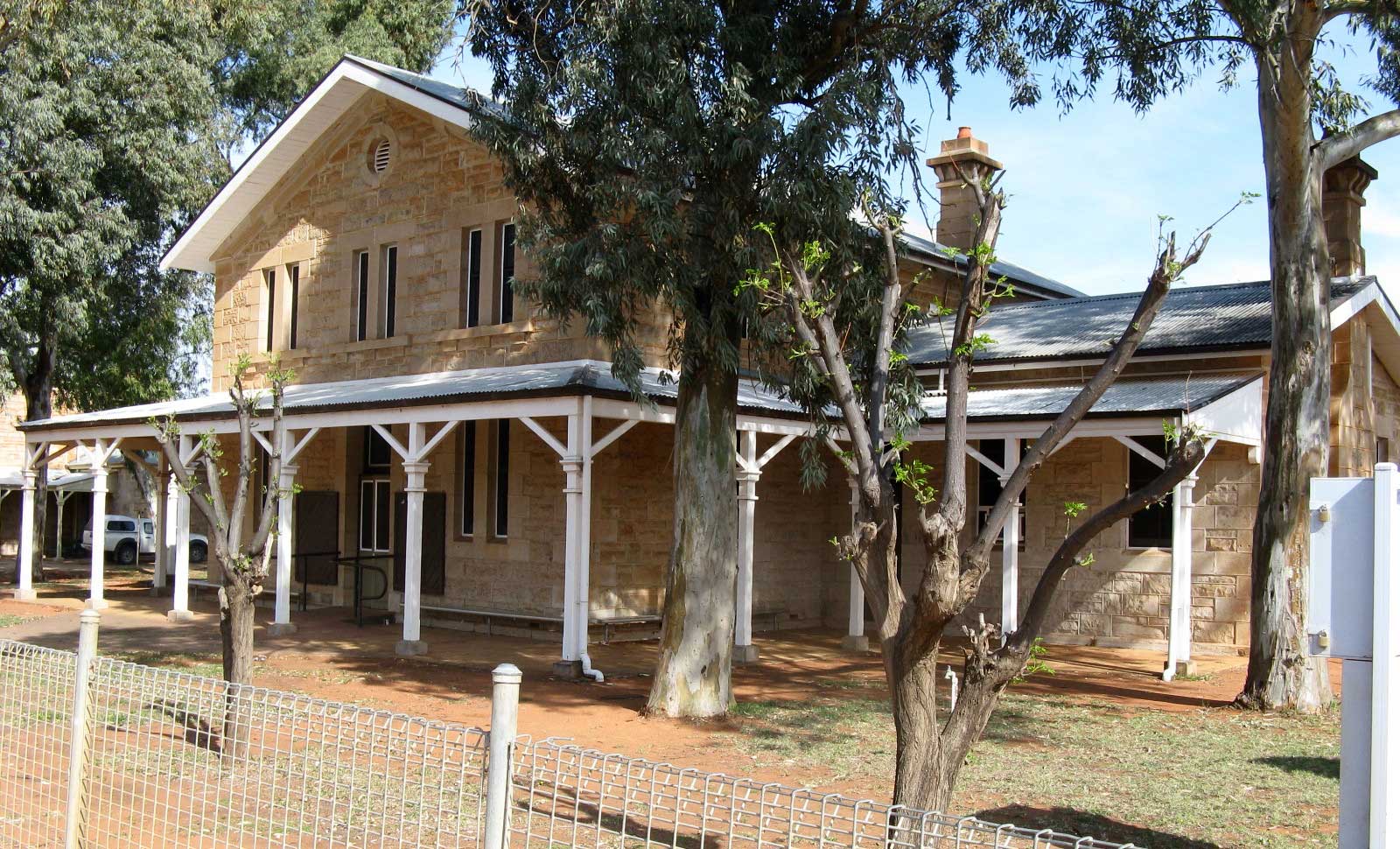
Designed by NSW Colonial Architect, James Barnet. Photo: Peter de Waal
Of the seven or eight general stores in Wilcannia, those of Messrs A Kirkpatrick and Co, Cramsie, Bowden and Woodfalls, and Messrs WC Palmer and Co stand out prominent; in fact, one might rank these firms more as merchants than storekeepers. Opposite the premises of the first named, which are, I am told, larger than those of any other inland store in New South Wales, are the court house, gaol, and police quarters, which, collectively, form a really handsome group, having been recently erected, and the local quarries having been called into requisition for the purpose. The post and telegraph offices, together with the master’s residence, are (as you will see from the illustration) both a substantial and ornamental piece of architecture. The public school, which is under the superintendence of Mr Hutchinson, was at one time “the edifice” of Wilcannia, but now takes a very modest place amongst the buildings of the town, and will, if the town progresses as many expect, soon become too small for the requirements of the neighbourhood.
Wilcannia is not wanting in hotels, there being nine in the town, Mr O’Leary’s Mount Murchison and Felgate’s dividing the palm pretty equally between them. The former is the “old established House,” and the stopping place for almost all the lines of coaches; but the latter, being recently finished, is the more imposing structure of the two, being a fine two-storey stone building. Talking of hotels one naturally comes to breweries, of which there are two in Wilcannia, that of Messrs Resch Bros, which is a three-storey stone building, forming quite an ornamental feature to the town. This firm, which gets through about 30 hogsheads per week, does a large export trade in bottled beer, especially with Queensland. Amongst other local industries there are two woolscouring firms, three saddlers, amongst whom Messrs Edmends and Allchin stand for most, employing some 10 or 12 men, besides the usual number of blacksmiths, wheelwrights, &c.
A School of Arts is greatly needed in Wilcannia, for which purpose there are already £300 in hand, all that is now wanting being some leading spirit to take the matter up, upon which the thing could be worked into existence in a very short time; in fact, there is very little doubt that if it contained a large hall, suitable for lecturing, theatricals, &c, it would very soon pay for itself.
Branches of the AJ Stock and Commercial banks are established here, neither of them being endowed with very elegant quarters, especially the former, which I took at first for a butcher’s shop, until one of the young bankers told me it was the scene of his daily labours. The manager, Mr Eliot Mullens, kindly allowed me to see 315oz of Mount Browne gold which he had bought. Amongst it there were nuggets of the following weights, viz, one 15oz 6dwt, one 3oz 2dwt, one 2oz 10dwt, two 2oz, three 1oz, and several ½oz. All of this goes down to Victoria, and will continue to do so until something in the shape of an escort is established between here and, say, Narandera [sic], the present terminus; and it is not only the gold that is thus diverted from its proper destination, but also the wool grown in the immense district of which Wilcannia is a centre, all of which goes down to either Adelaide or Melbourne. Besides these two materials there is something else that goes down from here to either one or the other of these two capitals, and that is, orders for goods, which amount to no insignificant sum. As a proof of this I might state the fact that a commercial traveller from our own capital is almost a curiosity up here, but that from Adelaide or Melbourne they “come up in mobs.” In spite of this provisions are at famine prices in Wilcannia—flour £6 per bag, with every probability of its becoming £10; and this because the Darling is unnavigable and does not seem likely to rise for months. What is the panacea for all these evils? What will turn the trade and resources of this grand district into its legitimate channel? Echo answers, “What?” the people of Wilcannia, “A railway;”—and I believe them.
I was initiated the other evening into a pastime which is very fashionable here at present, namely, the “game of yes,” in which the unlucky individual who first gives utterance to the affirmative monosyllable has to “shout drinks for the crowd;” a splendid game! (for the publicans). There are supposed to be two cricket clubs here, but their members do not (and wisely) allow that fine game to monopolise all their thoughts, words and deeds; they, like myself, considering that there are things in this life of quite as grave importance as cricket. I should not omit to mention (and it might be a hint worth taking to other upcountry communities) that the “young bloods” of Wilcannia have organised a very pleasant institution, namely, a monthly dancing party, in the old court-house, when a few enjoyable hours are spent on “the light fantastic toe.” I need not add that certain mammas make a point of chaperoning their daughters to and from the dance, which, no doubt, will cause a thrill of gratitude to pass through the breasts of the opposite sex.
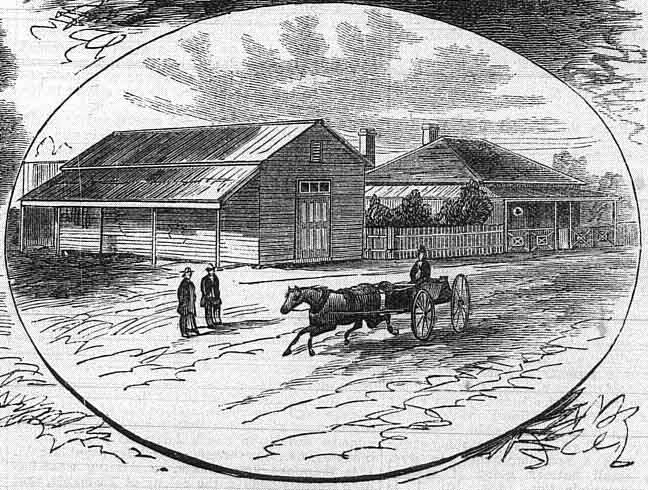
Journal, Sat 8 Oct 1881, p. 696. Reproduction: Peter de Waal
There are two weekly papers in Wilcannia, the “Western Grazier” and the “Wilcannia Times,” the former being published by Messrs Reid and Co and the latter by Mr Walterus Brown. There has been a good deal of discussion lately about the advisability of forming a municipality here, but nothing definite has, as yet, been arrived at; in the meantime, I suppose, they will content themselves with a progress committee, which has been in existence for some time.
The proprietor of the Wilcannia punt is an ingenious fellow; he keeps two or three pet sheep, which follow him about like dogs. By means of these he is able to cross a mob of 10,000 travelling sheep in the time usually occupied in getting these most stupid quadrupeds to start. The other day he surprised a drover, who wished to cross a mob of 8000, by the ease and speed with which he accomplished his purpose. He made a kind of pontoon of the punt and a few planks, asked the aforesaid drover to have all the sheep “rounded up,” and walked on to his improvised bridge followed by his pets. These were soon followed, I need hardly say, by the entire number. To all owners of punts or pontoons I would say “Go thou and do likewise.”
An hour or two ago Morrison’s coach from Mount Browne arrived with 396oz of gold. Consequent excitement! Although Chinese are not allowed at Mount Browne, there is no lack of them in Wilcannia, most of them being interested in the cultivation of vegetables, without which life up here would be almost unendurable; and they do not draw the line at vegetables, as grapes and figs bring in no small revenue to their pockets.
1 The Sydney Morning Herald, Sat 2 Jul 1881, p. 6. Emphasis added.
2 Australian Town and Country Journal, Sat 8 Oct 1881, p. 699. Emphasis added.