Australian Town and Country Journal, Sat 27 Jul 1878 1
MINISTERIAL TRIP TO YASS.
————
THE Hon J[ames] S[quire] Farnell, Premier, the Hon Mr Fitzpatrick, Colonial Secretary, the Hon John Sutherland, Minister for Works, and the Hon JW Foster, Attorney-General, made a semi-official visit to Yass, on Saturday, having left Sydney on Friday evening by train. Mr Barnet, Colonial Architect, was with the ministerial party. The occasion of this outing on the part of the leading members of the Government was the laying of the foundation stone of the Yass Court-house. This ceremony was regarded by the people in and around Yass as one of considerable local importance, and the inhabitants gathered in strong force to witness it, and to give as much eclat to the proceedings as possible. The Colonial Secretary being the representative of Yass in Parliament, the duty of laying the stone was very appropriately allotted to that gentleman. The ceremony took place about noon, the site of the new building being in Cooma-street, and the proceedings were initiated by the Mayor of Yass, Dr Perry, inviting Mr Fitzpatrick to lay the stone, at the same time presenting the hon gentleman with an exceedingly handsome myall mallet and silver trowel, each article being suitably inscribed. Mr Fitzpatrick performed the ceremony of laying the stone with the usual formulas, and then addressed the assemblage at considerable length, chiefly upon matters affecting the Yass people. Speaking more generally, he expressed his earnest desire to see municipalities or shire councils pervading the whole colony, as tending, firstly, to purify the central government, and secondly as being the best schools for rearing up public men. He mentioned that the money for the building of which he was then laying the foundation-stone was not granted by the present Government, but had been placed on the estimates by the Government of Sir Henry Parkes, and voted, he believed, by the Government of Sir John Robertson. It therefore only remained for the present Government to carry out the work. Mr Fitzpatrick’s remarks were received in a manner which showed that the inhabitants of Yass believe in their representative. The afternoon was pretty well devoted to deputions, [sic] and the townsfolk had a field day with their local wants and grievances. One grievance was the site of the present post office, and on the present inadequate accommodation being represented to the Colonial Secretary, that gentleman promised his interviewers that if they could secure the allotments they had their eye on,—near the Joint Stock Bank, in Cooma-street—he would place a sum of money on the estimates sufficient for the purpose. Another matter brought under Mr Fitzpatrick’s notice was the want of money for the hospital, and assistance was asked from the public purse. Mr Fitzpatrick explained the terms upon which public money was granted to such institutions, namely, twenty shillings of public money for every pound raised by bona fide private contributions; and he told them they could have as much money as they liked on these terms. The Minister for Works, Mr Sutherland, was kept very busy during the afternoon attending to his interviewers. There seems to be a dispute about a road and a bridge, somewhere about Yass, some people wanting them in one place and others in another; and, accordingly, to give the Minister an opportunity of judging for himself (and by way of sharpening his appetite for the banquet that was to follow), they trotted him out about ten or twelve miles to see the roads and the proposed sites for the bridge. If Mr Sutherland’s entertainers expected him to give a decision right off-hand, they were disappointed. He gave them just such an answer as he might have been expected to return, namely, that each side would have its claims duly considered, and, after all information was collected by the proper officer, he would decide where the bridge should be erected, and in which direction the road should go.
During the afternoon, the Ministers and several of the leading residents visited the Yass Gaol, and had a look at the additions and alterations going on in that building. They afterwards visited the public school, now being erected in North Yass—a fine building, and nearly completed.
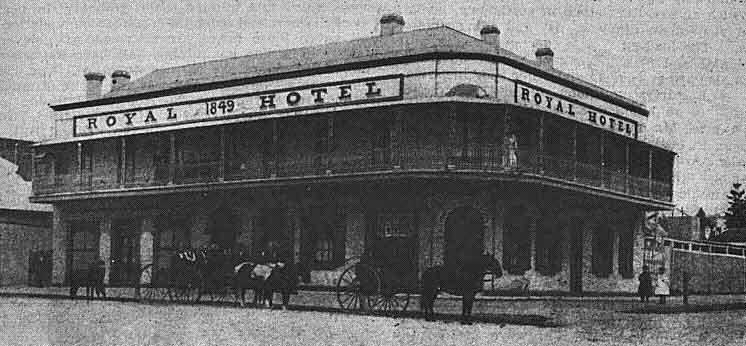
Sat 1 Dec 1900 p. 35. Reproduction: Peter de Waal
The banquet in the evening was a tip-top affair, the oldest inhabitant pronouncing authoritatively that the like of it had never before been seen in Yass. It was held at the Royal Hotel, and the large room of that well-known hostelrie [sic] was fairly crowded, about seventy gentlemen being present in good form for using their knives and forks. Dr Campbell, the oldest magistrate in the district, occupied the chair, having on his right the Premier and the Attorney-General, on his left the Colonial Secretary and Minister for Works, and in front of him a fine large turkey, “fat and young,” like Mr PV Nasby’s. Dr Perry, mayor of Yass, was in the vice-chair. The usual loyal and complimentary toasts were done full honour to, after the viands had been dealt with. To the toast of “Our Guests,” all of the Ministers had something to say—the Colonial Secretary the most. They let out no state secrets, however, and foreshadowed nothing of their policy, and spoke more about social and personal matters than politics. Mr Fitzpatrick, during his innings, justified the formation of the Ministry, contending that they were constitutionally in office, and that there was nothing in the personnel of the Government to prevent them from filling the offices they had been called up to fill. As to their fitness to govern, that must be judged by results. The speeches of the Ministers were very favourably received. A capital band—the Oddfellows band—played appropriate airs to the toasts.
The Ministerial party left Yass on Sunday night by the ordinary train, and reached Sydney safely next morning; all well.
~ ~ ~ ~ ~
Australian Town and Country Journal, Sat 31 Aug 1878 2
YASS COURT HOUSE.
————
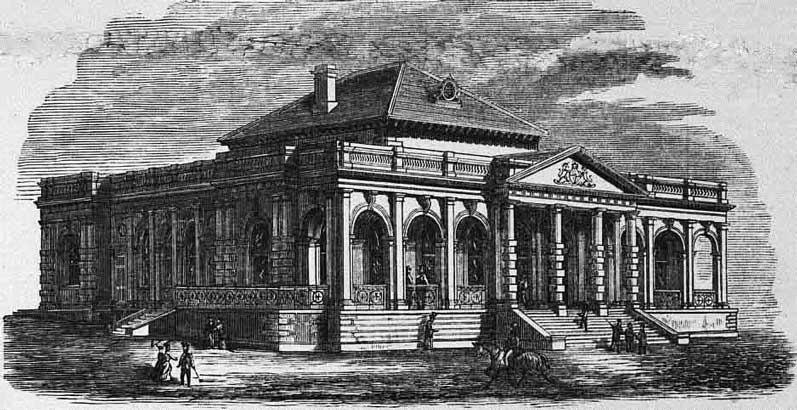
Sat 31 Aug 1878, p. 409. Reproduction: Peter de Waal
WE are glad to be able this week to present to our readers an illustration of the new court house at Yass, now in course of erection, the ceremony of laying the foundation-stone of which, on this 20th of July last, by the Honourable the Colonial Secretary, in the presence of the Premier, Minister of Works, Attorney-General, &c, was duly recorded in our columns. The design has been prepared by the Colonial Architect, and is on a scale commensurate with the requirements of the district. The style chosen is classic of the Roman Doric order. Advantage has been taken of the site to give effect to the design by its approach, which is by a very broad and imposing flight of steps. The principal front consists of a colonnade extending upwards of 104 feet, with central portico in advance of four detached rusticated columns supporting a pediment to be filled in with the Royal arms. The elevation to Rossi-street is also of an ornate character, the wings having engaged columns and pilasters. Whatever attention has been given to architectural treatment, the “plan” must always be the great object of consideration. In this case the utmost simlicity [sic] of arrangement has been adopted, and the block is nearly a square; and consists of a court-room in the centre 45ft by 30ft and 25ft high, lighted by windows at the side. It contains a bench, with large canopy over, ample space for the public, and the usual arrangement of court fittings, the entrance to the prisoners’ dock being obtained by a passage under the floor of the court. The court is separated from the portico by an enclosed lobby, 10ft wide and 30ft in length, and is also separated from the offices by passages 6ft wide, extending along the sides and end. This preserves the quietness of the court; and, by offering every facility of communication with the different offices, prevents the court being used as a thoroughfare. The accommodation consists of judge’s room, 20ft by 15ft, with separate entrance and lavatory; sheriff’s room, 15ft by 15ft; lands office, 25ft by 15ft; clerk of petty sessions’ room, 15ft 3in by 15ft; two jury rooms, each 20ft by 15ft; room for witnesses, 18ft 9in by 15ft; barristers’ room, 18ft 9in by 15ft; attorney-general and crown solicitor’s room, 16ft 8in by 15ft; police magistrate’s roon, 16ft 8in by 15ft. Enclosed yards have been arranged for the judge and jury, and every accommodation provided for the court officials and the public. Great attention has been paid to the ventilation of the court-room and offices. The system adopted is a modification of that known as Tobin’s, and has been adapted by the Colonial Architect with great success, pure air being freely introduced by galvanized iron pipes throughout the entire building.
Mr Horn, of Goulburn, is the contractor.
~ ~ ~ ~ ~
The Sydney Morning Herald, Mon 2 Feb 1880 3
YASS.
Saturday.
The Joint Stock Bank intend building new premises on land in Cooma-street, purchased yesterday.
At a meeting held last night it was decided to commemorate the opening of the new Court-house by a public ball on the 1st of April, the date of the Circuit Court sitting.
Dissatisfaction exists that tenders are not called for the erection of the post-office, the plans for which were completed six months since.
An agitation is likely to be shortly commenced for the formation of a tramway to connect the town with the railway.
Petitions in favour of the Education Bill are being numerously signed, and Roman Catholics are willingly attaching their signatures.
~ ~ ~ ~ ~
The Yass Courier, Fri 2 Apr 1880 4
LOCAL AND GENERAL.
———◦———
YASS CIRCUIT COURT.
THIS court was opened yesterday at ten o’clock before his Honor Mr Justice Hargrave. Mr WL Merewether was crown prosecutor. Mr Willans represented the crown solicitor. Mr RW Robberds was clerk of assize. Mr C Cowper, sheriff, was in attendance. The legal gentlemen present were Mr Wilkinson and Mr Iceton. Mr H Hall, JP, had a seat on the bench.
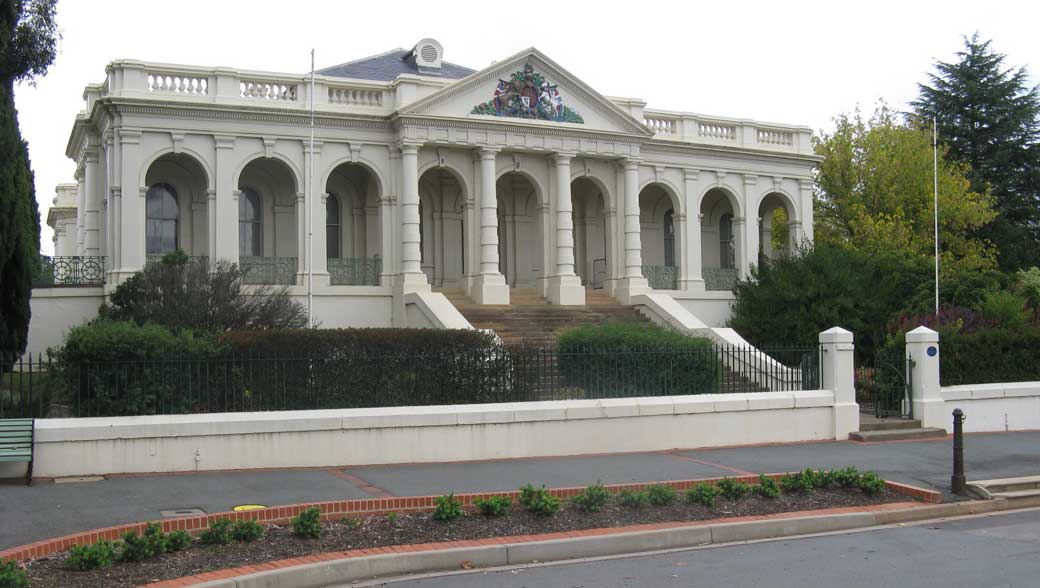
Photo: Peter de Waal
Before the proceedings of the court commenced, his Honor Mr Justice Hargrave said—It is now ten years since I had the honour of inaugurating the establishment of Circuit Courts at Albury, thereby extending the regular assize sittings by the Supreme Court Judges in all civil criminal matters among the inhabitants of that remote but beautiful district of our colony. I then addressed a few observations at the opening of the Albury Court as to the great value of thus extending out Supreme Court sittings to all parts of the colony—wherever extra labour on the part of the Supreme Court Judges can thus “bring justice home” to the inhabitants of the colony—and especially to jurors, witnesses, litigants, and suitors of every degree, and more especially in suitable buildings, such as will be enjoyed henceforth by the Yass district.
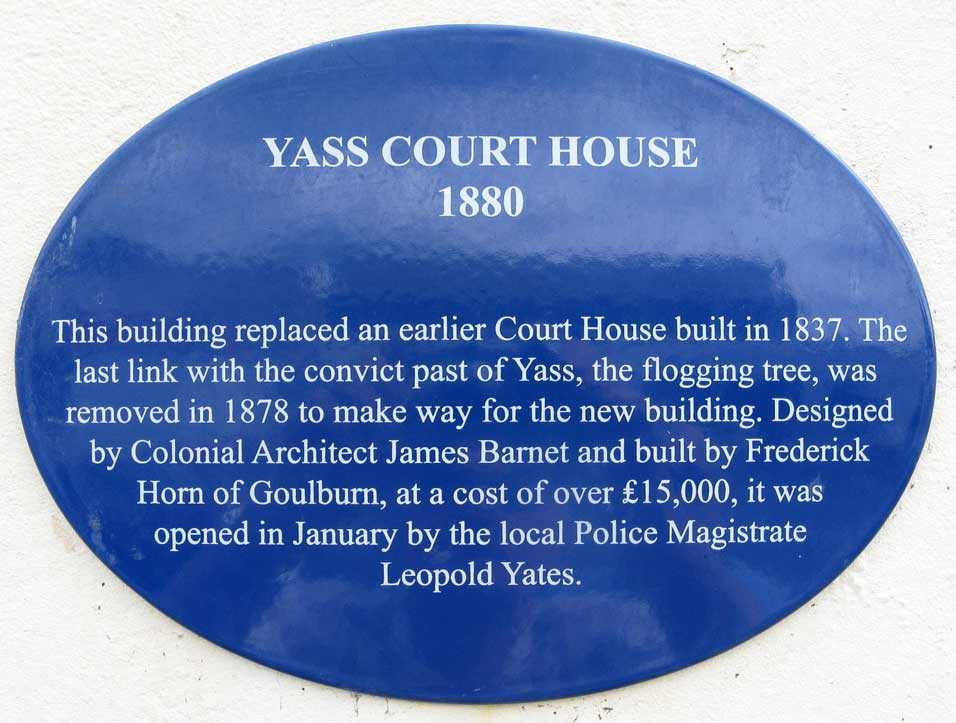
With regard to the building itself, it provides such ample accommodation, not only for the daily business of your able and experienced police magistrate (Mr Yates) and for the local magistrates who join him in the administration of justice for this district, but also for the multitudinous official business in the District Court and under our Land Acts, that this handsome building, with its well-arranged apartments for the judges, jurors, professional gentlemen, and witnesses, evidently constitute the most perfect court-house ever granted to any district of our colony. As I always prefer to adopt the language of great and good men, whose words have become established and familiar to us all, wherever the English language is spoken, I will read to you one single extract expressive of my own thoughts on this occasion. The passage I will read to you is a short page from Macaulay’s History of England, which I am sure will be welcome reading to every one who has ever perused the pages of that invaluable historian:—“Now, if ever,” says Macaulay (writing in 1853, at the close of the European insurrections and the opening of the Crimean was)—“Now, if ever, ought all who enjoy the protection of British law to appreciate the wisdom and patriotism of our forefathers. All around us the world is convulsed by the agonies of great nations. Governments which seemed likely to stand during ages have been, on a sudden, shaken and overthrown. The proudest capitals of Western Europe have streamed with civil blood. All evil passions, the thirst of gain, the thirst of vengeance, the antipathy of class to class, the antipathy of race to race, have broken loose from the control of all human and Divine laws. Fear and anxiety have clouded the faces and depressed the hearts of millions. Trade has been suspended, and industry paralysed. The rich have become poor and the poor have become poorer. Doctrines hostile to all sciences, to all arts, to all industries, to all domestic charities—doctrines which (if carried into effect) would in thirty years undo all that thirty centuries have done for mankind, and would make the fairest provinces of France and Germany as savage as Congo and Patagonia—have been avowed from the tribune and defended by the sword. Europe has been threatened with subjugation by barbarians, compared with whom the barbarians who marched under Attila and Alboin were enlightened and humane. The truest friends of the people have, with deep sorrow, owned that interests more precious than any political privileges were in jeopardy, and that it might become necessary even to sacrifice liberty to save civilisation. Meanwhile (writes Macaulay) in Great Britain and Ireland the regular course of government has never been for a day interrupted. The few mad men who longed for license and plunder have not had the courage to confront, for one moment, the strength of a loyal nation rallied in firm array around a parental throne. And if it be asked what has made us to differ from others, the answer is—We never lost what others are wildly and blindly seeking to regain, the authority of law, for the security of property, for the peace of our streets, for the happiness of our homes.”
Her Majesty’s proclamation for the encouragement of piety and virtue and for preventing of vice and immorality will now be read by my associate, as appointed to be read before the opening of all Courts of Assize in the Queen’s dominions.
The Clerk of Assize then read the Queen’s proclamation, and the business of the court commenced.
1 Australian Town and Country Journal, Sat 27 Jul 1878, p. 8. Emphasis added.
2 Australian Town and Country Journal, Sat 31 Aug 1878, p. 409.
3 The Sydney Morning Herald, Mon 2 Feb 1880, p. 5.
4 The Yass Courier, Fri 2 Apr 1880, p. 2.