The Wellington Times, Thu 19 Mar 1908 1
A NEW COURTHOUSE
WANTED.
————
ATTENTION has more than once been directed in these columns to the antiquated building which does duty as a courthouse in Wellington. When the town was about half the size of what it is at present this building may have served the needs of the time, and may even have appeared an imposing structure to those who had been condemned to do with worse. The conditions, however, have changed materially since the courthouse was erected. Wellington has gone ahead by leaps and bounds and has achieved a position in the State which entitles it to the consideration of the Government in the matter of public buildings.
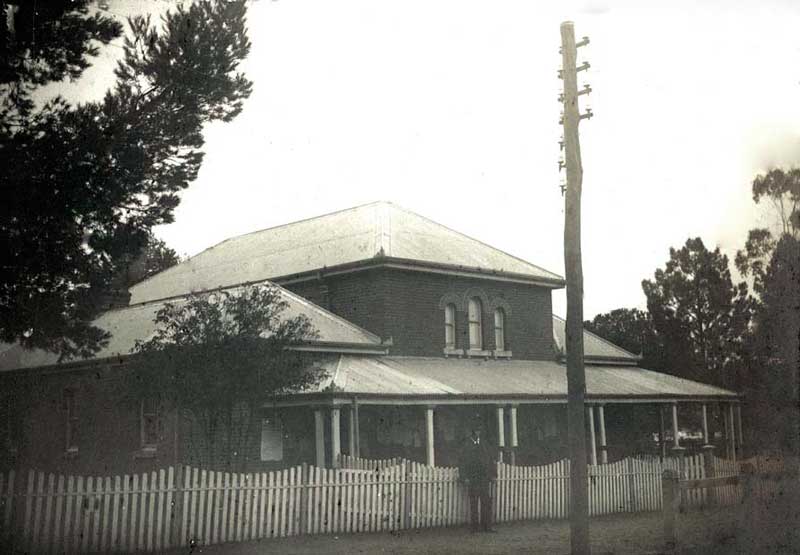
Colonial Architect, build 1872 by George Kennard.
Photo ID: SRNSW 4346_a020_a020000102.jpg
The present courthouse is from every point of view a disgrace to the Government that owns it. The lapse of years has played havoc with it, and cracked ceilings and other signs of decay give warning that something will have to be done before long. While the dilapidated condition of the building is a well-founded cause of complaint, a renovation would not make it any less objectionable than it is, because the principal trouble is the total inadequacy of the building for the purpose to which it is devoted. It might meet all the requirements of a back-blocks township with a small population, but even were it a new building it would not suffice for the requirements of Wellington. When sittings of the higher court are held, especially in the hot weather, the conditions that prevail are intolerable. A certain number, of course, attend the court out of curiosity or other motives, but the vast majority are there on account of being concerned in the causes listed or because they have been summoned to serve their country as jurymen, and under these circumstances they have a claim to some consideration for their comfort and even their health, which certainly does not benefit by being crowded into a building reeking with a polluted atmosphere. There is no suitable accommodation for the jurymen, litigants, or witnesses compelled to be in attendance. The furniture of the court is of the most primitive character and occasions great inconvenience to all who have business at the court. The sight of a judge clad in his scarlet robes, sitting in state in such a hovel, would be laughable if it were not pitiable. The dignity which should surround a court of justice is impossible in such a shabby environment, and that in itself should be sufficient to stir the authorities to action. When this matter was commented upon previously, officers were sent along to report, and the only possible report they could make was that a new building was absolutely necessary. As a consequence it was stated that a new courthouse would shortly be erected, but apparently the papers in connection with the matter have been stowed away in a pigeonhole and forgotten. The officials charged with the duty of attending to these matters do not have to suffer the discomfort of those who have to use the court. Sitting in their comfortable and well-furnished offices in the city they no doubt feel it an annoyance to be troubled by the wants of the people in the country, who are regarded as being very inconsiderate when they disturb the peace of a Government department by clamouring for attention to their affairs. This, however, must not be allowed to serve as an excuse for the scandalous delay that has taken place in connection with the Wellington courthouse, and the member for the district in the State Parliament would do a service to the town by shaking things up in a way that would be productive of some practical result. The official reports will give him such a strong case to put before the Minister that he should have little difficulty in arousing that gentleman to the necessity for stirring up the offers of his department to do something within a reasonable time.
~ ~ ~ ~ ~
The Sydney Morning Herald, Fri 26 Jun 1908 2
AN INDIGNANT COUNCIL.
———
Wellington, Thursday.
When the Minister for Public Works was in Wellington at show time a request was made to him for a new courthouse by the municipal council. Through Mr Barton, MLA, a letter was received from the Attorney-General’s Department stating that the Minister was unable to approve of the erection of a new building at present, but that additional accommodation would be provided for the clerk of courts, the additions being designed in such a way as to permit of the court room being enlarged at a later date. The Mayor moved that a letter be sent to the department stating that the council thought they had been very unfairly treated over the matter, and that in the opinion of the council no repairs would meet the convenience required. As much money had been spent during the past few years as would have built a new courthouse. Alderman Lennard, in seconding the motion, said the building was a disgrace to Wellington. Many towns of half the size had a better building.
~ ~ ~ ~ ~
The Sydney Morning Herald, Mon 8 Feb 1909 3
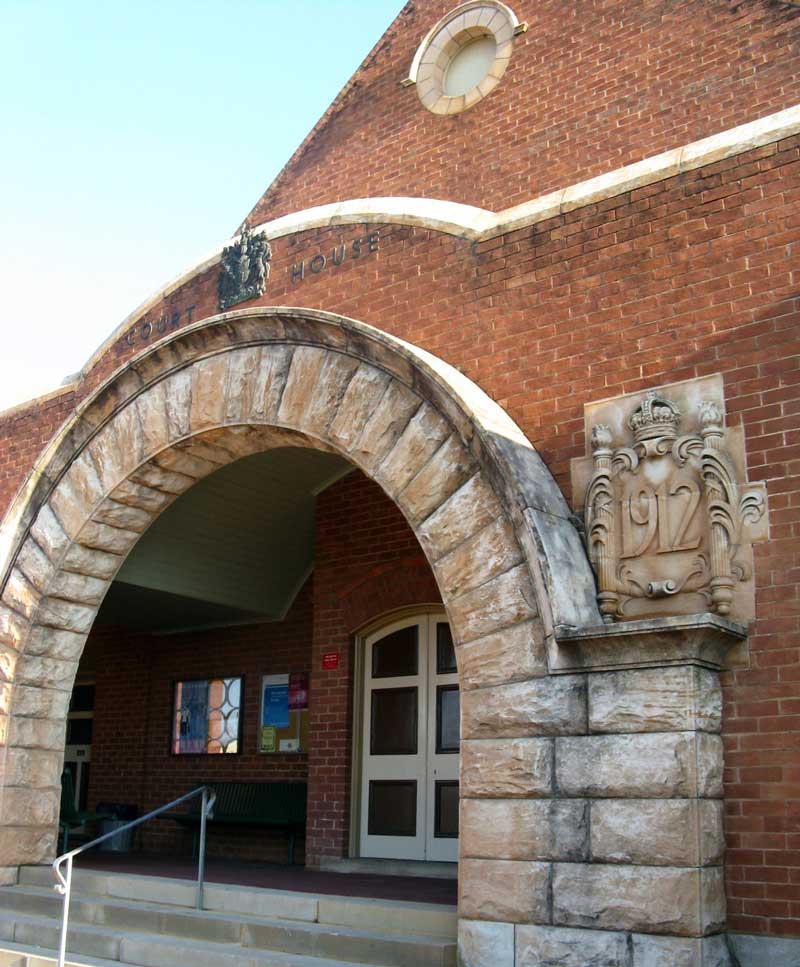
Photo: Peter de Waal
DEPARTMENTAL ERROR.
———◦———
WELLINGTON ALDERMAN AMUSED.
———
Wellington, Saturday.
The council for a considerable time past has been agitating for a new court-house, to replace the present dilapidated structure, and finally it was promised that the matter would receive consideration when the estimates were being prepared. After the estimates had been passed by Parliament, the council wrote to the department, asking if any provision had been made for the court-house, and the reply received was that no money had been placed on the estimates for this purpose, but that £300 had been provided for additions to the Wellington gaol. The reading of the letter was greeted with laughter, and it was decided to draw the attention of the department to the breach of faith with the council. Why the reference was made to the gaol is inexplicable, as the council has never complained of the inadequate accommodation of that institution.
~ ~ ~ ~ ~
The Sydney Morning Herald, Fri 5 Mar 1909 4
WELLINGTON COURT-HOUSE.
——
MINISTER CHARGED WITH EVASION.
——
Wellington, Thursday.
Some time ago the municipal council wrote to the Public Works Department asking if a sum of money had been placed on the estimates for the erection of a new court-house at Wellington, as had been promised, and received a reply tat £300 had been placed on the Estimates for an addition to the gaol. The council then wrote repeating the question, and the reply received was that the work of erecting a new court house would have to await the provision of funds by Parliament. The Mayor remarked that this was an evasion f the question, and was not a reply to the question asked. It was decided to again write to the department, asking specifically if it was intended to place a sum on the next Estimates for the erection of a new court-house.
~ ~ ~ ~ ~
The Wellington Times, Thu 22 Feb 1912 5
THE COURT HOUSE.
————
A commencement has been made to pull down the old court-house with a view to the erection of the long promised new building. The old court-house in one of the antiquities of the town. Wellington was a very small place when it was erected, and for a considerable time it served as a place of worship for various denominations. Its disappearance will not be regretted by those whose business used to take them to it. The accommodation was totally inadequate for a town of the importance of Wellington, and in both cold and hot weather a long day in the court entailed discomfort on those who had to be there.
~ ~ ~ ~ ~
The Sydney Morning Herald, Wed 8 May 1912 6
PREMIER IN THE WEST.
———◦———
WELLINGTON’S WELCOME.
——
NO PARTY POLITICS.
——
Wellington, Tuesday.
The Premier, accompanied by Messrs Johnson, MP, Thrower, Dunn, and Ashford, MsLA, arrived from Stuart Town per motor yesterday afternoon, and was met on arrival by the Mayor and alderman of the municipality and the president and councillors of the Macquarie Shire Council, and welcomed to the district. Later a deputation from both councils asked the Premier for a grant of £500 towards the development and lighting of Wellington.
The Premier replied that he would look into the matter, and see if he could give some assistance on the next Estimates. He also promised to go into the matter of providing a clock in the new court-house in course of erection.
~ ~ ~ ~ ~
The Wellington Times, Thu 5 Sep 1912 7
RESTORING THE QUARTER
SESSIONS.
————
As the new court house in Wellington is approaching completion the opportunity would be a favourable one to renew that agitation to restore the quarter sessions, abolished some time ago. As a judge has to come to Wellington to deal with district court matters, it does not seem reasonable that if there is a criminal case to be tried here the judge will go on to Dubbo next morning, and the parties involved in the criminal case will have to do likewise. A suggestion has been thrown out that the Attorney-General should be invited to open the new courthouse, and that the facts should then be placed before him in a way that could not be done by the ordinary methods of dealing with the department. The Municipal Council might take the idea into consideration.
~ ~ ~ ~ ~
The Wellington Times, Thu 10 Oct 1912 8
OPENING THE NEW COURT HOUSE.
————
A letter from Mr Thrower, MLA, stating that the Attorney-General had consented to come to Wellington to open the new court house was read at the meeting of the municipal council on Thursday evening. The Mayor stated that there would also be a big Parliamentary party if the opening were arranged for a Monday, and asked if it were the intention of the council to entertain the visitors. Ald FH Kennard thought they ought to do something and the Mayor observed that the visitor was a Minister of the Crown, and when he came to Wellington should be treated properly. If they got ten or twelve men representing all parts of the State to come with the Minister it would not do the district any harm. It was decided on the motion of Aldermen Rose and McLeod that the Attorney-General and members accompanying him be entertained att a banquet. The Mayor intimated that it was his intention to call a meeting of citizens in connection with the matter.
~ ~ ~ ~ ~
Leader, Tue 15 Oct 1912 9
LOCAL AND GENERAL.
————
…
WELLINGTON COURT-HOUSE.
A big Parliamentary party are to arrive in Wellington shortly to open the new Court-house at that town. The Wellington folk are going to make a gala day of it, and the town will be en fete. En passant, the “Times” says:—“The question of restoring the quarter sessions will be one of the matters which will be brought under the notice of the Attorney-General, when he visits Wellington to open the new court-house. There was a committal case at the last police court, and although the case occurred at Wellington, and most of the witnesses live here, they will all have to go to Dubbo for the trial. This means a very large expense to the Crown, than if a judge dropped off at Wellington, and tried the case.”
~ ~ ~ ~ ~
The Wellington Times, Thu 21 Nov 1912 10
THE ATTORNEY-GENERAL.
————
THE PUBLIC MEETING.
————
A fairly well attended and representative meeting of citizens was held in the Council Chambers on Monday night, to decide on what form of entertainment should be given to the Hon Mr [William] A[rthur] Holman, MLA, State Attorney-General and Associate Premier, who will visit Wellington on Wednesday, 4th December, to officially open the new court house in Maughan Street, which has just been completed.
The Mayor, in explaining the object of the meeting, pointed out that this would be the first occasions on which the people of Wellington and district had had an opportunity of welcoming an Attorney-General, and he hoped that the meeting would see fit to make the function as fitting a one as possible. The Mayor said that Mr Holman would arrive in Wellington on the morning of the 4th December, and it would be necessary for him to leave again that night. He suggested that a banquet be tendered the visitors at mid-day, and that the opening ceremony be held either in the afternon [sic] or morning. He explained that the council was prepared to meet the expenses of the visit if necessary, but he would like to have the hearty co-operation of the people with him. The visit was one of great moment, and should be helpful towards the re-establishment of the quarter sessions.
A strong committee was elected, consisting of the Presidents of the Macquarie and Cobbora Shires, the aldermen of the Wellington Council, the Justices of the Peace in the district, the members of the legal profession, those present at the meeting, and Messrs EW Payne and Thos Porton. Messrs SE Marsden and WW Lorton were elected secretaries.
A strong executive committee was also appointed who will meet again tomorrow night to deal with preliminaries.
The meeting decided that a banquet be given to Mr Holman at 1.30 pm on 4th December, tickets to be sold at 10/6, and that the opening of the Court House take place on the same afternoon at 3.30 pm. Mr Holman is to be presented with a gold key, suitably inscribed, from the citizens.
~ ~ ~ ~ ~
The Wellington Times, Mon 2 Dec 1912 11
THE ATTORNEY-GENERAL’S VISIT.
————
The arrangements in connection with the visit of the Attorney-General to Wellington on Wednesday next are now complete. Mr Holman will be met on his arrival at the station, and during the morning will be taken to the waterworks, the Wellington caves, and other places of interest. He will then be entertained at a banquet, at the conclusion of which he will formerly open the new court house, and will receive one or two deputations regarding local wants. The Attorney General will leave for Sydney in the evening.
~ ~ ~ ~ ~
The Wellington Times, Thu 5 Dec 1912 12
A WELCOME VISITOR.
————
Amongst the visitors to Wellington yesterday in connection with the opening of the new court house was Mr GH Taylor, of Dubbo. Mr Taylor is still hale and hearty, and many of the residents of this district regret that he is not one of our citizens. However, there are few public functions in Wellington at which he is not present as a welcome guest. He is full of reminiscences of the early days, and was able to mention yesterday many of the great legal luminaries f the past he had heard in the old court house.
…
VISIT OF THE ATTORNEY-
GENERAL
————
GOVERNMENT RAILWAY AND
LAND POLICIES OUTLINED.
————
OPENING OF THE NEW COURT
HOUSE.
————
The Attorney-General arrived in Wellington yesterday morning for the purpose of performing the ceremony of opening the new court house. He was accompanied by Mr Thrower, MLA. On arrival the ministerial party was met at the station by the Mayor (Ald Kelly), and several aldermen. Later he was taken by motor to the Wellington caves, and also to the waterworks, which were inspected. The first public function was the banquet in the public hall, which was followed by the opening of the new court house, after which Mr Thrower introduced several deputations, which had requests to make regarding local wants. Mr Holman left by the evening train on the return journey to Sydney.
THE BANQUET.
There was a large attendance at the banquet which was held in Ferguson’s Public Hall. The catering was in the hands of Mr RM Kimbell who carried it out in his customary satisfactory way. The Mayor (Ald Kelly) presided, and apologised for the absence of Mr Johnson, MHR, Dr Watt, and Messrs EA Fulton and AJL Stockwell.
The Mayor, after the usual loyal toast had been honoured, proposed “The Attorney General.” On behalf of the citizens of Wellington he congratulated Mr Holman on his elevation to the high and important position of Attorney-General of the State, and extended to him the heartiest welcome on his visit to Wellington in his official capacity. Whether they agreed with their distinguished guest or not in politics they must all admit that he was a man of high educational attainments and culture. It was very pleasing to him, as mayor, to see such a large assemblage to do honour to the Attorney-General. It must be very gratifying to that gentleman when he assured him that all shades of political opinion were represented, showing that when the occasion arose the collective manhood of Wellington stood shoulder to shoulder to do honour to the position a man occupied in N[ew] S[outh] Wales. While holding the office of Attorney-General their visitor had been plunged into the vortex of politics. It was most unusual for a gentleman holding the high position of Attorney-General to get into close touch with the active politics of the day, but it had been Mr Holman’s lot. Whether friends or opponents, they must all admit that Mr Holman had held up his end of the stick. He was sure that when Mr Holman came to relinquish his high and important office they would be able to say that he had done his part nobly and well. (Applause).
The Attorney-General, who was received with loud applause, said that he could not sufficiently acknowledge the cordial terms in which the toast had been proposed or the heartiness with which it had been received. He did not for one moment deceive himself into imagining that the cordiality of his reception was anything more than a general recognition of the merits of the Ministry, of which he was a member, but at the same time he would be blind if he did not recognised the note of personal appreciation which had animated the remarks of the Mayor. The Mayor and he were brother sharks. (Laughter). They were both representatives of a profession whose business it was to prey on the weaknesses and follies of mankind, and in welcoming him the Mayor was holding out the hand of cordiality to a fellow professional in a doubtful, and in the minds of some, of an inglorious trade (Laughter). When he accepted the invitation to be present he thought the session would have ended, and that the troubles of the Government would be troubles of the past, and that it would be possible for him to explain to them and the world what they had done, and why they had done it. Unfortunately, Mr Thrower and himself had to leave in the fourth act of the drama. The villain was not dead, the hero had not been established in his rights, and nothing in the shape of a denouncement had happened. On the contrary, the struggle was still at its height, and the floor was held by an opposition characterised by all the patriotic and Christian virtues, and also by a stubborn pig-headedness that could only be viewed with accord by those who wished to see the business of the country blocked. What the consciences of the members of the opposition said to them in the stillness of the night, he did not know. It was to be hoped that their consciences were dealing it out to them, because there was nothing else but the kindly rule of the Speaker to do so. If ever there was a Government which sought to do well it was the present government, and if ever a government met lions in the path it was the present one. Under the circumstances he felt a great handicap in entering on any attempt to review the work of the session, but they had in Mr Thrower a gentleman who was entirely in the confidence of the Ministry, who would later on explain the policy of the government. There were one or two matters, however, he would like to say something about. The first was that the present ministry was a ministry of country representatives. With the exception of the Premier and the Minister for Public Instruction everyone of them was a representative of the country. While they had been in office they had made it their primary duty to see that nothing was allowed to stand in the way of the development of the resources of the country districts. They may have been told that the government were confronted with financial difficulties, and that they had spent money so extravagantly that the Treasurer had been compelled to step in and tell them that there was no money to spend, and that the policy of country development must be arrested. The facts were that last year they spent five millions of loan funds in country development. They were attacked for that, and told they were guilty of extravagance. The suggestion was now made that they were completed to face the error of their ways and adopt a sudden policy of retrenchment. The loan estimates for this year amounted to 6½ million pounds, and the greater bulk of the money was to be spent in developing the interior of New South Wales. For the moment, owing to the trouble in Eastern Europe, the Treasurer had some difficulty in raising the money to give effect to that policy, and had to postpone until Xmas the million and a half which he wanted to raise at once. The policy of the government was to raise and spend 6½ millions, principally in country development. They were told on the one hand that they were guilty of wasteful extravagance, and were prepared to meet that criticism, but when they were told that it had brought the government to such a pass that they could not carry out their policy they had a right to ask what they were listening to. The men who spoke like that, and the newspaper critics, did not understand the circumstances, because even not the government contemplated a bolder policy than last year. He was the representative of the Cootamundra and Temora districts, which, like Wellington, were leading wheat growing centres. The government proposed this year to give the Railway Commissioners 3¼ millions for the purpose of duplicating the lines and increasing the rolling stock. The policy of the government was to build branch lines to every new district which needed development, but they felt that to authorise the building of additional branch lines without doing something to relieve the congestion on the main lines would be only playing with the railway policy. The real task of a government which desired to afford railway facilities in the State was to provide for the duplication of the trunk lines. At present it took a truck a week to go from Temora to Sydney and back, and he had no doubt the same state of affairs existed in Wellington. They had determined that as a step towards genuine railway development, as contrasted with a sham one to complete the duplication of the main lines, and to do that they had faced the cry of extravagance. Until the duplication was completed he had no hesitation in saying that the building of branch lines was a farce and a pretence. When they heard of the gross extravagance of the present government, let them remember that while the government had spent more than the Wade Government in building branch railways, the increased expenditure was due to their determination to face the great problem of the duplication of the main lines. They were also entering on a very bold policy of land settlement. During the past eighteen months the Minister for Lands had been busily engaged in devising schemes for advancing land settlement in the State. The legislation which was necessary had not all been passed but some of it had been, and some of it would be. It was the belief of the government that before another six months had passed several millions of acres of Crown lands hitherto locked up would be available for closer settlement. This would not be land in the wilderness, but land readily served by the railway, offering every possible advantage to the intending settler. The Minister had been making enquiries and preparing for the policy, and was now in a position to take his stand and open these lands for settlement. There was an old proverb which said “Never show to a child or a fool a job that was only half done.” They were neither children nor fools. In a few months they would see the completion of the work on which the Minister had been engaged. It was hoped that between three and four million acres of land would be thrown open, and they also hoped to be able to enormously forward the work of duplication of the main lines, and to build branch lines to open up new districts for production. These were the contributions the government would make to the well-being, prosperity, and happiness of the State. In making this they had had the unswerving support of Mr Thrower and dozens of other country representatives. They might have heard in their time of a man named Willis, and the closing up of a house against a certain public official in Sydney, they might have been told that the eviction of the Governor-General was one of the leading things which had occupied their minds. He did not wish to detract from these things. Both were important, but infinitely more important was another man, and that was the man who produced the wealth by which Australia was kept going. That was the man the government had their eyes on all the time, and if they did not spend their time running about after the Governor-General or opposing the Speaker, did they not spend it in considering the conditions which make for the prosperity of the man on the land? Since the Government took office they had been animated by a single desire to forward the welfare of the State as a whole. (Applause).
Mr McLeod proposed the toast of the Federal and State Parliaments. He was pleased to have the honour of proposing the toast, but at the same time he must confess feeling limp after listening to [the Attorney-General] and Mayor. He felt that he could not do the eloquence of the Attorney-General justice to the toast and his conscience was beginning to prick him. He could trot out the old adage that Parliament was what the people had made it. That might be right in regard to the Federal Parliament but in regard to the State Parliament he had his doubts. He thought Mr Willis had a hand in it (Laughter). In the words of the Scotchman he would say in regard to the State Parliament that “it might hae been waur.” There were a good many agriculturists amongst them and if he described it as a fair average Parliament he would about hit it. By some such as the Labor men and the socialists, it might be described as a prime Parliament, but others, hoary-headed old conservatives, would say it was not f. a. q., that it was a fowl feed Parliament (Laughter). He was now one of those, and would describe it as an f. a. q. Parliament. He had a sneaking regard for Mr Willis, whom he recognised as a disciplinarian who had humbled the pride of many members, and he ventured to say that even the Attorney-General felt all the better for Mr Willis’s discipline. As Australians, and he claimed to be an Australian, they recognised that discipline was good for them. As an old sailor he was taught that discipline was the only thing worth striving for. He often pictured Mr Willis as an officer walking the quarter deck of one of his Majesty’s ships with a spy-glass under his arm, and the opposition being brought before him and sentenced to 400 lashes with the cat and given some discipline. The present Parliament might be a little better or a little worse than others and God only knew what was before us in the future.
Mr Thrower responded on behalf of the Federal Parliament for Mr Johnson who was unable to be present. He thanked them on behalf of the State Parliament for the cordiality with which the toast had been received. Referring to the Main Roads Bill he said that it was often stated that Labor men were bound to support the government but on this occasion he voted against the government and was pleased to know that there were sufficient against the measure to defeat it. He expressed the hope that because the bill was not passed the government would see that the roads were not going to suffer. The Parliament was no doubt of fair average quality, as Mr McLeod had said but they might find a few black oats if they looked for them. He wanted to take the opportunity of publicly thanking Mr Holman for the valuable assistance he had rendered in getting the new court house. It was only after a severe struggle that the building was obtained and the case looked hopeless until he obtained the sympathy of Mr Holman. He also thanked the people of Wellington for the reception they had given Mr Holman and other ministers who had visited the town.
The Attorney-General proposed Wellington and District and paid high tribute to the beauty and fertility of the district. In Wellington he had a number of warm friend amongst them being Dr Rygate. He also mentioned that Dr Rygate’s brother had been a warm supporter of his at Grenfell when he first sought entrance to politics.
Cr Fuller president of the Macquarie shire, in responding, said that everyone there knew this was the best district in New South Wales, or a great many of them would not be here, but would be in the best. He was pleased to hear Mr Thrower state that he had voted against the Main Roads Bill. If the Minister for Works would only come into the country districts he would find that the main roads in the country districts had been kept in proper order by the shire councils. In the Macquarie shire they had only two main roads—from Wellington to Yullundry, and from Wellington to Molong. On these two roads since the establishment of local government, the shire had spent nearly £7000 out of a revenue of a little over £3000 a year, so that the Minister would find that the council had not neglected the main roads. There were other roads which were really main roads, though they were not so scheduled by the government. With the present revenue it was impossible for the council to make decent roads for the farmers to being their produce to the railways, unless they got a big subsidy from the government. He was sure the Attorney-General would put in a word for them with the other members of the Cabinet, and prevent the reduction of the subsidy because the Main Roads Bill did not pass. They had tried to work on a penny rate, but could not do so. They had then raised the rate to 2d, and found that they were just as badly off as before. It was hard for the farmer, whom everybody was pulling at, to pay more than 2d to make the roads good, and some of the other fellows ought to help him. He was sure the present government would think over it, and give the subsidy which was going to be taken away. He apologised for the absence of a number of councillors, who were engaged in harvesting.
Cr Whiteley, president of the Cobbora shire, also responded. He was pleased to hear the Attorney-General say that it was the intention of the government to spend such a large amount in the duplication of the railways. There was no doubt that it was a thing needed by the interior. There was also the question of cross-country railways to which Mr Holman had not referred, and which would relieve some of the congestion. The Main Roads Bill had been brought forward without proper consideration. It would not have been satisfactory, but at the same time it was necessary that something should be done in regard to the main roads. In the Macquarie and Cobbora shire the subsidy was only 10/ in the £, and most of it was laid out on the main roads. Main roads, in the eyes of the government and the travelling public, were not main roads in the eyes of the farmer. The main road in the farmer’s opinion was that leading to the station but to the government and the travelling public it was the road along the line. He had travelled most of the main roads from Nyngan to Sydney, and the worst part of it was between Parramatta and Sydney.
The Attorney-General observed that it was too early yet for him to make a pronouncement on behalf of the Minister for Works, as to his intentions after the defeat of the Main Roads Bill. The matter had not yet had the consideration of the Cabinet, but the shires could rely upon the most sympathetic consideration both from the Minister for Works and his colleagues. The question of cross-country lines had also been dealt with by the Government, and amongst the lines referred to the public works committee was the proposed line from Dubbo to Werris Creek.
Mr GH Taylor (Dubbo): Hear, hear.
Mr Holman remarked that Mr Taylor must not rejoice too early, as the proposed line from Wellington to Werris Creek had also been referred to the committee. They were only awaiting the report from the committee to take action in Parliament.
The health of the Mayor was drunk at the instance of Mr Holman and the proceedings terminated.
———————
THE NEW COURT HOUSE.
————
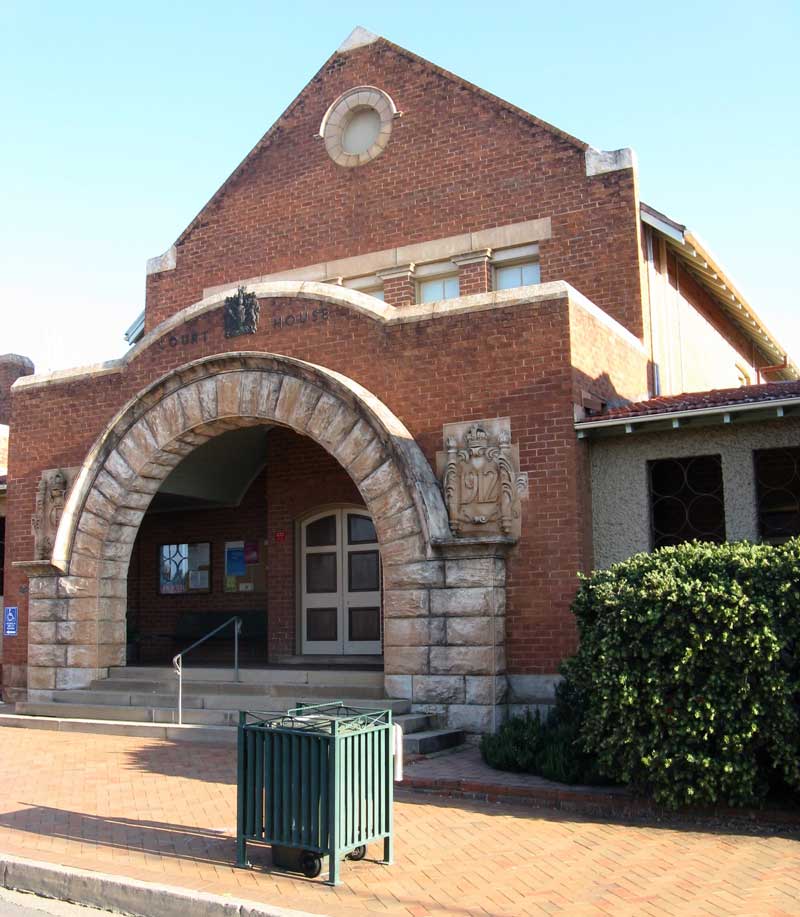
At the conclusion of the banquet the ministerial party adjourned to the new court house, where the ceremony of declaring it open was performed by the Attorney-General. There was a large attendance of police. On arrival at the court house the Mayor introduced the Attorney-General and expressed the appreciation felt at the completion of the building. He presented Mr Holman with a gold key as memento of the occasion. The Attorney-General opened the door and when the public fad entered the building Mr Robertson, PM, who presided, requested the Attorney-General to declare the new court house open.
The Attorney-General mentioned that that was the only new court house which had been erected since the government came into office. The building had been erected by the much-controverted system of day labor under the direction of Mr Moran and the results were exceedingly satisfactory in spite of two or three accidents which had occurred. The total cost was between £3000 and £4000, and there was reason to believe that it was less than it would have been under contract. Dealing with the administration of justice in New South Wales he pointed out that the State was equal in area as Germany and England or France and England, but only had a population of one and three-quarters of a million. There was consequently a sparse population scattered over a large area, and he dwelt at length on the splendid manner in which courts had been provided for the people. In an eloquent address the Attorney-General urged upon all and especially the rising generation respect for the law, which was a primary condition of liberty as we understood it in a constitutional State. The law was not the enemy but the safeguard of us all. The object of the machinery of the law was not to punish the evil-doer, but to ensure the safety of the innocent from wrongful punishment. He explained the operation of the Supreme Court Bill , which had been passed by Parliament, which would enable Supreme Court cases to be dealt with in the State, instead of litigants having to go to Sydney, or wait for months until a judge was on circuit.
The police magistrate expressed his pleasure at seeing such a large gathering present, and on the motion of the Mayor a vote of thanks was accorded to Mr Holman for coming to Wellington at such inconvenience to open the new court house. A vote of thanks was also accorded to the police magistrate for presiding at the instance of the Attorney-General.
THE QUARTER SESSIONS.
After opening of the court house the Attorney-General received several deputations. The first was in reference to the re-establishment of the quarter sessions. The Mayor pointed out that when the matter was last brought forward it was stated that it would be considered when the new court house was erected. There had been quarter sessions in Wellington as far back as 42 years ago, and it was strange that the court had been abolished, when the town had progressed so much. Dr Rygate and Mr Rose also spoke.
The Attorney-General regretted that he did not have the papers with him, so that he was unable to give a definite reply. As far as he was aware there was no reason why the quarter sessions should not be restored, but he would not say that would be done until he had consulted the officers of the department, and ascertained what objections there were, if any. He would look into the matter with the disposition to accede to the request of the deputation, unless there were reasons to the contrary of which he knew nothing. He would consult Mr Thrower, and send a reply early next week.
THE HOSPITAL.
A deputation then waited on Mr Holman to ask him to lay the position of the institution before the Chief Secretary.
Mr Kenyon, vice-president, explained that the hospital was about £200 in debt, and if they did not get any assistance they would have to close down some of the beds, which would be a hardship to the district.
The secretary apologised for the absence of Mr Nancarrow, the President, and submitted some figures showing the position of the hospital. They had recently made an appeal to the public, and could not make another for some months. There was a debit balance at the bank of £129, and when this month’s accounts were paid, the indebtedness to the bank would be over £200. The president had requested him to state that the position was such that if the government did no [sic] come to their aid, the committee would be forced to consider what steps should be taken.
Mr Holman asked the secretary to supply him with a detailed account of the receipts and expenditure this year, and last, so that it could be seen what was the cause of the present position.
Mr WH Paul hoped that it was not going to the world that Wellington was going to close any of the beds at the hospital. The Attorney-General had asked where the deficiency had occurred, but if the committee would look up the subscriptions in past years they would find that it was because the committee had not done their duty is asking people to subscribe. Some years ago the whole district used to be divided, and collectors send round, and better results obtained. This year the committee were hoping to make one big effort, but the general subscription did not come in to any great extent. If the people were asking for their subscriptions they would be given.
Mr Kenyon: You were asked for yours, and said you would not give it until the end of the year.
Mr Paul: That is not correct. I had paid my subscription to the end of the year.
Mr Rose stated that the expenses had increased, and the number of patients had been increasing, but there had been a gradual falling off in the revenue. He did not think the committee would be likely to resign if they did not get a grant, and they would probably be able to carry on.
Rev WG Sharpe also spoke.
The Attorney-General stated that the matter would have to be referred to Mr Flowers, and he would consider the matter of putting it to that gentleman that he should grant a subsidy of £400, conditionally on the committee raising £200 within a certain time.
YEOVAL TO WELLINGTON
RAILWAY.
Messrs Paul, McLeod, EW Payne, and Dr Rygate brought before Mr Holman the matter of the proposed railway line from Cumnock to Yeoval, and thence to connect with the western line. The Minister for Works had promised to inspect the route from Yeoval to Dubbo, and it was desired that he should at the same time inspect the route from Yeoval to Wellington. Mr Holman undertook to bring the matter before his colleague, and remarked that he did not think there would be any difficulty in arranging it.
1 The Wellington Times, Thu 19 Mar 1908, p. 3.
2 The Sydney Morning Herald, Fri 26 Jun 1908, p. 11.
3 The Sydney Morning Herald, Mon 8 Feb 1909, p. 7.
4 The Sydney Morning Herald, Fri 5 Mar 1909, p. 10.
5 The Wellington Times, Thu 22 Feb 1912, p. 4.
6 The Sydney Morning Herald, Wed 8 May 1912, p. 22.
7 The Wellington Times, Thu 5 Sep 1912, p. 6.
8 The Wellington Times, Thu 10 Oct 1912, p. 4.
9 Leader, (Orange, NSW) Tue 15 Oct 1912, p. 2.
10 The Wellington Times, Thu 21 Nov 1912, p. 4.
11 The Wellington Times, Mon 2 Dec 1912, p. 2.
12 The Wellington Times, Thu 5 Dec 1912, pp. 6, 7. Emphasis added.