Evening News, Thu 22 Dec 1921 1
AFTER 17 YEARS
————
RAILWAY OFFICER’S LAPSE
————
Edward Dew, 33, a night officer of the Railway Department with 17 years’ service, was charged at Newtown Police Court with indecent conduct in a railway carriage at Petersham on December 15.
Catherine Hooper, a special constable, and three girls from Normanhurst College, who were in the carriage, gave evidence as to the offence.
Accused was arrested on the platform at Petersham station by Sergeant Kennedy, of Ashfield.
The magistrate (Mr Jennings) said the woman police officer had been specially detailed to watch for this sort of thing and he could not see any doubt in the matter in spite of accused’s previous good character.
Dew was sentenced to two months hard labor, the sentence to be suspended on his giving a surety of £30 to be of good behaviour for 12 months.
~ ~ ~ ~ ~
Truth, Sun 25 Dec 1921 2
“IN CAMERA.”
———◦———
NIGHT OFFICER DEW’S DEBACLE.
————
Disgraceful Doings in First-Class Carriage.
————
DETECTED BY A LADY SLEUTH.
————
An array of witnesses, numbering a lady Joan Hop, a sergeant of police, and several refined young girl scholars from Normanhurst College, Ashfield, were responsible for the conviction of Edward Dew, 33, before Mr Jennings, SM, at the Newtown Police Court, on Wednesday, on a charge of indecency on December 16 in a first-class railway carriage of a suburban train.
Dew, who is extensively bald, looked alert, spick and span. He wore a returned soldier’s badge. Considerable interest attaches to the case owing to Dew occupying a very responsible position as night officer in the Railway Department, and the fact that hitherto he had borne an unblemished character. It was alleged for the prosecution that girls travelling by train to school had been pestered and shocked by the indecent attentions of a man, and that as a result of investigations Dew was arrested.
Two other charges of indecency, both alleged to have occurred in first-class railway carriages, were listed against Dew, viz, at Lewisham on December 8 and on December 12 at Petersham.
Mr W Parker appeared for the defendant, who during the course of the case pleaded not guilty, and Police Prosecutor Cummins guided the prosecution.
The case was heard behind closed doors.
Sergeant WH Kennedy said that at 3.10 pm on December 5 he was in a first-class smoking carriage of a train going to Sydney. Just as the train was pulling into Petersham platform he saw Dew sitting in the adjoining first-class carriage—which was of the usual suburban type—in the end seat, farthest from the engine, with a newspaper in front of him. As the train stopped, four young girls walked out of the carriage, and one of the girls made a sign with her head to witness. They were Immediately followed by
SPECIAL CONSTABLE MRS HOOPER,
who from the carriage platform beckoned to him, and he joined her. Pointing to Dew, she said he was the man who had been guilty of certain indecent behavior. After telling Dew he was a police officer, he took him on to the station platform. Answering his questions, the man said that his name was Dew, and gave his address as Oak-street, Ashfield. He added that he was a night relieving officer on the railway, and was then on his way to relieve at the Rockdale station. Witness said to him, “You heard what the lady detective of the Police Department has said, and we have also had complaints from young girls about this matter”. Dew, in reply, said, “Couldn’t you let me go now. I have to be on duty at half-past four, but I’ll meet you to-morrow morning at the Police Station”. He was then arrested.
To Mr Parker: I boarded the train at Summer Hill and Mrs Hooper got on at Ashfield. I knew she was on the train. She was sitting half-way up the carriage and the four girls in front of her in the next two seats. She and two of the girls had their backs towards Dew. I saw the four girls previously at Normanhursf College, and specially travelled on the same train as they. I had received complaints on the previous Tuesday, but didn’t know that complaints had also been made to the station masters at Ashfleld and Croydon. Dew was sitting on the cross seat just behind the door of the carriage. Mrs Hooper on the Petersham platform told me that she saw Dew’s misconduct. I know him by sight, also that he has seventeen or eighteen years’ service in the Railway Department. His character hitherto, I understand, was unimpeachable.
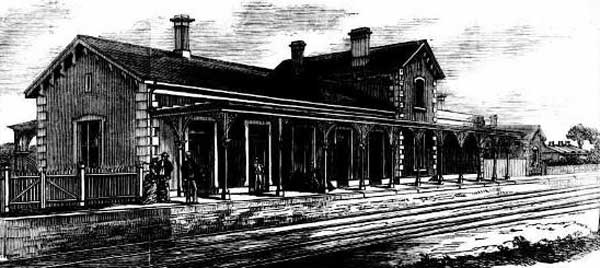
Country Journal, (Sydney, NSW), Sat 11 Mar 1876, p. 421.
Reproduction: Peter de Waal
Catherine Hooper said she was a special constable attached to the No. 1 Police Station. On December 15 at the Ashfield station she got into a first class carriage of the 3.3 pm train to Sydney, and sat behind four young girls. She saw Dew in the same carriage sitting on the seat near the rear door of the car. He was pretending to read a newspaper, and each time she looked at him he was looking over it at her. She was seated with her back to him, and turned three or four times to watch him. On arrival at Petersham the four girls got up to go out, and she followed immediately after. As the passed the defendant he lifted the newspaper and misconducted himself. He also made
SIGNS WITH HIS EYES
in the direction of the girls. After looking at her, he looked down at himself. She then brought Sergeant Kennedy on the scene, and in his presence made her accusation against the defendant, to which he made no reply. She remembered seeing him on the platform, and noticed that he waited till the girls got on, and then he boarded the train and she followed.
To Mr Parker: “I am a widow of a constable, and have been two and a half years in the force. I was on special duty this day, and had instructions that this class of conduct was going on. I was speaking to Sergeant Kennedy at Ashfield about half an hour before I got on the train, but didn’t speak to the girls on the platform, though I did at the school. I do not remember seeing Dew before, I got a description of a man from Kennedy, which, was medium height, rather stout build, and wearing a soft felt hat. I never heard anything about glasses, and consider the defendant answers to this description. I saw him sitting on the Ashfield Station, but did not have a good look at him. My information was that the man usually got on at Ashfield, but I did not take much notice of Dew then. I did not speak to the girls in the train and cannot give a reason why I looked round at defendant. I could not say if any of the girls looked round. I haven’t got the paper Dew had in his hand, I didn’t think it was material. When I saw him at Ashfield, I didn’t make up my mind that he was the man. I told Kennedy that I saw the indecent action. I saw him rearranging his clothes, and admit that that was not in the statement I made for official purposes”.
“Anything I tell you, you can depend upon it being the gospel truth”, here burst out the witness to Mr Parker, who closely questioned every statement by her.
“Kennedy told Dew that there was a button of his clothing undone”, continued the lady police sleuth.
Mr Parker: You’d be surprised to hear that Kennedy, in his evidence, never said anything about that?—Yes.
To Police Prosecutor Cummins: I did not see any other man sitting near the defendant.
To the Bench: When we got out, others were getting out at the same time, some before and some behind. I let some people get out in front of me while I stood on the carriage platform. I think they were two or three women.
“I’M QUITE POSITIVE
that Dew was the man”.
Mr Parker: When Kennedy was giving evidence, weren’t you asked to leave the door of the Court by a constable?—He didn’t speak to me, I spoke to him, and said, “That man there seems to think I’m listening”.
Didn’t that man (Mr Starkey) speak to the police officer about you listening to the evidence?—I don’t know. I never had my ear turned to the door. I was standing near an officer.
But you left the vicinity of the door when spoken to?—I went and sat on a seat.
The next witness was a refined-looking school girl of twelve years of age. She said that she was a pupil of Normanhurst College. On the date in question, with three other scholars, she was sitting in the same carriage in about the middle, facing the engine. When getting out at Petersham, she saw a man whom she now recognised as Dew sitting on a seat by the door. As she passed him, she glanced quickly and saw him do something. The girl here became too embarrassed to state what she saw, and wrote down the details of the alleged indecent act.
To Mr Parker: I knew the lady detective. She came to our school the same day, and I was speaking to her about something I saw on another day.
Mr Parker: Who told you to use the word exposed?—The Head Mistress at the College used it when she was talking about it.
What do you mean by exposed?—To show.
Did the defendant have anything in his hand?—Yes, a bag and a newspaper.
Who got out of the carriage first?—I think Mrs Hooper.
Another girl, 14 years of age, also a pupil of Normanhurst, faced her ordeal courageously. She said that she identified the defendant as the man she saw on the platform at Ashfield and also in the same carriage as she. She saw him while seated near the door of the carriage touching his clothes and noticed the paper in his lap. When getting out she didn’t look at him. She got out after Mrs Hooper.
A third member of the schoolgirl quartette, who was 12 years of age, and the smallest, stated that she
IDENTIFIED THE DEFENDANT
as the man she had seen five times before that day, namely, on the Friday, Monday, Tuesday (on the platform of the train); Wednesday (running across the line); and on Thursday the 15th December seated behind the door near the carriage and farthest from the engine. She saw him move from one side of the carriage to the other. When she stood up to leave she saw his clothes disarranged. The little girl said that she and her companions were seated on the right side of the carriage. She was sure of this.
To Mr Parker: She didn’t think defendant did anything in front of Mrs Hooper. She saw (what she saw) first. The defendant had a paper in his lap and didn’t lift it.
This little witness, like her companions, shrank from giving details, but agreed and did write down what she saw of an indecent nature.
At this stage the magistrate intimated that in order to comply with the act, he was going to alter the charge to read “a place of public resort, to wit a railway carriage”. After argument by Mr Parker, who contended that if anything the evidence showed that defendant was only guilty of a common law misdemeanor, and was entitled to go before a jury, the magistrate said he would overrule the objection, and then asked Dew to plead to the altered charge. A plea of not guilty was then entered.
For convenience the evidence of first-class Inspector Morris, of the Railway Department, on the question of character was here interposed. He said that he had known defendant for twenty-five years, ever since he had been going to school. He had been in the employ of the Railway Department for seventeen years, and the records gave him a very good character. He had always found him a very moral, straight going young fellow, highly respectable and the possessor of
A VERY CLEAN TONGUE.
In private conversation he had not heard him speak one word out of place.
At this stage, after occupying the major portion of the Court day, the case was adjourned to the following Wednesday.
On Wednesday, when the case was resumed, Edward Dew gave evidence. He said that he lived at 21 Oak-street. Ashfield, and for eight years had been relieving night officer in the Railways. For seventeen years he had been in the service, and worked his way up from a five shillings a week probationer. On the day of his arrest he was employed as relieving night officer at Rockdale, and was to go on duty at 4.30 pm. He had worked on this station since November 30. Before catching the two minutes past three train from Ashfield he bought a paper at the bookstall and then got in the second first class carriage from the engine. He didn’t smoke or drink. He sat on the seat nearest the rear door, but first stood on the platform till the train was passing Summer Hill. There were fifty or sixty people in the carriage, and a number sitting in his vicinity. From Summer Hill to Petersham he sat reading the paper. It was not true, as stated by one girl, that he moved to an opposite seat. At Petersham he saw some girls getting out, but did not take any notice of them. He had no idea how many people got out It was absolutely untrue that, with the aid of a paper, he behaved indecently, as the policewoman said, nor that he misconducted himself in front of anybody else.
The first intimation he had of any trouble was when accused by her in the presence of the sergeant. He was taken back completely. Kennedy said, “I want you”, and he asked, “What for?” The sergeant said, “Come on the platform and I’ll tell you”, and there informed him: “This is a lady policewoman, and she says you behaved indecently”. Witness said, “You are making a mistake”, to which Kennedy replied, “There is no mistake; this lady is a detective”. When asked, he gave his correct name and address. His clothes were not disarranged, and at no time was his attention drawn to any disarrangement. He did ask to be let go, and said he would report next day at the Police Station, but this was on account of not wishing to neglect his duty. He had worked for the Department in the North, South and West of the State, and had never been charged with any sort of a crime before. If required, he could call the highest officials in the Railway Department and other persons as to character. At the time he had no opportunity of getting witnesses, and had
SINCE ADVERTISED FRUITLESSLY
for any people, who might have seen the occurrence
To Police Prosecutor Cummins: He had travelled by this particular train twice during that week, on the Wednesday and 'Thursday. He didn’t deny as stated by one girl, that he crossed the line on one occasion, but that was to get a ticket for his sister and lady friend. One of the girls was quite correct when she said she saw him running across the line. He travelled by this train on December 3, but not on December 12, as stated by the girl He could not say if those who gave evidence were in the carriage, because he did not see them. He did not say to Kennedy, when that officer was supposed to have drawn his attention to the state of his clothes, “That might happen to anyone”. Prior to being arrested he did not know any of the witnesses for the prosecution. He had had three years’ war service; had seen active service, and his record on discharge was good
Mr Parker here had the policewoman’s statement put in as evidence.
Sergeant Kennedy, recalled, said that heard defendant say that he did not point out disarrangement of his clothes. He did indicate this on the Petersham platform.
Mr Parker: “Can you say why you omitted that statement in your evidence in chief?”—“I didn’t really think of it”.
“At the station you examined the contents of defendant’s pockets and found nothing disgusting in his papers or letters?”—“Nothing was found of that kind”.
This closed the evidence.
Mr Parker, addressing the bench, said that this class of accusation, was very easy to make, but very hard to disprove, and it was hard to realise a man of his (Dew’s) character and reputation being guilty of such an offence. He asked the Magistrate to disbelieve the evidence of the lady police officer in every word she said, and he drew attention to the fact that during the case she had tried to hear, outside the door of the court, the sergeant’s evidence. With reference to her statement that the defendant looked over his paper at her three or four times, it was evidently a palpable deliberate lie. In her statement, written a few hours after the occurrence, there was not one word of this. Portions of her evidence were at absolute variance with that of the young girls, and also, where she said she came out of the carriage, after the girls, disagreed with Kennedy’s evidence. The statement did not include any reference to the disarrangement of Dew’s clothing. He submitted that there was
A VERY GRAVE DOUBT
in the whole of the circumstances, and, regarding the evidence given by the school girls, the discrepancies in their versions should have very careful weighing.
The Magistrate [Mr Jennings, SM] said he didn’t pretend to understand the man who did this kind of thing in front of women or children . The woman police officer had been specially detailed to discover these offences, and though it might be argued that it was an inducement to make a charge, he could not take that attitude. He knew nothing to her detriment as a police officer, and she said she saw this man acting indecently. In view of her evidence and that of the girls, could he have any doubt, despite the minor differences in detail, that the defendant had committed the act? It was an ordeal for these children to come to the court, and he saw nothing to make him disbelieve their evidence. He would find the defendant guilty, and sentence him to two months’ hard labor.
Mr Parker in appealing for the provisions of the First Offenders Act to be extended to the defendant, said that the sentence was only a flea bite to what Dew had now lost in life—his reputation and position.
The Magistrate said that under the circumstances he would suspend the sentence on defendant entering into recognisances, himself in thirty pounds and a surety in like amount to be of good behaviour for twelve months.
The two other charges against Dew we’re adjourned until January 13, bail in the amount of twenty pounds being allowed in each case.
1 Evening News, (Sydney, NSW), Thu 22 Dec 1921, p. 9. Emphasis added.
2 Truth, (Syd, NSW), Sun 25 Dec 1921, p. 7. Emphasis added.