Below also see: Alan Willis, 1928 – Indecent assault
Alan Willis, 1929
Evening News, Mon 20 Feb 1922 1
ASSAULT ON A GIRL
———◦———
WILLIS DECLARED INSANE
———
EFFECTS OF SHELL SHOCK
———
JUDGE'S VIEWS
———
Before Judge Scholes, at the Darlinghurst Sessions to-day, Alan Willis was charged with indecently assaulting a girl, aged 10, at Ashfield, on December 10 last.
Mr Rowland (instructed by Mr WC Lacey, of the Crown Law Department) appeared for the Crown; and Mr Windeyer, KC, with Mr Cordell (instructed by Messrs Lobban, Lobban, and Harvey) for the defence.
In answer to the charge Willis said, “I am not guilty on the grounds of insanity.”
Judge Scholes: That will be a plea of not guilty.
In outlining the case to the jury, Mr Rowlands said it was alleged accused met the girl shortly after 7 o’clock at night in Norton-street, Ashfield. He asked her did she know a certain street; then said he could find it from Pratten Park. The girl went with him to the park to direct him; and, on his suggestion, they entered the park, and the offence was committed.
Willis said he saw service at Gallipoli. 2 The death of a great friend by an explosion within sight of him greatly affected his nerves. He later suffered from enteric fever and was invalided from the Peninsula. He returned to Australia and subsequently went to England again and joined up. He saw service in France and was taken prisoner during the German offensive in 1918.
What he had seen during the big battle prior to his capture, and the fact of many young boys of his company having been killed, had recurred to his mind ever since. On his return to London from Germany, badly affected in health, he began to drink heavily. He had not taken drink prior to going to the war.
A HEAVY DRINKER
Accrued said he had continued drinking since his return to Australia, and had been told of things which he had done, but of which he had no recollection.
Frederick Willis, a brother, said accused suffered from fits of depression, and his nights were restless. He used to call out in his sleep, and was very nervous.
He shunned company, and at times his eyes were bloodshot, and complained of buzzing in the head. He would sometimes promise to take his mother to England, and do other things, but the next day would remember nothing of that he had said.
Mrs [Edith May] Willis corroborated the previous witness’ story, and said that on the morning of December 10 accused’s eyes were bloodshot, and he was very depressed.
MEDICAL EVIDENCE
Dr Andrew Davidson said accused was suffering from shell shock and war strain, and had never actually recovered from the particular experience referred to.
It was highly probable that accused was quite unconscious of what he was doing on the afternoon of December 10. He certainly had no recollection of it now.
Dr Davidson said he understood that the treatment available in gaol would not meet accused’s case. Broughton Hall 3 would be more desirable.
Dr Lee Brown, called by the Crown, stated that he had had Willis under observation at Long Bay since December 22. When he first saw accused, he thought he was mentally unstable, or suffering from the effects of drink.
Accused was placed in the observation ward. He, at times, suffered from mental depression, and was giving sleeping draughts. As the result of treatment, his condition had improved.
To Mr Windeyer: I am quite satisfied he is suffering from war strain. It would be possible to do things without being aware of it.
THE JURY'S VERDICT
The jury returned a verdict of not guilty on the grounds of temporary insanity.
The Judge made an order for the safe custody of the accused during the Governor’s pleasure.
His Honor added that if he were asked for a report he would give one in the words of Dr Davidson—that the proper place for accused was Broughton Hall.
~ ~ ~ ~ ~
The Bathurst Times, Tue 21 Feb 1922 4
WAR’S NIGHTMARE
————
SHELL SHOCK VICTIM
————
ASSAULTS GIRL
————
Sydney, Tuesday.
Before Judge Scholes, at the Darlinghurst Sessions, Alan Willis was charged with indecently assaulting a girl, aged 10, at Ashfield, on December 10 last.
In answer to the charge Willis said “I am not guilty on the grounds on insanity.”
Judge Scholes: That will be a plea of not guilty.
In outlining the case to the jury, Mr Rowlands said it was alleged accused met the girl shortly after 7 o’clock at night in Norton-street, Ashfield. He asked her did she know a certain street; then said he could find it from Pratten Park. The girl went with him to the park to direct him; and, on his suggestion, they entered the park, and the offence was committed.
Willis said he saw service at Gallipoli. The death of a great friend by an explosion within sight of him greatly affected his nerves. He later suffered from enteric fever and was invalided from the Peninsula. He returned to Australia and subsequently went to England again and joined up. He saw service in France and was taken prisoner during the German offensive in 1918.
What he had seen during the big battle prior to his capture, and the fact of many young boys of his company having been killed, had recurred to his mind ever since. On his return to London from Germany, badly affected in health, he began to drink heavily. He had not taken drink prior to going to the war.
Accrued said he had continued drinking since his return to Australia, and had been told of things which he had done, but of which he had no recollection.
Frederick Willis, a brother, said accused suffered from fits of depression, and his nights were restless. He used to call out in his sleep, and was very nervous.
He shunned company, and at times his eyes were bloodshot, and complained of buzzing in the head. He would sometimes promise to take his mother to England, and do other things, but the next day would remember nothing of that he had said.
Mrs Willis corroborated the previous witness’ story, and said that on the morning of December 10 accused’s eyes were bloodshot, and he was very depressed.
Dr Andrew Davidson said accused was suffering from shell shock and war strain, and had never actually recovered from the particular experience referred to.
It was highly probable that accused was quite unconscious of what he was doing on the afternoon of December 10. He certainly had no recollection of it now.
Dr Davidson said he understood that the treatment available in gaol would not meet accused’s case. Broughton Hall would be more desirable.
Dr Lee Brown, called by the Crown, stated that he had had Willis under observation at Long Bay since December 22. When he first saw accused, he thought he was mentally unstable, or suffering from the effects of drink.
Accused was placed in the observation ward. He, at times, suffered from mental depression, and was giving sleeping draughts. As the result of treatment, his condition had improved.
To Mr Windeyer: I am quite satisfied he is suffering from war strain. It would be possible to do things without being aware of it.
The jury returned a verdict of not guilty on the grounds of temporary insanity.
The Judge made an order for the safe custody of the accused during the Governor’s pleasure.
His Honor added that if he were asked for a report he would give one in the words of Dr Davidson—that the proper place for accused was Broughton Hall.
~ ~ ~ ~ ~
The Sydney Morning Herald, Tue 21 Feb 1922 5
QUARTER SESSIONS.
(Before Judge Scholes.)
Mr N de H Rowland, Crown Prosecutor.
ALLEGED INDECENT ASSAULT.
Alan Willis was charged with having committed an indecent assault upon a girl of 10 years of age. Mr Windeyer and Mr Cordell (instructed by Messrs Loban, Loban, and Harvey) appeared for the defence.
The jury returned a verdict of not guilty, owing to temporary insanity.
His Honor made an order that accused be remanded to his former custody during the Governor’s pleasure.
~ ~ ~ ~ ~
Young Witness, Tue 21 Feb 1922 6
BANK CLERK’S LAPSE.
———◦———
SHELL-SHOCKED ON GALLIPOLI.
————
Sydney, Monday.
At the Darlinghurst Sessions to-day, Alan Willis, a young bank clerk was charged with indecently assaulting a girl aged ten years. When asked to plead, Willis said he was not guilty on the ground of insanity.
The Crown case was that Willis, meeting a little girl on the night of December 10th, led her to Pratten Park. The girl later identified accused at the police station.
Willis gave evidence that while serving on Gallipoli, he received a great shock and became unnerved. There were occasions where he had no recollection of what he had done.
Willis’s brother gave evidence that accused was a woman-hater.
The Government Medical Officer, in evidence said that Willis might do acts inconsistent with his ideas of general morality.
The jury returned a verdict of not guilty on the ground of temporary insanity.
[sic] The jury returned a verdict of not guilty on the ground of temporary insanity.
Accused was ordered to be detained during the Governor’s pleasure.
~ ~ ~ ~ ~
Truth, Sun 26 Feb 1922 7
A WAR AFTERMATH.
———◦———
RETURNED SOLDIER AND GIRL.
————
Case In Which Doctors Didn’t Differ.
————
ACCUSATION OF “ASSAULT WITH INTENT”.
————
“Not Guilty, Because Temporarily Insane”, say Jury.
————
Claims that the accused young man was a chronic victim of “shell-shock” and “war-strain” figured with very pronounced prominence in a case that came up for determination before Judge Scholes and a jury of 12 at the Darlinghurst Quarter Sessions last Monday afternoon. The case was one in which a young man, acceptable in appearance and demeanor, named Alan Willis, was indicted on two charges—first, of having assaulted a girl under the age of 16 years, with intent to commit rape upon her, and secondly, with having assaulted the girl. The offence was alleged to have taken place at Pratten Park, Ashfield, on the evening of December 10 last. The girl complainant Jean Isabel Wallace, will not be 11 years old till next May.
Mr N de H Rowland was the Crown Prosecutor, while the accused was defended by Mr R Windeyer, KC, with Mr Carroll (instructed by Messrs Lobban, Lobban, and Harney). The accused pleaded not guilty to each charge.
Mr Windeyer intimated that the defence would unfold one of the most pathetic cases of “ shell-shock” and “war-strain” that had ever come before this or any other court.
Crux of Crown Case.
The Crown Prosecutor explained that accused charged with having assaulted this young girl with intent to carnally know her, and, on the second count, with having assaulted her. In this case consent on the part of the victim did not matter. With a little girl under the age of 14 years, the question of consent could not arise in any shape or form. They would be by the Judge that it was dangerous for a jury to convict on the uncorroborated testimony of a female complainant. Not that the accused was there to prove his innocence; it was for the Crown to prove his guilt. The Crown Prosecutor then detailed how accused had caught up to the little girl on the evening of Saturday, December 10, enticed her into Pratten Park, and there committed the offence with which he now stood charged. When the girl cried out, the accused said to her, “If you make a noise a lot of people will come, and we might spend the night in gaol.” But he released the girl, who ran home and told her mother what had happened, and later the same evening, at the Ashfield Police Station, identified prisoner as the man who had assaulted her in Pratten Park.
The Little Girl's Story.
Jean Isabel Wallace, a dainty little girl of between 10 and 11 years, did not seem greatly concerned at the queer corner in which she found herself. In answer to his kindly queries, she told the Judge that she attended a public school. She understood why she was in court for that day. She was to tell all the truth about the case in the park. The little lady, having smilingly answered the queries put to her by Judge Scholes, was duly sworn.
She told counsel she was 10 years and 6 months old and lived with her parents at Brunswick-parade, Ashfield. At 3 o’clock on Saturday, December 10, she went down to her aunt’s, and returned from there about 7 pm. On the way home, in Norton-street, accused, whom she had never seen before, came up from behind her and asked if she knew where Holborn-street was. He also asked if she knew where Pratten Park was, and she went with him to show him.
“My Little Sister”.
As they walked along accused said to her, “If anybody asks you who you are, you say you are my little sister”. When they reached the park she and accused went into the grounds. First they sat on a seat, but after a while accused pulled her down on to the ground. Than accused disarranged her clothes and also undid his own trousers and (the little witness then gave details of the alleged attempt on the part of the accused to carnally know her). She began to cry out when accused hurt her, “I sort of screamed but not very loud”, said the little girl. Thereupon accused let her go, saying, “There’s a man over there, and if anybody hears you, you’ll have to spend the night in gaol”. As soon as ever accused let her go, she ran away home, not looking bac. At home she told her mother what had happened. Later on that night, at the Ashfield Police Sation, she identified accused as the man who had assaulted her in the park.
Mr Windeyer: When accused pulled your clothes up, he only pulled them as far as the knee?
Witness: He didn’t pull them right up.
Eleven Years Old Next May.
Ada Elizabeth Wallace, mother of the last witness, gave evidence to the effect that her daughter Jean Isabel was 10 years old on May 27, 1921. On the evening of December 10 last, after return from her aunt’s witness was told something by her daughter Jean, in consequence of which she informed the Ashfield police something.
Dr Alexander Menzies McIntosh, duly qualified medical practitioner, practising at Ashfield, gave particulars of his examination of Wallace on the night of December 10.
Police Constable George Frances Mason, of Ashfield, stated that on the evening of December 10 last at the local police station he lined accused up with six others, having first told him, “you answer the description of a man charged with having assaulted a little girl in Pratten Park this evening, and I’m going to line you up for identification.” When accused was recognised by the little girl, Jean Isabel Wallace, he made no reply.
Mr Windeyer: Did you notice that at the time accused appeared to be dazed?
Witness: I did not notice that.
This constituted the case for the crown.
Mr Windeyer called accused to give evidence on his own behalf.
“Shell-Shock” and “War Strain”.
Alan Willis, the accused, stated that prior to the war he had been a clerk in the ES and A Bank. He had indulged in a good deal of sport. In 1917 he resigned from the bank, though he had enlisted in the AIF as early as August, 1914. He had been on Gallipoli. There a great comrade was blown up alongside him, and that was an episode he had never forgotten. About three days before the evacuation of Gallipoli (December 19, 1915) he was sent to hospital in Malta. After some months there he returned to Australia, his father having died. In July, 1916, he returned to England, and was attached to the instructional staff with “Kitchener’s Army”. He gained his commission on the field, and having transferred to the Imperial Army, rose to be captain in the old 5th Foot—now known as the Northumberland Fusiliers. In 1918, during the Allied advance known as the “Big Push”, near Rheims, he was taken prisoner of war by the Germans. Witness gave a vivid account of the engagement in which he was captured. Most members of his company had become casualties, and he himself was wounded. For some time after his capture he was in a German hospital. Since then he had not been able to rid his mind of the details of that battle. In the English army there had existed a deep bond of affection between officers and man. When under starvation in Germany he became obsessed with all that had happened. Prior to going to the war he had never taken drink except medically. He was repatriated to England some three weeks after the signing of the Armistice. He had to face a War-Office court of inquiry concerning his capture, but was honourably acquitted. He suffered from sleeplessness, and as a remedy took to drink. He volunteered for service with the Archangel Expedition in Russia, and was accepted in a training capacity. He had several periods in hospital—the Prince of Wales and the base hospital at Boulogne. Toward the end of 1917 he had been slightly wounded at Passchendaele. He returned to Australia in 1919, but stayed at the Cape for a term, actually reaching Australia in October, 1920. Again he could not sleep, and had recourse to brandy. On return to Australia he seemed to have lost all inclination for sport. He seemed to feel older than his years, to have lost almost all vitality. His mother had devotedly done all she could for him. For a whole year he had been in the service of the Naval Office at Garden Island. But all the time he had been
Silent and Surreptitiously
drinking whisky. On the occasion of his arrest the first thing he remembered was at about midnight. He then remembered having gone to work that morning, but all the rest was a blank. He caught the 8.45 am boat across. He felt very bad, had been bad all the week. That morning he had indulged, as usual, at the North British Hotel near the Quay. At noon that day—it was a Saturday—he came ashore with a friend named Grice, and they had more drinks at the Paragon Hotel. Later accused went to Watson’s Bay, had a swim, and then had more drinks. After that the whole thing was a blank—after a drink at the North British Hotel on his return. These fits of depression and insomnia attacked him intermittently. The weather seemed to materially affect him. The fit came on as a sort of irritable feeling toward even those for whom he had the most affection. He had been in Long Bay prison for about two months, and was all praise for the treatment he had there received. He was sleeping on a seat at the police station when a constable woke him up and told him to get to bed, showing him into a cell. That was his first intimation as to where he was. He had never before been in any trouble.
Mr Rowland: Where are you living”
Accused: At Croydon.
Had you never been in Pratten Park before?—Not that I remember, though apparently I have.
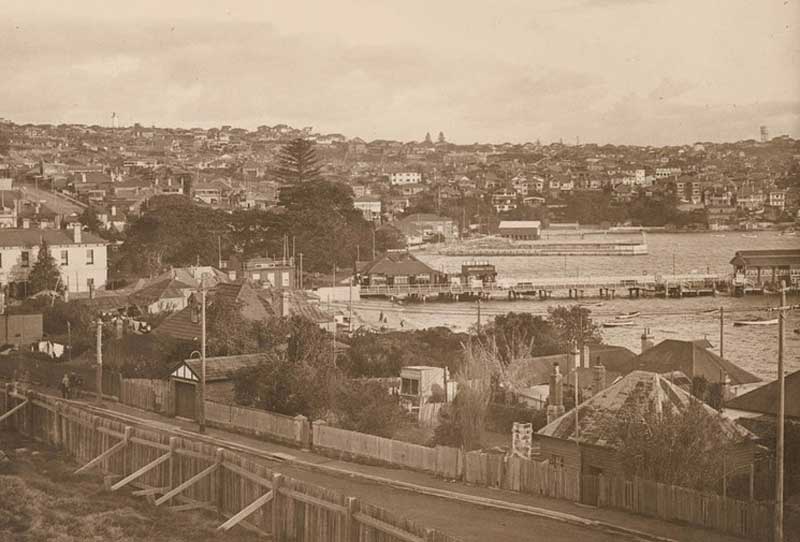
Reproduction: Peter de Waal
After your return from Watson’s Bay, what time would it be?—I think I could safely say somewhere in the region of 4 o’clock.
You usually go out home by train?—Always.
Any recollection of going home that night?—No, I don’t remember going to the railway station at all.
You know where Norton-street is?—It’s a street I’ve never been in. It runs parallel to the street in which I live, about a quarter of a mile distant.
You are a single man?—Yes.
During the past two months you have had no drink?—None at all.
When you came to your senses did you tell the police anything about this state of mind of yours?—I don’t remember.
Do you remember when the little girl identified you?—I didn’t remember anything about it.
Brother on Brother.
Frederick Willis, a brother of accused, also employed in a Sydney banking institution, deposed that before accused went to the war he had been very interested in the militia, having attained the rank of lieutenant. Accused lived a very active life, was a good brother, and a model son. He was only 18 when he enlisted, and he returned in 1916. Then he was very nervous. Witness knew that for he shared the same room with accused. Accused returned to England, and finally came back to Australia in October, 1920. Witness then noticed that his brother had strangely changed. He could not settle down and seemed depressed. Then accused had been engaged in marriage to a girl in South Africa. That engagement was broken off, and it was at about that time that accused began to indulge in excessive drinking. Accused spoke from time to time very foolishly—telling them that he intended becoming a member of Parliament and offering to take his mother a trip to England. Next day he would have forgotten all about what he had said. It was plain to them that he had been drinking. Witness frequently questioned accused about these foolish utterances, but accused appeared to have remembered nothing at all about them. These strange lapses of memory occurred intermittently; perhaps they might not recur for a period of a couple of months. Accused had also been treated for ear and nerve trouble in London. When these fits were coming on him, accused appeared irritable and restless, and could not sleep at night. At these times he did not like meeting people. Before the war he was sociable and liked meeting people.
A “Woman-Hater”.
So far as witness knew, accused was a woman-hater. That was after the war. Accused stated that he must have a rest and a change away from Sydney, saying that otherwise he would go mad. On one occasion witness had been recalled from Newcastle, and found his brother depressed and moping about the house. During these seizures accused would speak only to his mother, sometimes not speaking to witness for weeks at a stretch.
To the Crown Prosecutor: It was between September and December last that accused had refused to see a doctor. Witness would see his brother at breakfast-time, but not again till the evening, and knew nothing of the habits of accused during the day.
The Ravages of War-Strain.
Edith May Willis, mother of the accused, stated that her son Alan was now 26 years old. Before her son went to the war he was “everything that was good”. On his return from “the Peninsula” he was not quite the same. He finally returned home in October, 1920, having tarried some time in South Africa. About three months after his return accused obtained an appointment at Garden Island. But he habitually gave way to fits of depression and seemed weighed down with a sense of responsibility. Since his return she had noticed that her son had taken to drink. He would say all sorts of things and later on seem to have forgotten that he had said them. There were periods when he was free from these fits of depression, but lately the fits of depression had been more frequent. She could not have visitors, on account of Alan, who from time to time had been rude to people. He did not now desire to meet people. So far as she knew, accused had never touched drink before he enlisted. On the day of his arrest, in the morning accused was in a very depressed condition. The last she saw of him that day was when he left for work at about 7 o’clock. That evening a constable told her Alan had been arrested. She said to the constable, “Don’t be afraid to tell me wait for. I’ve been expecting something to happen”. When the constable told her the charge upon which her son had been arrested, she said, “he wasn’t rational! He couldn’t have been in his right senses”.
Ernest Grice, clerk on Garden Island, stated that for 13 months he and accused had worked at the same office table. Accused’s conduct varied. If he had had a drink in the morning there was no knowing what he might do. He had fits of moody depression and imagined that he suffered from all sorts of ailments. At times a casual remark would incite him to an outburst of passionate rage. But normally accused was a “very gentlemanly young fellow”. On the day of his arrest, accused when he came to work, appeared depressed and shifty. First he Saidie was going swimming at Bondi, but then he decided to go to Watson’s Bay. On return from Garden Island he and accused had a drink. Beyond his war troubles accused had never told witness about any trouble of the past. His war experiences, especially the starvation to which he had been subjected while a prisoner of war in Germany, seemed to depress him, and he had said that on several occasions he had been tempted to “do himself in”.
To the Crown Prosecutor: It was by no means a frequent occurrence for witness to detect signs of drink on accused. Accused did his work fairly accurately. He imagined complaints and fancied insults where none had been given or intended.
Ernest Chapman, clerk, of the Treasury, stated that before the War he had known accused intimately. Accused always took an interest in manly sports, and witness always regarded accused as a clean-living young man. Accused had been one of the first in his district to enlist, but since his return from the War appeared to have markedly changed. Accused seemed to wear a hunted look, but accused had never confided to witness to to [sic] whether he was worried about anything.
Doctors Don’t Differ!
Dr Andrew Davidson stated that he specialised in nervous and mental diseases. He had examined accused on Tuesday last, the 14th inst. Accused’s mental condition was most unstable. Witness’s opinion was that accused was suffering from shell-shock and war-strain , and in the opinion of witness accused had never really recovered from the incident of his capture by the Germans. In his mind was occurrences were always cropping up, and he could get no rest. Recourse to alcohol did not necessarily follow, but, unfortunately, it did follow. It was quite possible that accused now had no recollection of what he did after a certain time on the afternoon of December 10 last. Witness had discussed the events of that afternoon with accused and was of opinion that accused’s statement—that he had no recollection—should be believed. A man might be in that condition, might still mechanically obey orders—act sub-consciously. The effect of drink would be to weaken the brain sill further. If accused were drafted to a criminal ward in Parramatta witness thought it would be most unwise. Witness would suggest that accused might be a fit subject for admission to Broughton Hall.
To Mr Windeyer: People who walked in their sleep would also talk.
Dr Robert Lee Brown, in the Government service at Long Bay, called by the Crown, said that he had observed accused since his arrival at that gaol on December 12. When accused arrived witness regarded him as either mentally unstable or suffering from drink. On arrival there accused suffered severely from mental depression. The condition of accused, as regards mental depression, was now better, though naturally accused was of neurotic disposition.
To Mr Windeyer: Since the war started witness had treated some 30 cases of war-strain and he regarded accused as a very pronounced instance of patients suffering from war-strain. Such a man might commit acts that were quite inconsistent with his general principles of morality.
Was Willis Sane?
Mr Windeyer, in the course of his address, said that in considering cases such as this it was hard to consider them in view of all that had taken place during recent years. He urged that the jury should not permit their minds to be swayed by sentiment. Some men had lost more of their manhood in the recent war than had others. This young man had been a credit to his country before he enlisted. Was it not true that this lad of 22 had been weighed down by the responsibility of having had to lead his company of young men to their death? The case presented a plain question that had been fairly and sympathetically met by the Crown. The question was, whether on that Saturday afternoon this young man understood or remembered what he did? Was there any reason they should not believe the case that had been put forward on behalf of accused? The claim put forward for accused was an honest and an honorable one. Counsel had been told that juries had brown sick of these “shell-shock pleas”. But was this one not a just plea?
The Crown Prosecutor pointed out that this issue before the jury was very plain: Was this man insane when he attempted either to have intercourse with this girl or to assault her? It was clear that the story told by the girl was true. Was the accused at the time suffering from insanity as understood by the law? De Davidson and Dr Lee Brown were in agreement that a case might arise where a man, having committed an action, might lose all recollection of it. Although the duty of establishing insanity lay with the defence, yet if there was any reasonable substantial doubt, the accused was entitled to the benefit of that doubt. They had to determine whether that mental disturbance obtained with prisoner at the time of the commission of this offence.
Prisoners’ Privileges.
Judge Scholes, in the course of his summing-up, pointed out that the jury must find accused guilty or not guilty of assault with intent to carnally know. It was not upon the accused to established his innocence, but for the Crown to prove his guilt, to the satisfaction of the jury and beyond reasonable doubt. He would ask them to remember that when they were considering the defence advanced—a plea of insanity in both instances. A man was presumed to be sane till the contrary was proved, but if there was any doubt at all the accused was entitled to the benefit of it. The story told by the little girl had not been contradicted in any way at all. If the jury were satisfied of the accuracy of her story the jury might accept the uncorroborated testimony of the female complainant. Accused would need to satisfy them that he was insane at the time or leave them in reasonable doubt upon the point. The test was: Did the accused know the nature of his act, and that his act was wrong? Was the defence set up an honest one? It was the duty of the jury to investigate and determine these questions. There must be some intent before a crime could be committed.
“Not Guilty, Because Insane”.
After a short retirement the jury returned a verdict on both counts of “not guilty on the ground of temporary insanity”.
Judge Scholes: I understand, Mr Foreman, that you find specifically that accused was insane at the time of the commission of the offence?
The Foreman: Yes.
I suppose you find that accused actually did commit the offence?—I think, you Honor, that that is the unanimous opinion of the jury.
Judge Scholes: I make an order for the safe custody of the accused until the Governor’s pleasure be known.
The Judge later intimated that if the matter were submitted to him for report he would report in the words of Dr Davidson, that the proper place for accused was Broughton Hall.
~ ~ ~ ~ ~
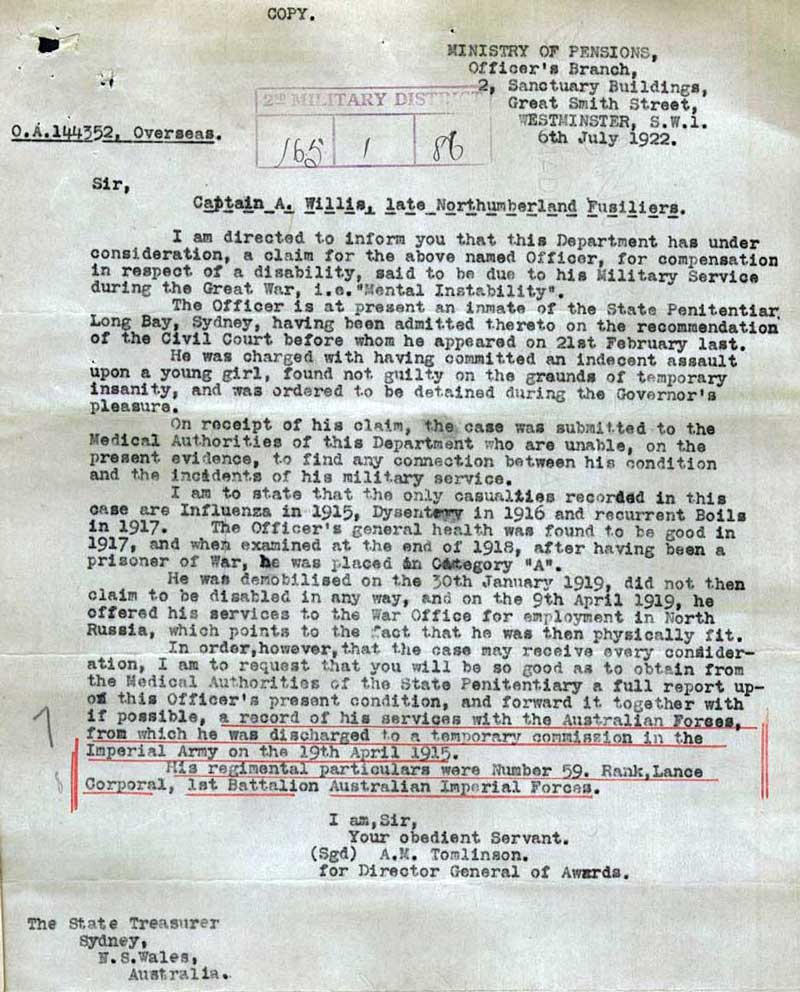
UK Ministry of Pensions Letter, Thu 6 Jul 1922 8
~ ~ ~ ~ ~
Alan Willis, Gaol photo sheet 9
![SRNSW: NRS2467, [3/6107], State Penitentiary photographic description book, 8 Feb 1922-5 Sep 1922, No. 18397, p. 34.](../../images/trials/1922-Willis-6107-gaol-photo-18397.jpg "SRNSW: NRS2467, [3/6107], State Penitentiary photographic description book, 8 Feb 1922-5 Sep 1922, No. 18397, p. 34.") |
Gaol Photo Sheet - Transcribed Details
No. 18397
Date when Portrait was taken: 21-2-1922
Name: Alan Willis
(aka Kenneth Grovenor)
|
Native place: St Leonards Year of birth: 21-6-1895 Arrived Ship: Trade or occupation Religion: C of E Education, degree of: R & W Height: 5' 6⅜" Weight On committal: 127 Colour of hair: Light brown Colour of eyes: Brown |
Marks or special features: Shell wound under right armpit |
|
(No. of previous Portrait ... ) CONVICTIONS |
|||||
|
Where and When |
Offence. |
Sentence |
|||
|
Sydney Q.S Goulburn PC Central PC |
20 11 20 |
2 2 9 |
1922 1929 1929 |
1) Attempt to carnally know a girl False pretences (2 charges) Assault child |
Found not guilty on the ground of 3 months HL on each charge 3 months HL. Crimes Act |
Alan Willis, 1928
The Mudgee Guardian and North-Western Representative, Thu 26 Apr 1928 10
DISTRICT NEWS
————
…
At the Gunnedah Police Court recently Alan Willis was charged with indecent assault on a male person. Accused, who reserved his defence, was committed for trial at Gunnedah Quarter Sessions on 2nd May, or at other such place as the Attorney-General may appoint. Bail was allowed as before, self in £40, and surety in £40, or two in £20 each.
~ ~ ~ ~ ~
The Northern Daily Leader, Tue 22 May 1928 11
QUARTER SESSIONS.
———
TAMWORTH SITTINGS.
———
At Tamworth Quarter Sessions yesterday morning Allen [aka Alan] Willis was charged with having at Gunnedah committed an indecent assault against a boy [Percy Leary] 11 years of age. The case had previously been tried at Gunnedah, where the jury failed to agree.
Acting Judge Thompson was on the bench, Mr Browning had charge of the Crown case and Mr Byrne appeared for the defence.
After hearing evidence the jury, retired at 12.35 pm, returning at 2.25 pm with a verdict of not guilty.
Accused was discharged.
———
…
NEW JUSTICES.
——
Acting Judge Thompson yesterday morning, at the Quarter Sessions , Tamworth, swore in twelve new Justices of the Peace for the State of New South Wales. They included one woman, Ira Eveline Mychael.
——————
CONGRATULATIONS.
——
TO ACTING JUDGE THOMPSON.
——
Prior to the commencement of the Quarter Sessions at Tamworth yesterday morning, the Crown Prosecutor (Mr Browning) offered his congratulations to Acting-Judge Thompson, on his appointment to the Bench in a town where he had so often appeared at the table. His congratulations, he felt sure, would be indorsed by everyone in Tamworth who had known him. Mr Prentice, on behalf of the solicitors, also tendered congratulations, His Honor, in acknowledgment, expressed his gratitude. The task, he said, was fairly novel to him, but it was with pleasure that he came back to renew acquaintance with a circuit town for which he had so much respect.
Alan Willis, 1929
Goulburn Evening Penny Post, Mon 11 Feb 1929 12
BLAMED THE WAR
———◦———
MAN’S HARD LUCK STORY
————
FALSE CHEQUES AT TARAGO
————
For falsely uttering cheques to the value of £20 and £10 at Tarago on January 2, Allan Willis (32) was, at the Goulburn Police Court this morning, sentenced to three months’ imprisonment in the Goulburn Reformatory on each charge, the sentences to be concurrent.
In pleading “guilty, under extreme provocation” Willis told a story of years of suffering from nervous troubles and depression following 4½ years of active service at the war, nine months of which he had spent as a prisoner of war in Germany.
Since returning to Australia he had suffered a recurrence of attacks of depression and nerves and at the time of the offence he was just out of hospital and had returned to Tarago, where, in consequence of his state of mind, he had commenced drinking again.
The offence had not been premeditated, but his state of mind might be judged from the fact that he had returned the kindness shown him by Mrs Brogan, the licensee of the Lake Bathurst Hotel, who had treated him as a son, by falsely pretending the cheque he had given her was a good one.
It was a case of sheer desperation, he said, brought about by the after-effects of the war.
Asked by the magistrate, Mr GA Stevenson, whether there were any previous convictions against Willis, Sergeant Hooper said that he had been found guilty on the grounds of insanity on a charge of carnally knowing a girl, aged 10½ years. He was also on remand on a charge of [indecent] assault against a male person, the jury having failed to agree at a previous trial.
First Class Constable Murphy, of Tarago, in evidence, said he saw Willis in custody this morning, when he admitted that the signature on the cheques was made by him, and that he had tendered them in payment to Mrs Brogan and Charles Allalook. There was no money in the bank to meet the cheques, he said.
Elizabeth Violet May Brogan, widow, and licensee of the Hotel Lake Bathurst , at Tarago, said she had known Willis for about five months. He had been employed by Lehane’s.
During that time he had an account at the hotel, amounting to £3/14/-. On January 2 he tendered a cheque for £20 which she cashed, giving him the change of £16/16/-. Willis had previously given her to understand that he was expecting some money from his mother.
Charles Allalook, storekeeper, residing at Tarago, said he had known Willis six or seven months. On January 2 Willis said he had a cheque from his brother as a New Year’s gift and wanted to buy a shirt and some pyjamas. He tendered a cheque for £10 and witness gave him the shirt and pyjamas and £3 in money, this being all the change he had in place. Willis said he would get the rest of the money later. The cheque had been presented at the bank and had been returned unpaid.
1 Evening News, (Sydney, NSW), Mon 20 Feb 1922, p. 5. Emphasis added.
2 To view the digitised WWI service record (service number 59, barcode 8846006) of Alan Willis go to: www.naa.gov.au
3 Broughton Hall was part of the Callan Park Hospital for the Insane (1878-1914) was an insane asylum located in the grounds of Callan Park, in the Sydney suburb Lilyfield.
4 The Bathurst Times, Tue 21 Feb 1922, p. 2. Emphasis added.
5 The Sydney Morning Herald, Tue 21 Feb 1922, p. 7.
6 Young Witness, (NSW), Tue 21 Feb 1922, p. 1.
7 Truth, (Syd, NSW), Sun 26 Feb 1926, p. 11. Emphasis in original and added.
8 NAA: B2455, Willis, Alan, p. 15 .
9 SRNSW: NRS2467, [3/6107], State Penitentiary photographic description book, 8 Feb 1922-5 Sep 1922, No. 18397, p. 34.
10 The Mudgee Guardian and North-Western Representative, Thu 26 Apr 1928, p. 19.
11 The Northern Daily Leader, Tue 22 May 1928, p. 5.
12 Goulburn Evening Penny Post, Mon 11 Feb 1929, p. 4. Emphasis added and in original article.