Thomas Morris, 1918
Below also see: Arthur Boughton, William Sonter, Charles Weeks, George Alfred Hill , 1919
Thomas Morris, 1921 – Indecent assault,
Thomas Morris, 1922,
Thomas Morris, 1925 – Indecent assault,
Thomas Morris, 1927,
Thomas Morris, 1937
The Referee, Wed 6 Mar 1918 1
TOM MORRIS SWIMS EIGHT MILES
Tom Morris, writing at Parramatta on Monday, says: “I am lucky to have done any swimming on George’s River last Sunday. I am sure no other swimmer in Australia could swim the same distance under the same conditions. When we arrived at Latty’s boatshed at Fairfield, the tide was coming in. It was seen that I was in for a rough time, and was warned to put my attempt off until late. But as I promised to do the swim on March 3, I said I would start. At 11 am, I dived in and battled against the tide, and swam over the same five-mile course as I did last season.
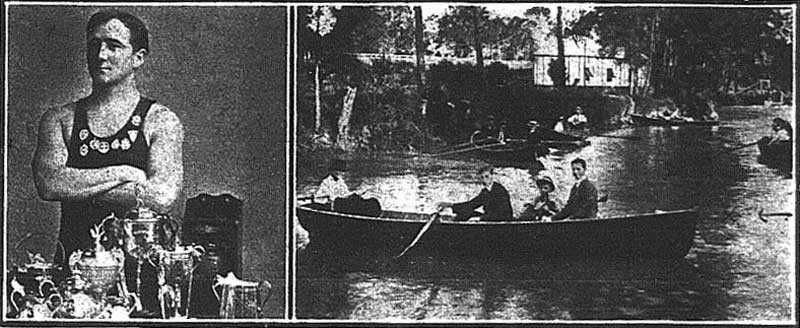
starting point for Morris’ five miles’ swim last year. Image: The Referee,
(Sydney, NSW), Wed 6 Mar 1918, p. 16. Reproduction: Peter de Waal
I was followed by people in boats, also a boatload of timekeepers. Those appointed were Messrs M Harding, P Adam, and G Latty. I arrived at the five-mile point, and turned and started back to the boatshed at Fairfield. I found the tide also had turned and was running against me. So I settled down for a stiff swim. I swam back to Lansdowne Bridge (eight miles), when the officials said the tide was running too strong, and suggested that I had better give up. I wanted to battle it out, but was told I would strain myself. Others advised me to give it up, so I stopped, and was taken ashore and given a good feed and a rub down. The water was muddy. I had on full costume. My time for the eight miles was 4hr 30min. Next season I shall make an attempt over a straight 10-mile course. I would like to see another amateur swimmer better my time under the same conditions, and swim over the same eight-mile course. I have friends who will give a valuable trophy to the one who succeeds. I am willing to show them over the course. I used the trudgeon-crawl stroke all the way.”
Arthur Boughton, William Sonter, Charles Weeks, George Alfred Hill , 1919
The Cumberland Argus and Fruitgrowers’ Advocate, Wed 19 Feb 1919 2
CURRENT NEWS.
———◦———
…
THE SWIMMER IN COURT.
Tom Morris, Parramatta’s champion swimmer, was down on the list at Parramatta Court on Monday as the complainant in a case of alleged assault, in which the defendants were named as Arthur Boughton, William Sonter, Chas Weeks and George Alfred Hill. Mr Moss was for the defendants, and he obtained a postponement of the matter till March 3, as he had not had time to obtain instructions from his clients.
~ ~ ~ ~ ~
The Cumberland Argus and Fruitgrowers’ Advocate, Wed 5 Mar 1919 3
BEER SOIREE IN THE PARK.
————
COWARDLY ASSAULT ON TOM MORRIS.
————
At Parramatta Court on Monday (before Mr MH Fitzhardinge, SM), Arthur Boughton, William Sonter, Charles Weeks and George Alfred Hill, four young men, were charged with assaulting Tom Morris—the professional swimmer—in Parramatta Park on February 8. Mr Todhunter for Morris; Mr Moss for the four accused.
Tom Morris deposed that he was a professional swimmer, and resided at Albert-street, Parramatta. He had received a medal for numerous life-saving episodes. Was swimming on February 8 not far from Ring’s bridge. There were a dozen persons present. The defendants were there. The defendants had beer, and were drinking it. The defendants were singing and
EXPOSING THEMSELVES INDECENTLY.
There were women and children near—say, 50 yards away. Was, later, standing on the northern bank of the river. The accused were on the north side, half-a-dozen yards away. Hill, Boughton and Weeks came up to him. They were swearing and going on. Told them to stop the swearing because of the women being there. Then, of course, their remarks seemed to indicate that he should not have interfered. They jeered at him. Then they rushed in at him. Was struck by the three. Was afterwards getting away towards the bridge. Called out to some one to go for the police. The three called to the rest of their party to come. They came across to cut witness off. Sonter came in the lead to stop him. Others came up, and witness was confronted by Sonter and the first-named three. Witness smothered up and got away. Some one on the bridge spoke to the accused, telling them to leave witness alone. Witness got away. Got dressed, and met, later, Sergeant Nelson. Was cut about the face with rings. The injuries were now healed. Hill was in company with others met with one day after a prosecution (in which witness gave evidence) against persons for ill-using a dog. Hill said to witness,
“IF YOU DON'T GET OUT OF TOWN THE
POLICE WILL FIND YOU DEAD!”
Complained to the police on the day of the assault.
To Mr Moss: Hill and others made a threat against witness. That was during the Christmas holidays. Was bathing on that day (of the alleged assault) for half-an-hour. The men were 50 yards away, right up amongst the trees. Witness dressed further down, past Ring’s bridge. Three men rushed witness, because he complained about the swearing. Called out to them six yards away. That was the start of the trouble. Did not say, “If any of you —– come through the fence I’ll fight you one at a time.” When he said that he smothered up and got away he meant that he put up his arms to defend his face. The men did not knock witness into the river. Weeks was not the first one to speak, saying, “What are you looking at me for? I owe you nothing!” When witness looked towards the men they were drinking. Said to Hill, “You had better be careful what you are doing. I’ll get you put out of the park.” Boughton said, “What will you do?” Hill hit with one arm. He was a returned soldier; and he had lost, witness knew, the use of one arm. Ran 150 yards to get away. Could have got away by swimming across the river, but had been doing a lot of swimming before that and had had enough. Did not say to Boughton,
“COME THROUGH THE FENCE AND I’LL HAVE
YOU ON AT A TIME.”
Did not hear some men on the bridge say, “A fair go; one at a time.” Went straight on through The King’s School grounds. A boy later on brought along his clothes. Did not, when Boughton came through, have a fair stand-up fight with him. The rest of the accused’s party were standing around. What assault took place on the northern bank before he started to run away. Did not shake hands with Boughton, saying, “I have had enough.” Pointed out four men to Sergeant Nelson.
Sergeant Nelson deposed that on the 8th ult he saw Tom Morris near the dam in Marsden-street. He had two or three patches of skin off his face. His left eye was swelled up badly, and he seemed to be in a bad way. From something he told witness, witness went to the bridge below O’Connell-street. There were seven or eight men farther along the bank of the river. Walked towards them, and they made away. Constable Foran and Sergt Landers got to the young men and stopped them. They appeared to be under the influence of drink. They had what appeared to be a demijohn of beer in a bag; the beer was running out. Morris pointed Hill out. Morris was an exceptionally decent boy. Two of the group were locked up the same day. Hill said, “Sergeant, I want to lay a complaint.” He did not mention Morris. The complaint was against Sergeant and witness and Constable Foran. One man said, with reference to Morris, that if witness knew why they had got to him, he (witness) would not be surprised.
Ernest Edward Turner, of Sorrell-street, Parramatta North, deposed that he was in the park on February 8. Was near Ring’s bridge. Saw Morris swimming. Saw the accused. Morris got out of the water. Weeks came down. Two other joined Weeks—Sonter and Hill. They started swearing. Morris said that he would
“GET THEM OUT OF THE PARK.”
The three attacked him with their fists. He got marked all over. Morris ran towards the bridge. Three of the young men chased Morris, and one (Sonter or Boughton) joined the other three. Witness started to get dressed. Weeks was the first one that spoke. He said to Morris, “Look at that!” Morris did not hit at Hill. He put up his fists to defend himself against three assailants. They hit Morris seven or eight times. When Morris got a chance to run he ran.
George Whiting, 16, of Isabella-street, Parramatta, deposed that on Saturday, February 8, he was in the park, swimming, with Morris and Turner. Came out with Morris. Was four or five yards from Morris. Weeks came up; Boughton and Hill came after. Weeks started using filthy words. Morris said (as there were women and children about) that he would have them shifted out of the park. The witness then described the assault. Hill and Weeks and Boughton
ATTACKED (“MOBBED”) MORRIS
and called on Sonter to stop him. Saw blood on Morris’s face, at the spot where the assault took place. Morris was only putting up his hands so as to block the hits.
Boughton, of the accused group, gave evidence that Morris challenged any one of them. Was not swearing. Morris, after some remarks made by Weeks, hit at Hill and hit witness. Did not run away from Sergeant Nelson. Some of those who ran away were brought back by the police. Witness, Sonter, Hill and Weeks stayed; they did not run. Did not say to Sergeant Nelson, “If you knew why we got to him, you wouldn’t wonder we gave it to him.” About nine fellows in witnesses’ group had a couple of gallons of beer. Some one on the bridge said, “Have a fair go; one at a time!” It might have appeared to the onlookers that the four were going to tackle Morris. Morris was asking witness and his comrades to come one at a time and fight him. Shook hands with Morris after witness had fought him. Was 19 years of age.
GA Hill deposed that he had been a soldier at the front, and had been wounded. His arm was pretty well useless. Was under the influence of drink in the park on February 8. Weeks went to the river first. He had witness’s tunic on. He asked Morris what he was looking at. Morris said that he would get them shifted out of the park. Did not say to Morris that if he “did not get out of the town the police might find him dead some day,” as he (witness) intended to get at him. A couple of chaps on the bridge sang out,
“A FAIR GO; ONE AT A TIME!”
Went through the fence. A fight took place between Boughton and Morris. Morris at the end said, “I have had enough,” and he shook hands with Boughton. Sergeant Nelson came up afterward and asked who Morris complained of, and Morris picked out Sonter, Boughton and Weeks. Witness wanted to make a complaint. Sergeant Nelson would not take the complaint. Was later on that day locked up for drunkenness and using language. Was taken straight from the park. Had got drunk with the liquor drunk in the park. Boughton had no drink; the others were drinking.
WJ Sonter, laborer, gave evidence that he was amongst the trees. Was not at the river. Later on went under the bridge. Morris said, “Come through you —– —– and I’ll right you one at a time.” Some one on the bridge said, “A fair go!” A fair fight took place between Boughton and Morris. Boughton was knocked down; Morris was knocked in the water afterwards. He got out of the water, and the fight was continued. They shook hands, and that was all that witness saw. Had two glasses of beer with the other defendants. Had been there for about an hour. Saw Morris walking towards the bridge. Saw Weeks going in the same direction. Witness followed. Nobody struck Morris before he got through the fence. Witness was ahead of Hill and Boughton. Caught up to Weeks. Left the beer because he saw his friend Weeks walking towards the bridge. Boughton got through fence first; Weeks and witness had got there first. Morris got the other side of the fence. He said, “Come through and I’ll fight any —– —– of you.”
Charles Cecil Weeks, O’Connell-street, Parramatta, a laborer, deposed that he was in the park on February 8. Was under the trees with Boughton and Sonter and Hill. Witness did not, nor did Hill or Sonter, lay a hand on Morris on the river bank. He said, “Come down and I’ll fight you one at a time.”
The witness stated that Morris used objectionable language when he invited them to come one by one and fight in The King’s School grounds. Boughton knocked Morris down. Boughton hit Morris and
KNOCKED HIM INTO THE RIVER.
Morris knocked Boughton down. Some blows were exchanged. Then they shook hands. Were not misbehaving or exposing themselves indecently.
Mr Todhunter: You have no love for Morris?
Witness: No hate for him either, no feeling one way or the other.
The witness said that he had had one beer. Morris said nothing to witness. Did not say anything to Turner. Could not say that he saw Turner, saw a lot of fellows in costumes. Had not reason to think that the boy White would say anything that was untrue about witness. When Morris aimed a blow at Hill, Boughton stopped him. Boughton his Morris once. Morris had no marks on him when he turned to go towards the bridge. Witness went up to fight Morris. He challenged the other three. Would have fought him; one coming on at him afer the other—the whole four of them. Morris was a champion athlete in boxing, swimming and wrestling. Was going to take him on first.
Mr Todhunter: Why didn’t you?
Witness: Because I couldn’t get through the fence.
Mr Todhunter: What was the objection to fighting there under the bridge.
Witness: He wouldn’t stop there.
Mr Todhunter: Why didn’t you tell this to the police.
Witness: I did not think it necessary. I thought that you had to give your evidence in court.
Albert C Stephenson, Crimea-street, Parramatta, a grocer’s carter, deposed that he was on Ring’s bridge on February 8. Saw the four accused and Morris. Heard a bit of an argument. Saw a lot looking over the bridge. Saw some persons “arguing the point.” Saw Morris and the others. Morris said that he would fight any of the —–. One of the others went to get through the fence. Witness said that he would see a fair go; and others there agreed to do so also. The two, Boughon and Morris, had a fight, after which they shook hands. Went down to see that Morris got a fair go.
To Mr Todhunter: Saw three on one side of The King’s School fence and Morris on the other side. Saw Boughton, Sonter and Weeks. Hill came up when the fight came off. Boughton was through the fence, and the two were shaping up to fight when witness got there. Boughton had his coat off. Saw Boughton go down, and Morris hit him on the ground. Pulled him off. Noticed Morris when he looked over the fence.
William Patrick Redden stated, in the box, that he lived at O’Connell-street, Parramatta. Was fishing. Went from the south to the north side of the river. Saw a disturbance. Morris challenged any one of the boys—to fight “any of them one at a time.” Witness stood on the bridge Stephenson went down. Boughton tried to get through the fence to fight Morris. Morris would hit at him as he went to get through the fence. Boughton got through, and a fight took place between the two. At the end
THE TWO SHOOK HANDS.
Later on Sergeant Nelson came along.
To Mr Todhunter: The fight took place in The King’s School ground. Witness left his fishing to see the row. Was under the bridge. Climbed up a pile and got across the bridge.
The SM had to warn the witness (who was more than chatty) not to be impertinent.
To Mr Todhunter: Had not had a drink that morning.
Mr Moss said that there was no evidence against Sonter. And Sergeant Nelson’s evidence took the case no further. Morris was a well known athlete—a wrestler and all that—and he was “looking for it” that afternoon. He asked the men to come on one at a time.
Mr Todhunter replied, pointing out that Sonter doubled across and stopped Morris from getting away.
The case against Sonter was dismissed. The other three were convicted. Boughton was fined 40s, with 6s 6d costs, professional costs 42s, or a month’s imprisonment. Weeks was fined 40s, with 6s 6d costs, 42s professional costs or a month’s imprisonment. Hill (who had been before the court twice this year, but still was a returned soldier) was also fined 40s, with £2 8s 6d costs.
James Percival Bearrell, 1920
The Cumberland Argus and Fruitgrowers’ Advocate, Wed 24 Nov 1920 4
ALLEGED SHOOTING.
———◦———
IN ALBERT STREET.
————
James Percival Bearrell was charged that at Parramatta on the 13th November he did discharge a loaded revolver at Thomas Morris with intent to do grievous bodily harm. Mr MH Fitzhardinge (for Messrs Bowden and Bowden) for defendant.
Sergeant Walsh stated that on the 13th he went to Albert-street, where he saw the accused and asked him if he had complained to the police of a man firing a revolver off. He said, “Yes, it was Tom Morris who fired it off.” Asked him if it was fired at him and he said, “No; it was fired in the yard.” Asked him if he had a revolver on him and he said, “No; you can search me.” Searched him and he had no revolver. Then searched his home with a view to finding the revolver, when accused said, “I want you to search Morris’ room.” Accused said to Morris, “You know, Morris, you fired a shot and then threw the revolver into the yard.” Morris said, “I did nothing of the sort. You fired point blank at me and missed.” Searched accused’s house and premises, but did not find a revolver. Returned a few minutes later and said, “I want to search your room again.” Accused asked why, and witness said, “I was informed that when you fired you picked the revolver up and brought it in here.” Then cautioned accused, who said, “This is a put-up job. I suppose I can consider myself under arrest.. Searched the room again, but failed to find any revolver. Searched the garden also. When searching accused’s room he handed witness a rifle. Examined it, but it had not recently been discharged. Then took accused to the police station, and on the way to the station he said, “Morris knows I did not fire at him. If ever I do I won’t miss.” Told him that was a serious remark, and accused said, “Morris has given me considerable trouble. I had to practically leave my home through him.” When charges accused made no reply.
To Mr Fitzhardinge: Had made enquiries as to accused’s character, and found him to be of good character—of peaceable character.
Thomas Morris, professional swimmer, residing in Albert-street, Parramatta, said the defendant was his step-father, and resided with him and his mother. On the 13th he was at his home at about 6.30pm. His mother was out. Saw defendant, who came in about that time. Defendant asked where his mother was, said he did not know. He then said something derogatory against his mother, and witness said, “It’s only a cur that makes use of those words.” Accused said, “I’ve come back to make hell of the place.” They were in the ki8tchen at the time. No one else was there at the time. Defendant put his hand to his right-side pocket, and he saw defendant take something from his pocket, which he took to be a revolver. Got out of the door on to the back verandah, and at the same moment heard a shot. Looked back and saw accused coming forward. Then rushed in and had a bit of a fight. Witness smelt powder. The fight took place on the back verandah. Accused had a revolver in his hand, and when the fight took place it must have dropped from accused’s hand, as he saw it on the floor. The light was fairly good at the time. As regards the fight, witness hit first. After the fight witness got up off the ground and got away. At the gate accused asked him to come in and renew the fight. Witness went away and returned with Sergt Walsh. Had not been living on too good terms with accused. On a couple of occasions accused had left owing to domestic differences.
To Mr Fitzhardinge: I am about 23. I never trouble about my age. I am a professional swimmer and do all sorts of jobs. I do some boxing. A couple of young men came to box at the house. Accused objected, and witness had not brought them since he objected. I teach swimming at Hunt’s Creek. I have not done any revolver shooting out there. My step-father said I was old enough to go and earn something instead of loafing about with this swimming. I heard accused tell the Sergeant it was I that fired the revolver.
Clorine Wilson, aged 9 years, said she resided with her mother in Albert-street, Parramatta. Accused’s place was next door. About 6.30 pm on the 13th she was playing near accused’s residence in the street, right in front of his place. Saw accused go into his house. The front door was open. Saw accused go to the kitchen and put his hand into his right-hand pocket and take a revolver out. Tom Morris was just by the kitchen door, going out. Accused pointed the revolver at him, and witness heard the report and saw the smoke. Then Morris and accused had a fight. Accused dropped the revolver on the floor while the fight was on. Afterwards saw accused pick up the revolver and take it into the bedroom.
To Mr Fitzhardinge: The first person I told of the occurrence was my mother. I afterwards told Morris.
Harold Wilson. Aged 13 years, brother of the previous witness, corroborated her evidence, adding that after the fight accused, who had gone to the back gate, went back to the house, picked the revolver up and shot it over into the grass, over near a banana tree.
Cecil Edward Alexander and Stanley Smith also gave confirmatory evidence.
The accused, who reserved his defence, was committed to take his trial at the next Parramatta Court of Quarter Sessions, to be held on the 6th December. Bail was allowed in £100, with surety in £100 or two in £50.
~ ~ ~ ~ ~
The Cumberland Argus and Fruitgrowers’ Advocate, Sat 11 Dec 1920 5
STEP-FATHER AND SON.
———◦———
ALLEGED SHOOTING.
————
At the Parramatta Court of Quarter Sessions on Tuesday, before Judge Armstrong, James Percival Bearrell, a middle-aged man, pleaded not guilty to a charge of maliciously shooting at Tom Morris, his step-son, at their residence, Albert-street, Parramatta North, on 13th November. There was a second count in the indictment of common assault, to which accused also pleaded not guilty. He was defended by Mr Young, instructed by Mr MH Fitzhardinge.
Tom Morris, a professional swimmer, repeated the evidence given in the lower court, which has already been published.
To Mr Young: Am a professional window cleaner as well as a professional swimmer. Don’t know my age. Had no revolver. Did not go into the yard and fire a revolver and call out “He missed me.” Accused got to the police first and laid an information against me. Said to the police, “He may have dropped the revolver.” Hit the accused first because of an insult to his mother. Did not kick him. Accused fell on the ground. He tried to get his two hands round witness’ throat. Have no bedroom. Sleep on the verandah. Accused objected to witness having boys there. He taught boys boxing. Was not creating trouble between accused and his mother.
Florence and Harold Wilson, Cecil E Alexander, and Stanley Smith gave similar evidence to that they had given in the lower court.
Sergt JJ Walsh (Parramatta) stated he saw the accused and questioned him. He said Tom Morris fired the revolver. Witness searched both Morris’s and accused’s rooms but failed to find a revolver. Accused handed to him a wallaby rifle. Examined it and found it quite clean. Searched all round the house and failed to find revolver. Accused said, “If ever I shoot I won’t miss, I’ll shoot for keeps.” Witness said to him, “That’s a serious statement to make.” Accused said, “Morris has given me a lot of trouble and his mother always sticks up for him.”
To Mr Young: I have ascertained that accused is a man of very high character. Have seen Morris cleaning shop windows about the town. Have only been in the district two months.
Accused went into the witness box. He stated that he was an employee of the Gas Company and had lived in Parramatta in the same street for 30 years. He married Morris’ mother six years ago. Morris did very little work. Accused had been in the Park with his little daughter on Saturday afternoon, and when he got home about 6.30 pm Morris was in the dining room. They met at the back and accused said to him, “If you are looking for me, here I am.” They had some words and a scuffle took place. Morris fired a revolver into the yard and cried out, “You missed me that time.” Accused went to the police station. Never had a revolver in his life and never fired one. The children could not see through the house as their view was blocked by a chair in the doorway.
To his Honor: The children might be able to see through the house if there was no obstruction. Told Morris he ought to have his brains blown out. Did not say he (accused) would do it.
To the Crown Prosecutor: Morris put the revolver in his pocket again. I don’t deny making a statement about “shooting for keeps.” There was continual trouble between Morris and me.
The jury, after an absence of about an hour, returned with a verdict of not guilty on both counts, and accused was discharged.
Thomas Morris, 1921
The Cumberland Argus and Fruitgrowers’ Advocate, Sat 10 Feb 1921 6
CURRENT NEWS.
———◦———
ALLEGED SERIOUS OFFENCES.
Thomas Morris, for whom Mr Moss appeared, was again before Mr AJ Piesley, SM, at the Parramatta Police Court last Wednesday, in respect of several alleged serious charges. The accused was committed for trial at the next sittings of the Parramatta Quarter Sessions on the 24th of October, 1921.
———
ST PATRICK'S MISSION.
A very comprehensive and unique course of sermons on Catholic apologetics will be preached during the mission that is being held at St Patrick’s, Parramatta, next week. The programme includes various phases of the Eucharist, the Church, the True Faith, the Sacerdotal Power of Absolution, the Ideal Catholic Home—subjects of interest to evevry citizen. The Fathers who are conducting the mission are distinguished members of the famous Order of the Sacred Heart, and are quite capable of dealing with these great questions in a broad and popular way.
…
A FAR-SEEING INVESTOR.
The late Edwin Pike, of Wentworthville, who met a tragic death at Rooty Hill railway station a few months ago, proved himself to be a wise land buyer. Not many years ago he sold out his orchard property at Seven Hills and bought a 25-acre block fronting Darcy-road, Wentworthville, for £400. On this land he built a cottage and shop, costing him about £1200, and recently re-sold 25 acres for £4000. This land was cut up and sold, and five of the best lots on the estate, now known as Owen Park, were reserved and re-purchased. At a recent sale of Locksley Hall Estate, Merrylands, the late Mr Pike picked out and purchased what he considered the five best lots on that estate. The trustees of the late Edwin Pike are now compelled to realise on the whole of the deceased’s estate and the abovementioned well-chosen properties and others are to be sold by public auction by Rawlinson and Co, on Friday, 23rd September. Full particulars are given in our advertising columns.
~ ~ ~ ~ ~
The Cumberland Argus and Fruitgrowers’ Advocate, Wed 31 Aug 1921 7
PARRAMATTA POLICE COURT
———◦———
Wednesday, August 24th, 1921.
(Before Mr AJ Piesley, SM).
————
…
Monday, August 29.
(Before Mr AJ Piesley, SM.)
…
ALLEGED INDECENT ASSAULT.
Thomas Morris (24) was charged with committing an indecent assault on a lad 14 years of age at North Rocks-road, Parramatta, on 23rd August.
Mr HCG Moss, who appeared for defendant, applied for a remand for a week, which was granted, bail being fixed at self in £100 and two sureties in £50 each.
~ ~ ~ ~ ~
The Cumberland Argus and Fruitgrowers’ Advocate, Sat 10 Sep 1921 8
CURRENT NEWS.
———◦———
ALLEGED SERIOUS OFFENCES.
Thomas Morris, for whom Mr Moss appeared, was again before Mr AJ Piesley, SM, at the Parramatta Police Court last Wednesday, in respect of several alleged serious charges. The accused was committed for trial at the next sitting of the Parramatta Quarter Sessions on the 24th of October, 1921.
~ ~ ~ ~ ~
The Cumberland Argus and Fruitgrowers’ Advocate, Wed 26 Oct 1921 9
PARRAMATTA QUARTER SESSIONS.
———◦———
STEALING AND RECEIVING.—
TOM MORRIS’ CASE.
———◦———
Monday, 24th October, 1921.
(Before Mr Justice Armstrong).
Mr TS Crawford was Crown Prosecutor, Mr HJ Studdert, Deputy Clerk of the Peace, and Mr JH Murray the Deputy Sheriff.
…
ALLEGED INDECENT ASSAULT.
Thomas Morris was charged with having committed an indecent assault on the 23rd August last, to which he pleaded not guilty.
Accused was defended by Mr Moss.
A statement of confession, signed by the accused, was the subject of much deliberation. Sergt Walsh, in reply to Mr Moss, at one stage, said: “He made no secret of it, (meaning the accused); he told me he was pleading guilty.”
Const Walter George Beer deposed that with regard to the statement in question, it had been read over to the accused at the Parramatta Police Station on the August 24, 1921. He (witness) and Const Travers and Odewahn were present.
Mr Moss: It was read over after it was signed?—Yes, I did. I witnessed it.
In appealing to the jury to give the accused the benefit of the doubt. Mr Moss said that if the condition of affairs were true he almost deprecated them. They would then be disgraceful. He would ask the jury to judge the case by the evidence that had been put before them. Rumor was a lying jade, and rumors had been circulated about the accused. A local place was not like a large city. If a man, who was a well-known athlete, were down, it was, perhaps, only the way of human nature that he should be “damned” in the eyes of those people who listened to rumor. Metaphorically speaking, they were always ready to put in the boot, and so it had been in the case of the accused. He was charged with the most serious offence, which was entitled to the closest scrutiny. With regard to the statement of confession, the question remained had it been induced by promises held out to the accused by Const Travers, and thus been obtained? He cited legal authorities to prove that confessions must be voluntarily made. As reasonable men he thought they could only return a verdict of not guilty.
The Crown Prosecutor stated that the case presented by Mr Moss was not the case at all. Suppose the statement were left out, there would still be the evidence of direct observations by Const Travers when he looked through the crevice in the humpy on the day, alleged, at Rocks-road.
In summing up, His Honor said that the jury could consider their verdict while they were having tea. The accused was charged with indecent assault. Really the main gist of the case was: Did the indecent assault take place in the humpy on the “23rd?” The evidence had been put before them with a deliberation quite unnecessary, and an exaggerated expenditure of time. The case had to be made out to their satisfaction beyond reasonable doubt. The accused had been given a good character, and this should be borne in mind. But, the importance of the offence was very great, and if true, such malpractices must be suppressed.
The jury retired at 6.30 pm to consider their verdict, and on the Court resuming at 7.30 o’clock, after adjournment, returned one of not guilty, and the accused was discharged.
With regard to a further pending charge against him, he was allowed bail.
~ ~ ~ ~ ~
The Cumberland Argus and Fruitgrowers’ Advocate, Sat 10 Dec 1921 10
PARRAMATTA SESSIONS.
———◦———
Tuesday, December 6.
(Before Judge Armstrong.)
———
ALLEGED INDECENT ASSAULT.
Thomas Morris, a well known local professional swimmer, pleaded not guilty to a charge of indecently assaulting a boy, 12 years of age, in Parramatta Park, in October, 1920. He was defended by Mr HCG Moss.
Three lads gave evidence in support of the case for the Crown.
Accused went into the box and swore he was not in the Park on the night in question. He said the case was a “frame-up.”
A young man gave evidence to the effect that he was with accused every night in October, 1920, training, and the latter was not in the Park during the holding of a carnival in that month, when the offence was alleged to have taken place.
The jury retired to consider their verdict at 12.50 pm, and returned to court at 8 o’clock with a verdict of not guilty, and accused was discharged.
Thomas Morris, 1922
The Referee, Wed 5 Jul 1922 11
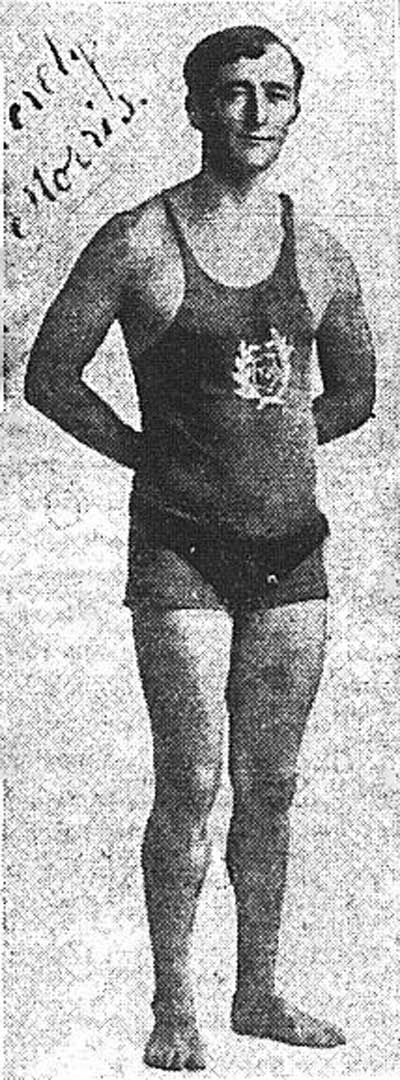
Referee, (Sydney, NSW), Wed 7 Jul
1922, p. 13. Reproduction: Peter de Waal
SENSATIONAL TOM MORRIS,
THE AUSTRALIAN SWIMMER.
Tom Morris, the Parramatta swimmer, lost no time in making himself and his mission known in England. A Sunday Times cable message runs thus: “London, Saturday.—Tom Morris, an Australian, has performed a sensational feat. He jumped off Westminster Bridge with his hands and feet tied, and swam in this condition to Cleopatra’s Needle, which is about half a mile away.
Tom Morris is a short, sturdy athlete, of great stamina, whose swimming exploits in the Parramatta district and in the Nepean River are well known to readers of The Referee. Prior to setting out for England he epitomised his ambitions thus:
“Everything comes to those who wait. And I have been waiting some time to get the chance to have a go at the English Channel swim. So my ambition will be fulfilled in the near future. I am to tour England, the Continent, etc, and will be away for two years. A suitable time is to be arranged for me to attempt the Channel swim before returning to the land of my birth, Australia. Jabez Wolffe, in a letter to me lately, says that on my performances, etc, and provided I can stay in the water for 12 or 14 hours, I stand a good chance of doing the feat, which I am confident of doing. Jabez Wolffe is not the person who is taking me in hand. Anyhow, I can only do my best, and that is all one can do at all times. I am to leave Sydney on May 16, by the RMS Ormuz, arriving in London about June 23, 1922. I will do my best to keep Australia in the limelight.”
Tom Morris, most confident of men, is keeping his promise. A little while back a prize of £1000 was offered in England for the man who swims the Channel. The money will tempt many, and we may be sure the Parramatta man will soon make his effort, it being mid-Summer in England just now. For some few years Morris has had an ardent desire to swim across the Channel. About three years ago he sent a challenge broadcast to the world of swim any many three races of five miles at back-stroke, breast-stroke, and free style. He said he was prepared to pay his own expenses and meet any man accepting the challenge in his own country.
Captain Matthew Webb and TW Burgess were the only men to swim across the English Channel. Many others have tried the Channel swim, but the currents have baffled all, including Jabez Wolffe, who has had many trials.
~ ~ ~ ~ ~
The Mercury, Mon 11 Sep 1922 12
THE CHANNEL SWIM.
————
STILL MANY ASPIRANTS.
——
London, September 9.
There are still many aspirants to swim the English Channel, the chief stimulus being a prize of £1,000 offered by a London paper, but there is little prospect of anyone succeeding, most of them being about as likely to succeed swimming the Atlantic as the Channel. The water is getting colder, and the strong tides almost invariably intervene in sweeping the swimmers back to mid-channel when they have reached four or five miles from the shore. Tom [aka Thomas] Morris, the Australian, is regarded as the most likely to achieve success, but the weather is too much for him. Channel boatmen think it will be a long time before anyone succeeds in emulating the great feat of Captain Webb and of Thomas Burgess (who accomplished the journey in 1911).
Morris has challenged any Channel swimmer to a 20-mile race on the Thames in five-mile stages, successively using three styles, sidestroke, backstroke and breast stroke.
Thomas Morris, 1925
Evening News, Thu 19 Feb 1925 13
TOM MORRIS
————
ON SERIOUS CHARGE
————
WELL-KNOWN SWIMMER
————
THOMAS MORRISs, 27, athletic instructor, of John-street, Erskineville, was charged at Darlinghurst Sessions to-day with having committed an assault on a boy[s]. [Arthur Dobson (13), Henry William Davis (14), and George Duffy (8)].
It was stated that Morris had attempted unsuccessful to swim the English Channel.
In opening the case for the Crown, Mr JL McKean said the victim of the assault met Morris at the Domain Baths in November. On November 30, the lad and several other boys went to Morris’ home, where he had promised to teach them boxing. He showed the lads some postcards of women in the nude, and afterwards the alleged assault took place.
Sergeant Philpott stated that Morris said “This is all a ‘frame-up.’ The boys all get jealous of each other.”
Witness said: “Do you think boys of 10 and 12 years of age could concoct a story like this?”
Morris replied: Yes.
The jury after a short retirement returned a verdict of not guilty.
~ ~ ~ ~ ~
The Daily Telegraph, Fri 20 Feb 1925 14
CRIMINAL
———
(Before Judge Edwards.)
Crown Prosecutor, Mr LJ McKean.
…
ACQUITTED AND DISCHARGED.
Thomas Morris, charged with indecent assault, was acquitted and discharged.
~ ~ ~ ~ ~
The Sydney Morning Herald, Fri 20 Feb 1925 15
QUARTER SESSIONS.
No. 1 COURT.
(Before Judge Edwards.)
(Crown Prosecutor, Mr LJ McKean.)
…
ACQUITTED.
Thomas Morris was charged with committing an indecent assault upon a boy 13 years of age, at Erskineville, on some day in November last.
The accused was acquitted and discharged
~ ~ ~ ~ ~
Barrier Miner, Tue 24 Feb 1925 16
SWIMMER IS ACQUITTED
ON ASSAULT CHARGE
———◦———
WELL KNOWN IN ENGLAND
———
Thomas Morris (27), of athletic fame, was acquitted at the Darlinghurst Sessions on Thursday on a charge of having committed an assault on a boy (says the “Labor Daily”).
It was stated that Morris made an unsuccessful attempt to swim the English Channel on September 27, 1922, remaining in the water from 7 am to 4.30 pm, and giving up only because of rough weather.
He was also credited with numerous other swimming and various diving stunts in England.
Mr LJ McKean said the victim of the alleged assault met Morris at the Domain Baths in November. He invited the lad and several other boys to his home at Erskineville to learn boxing. It was there that the alleged assault took place.
A lad, one of the Crown witnesses, after being sworn, swooned in the witness box and had to leave the court.
Sergeant Philpott said accused, when arrested, said, “This is a frame-up. The boys were jealous of each other.”
“Do you think boys of 10 and 12 years would concoct a story like this?” asked the sergeant.
Morris replied “Yes.”
Accused, who was not represented by counsel, had written out an address to the jury. The address, which summarised his athletic exploits, also contained references as to character, and was read to the jury by Judge Edwards.
The jury, after an absence of 15 minutes, brought in a verdict of not guilty.
Thomas Morris, 1927
The Cumberland Argus and Fruitgrowers’ Advocate, Thu 14 Apr 1927 17
“MENACE TO SOCIETY”
———◦———
TOM MORRIS IN GAOL
————
CHARGES AGAINST POLICE
————
“The defendant is a menace to society. Every time he is arrested, he makes these insinuations against the police. In 1921, he made diabolical charges two police officers. He’s a man of low moral standard.”—Sergeant Williamson on Thomas Morris.
Thomas Morris once gained a little publicity by trying to swim the Channel.
Now he is gaining a little more—by being charged with having stolen a bicycle.
The bicycle in question, valued at £5, belongs to Bruce Jarrett; and Morris is alleged to have stolen it at Parramatta last Saturday.
Morris appeared at the Parramatta Police Court on Monday.
“Guilty, but with no intention or [sic] stealing,” was his answer to the charge.
Sergeant Williamson: You’ll admit that you took the bicycle?—Yes.
Did you have the owner’s permission to take it?—No.
Morris, however, wanted to tell the magistrate all about it.
“I was at Hunts’ Creek,” he said. “Some chaps were firing a rifle. They fired at a dog. Being a lover of animals myself, I got heated with temper, and called out to them. They then fired in my direction several times. I followed them, thinking I could find out who they were. Then I took the bicycle. But I had no intention of stealing it.”
Sergeant Williamson: The defendant said nothing about this to the police. He denied all knowledge of the bicycle, which was subsequently found secreted on his premises.
As Morris had intimated his intention to plead guilty, the sergeant said, Jarrett was not in attendance. Consequently, an adjournment would be necessary.
The matter was adjourned until Wednesday, and Morris was led away.
Within a few minutes, however, he was back again.
Sergeant Williamson intimated that the defendant now wished to plead guilty.
When charged again, however, Morris did not plead guilty. He started to qualify.
The magistrate: You must either plead guilty or not guilty.
The defendant: I wasn’t able to get bail. And I was promised that, if I pleaded guilty, I would be let off with a fine.
The magistrate: That’s a matter for me.
Constable McCarthy: Nothing of the sort was said to him. He asked to be brought back to Court, so that he could plead guilty.
And once more the case was adjourned until Wednesday.
When the case was called on Wednesday, Morris pleaded not guilty.
Constable McCarthy gave evidence of having interviewed Morris at North Rocks on the day after that of the alleged theft.
Morris, he said, denied having even seen the bicycle; also, he denied having been at Hunt’s Creek the day before.
“I went to his hut in the bush,” said the constable, “where I found the bicycle covered with newly-cut bushes. At the defendant’s wood-heap I found an axe, which bore green sap stains.”
Morris said, later, according to the rest of the constable’s evidence: “I stole the bike. I am sorry for doing it; but it’s just what those fellows want—for shooting the dog. I would plead guilty to it if I thought I could get a fine, as I don’t want to go to gaol.”
“I told him that was a matter for the magistrate,: said Constable McCarthy.
Wilfred Bruce Jarrett owner of the bicycle, admitted having shot a dog at Hunt’s Creek, having taken it there for that purpose. Before he shot the dog, he said, he saw Morris nearby.
“After shooting the dog,” said Jarrett, “I came back to where I had the bicycle. It wasn’t there. Morris had gone, also.”
Morris went into the witness box, and told again his story of the shooting of the dag.
“Being a lover of animals,: said Morris, “the whole incident put me into a rage.”
The defendant said that he took the bicycle, as he thought that was the only was he could find out who had ill-treated the dog.
Morris alleged that Constable McCarthy said to him, at the lock-up, “By pleading guilty, you will get a light fine, and you will save us a lot of bother.”
Re-called, Constable McCarthy denied having suggested in any way that the defendant would receive better treatment pleading guilty.
Morris was convicted.
Sergeant Williamson then referred to the defendant’s allegations against the police.
The defendant was sentenced to three months hard labor.
~ ~ ~ ~ ~
Evening News, Thu 14 Apr 1927 18
TOM MORRIS,
SWIMMER,
GETS 3 MONTHS
———
“MENACE TO SOCIETY”
———
TALES ABOUT POLICE
———
THOMAS MORRIS, the well-known swimmer. Who was sentenced to three months’ hard labor at Parramatta Court, for having stolen a bicycle worth £5, was said by Sergt Williamson to be a man of low moral standing and a “menace to society.”
When arrested, said the sergeant, he made “diabolical insinuations” against the police.
Detective McCarthy said that on April 10 he found the stolen bicycle, covered with some freshly-cut bushes, near defendant’s hut. He arrested Morris, who later admitted having stolen the bicycle.
Wilfred Jarrett, carpenter’s apprentice, said he left his bicycle near Hunt’s Creek Reservoir last Saturday, while he shot a dog, and buried it. When he returned, the machine had disappeared. Morris, whom he had seen skipping in the vicinity, had also gone. On the following day he traced the tracks of the bicycle to near Morris’ hut.
“LOVER OF ANIMALS.”
In defence, Morris stated that he was a lover of animals. On hearing the “screams” of the dog which Jarrett had shot, and boys laughing, be became enraged.
Defendant alleged that on Monday, prior to being brought before the court, McCarthy said to him: “Morris, if you want to get out of this, plead guilty, and it will save us a lot of bother.” When he was being taken to the cells, McCarthy abused him, and pushed him roughly.
“ON VERGE OF COLLAPSE.”
“He must have picked out the worst cell in the yard, and locked me in it,” said Morris. “I was in for three hours, and was on the verge of collapse when a constable opened the door. The constable said “it was no place for me, and let me out into the yard.”
Sergeant Williamson: When you were arrested in 1921, didn’t you make similar allegations against Constables Walsh and Travers?—Yes.
And at the last time you were before the court, in 1925, you told the same story about McCarthy?—No.
In 1925 you ran away from McCarthy, and he fired a few shots at you?—Yes.
Recalled, Detective McCarthy told Mr Williams, SM, that he did not suggest to Morris that if he pleaded guilty he would be left off with a light fine.
~ ~ ~ ~ ~
The Sydney Morning Herald, Fri 15 Apr 1927 19
TRICK SWIMMER.
———◦———
SENTENCED FOR THEFT.
———
Thomas Morris, a well-known trick swimmer, was charged at Parramatta Police Court with having stolen a bicycle, valued at £5, the property of Wilfred Jarrett.
The police evidence was to the effect that the bicycle was found near Morris’s hut, and after arrest, defendant had admitted the theft.
Morris alleged that he had been enraged, because Jarrett had shot a dog, and it had screamed with agony. He also alleged that Detective McCarthy had said to him: “Morris, if you want to get out of this, you plead guilty, and it will save us a lot of bother.” The detective had also abused him, and pushed him, and locked him in the worst cell in the yard.
Defendant admitted under cross-examination that he had brought charges against the police when he was arrested in 1921, and in 1925.
Sergeant Williamson said Morris was a man of low moral standing, and a menace to society.
Morris was sentenced to three months’ imprisonment, with hard labour.
~ ~ ~ ~ ~
Singleton Argus, Sat 16 Apr 1927 20
INSINUATIONS AGAINST POLICE
———◦———
A MENACE TO SOCIETY
————
(By Telegraph.)
Sydney, Thursday.
Thomas Morris, a well-known swimmer, was sentenced to three months’ hard labour at Parramatta Police Court, for having stolen a bicycle. The accused was stated by Sergeant Williamson, to be a man of low moral standing, and a menace to society. When arrested, it is alleged he made diabolical insinuations against the police.
~ ~ ~ ~ ~
Windsor and Richmond Gazette, Fri 22 Apr 1927 21
RIVERSTONE
————
…
Thomas Morris, at Parramatta Court last week, was charged with stealing a bicycle. Wilfred Bruce Jarrett, the owner of the bicycle, admitted having taken a dog to Hunt’s Creek and shooting it. He saw Morris before he shot the dog. Afterwards, he came back to where he had left the bicycle. It wasn’t there. Morris had gone also. Defendant claimed to being a lover of animals, and admitted he took the bicycle as he thought that was the only way he could find out who had ill-treated the dog. Sergeant Williamson said Morris was a menace to society. Morris was convicted and sentenced to three months hard labor.
Thomas Morris, 1937
The Courier-Mail, Sat 7 Aug 1937 22
POLICE STOPPED
SKIPPING TEST
———◦———
TOM MORRIS’S ARRIVAL
FROM SYDNEY
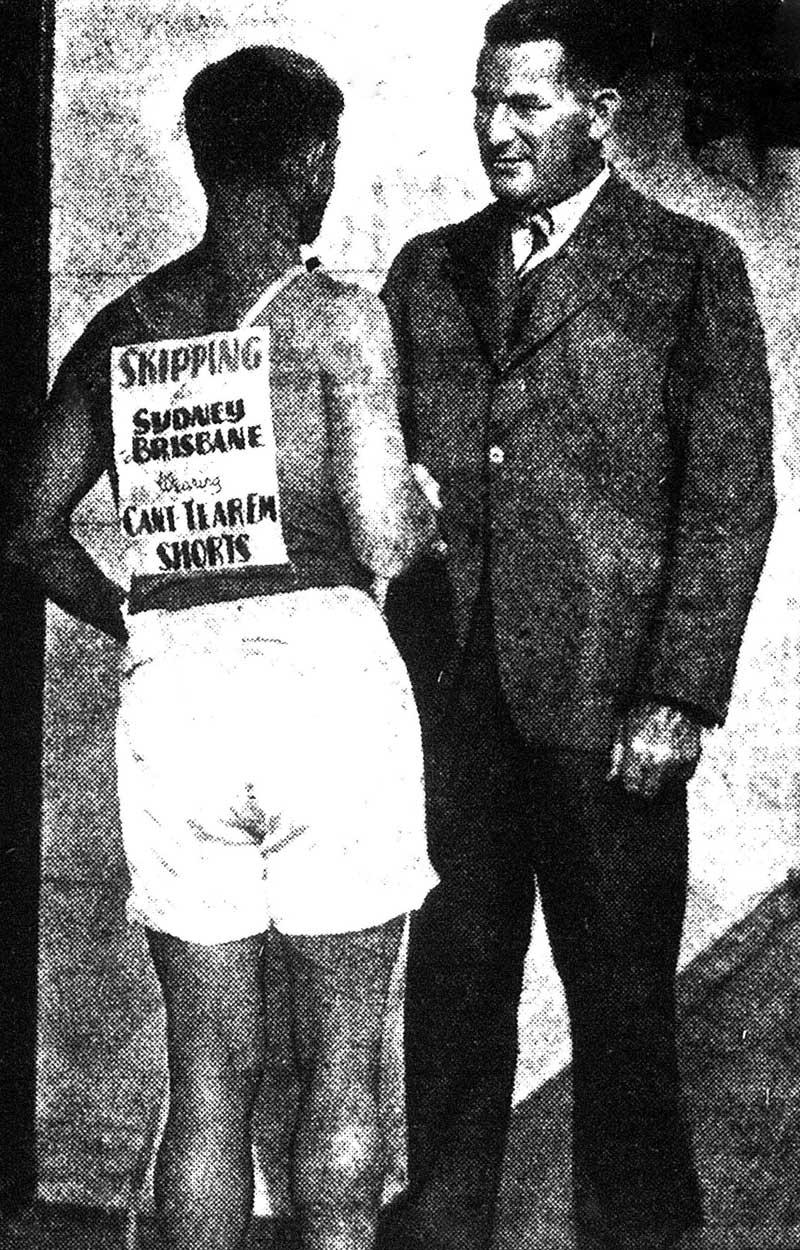
Courier-Mail (Brisbane, Qld), Sat 7 Aug 1937, p. 15.
Reproduction: Peter de Waal
Tom Morris, world’s skipping champion, and endurance swimmer, was not allowed to complete the final stage of his endurance skip from Sydney yesterday. The Commissioner of Police (Mr CJ Carroll) thought that Morris would interfere with the progress of the traffic, and he finished the final stage from Rocklea to the Tivoli Theatre by car.
He was greeted on arrival by Alderman A Laurie and representatives of the various sporting bodies of Brisbane.
Morris, who was sun-tanned and in the best of condition, said the main object of his feat was to demonstrate to the younger generation the physical benefits that could be derived from skipping. In Victoria skipping was indulged in by various sporting bodies, and was found most helpful in their training. Keen rivalry existed, and contests we re held. He hoped to create a skipping record while Queensland.
Mr E Lane (manager of the Tivoli Theatre) congratulated Morris, and referred to his various swimming and skipping records.
Morris left Sydney on June 28 on the 700 miles journey to Brisbane. His actual skipping time was about162 hours. “The rope turns at the rate of 900 to the mile, so you can work that out fort yourself,” he said.
~ ~ ~ ~ ~
The Queenslander, Thu 12 Aug 1937 23
STATE NEWS IN BRIEF
…
Sport
…
MARATHON SKIPPING TEST.—Tom Morris, world’s skipping champion and endurance swimmer, was not allowed to complete the final stages of his endurance skip from Sydney to Brisbane, as the police thought that Morris would interfere with the progress of traffic in the city streets. He finished the final stage from Rocklea to the city by car.
Morris left Sydney on June 26 on the 700 miles journey to Brisbane. His actual skipping time was about 162 hours.
1 The Referee, (Sydney, NSW), Wed 6 Mar 1918, p. 16.
2 The Cumberland Argus and Fruitgrowers’ Advocate (Parramatta), Wed 19 Feb 1919, p. 2. Emphasis added.
3 The Cumberland Argus and Fruitgrowers’ Advocate (Parramatta), Wed 5 Mar 1919, p. 1. Emphasis added.
4 The Cumberland Argus and Fruitgrowers’ Advocate (Parramatta), Wed 24 Nov 1920, p. 1. Emphasis added.
5 The Cumberland Argus and Fruitgrowers’ Advocate (Parramatta), Sat 11 Dec 1920, p. 11. Emphasis added.
6 The Cumberland Argus and Fruitgrowers’ Advocate (Parramatta), Sat 10 Feb 1921, p. 6. Emphasis added.
7 The Cumberland Argus and Fruitgrowers’ Advocate (Parramatta), Wed 31 Aug 1921, p. 5.
8 The Cumberland Argus and Fruitgrowers’ Advocate (Parramatta), Sat 10 Sep1921, p. 6.
9 The Cumberland Argus and Fruitgrowers’ Advocate (Parramatta), Wed 26 Oct 1921, p. 1. Emphasis added.
10 The Cumberland Argus and Fruitgrowers’ Advocate (Parramatta), Sat 10 Dec 1921, p. 11.
11 The Referee, (Sydney, NSW), Wed 7 Jul 1922, p. 13.
12 The Mercury, Mon 11 Sep 1922, p. 5.
13 Evening News, (Sydney, NSW), Thu 19 Feb 1925, p. 9. Emphasis added.
14 The Daily Telegraph, Fri 20 Feb 1925, p. 5.
15 The Sydney Morning Herald, Fri 20 Feb 1925, p. 6.
16 Barrier Miner, Tue 24 Feb 1925, p. 4. Emphasis added.
17 The Cumberland Argus and Fruitgrowers’ Advocate (Parramatta), Thu 14 Apr 1927, p. 4. Emphasis added and in original text.
18 Evening News, (Sydney, NSW), Thu 14 Apr 1927, p. 20. Emphasis added and in original text.
19 The Sydney Morning Herald, Fri 15 Apr 1927, p. 4.
20 Singleton Argus, Sat 16 Apr 1927, p. 2.
21 Windsor and Richmond Gazette, Fri 22 Apr 1927, p. 3.
22 The Courier-Mail (Brisbane, Qld), Sat 7 Aug 1937, p. 15. The above photo caption states: “Congratulations, Tom! Mr Ted Lane, manager of the Tivoli Theatre, congratulates Tom Morris, marathon skipper, athlete, and life-saver, who yesterday completed the arduous feat of skipping from Sydney to Brisbane, wearing “Cant-Tear-‘Em” Shorts available in Khaki and White Drill from all stores at 4/11 a pair.”
23 The Queenslander, Thu 12 Aug 1937, p. 46.