The Sydney Morning Herald, Wed 3 Feb 1915 1
LAW NOTICES.
———
Wednesday, February 3.
…
QUARTER SESSIONS.
William James McKinley, assault; Roger Benjamin Gibson, stealing.
~ ~ ~ ~ ~
The Daily Telegraph, Thu 4 Feb 1915 2
QUARTER SESSIONS.
————
(Before Judge Docker and a jury.)
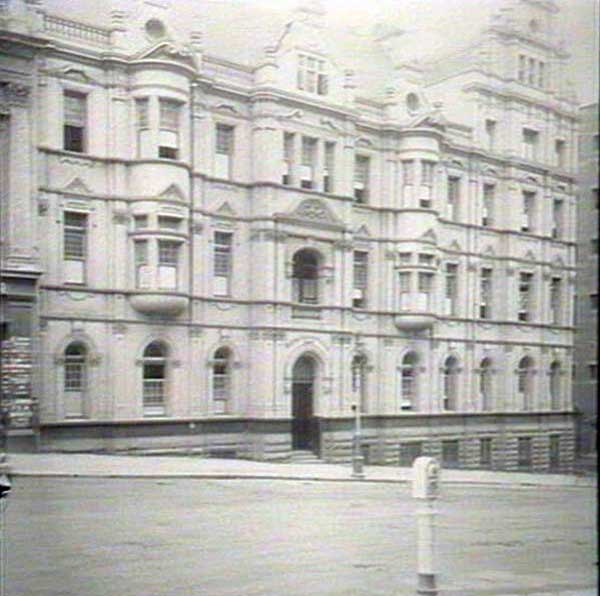
NSW State Library collection. Reproduction: Peter de Waal
Mr Herbert Harris prosecuted for the Crown.
…
ACQUITTED.
William James McKinley, a fine-looking young two-barred member of the Navy, was acquitted on a charge of indecency. Mr JW Abigail appeared for the accused.
~ ~ ~ ~ ~
The Sydney Morning Herald, Thu 4 Feb 1915 3
QUARTER SESSIONS.
(Before Judge Docker and juries.)
Mr Herbert Harris Crown Prosecutor.
…
CHARGED WITH AN ASSAULT.
Wm James McKinley pleaded not guilty to a charge of an [indecent] assault against Edward Arthur Jenkins on December 5, at the Royal Naval House. 4 Mr JW Abigail appeared for the defence. The jury, without leaving the box, returned a verdict of not guilty, and McKinley was accordingly discharged.
1 The Sydney Morning Herald, Wed 3 Feb 1915, p. 9. Emphasis added.
2 The Daily Telegraph, Thu 4 Feb 1915, p. 4.
3 The Sydney Morning Herald, Thu 4 Feb 1915, p. 5.
4 The land that Royal Naval House stands on was once part of the western limit of the first Parade Ground of the Colony of New South Wales. The street was originally called Charlotte Place, named after Charlotte Sophia, the wife of King George III. In 1897 the name of the street was changed to Grosvenor; the renaming was very unpopular at the time. Earliest claimants to the site were William Davis and children of the late Robert and Anne Howe, grandchildren to George Howe – Government Printer and founder of Sydney's first newspaper, the Sydney Gazette. Fowles’ street-scapes from “Sydney in 1848" show substantial two storey houses along the site and these remained essentially unaltered until their demolition for the Royal Naval House in 1889 and the other in 1907 for the later wing.
The 1890 section of Royal Naval House occupies the section of the site originally owned by William Davis, who was instrumental in helping the Catholic Church establish itself in NSW. John Samuel Shearston (1853-1916) was instrumental in the establishment of the Church of England Mission to Seamen in 1881, and his home a 3 Princes St, Dawes Point was its headquarters. In 1885 he moved to larger premises at 9 Princes Street, renamed Trafalgar House, where they were also able to offer some residential accommodation. At the end of 1886, at its Committee's request, he agreed to also act as Superintendent of Goodenough Royal Naval House at 39 Princes Street, which he ran in conjunction with Trafalgar House. Despite this both places could not cope with the demand for accommodation and a public subscription was taken up to construct Royal Naval House in Grosvenor Street.
Lord Carrington officially opened Royal Naval House in 1890. The land cost 9,000 pounds, the building 14,000, which was later extended, and the furnishings 1,200 pounds. Shearston resigned as Missioner to become Superintendent of Royal Naval House in September 1890. Mrs Shearston acted as housekeeper. The men, grateful for their warm welcome, soon referred to the premises as 'Johnnies' (after Shearston), the name used by seamen until it closed in 1970.