Argyle Liberal and District Recorder, Fri 23 Dec 1904 1
CROOKWELL POLICE COURT.
————
The usual monthly sittings of the above Court was held yesterday, before Mr Maitland, PM.
The Court lasted all day, therefore we are reluctantly compelled to hold over a full report of same till next issue.
~ ~ ~ ~ ~
The Crookwell Gazette and Settlers’ Advocate, Fri 23 Dec 1904 2
CROOKWELL POLICE COURT.
————
THERE was a lengthy sitting of the Crookwell Police Court yesterday, Mr EL Maitland, PM, of Goulburn, presiding. Some cases of interest were dealt with, one resulting in two young men [William George Warn and Reuben Corby] being committed for trial for indecent exposure under extraordinary circumstances. A full report of the day’s proceedings will be given in our next.
~ ~ ~ ~ ~
Goulburn Evening Penny Post, Sat 24 Dec 1904 3
CROOKWELL POLICE COURT.
————
Thursday, December 22.
————
Before Mr Maitland, PM.
Constable Debnam [sic] proceeded against William Warn and Reuben Corby for wilful and indecent exposure of the person in a public place, viz, the Crookwell show-ground, on the occasion of a sports meeting on November 14.
Mr EF Thomas appeared for both defendants.
Evidence was given by Constables Debnam and Walcott to the effect that the defendants were in the pavilion in a nude state, and could be seen by passers-by.
In the course of cross examination Mr Thomas elicited the facts that the defendants were competitors in the sports on November 14, and on that day, with other competitors, they were using the pavilion for the purpose of being “rubbed down” by their trainers; also that a portion of the pavilion which was used as a ladies’ lavatory was screened off, leaving the portion where the competitors were entirely reserved for their use.
At the close of the case for the prosecution Mr Thomas took the point that there had not been any wilful exposure of the person, and while he was arguing this point the PM said that he agreed, after the cross-examination, that the pavilion where the defendants were was a place of public resort. He thereupon dismissed the case, but bound the defendants over to appear at the Goulburn Quarter Sessions on a date fixed by the Attorney-General to answer a charge of obscenely exposing the person—a misdemeanour under Common Law.
Mr Thomas objected to the course proposed to be adopted by the PM on several grounds, the main contention being that the PM had no power to adopt the course in such a case as the one before the court.
The PM said that the point raised by Mr Thomas was a very nice one, but he thought he had the power to adopt the course he had taken. Her would, however, have the points noted on the depositions for submission to the Attorney-General.
Bail was immediately forthcoming. Each of the accused was bound over in £40 with one surety of £40 or two in £20.
~ ~ ~ ~ ~
The Crookwell Gazette and Settlers’ Advocate, Thu 29 Dec 1904 4
CROOKWELL POLICE COURT.
Thursday, December 22.
———
Before Mr EL Maitland, PM, and SL Cox.
…
Before Mr EL Maitland, PM.
R Corby and WG Warn pleaded not guilty to a charge, under the Vagrant Act , of wilfully and obscenely exposing themselves in a place of public resort.
Mr Thomas, of Goulburn, appeared for the accused, and Senior-Sergeant Kennedy conducted the case for the prosecution.
Constable [Edioni Wheatly] Dedman deposed—On the 14th of last month he was on Crookwell Show Ground, where sports were being held, the public being admitted to the ground; some 200 or 300 people were present; walked past the pavilion, 5 the side and front doors of which were wide open; a piece of hessian was hanging as a partition and making a passage-way for ladies to get to the lavatory, dividing pavilion in two; walked passed the side door, which was wide open; saw WG Warn and Reuben Corby in a perfectly nude state, facing the open door and fully exposed, with nothing to shield them from the public gaze; stepped on to the door-step and stood there a minute, and walked across to defendant Warn; asked him what sort of an exhibition he was making, and said he had better get to a private place to be rubbed down; Warn took it coolly and said they ought to keep the door shut; witness went out of the pavilion and met Constable Alcott, to whom he said something; he then walked into the pavilion; ten minutes afterwards witness went up again and found the side door still wide open, and the two defendants still there in a nude state and exposed, with a number of small boys watching them; two little girls about six years of age, were also standing in the doorway; one of them was pointing to Corby, drawing the attention of the other one, witness sent Constable Walcott to see the officials; after ten minutes the door was closed and locked; there were a number of people going in and out of the pavilion as well; there was no notice on pavilion of any kind except on front door—“competitors only”; people were going in through the ladies’ entrance at the front door; while the hessian was being lifted witness got a view at the men in a [sic] nude state through front door.
To Mr Thomas: No one who went into the pavilion had any right to but ladies and competitors; he could see Warn, but without entering the porch; the defendants were competitors in a footrace; did not speak to the boys; did not see any notice outside; will swear there was no notice outside; several persons lifted up the hessian; did not look in through the front door to see how Constable Alcott could get his view; there were several other competitors in the pavilion; Warn did not have a towel round his waist; he was being “rubbed down” when witness saw him, either before or after a race there were several others there rubbing him down; would not be certain who locked the door; Warn did not attempt to get out of the way; did not know a man named Kenny was on the door; those in the pavilion at the time were mostly competitors.
Constable Walcott gave corroborative evidence.
The PM expressed a doubt as to the pavilion being a “public place,” and had same noted on the depositions. He thereupon altered the charge to one of exposing their persons naked to the public view.
The accused reserved their defence, and were committed for trial at Goulburn on January 31, bail being granted.
Charles Anthony was granted a hawker’s licence, on finding sureties for £20.
William Thurlow was granted a stage-coach licence.
~ ~ ~ ~ ~
Goulburn Evening Penny Post, Tue 31 Jan 1905 6
GOULBURN QUARTER SESSIONS.
The Quarter Sessions opened this morning before His Honor Judge Fitzhardinge. Mr J Armstrong was Crown Prosecutor. The members of the legal profession in attendance were Mr S Betts (barrister), Messrs AM Betts, H O’Brien, EF Thomas, F Gillespie, E Howard, EA Betts, and F O’Brien (Yass).
~ ~ ~ ~ ~
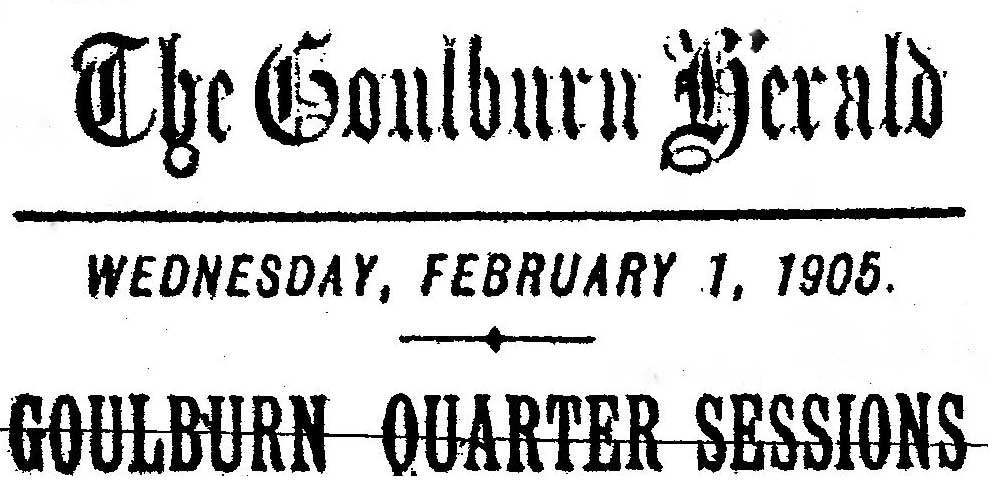
The Goulburn Herald, Wed 1 Feb 1905 7
OPENED yesterday before His Honor Judge Fitzhardinge. Mr J Armstrong was Crown Prosecutor, and Mr SH Belcher represented the Sheriff. The legal gentlemen present were Messrs S Betts (barrister), AM Betts, E Howard, F Gillespie, and FW O’Brien (Yass).
JUROR FINED.
Cornelius Sheekey of Goulburn and John C Henderson of Longreach were each fined £3 for non-attendance as jurors. This morning, however, the fines were remitted. Evidence was given that Henderson had removed to another State. Sheekey was excused from further attendance. Mr RC Chapman was excused as a juror on account of illness.
…
Wednesday.
His Honor took his seat at 9.30 am.
JURORS EXCUSED.
William Wood was excused as a juror from 10 am to 2 pm.
CHARGE OF INDECENT EXPOSURE.
William George Warn and Reuben Corby, two young men, were charged with indecently exposing themselves in a place of public resort—to wit, the Crookwell showground—on November 14th.
Accused pleaded not guilty, and were defended by Mr Thomas.
The accused challenged six jurors and the crown four.
All youths and females were ordered out of court during the hearing of the case.
Constable Dedman of Crookwell deposed that a portion of the pavilion on the Showground was used on the day in question as a dressing-room for competitors who were taking part in sports; there was a front door also a side door to the pavilion; one portion was partitioned off with a hessian curtain for the competitors, and another portion was reserved as a ladies’ lavatory; there was no notice up to show people that it was a dressing room; the public kept going in and out, and the accused could be seen by people passing the doors; as witness passed he saw Corby in a nude state and as he passed the other door he saw Warn in a similar state; once the curtain was lifted up and he saw Warn’s naked body from head to foot; several naked persons were in the room; witness asked Warn what sort of an exhibition he was making, and said he had better get to a private place to be rubbed down; Warn said they ought to keep the door shut; witness went out of the pavilion and met Constable Walcott, to whom he said something; he then walked into the pavilion; ten minutes afterwards witness found the door wide open, and the two defendants still there in a nude state and exposed, with a number of small boys watching them; two little girls, about six years of age, were also standing in the doorway; after ten minutes the door was closed and locked; there were a number of people going in and out of the pavilion as well; there was no notice on the pavilion of any kind except on the front door—“ladies only;” people were going in through the ladies’ entrance at the front door.
To Mr Thomas: Witness did not see the notice produced on the pavilion; the little girls were standing at the doorway; Warn did not even have a singlet on; the competitors went in their racing costumes from the ring to the pavilion; they were then rubbed down; witness heard Mr Thomas take the point at Crookwell that it was not wilful exposure; witness did not hear the Police Magistrate say “I agree with you;” witness did not hear the PM say he was not satisfied on the evidence that the place was a public resort.
His Honor: What! An agricultural showground not a place of public resort? No police magistrate could have held that.
Mr Thomas: It was this particular part of the pavilion that was referred to.
Constable Walcott gave corroborative evidence.
In answer to Mr Thomas, Constable Walcott said he did not tell Frank Boys that he was sorry for Corby but not for Warn; he was not sorry for either of them.
Accused [William George] Warn, tailor at Crookwell, deposed that the secretary of the sports told the competitors to occupy the room they did as a dressing-room; he was being rubbed down that day; when Constable Dedman came in witness had a singlet on; from where witness was standing it was impossible to see anyone outside the pavilion; Constable Walcott told witness to be careful what he was doing, as the side door was open; witness said he could not go and shut it; while witness’s legs were being rubbed down he shielded portion of his body with a singlet.
To the Crown Prosecutor: The whole of his body was rubbed down; when his legs were finished he put his running pants on and then took his singlet off.
Accused [Reuben] Corby, residing at Tuena, deposed that while his legs were being rubbed down he held a towel in front of his body; from where witness was standing he could not see anybody passing outside; a notice referring to competitors was posted inside.
Frank Boys, saddler, Crookwell, deposed that he was secretary for the sport; he put up the notice produced, referring to competitors being on their marks to time; he did not think people outside the pavilion could see Warn or Corby where they were standing; he had a conversation with Constable Walcott, who asked him if he was a witness in the case; Walcott said he was sorry for Corby, but not for Warn.
JT Naughton, grazier, deposed that he was judge at the sports; he passed the pavilion several times, but did not see any persons in a nude state.
George Littlefield deposed that he was rubbing Warn down; Warn had a singlet on.
Mr Thomas submitted that nothing more had been done by the accused in this case than was done in every sports’ gathering, at Manly every day by persons bathing, and by persons taking a bath. If the jury believed that the accused were of opinion that they could not be seen from outside when they were being rubbed down, they should acquit them. It seemed a strange thing in this case that not one of the public had come forward to say that they saw the accused in a nude state. All they had was the evidence of two constables, whose action in the case suggested that they were trying to sheet it home to Warn, and that Corby was made a scapegoat of. He came to this conclusion as a number of men were being rubbed down in the room yet only Warn and Corby had been brought before the court. He had no hesitation in asking the jury to say that there was no deliberation on the part of the accused, and he asked for their acquittal.
During the hearing of the case several persons in court were heard to laugh.
His Honor said if he heard laughing again he would have the court cleared. He could not understand any persons who had any decency about them, and who had no occasion to stay, remaining in court to listen to the evidence in such a case.
His Honor in summing up said if the jury came to the conclusion that the accused exposed themselves in the dressing-room it would be their duty to convict. One part of the evidence which suggested that there had been some offence was that Warn told Boys that the door better be shut, and it was then locked.
The jury retired at 12 o’clock, and at twenty minutes past four returned with a verdict of not guilty, and both accused were discharged.
~ ~ ~ ~ ~
Goulburn Evening Penny Post, Thu 2 Feb 1905 8
Wednesday, February 1.
The Court resumed at 9.30.
FINES REMITTED.
The fines imposed on Tuesday upon Messrs Cornelius Sheekey and JC Henderson were remitted. Mr Sheekey was excused from further attendance during the sitting of the Court
CHARGE OF INDECENT EXPOSURE.
William [George] Warn and Reuben Corby were charged with indecent exposure of the person in a public place, viz., Crookwell showground, on the occasion of a sports meeting on November 14.
Mr EF Thomas appeared for the accused.
The Crown asked four jurors to stand aside, and the accused challenged six jurors.
Constable Dedman deposed that on November 14 he was present at a sports gathering on Crookwell show-ground; there were a large number of people on the ground; on the show-ground was a pavilion, and the men who competed in the sports were rubbed down in a room in it screened off by a curtain; the public, however, kept going in and out; sports had been going on some time; the doors of the pavilion were half open and people passed by; as witness passed by one door he saw Corby in a naked state being rubbed down, and as he passed the other door he saw Warn in a naked state; the accused could be seen by people passing by; there was nothing to screen the men from public view; several other naked men were in the room; witness stood on the doorstep for a minute looking at accused and then he said to Warn, “This is a nice exhibition—you ought to go into a private room to be rubbed down;” the accused replied, “They ought to keep the door shut;” witness spoke to Constable Walcott and returned to the pavilion; accused were in the same place and still in a naked condition; the doors were still open, and a number of small boys were inside; two girls about six years of age were looking in, and one of them was pointing to accused Corby and attracting the attention of the other girl; witness sent Constable Walcott to an official to have the doors closed, and after a while the doors were locked; there was no notice up to indicate what the room was used for, but on the front door was a notice, “Ladies only.”
To Mr Thomas: Men were going from the ring in their togs to the pavilion; there was a porch inside each door; the notice produced was not on the building and could not be seen by persons going in by the side door; the building was 62ft long; he did not remember saying that the accused had not wilfully exposed themselves; he did not hear the Police Magistrate say at the Police Court that he agreed with him (Mr Thomas), and further that he was not satisfied that the pavilion where the accused were was a place of public resort.
His Honor remarked that no magistrate could say that the pavilion was not a place of public resort.
The witness continuing said that he never heard the PM say that he did not wish to hear Mr Thomas any further; if the front door was locked the men would have to pass the ladies’ lavatory.
Constable Walcott corroborated the evidence as to Warn’s nudity; witness pulled the door to, but it would not remain closed.
Mr Thomas submitted that there had been no deliberate act, but his Honor thought differently.
The case for the Crown was closed.
William [George] Warn, tailor, residing at Crookwell, deposed that on the day in question Mr Boys, secretary of the sports, told competitors to use the pavilion; when Constable Dedman came up to witness he had a singlet on, and it reached to his legs; he was holding the singlet down; from where he standing he did not see any one through the side door; Constable Dedman did not speak to witness, but said something to a man standing near by; Constable Walcott said to witness, “Be careful what you are doing—the side door is open;” witness said that he could not shut it the way he was; witness afterwards spoke to the secretary; Constable Walcott told Boys to shut the door, as Constable Dedman intended to summon someone; the door was afterwards shut; witness did not expose his person any more than he had said.
To the Crown-Prosecutor: He was rubbed all over, but he put his running pants on while his singlet was off.
Reuben Corby, farmer, residing at Tuena, deposed that he was occupying a portion of the dressing-room, and was in a corner of that room; he was holding a towel in front of himself while he was being rubbed down; he could not see anyone passing from where he was; the notice referring to competitors was posted inside the side door.
Frank Boys, saddler, residing at Crookwell, deposed that he allotted the place for competitors, and posted the notice to competitors on the inside of the door.
His Honor read the notice to the jury. It was to the effect that all competitors should be on their marks at a certain time, but made no reference to the pavilion being set apart for competitors. His Honor pointed out that the notice was in no way material, and had no bearing on the case.
John Thomas Naughton, grazier, deposed that he was a judge at the Crookwell sports; he passed the doors during the day, but did not see competitors in a nude state.
George Littlefield, tailor, residing at Crookwell, deposed that he was present when Constable Debnam [sic] came in; the constable did not speak to Warn; while Warn was being rubbed down he had a singlet on.
Mr Thomas submitted that the accused had done no more than any one else who while in his bath-room was obtruded upon by other persons. His Honor pointed out that a bath was scarcely a public place. Mr Thomas, continuing, said that there was no deliberation in the act, but the accused only did what was done at any sports gathering the world over. The evidence for the defence was as strong as or even stronger than the Crown case. Debnam [sic] instead of telling the accused that they were exposing themselves stood at the door for a minute, and then issued a summons against them. No one had been called to show that these men could be seen from the outside, but for the defence it had been stated that the men inside were not noticeable outside. The pavilion had been specifically reserved for competitors, and he took it that from the notice it would reasonably be inferred that the competitors had the use of the pavilion.
The Crown-Prosecutor did not address the jury.
Some laughter took place in the gallery while the case was being heard, and the Judge remarked that if he heard any more laughter he would have the court cleared. He did not know how people could smile when an indecent case was being heard, nor could he understand how any decent person could remain in court.
His Honor reviewed the evidence, pointing out there was an exposure, and that after the police had remained for a while to see if the men covered themselves they were still in a nude state. If Warn were not in a nude state, why was he warned by the constable that he could be seen from the outside.
The jury retired at noon exactly.
The jury returned into court at 4.40 pm with a verdict of not guilty.
~ ~ ~ ~ ~
The Sydney Morning Herald, Mon 24 Jul 1905 9
POSTAL TENDERS.
The Postmaster-General notifies that he has accepted the tender of Reuben Corby, of Tuena, for repairs to the telegraph lines between George’s Plains and Tuena, and between Burraga and the Junction with the Bathurst-Tuena line. He also notifies that he has extended the time of receipt of tenders for the supply of uniforms of mail guards, mailboys, letter-carriers, and so on, in New South Wales from the 19th inst until August 17. Tenders in Tasmania for similar supplies are extended until August 2.
1 Argyle Liberal and District Recorder, (NSW), Fri 23 Dec 1904, p. 2.
2 The Crookwell Gazette and Settlers’ Advocate, Fri 23 Dec 1904, p. 2.
3 Goulburn Evening Penny Post, Sat 24 Dec 1904, p. 2. Emphasis added.
4 The Crookwell Gazette and Settlers’ Advocate, Thu 29 Dec 1904, p. 2. Emphasis added.
5 The author wrote to the executive committee of the Crookwell AP & H Society on the 12th Jan 2009 seeking permission to use the photo entitled “Show Pavilion at Crookwell Showground” found on their website. Use your search engine and enter: “Crookwell Showground Pavilion.” On the 15th Jan 2009 the author received an email from Paul Anderson, stating: “Yes you may use the photo - do you have a history of the pavilion. Also if you do have problems with the pic I do have 2 good shots of it in its original state taken in 1912 (from glass plate negs).” On the same day the author responded asking for the ‘2 good shots’ in jpg format and who should be acknowledged for the image(s). The jpgs never arrived. The author emailed Anderson again regarding the use of photo on 16 Mar 2011 without getting a response consequently the image had to be deleted.
6 Goulburn Evening Penny Post, Tue 31 Jan 1905, p. 2.
7 The Goulburn Herald, Wed 1 Feb 1905, p. 2. Emphasis added.
8 Goulburn Evening Penny Post, Thu 2 Feb 1905, p. 4. Emphasis added.
9 The Sydney Morning Herald, Mon 24 Jul 1905, p. 5. Emphasis added.