Justice J Dowling’s Notebook 1
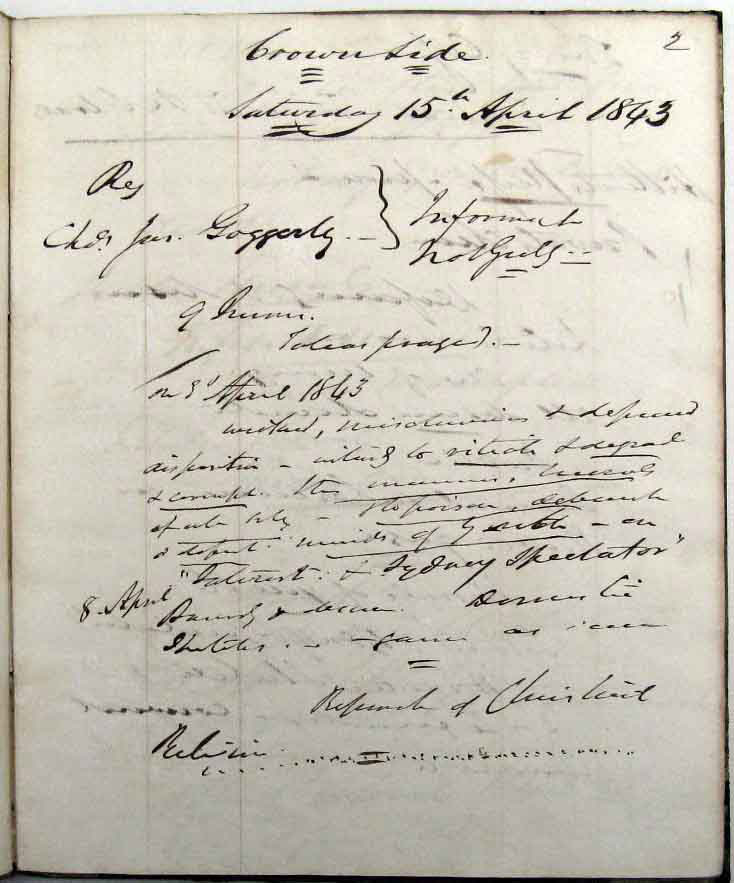
Gugerly et al ‘obscene libel’ trial. Photo: Peter de Waal
2
Crown Side
Saturday 15th April 1843
Re Chas Jas. Goggerly – Informant, Not Guilty
(? ? ? ?)
on 3rd April 1843. Wicked, mischievous & (depraved ?) disposition – (inciting ?) to vitiate & degrade & corrupt the manners, morals of (? ?) – & to poison, debauch & infect minds of youth – in Satirist & Sydney Spectator 8 April ( ? & ?) (Domestic ?) (? – ? as ?) (? of ? ?)
3
( ? ) (?)
First case Tried in N.S.Wales
(?) (Press ?) – (?)
Private (?)
(Defaming ?) & (?) (Libels ?)
one of many
all (? ?)
Public
Sexual intercourse in public gaze
(?) of Guilt
Satirist & Sydney Spectator
Domestic (?)
3 or 4 (? – ?) characteristic(s)
4
All men in a free country.
(intent ? interest ?) in the lot free (dom ?) of the press.
not dying a natural death
Public mind
Infant mind
taint & corruption
Libels – obscenity
(?) generation.
John Birch Clerk in the Colonial Society's office. I produce a newspaper the Satirist & Sydney Spectator of the 8 April 1843. I (Brought ?) it from Colonial Society. (S.2 ?)
5
It was lodged there. He has lodged two or 3 – this is (?) by (?) this. J. Goggerly – the same name (to ?) (affidavit ?) I believe the same name to the paper as affidavit. The writing appeared to be his writing. I believe it is. I have seen him write. It is signed by him. Before this the paper called The (Omnibus ?) & Sydney Spectator. Printed & published at the (?) Office (? ? ?) City of Sydney in Colony of New South Wales by Chas (James ?) Goggerly (?) at the (?) office above described. This is in the (?)
6
I have seen the (?) at the door at the office. I have (communicated ?) with him there once or twice. I have (?) with him. I have (bought ?) the (? ?) – two copies – only one of that date was (presented ?) to the Colonial Office signed – there was one unsigned of the same date. That was the only one of name of publisher. (Intent ? Interest ?) of Sydney Spectator (ready ?) signed paper – with the name changed. I wrote a note to the Dept. about the 8th April.
Dept. produces note.
This is (with ?) the note. [two lines of very rough shorthand follow, too difficult to decipher]
7
On Friday I wrote to the Dept. & on the Saturday this paper came with his name & evidence in the paper – in his writing. The paper of 8th April to (correspond ?) with the Imprint.
Cross-examined. The letter I sent was about the (Omnibus ?). There was no (?) at this time. I received the signed copy on Saturday. I won't say when I sent this letter. I believe I received signed copy on Saturday if I (?)
– the
one signed one with (name ?) without (evidence ?) – & note (respected ?) that one (Man ? than ?)
8
(Man ? than ?):–
one (1st ? 6th ?) April has CJ Goggerly without name of (?) in (?) (& ?) the 8th has his address –
18 (Mar ?) has CJ Goggerly (but ?) without (Street ?)
(?) sent for a copy of the paper.
I have seen him (sign ?) respecting printing press – I saw him sign on – him – I believe it his writing. I believe it is his writing. I got a note from him writing to checked:– make a (?) (affidavit ?) & I saw him the day after. I told him to call next day.
Re-examined. He has rendered himself liable for a (?) for (? ?) by (the same ?) & in print (?)
I (? ?)
9
I have seen him sign & I believe this is his writing.
=
(Domestic ?) (?)
Libel read.
10
Inf. That James Goggerly wicked, mischievous & depraved mind – & intending to vitiate & degrade & corrupt the manners & morals of the subjects of the Queen, & to debauch, poison & infect the minds of all the youth of (?) in the said Colony & to bring them into a state of wickedness & (lewdness ?) & debauchery & brutality.
On 8th April
Satirist & Sydney Spectator
not (?) (As ?) printer & publish a libel.
(?) of poison that a publication could (? ? ?) names if not supported by
11
Public
Attorney General duty –
12
Wm. Samuel Jagon I am a native of St. Kitts in the West Indies. I came in 1832. I can read & write – Looked at a newspaper the Satirist & Sydney Spectator April 8 – This is my writing. I got at the office where it (purports ?) to be printed – at (?) end of (George St. ?) where the obsance was Omnibus was printed – It was formerly (?). I got it in the presence of Goggerly – (Same ?) man – handed it to me & I paid for it – He said how do you do, I have been at. He appeared to belong in (there ?) He was behind the counter. I gave 6d.
Cross-examined. I said “How you do” I refused some papers – as soiled.
13
The (lame ?) man served me. He was there & came from a door (?). The Defendant said to the lame man “(change it ?) because it is dirty” – He came from stood on the other side of the counter.
I did not receive it from his hand.
=
Defence
Goggerly – (?) no (?) (took ?) my person.
(gave ?)
(?)
Witnesses –
No (? ?)
Jury may say guilty – no way of proving (innocent ?)
14
Verdict Guilty.
Thomas (?) Johnson – 2 years Newcastle
William Checked:–. (Brown ?) – 1 year Berrima
Cas Jas Goggerly – 1 year Berrima
~ ~ ~ ~ ~
The Australian, Mon 17 Apr 1843 3
CENTRAL CRIMINAL COURT.
…
SATURDAY, April 15.
(Before Sir James Dowling, 4 Chief Justice, and a Common Jury.)
On the sitting of the Court this morning Charles James Goggerly [aka Gugerley; Gogerly] was charged on an ex-officio information with having printed and published an obscene libel, on the 8th instant, in a certain paper called the Satirist and Sydney Spectator.
The defendant pleaded not guilty, but had not instructed any counsel to appear in his behalf.
The Attorney General, in opening the case, said it was the first of the kind that had ever been tried in New South Wales, and he had hoped it would have been very many years before he, or whoever might hereafter fill his office, would have had occasion to bring such an [sic] one before a jury. Many complaints had been made, at home and elsewhere, of the immorality of our population; and many slanderous imputations had been cast upon us; but hitherto we had been free from the accusation of encouraging such publications as he was now about to bring before them. All manner of questions had been before the public; and writings upon them had been warm, but, nevertheless, they had hitherto been preserved from the ignominy and disgrace of publishing obscene libels. A new era, however, seemed to have dawned, and such libels were published, and sold openly in the streets; and the document he should produce was only one of many similar libels now abounding. The Attorney General then read various quotations from the article containing the libel complained of; which article purported to be a conversation between a number of females of improper character. Although it might be such as might be expected to occur amongst such unfortunate persons, he would ask the Jury, as husbands and fathers, whether they must not be sensible that such writings tend to corrupt the minds of the children and families; to deprive their daughters of that innocence which was their boast and their blessing; and generally to corrupt the morals of the community? Such publications could only have such a tendency. And would they not therefore snatch them from the eyes of their children as they would poison from their lips, if about to devour it? On the part of the parties who were concerned in these prints, if they could not overreach the law, it was not because there was any want of disposition to do so. He could not conceive a man in the colony who could obtain a more dishonest livelihood than one who would disseminate such sentiments as would poison the mind of every youth, and shock the heart of every woman in the community. There was no honesty, or decency, or propriety, in the occupation. He claimed from the jury to infer no inuendo [sic], but asked them, as men sworn to do their duty, if they could misunderstand the intent of the passages he had read? It was said by some, it would be better to leave such publications alone, and they would die a natural death. But he did not think so; as the fact was, they were still going on, and weekly increasing; and there was now not a street or thoroughfare in the town, where they were not hawked, and where purchasers amongst the lower classes were found. But he apprehended their originators would find, to their cost, that the law was too strong for them. It was most reluctantly that he interfered with the press; but in order to prove that its freedom must be prevented from descending to abuse, he would quote the language of the great Lord Erskine, who had been one of the most powerful supporters of the liberty of the press. He, however, placed a limit, beyond which its liberty could not be allowed to extend; namely, when it descended to licentiousness, and operated against the Christian religion, and the laws of the land, of which that religion was a part; thus tending to corrupt the morals of the community. The learned gentleman then read as follows:
“Every man has a right to investigate with decency controversial points of the Christian religion, but no man consistently with a law which only exists under its sanction, has a right to deny its very existence, and pour forth such shocking and insulting invectives as the lowest establishments in the gradations of civil authority ought not to be subject to, and which would soon be borne down by insolence and disobedience if they were. The same principle pervades the whole system of the law, not merely in its abstract theory, but in its daily and most applauded practice. The intercourse between the sexes when properly regulated, not only combines, but humanises and adorns our natures, is the foundation of all the thousand romances, plays, and novels, which are in the hands of every body. Some of them lead to the confirmation of every virtuous principle, others, though with the same profession, address the imagination in a manner to lead the passions into dangerous excesses; but thought the law does not nicely discriminate the various shades which distinguish these works from one another so as to suffer many to pass, through its liberal spirit, that upon principle ought to be suppressed, would it, or does it tolerate, or does any decent man contend that it ought to pass by unpunished, libels of the most shameless obscenity manifestly pointed to debauch innocence, and to debauch and poison the morals of the rising generation? This is only another illustration to demonstrate the obvious distinction between the work of an author who fairly exercises the powers of his mind in investigating the religion or government of any country, and him who attacks the rational existence of every religion and government, and brands with absurdity and folly the State which sanctions and the obedient who cherish the delusion.”
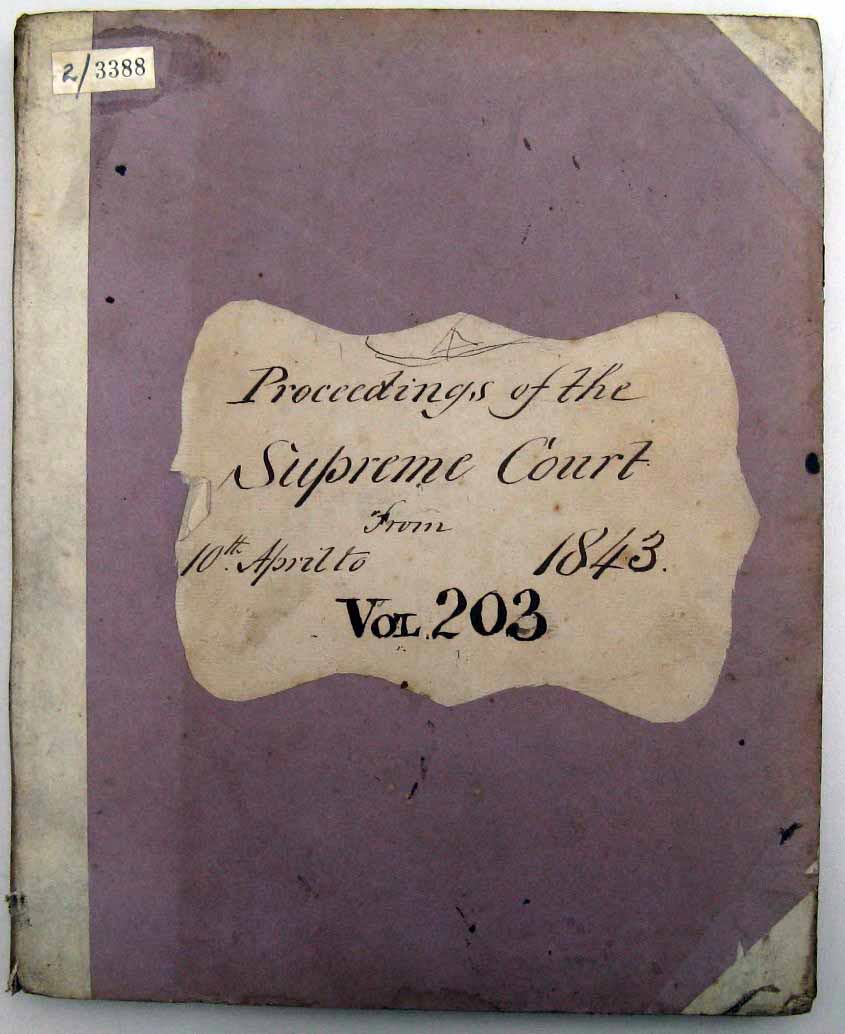
Photo: Peter de Waal
Such, he added, was the language of the great man he had quoted from, and those were the principles of reason and religion which he called upon them to uphold that day. It was competent for him, in the exercise of his official duty, to have caused the case to be tried before a special jury, but he had no occasion to do so. His experience of the common juries of this country, during a period of thirteen years, was such as to give him every confidence in them, and a similar confidence could also be testified to by the Court, and for that reason they were now called upon to try the present case. He did not believe there was any sympathy between vice and them; their conduct as citizens and jurors refuted the imputation, and he had no doubt, if he established the publication of the libel to their satisfaction, they would do justice in the case by finding the defendant guilty.
Mr John [Antonio] Birch, [temporary] clerk in the Colonial Secretary’s Office, was then called, and being sworn, produced an affidavit, filed at that office by the defendant, showing him to have been the printer and publisher of a certain paper entitled the Omnibus and Sydney Spectator. He also produced a paper called the Satirist and Sydney Spectator of the 8th instant, containing the libel complained of, and which bore the signature of, and purported in the imprint to have been also printed by the defendant. It further appeared that the original name of the Omnibus had been changed to that borne by the publication of the 8th instant, but that the defendant’s connection with it as shown on the face of it continued the same as before.
The defendant cross-examined the witness at considerable length as to whether the signature alluded to was in the handwriting of the former. The witness stated that he had seen him write, and would swear to the best of his knowledge and belief the signature to the particular paper in question filed at the Colonial Secretary’s Office was written by the defendant.
Wm Samuel Jagon, a man of colour, and a native of St Christopher’s in the West Indies, was the only other witness called, who deposed that he purchased a copy of the publication in question at the defendant’s office in Lower George street; that the defendant himself was present behind the counter at the time, and that although he did not actually serve him, he directed the party who did, to change a copy which the witness objected to on account of its being soiled.
The defendant, on being called upon to state what his defence was, expressed sorrow at being placed before the Jury on such a charge, and stated that he had been taken into custody from his bed, had since been immured in gaol without opportunity of subpoenaing witnesses or procuring bail, otherwise he should have been able to prove that he had nothing to do with the libel in question. He acknowledged his connection with the paper when called the Omnibus, and stated the Satirist ought to have come out in another name than his own, and would have done so but for the neglect of another party who had duped him. He further declared that he did not know of the article in question until it was actually published. He knew these statements went for nothing, he must be convicted, and only made them in order that so great a stigma might not rest upon him as otherwise would.
The Attorney General made a concise reply, in the course of which he said, in bringing this case forward he could only take notice of those parties whose names appeared in the imprint; but only let him (the Attorney General) get hold of the parties skulking behind the scenes, and the just blame and censure of the public would rest upon him if he did not take similar proceedings against those parties as he had already taken against the present defendant; and he could add, that perhaps there was more known about them than some of them believed.
His Honor then put the case to the jury, observing, as to the prisoner’s statement of his want of opportunity to prepare his defence, in consequence of not being at large, that he had had an opportunity of getting bail, and than even on the day of trial, if he had been prepared to make a solemn affidavit that there were circumstances of sufficient importance to justify the postponement of the trial, such postponement might have taken place, but he had brought forward no grounds whatever of such a nature. They were to bear in mind that this was not an information against the author of the libel, but against the printer and publisher, as the party who distributes the poison. No one pretended the defendant to be the author of it, and his illiterate manner shewed that such was not the fact. The first question to consider was, whether he was the publisher of the libel, which could be proved in two modes; first, by the affidavit required by the Colonial Law to be filed by the party intending to publish a paper, hearing a particular name; and secondly, under the Common Law, by shewing that he had actually superintended, or taken any part in vending the publication. They had evidence under both heads, and it was for them to judge whether both or either of these modes could be made use of to the defendant’s conviction. The next question was, to decide whether the tendency of the publication was such as was imputed to it in the information, to poison the public mind, and affect the morals of the rising generation. This was the first instance of such a case being brought before the Court, and whatever might be said respecting the morals of this country, it was a subject of grateful congratulation that publications of the nature of that before them had not heretofore been encouraged by the public, but he must observe, that whoever where [sic] the authors of such publications there must have been a ready sale found for them, or they would not have been carried on so long. His Honor then read, from a volume of Starkie on Libel, the following passage:
“If at any time the Press should have become generally venal, corrupt, and licentious, should teem with profligate and immoral publications, with artful and studied misrepresentation, with wanton calumnies on the characters of the well deserving, or, what is equally offensive, with venal and fulsome panegyric upon knives, the necessary conclusions would be, that the very condition of society was tainted and unsound. To say that the Press is corrupt is but a figurative expression, it means in reality that one set of men publishes, while the rest of society reads, approves of, and encourages vicious productions. But if such should be the disposition, or at all events, the apathy of the public, in regard of the morals of the Press, as to encourage or tolerate its ministers in committing licentious violations of truth and decency, it is manifest, not only that the temptation would always be sufficient to ensure a constant supply, at all risks, of scandalous and illegal matter; but that all attempts to earn public favour by honest means would be vain and fruitless. The public in fact are, or ought to be, the arbiters, directors, and movers of the Press, those who daily minister to their information and curiosity are their purveyors and agents. In the discharge of the important and lucrative office of catering for and ministering to the literary appetite of the public, it is manifest that candidates for popular favour must consult the public taste, and that as there will never be wanting talent, ability, and diligence, adequate to the enlightening and improving the public, so long as veracity, integrity, and ability, are recommendations to their patronage. On the other hand, agents will always be ready to prostitute their talents for the gratification of a corrupt and vitiated taste. The real corruptors of the Press are the public themselves, and the licentiousness of the Press, though it tend greatly to increase the evil, is yet to be regarded as symptomatic of a defect in public morals, than as the cause of the declension. If a man patronizes a series of licentious publications by purchasing them, or even contributing towards the purchase, what right can he have to complain of the impurity of the public Press, the immorality of the age, or the inadequacy of municipal restraints? It is he who offends against truth, against decency and morals, who, with some thousand others, encourages and supports in a state of affluence, the less guilty minister of the Press. The latter publishes that which is scandalous and impure, merely because, so long as he finds it lucrative to do so, he must necessarily suppose that he gratifies those who pay him for such services. In point of morals, to contribute to the existence and diffusion of noxious and offensive publications, is to share largely in the guilt. In short, as there can be no greater security for the truth and honour of public, or the integrity of private men, than the wholesome apprehension of public censure. It is of vital importance to society to consider that the preservation of this mighty and salutary moral power, efficacious and entire, rests wholly with the people themselves; that they must not look for effectual protection from the municipal law, or expect a remedy for the natural consequence of their own supineness; and that, if by culpable and careless indifference, they suffer the public Press to be corrupted and perverted to evil purposes, they not only reject a mighty engine, adequate to the protection of their best interests, but surrender it to enemies who will fatally apply it to undermine the very foundations of social happiness. The abuse of the liberty of the Press tends most directly to deprive it of all salutary and beneficial power. The influence of public opinion on political conduct operates on a mixed principle of shame and of interest, remotely, perhaps, on a feeling of fear, but nothing can more strongly tend to obliterate the sense of shame, and to render men’s minds obtuse and callous to the impression of public opinion, that daily attacks upon character, dictated by party feeling, and promulgated by a corrupt and venal Press. The tendency of a system of misrepresentation, consisting of illiberal abuse on the one hand, and of impure panegyric on the other, must be to confound guilt with innocence in the opinion of the world, to render men equally deaf to the voice of censure or of praise, and when they were no longer deterred from acts of political apostacy, and violations of public faith, by a principle of shame, it is obvious that those very motives of self-interest which, when connected with the love of character, constitute valuable incentives of useful, laudable, and honourable exertion, would, without such a corrective, tend to the most selfish and unworthy actions; all restraint, founded on fear, would cease, when the honest fervour of popular indignation had degenerated into the mutual hatred of contending factions.”
His Honor added, that he could not refrain from reading the above masterly and eloquent exposition, of what the public owe themselves. He regretted that the Attorney General had found it necessary to take such steps; but it was not a prosecution instituted with any desire to interfere with the Public Press, but rather an endeavour to emancipate ourselves from the stigma of allowing such vicious publications to go unchecked. After some further observations, his Honor left the case in the hands of the Jury.
The latter, after a few minutes’ consideration, returned a verdict of guilty.
The defendant was sent back until the first day of Term, when he will be brought up to receive sentence.
The jury was then discharged.
~ ~ ~ ~ ~
The Sydney Morning Herald, Mon 17 Apr 1843 5
LAW INTELLIGENCE.
SUPREME COURT. – (CRIMINAL SIDE)
SATURDAY.
Before the Chief Justice and a Common Jury.
OBSCENE PUBLICATION.
Charles James Gogerly, of Sydney, labourer, appeared to answer an information, filed by the Attorney General, ex officio, charging him with publishing an obscene libel. The information charged the defendant, for that he being a person of a wicked, mischievous, and depraved mind and disposition, and most unlawfully, wickedly, and immorally devising, contriving, and intending to vitiate, degrade, and corrupt, the manners and morals of all the subjects of our Lady the Queen, in the colony of New South Wales; and to debauch, poison, and infect, the minds of all the youth of our said Lady the Queen, in the said colony, and to bring them into a state of wickedness, lewdness, debauchery, and brutality; on the 8th day of April, in the year of our Lord 1843, did unlawfully, wickedly, and immorally, compose and publish, and cause and procure to be composed and published, a certain wicked, immoral, and obscene libel, (in the form of a newspaper) entitled the Satirist and Sydney Spectator. (The information here set forth a supposed dialogue between a number of lewd women, of a most obscene and disgusting description.) The offence was charged to be to the high displeasure of Almighty God; to the scandal and reproach of the Christian religion; in contempt of our Lady the Queen and her laws; and to the great offence of all Civil Governments; to the evil and pernicious example of all others; and against the peace of our said Lady the Queen, her Crown and dignity.
The defendant pleaded Not Guilty.
The ATTORNEY GENERAL said, that the remarks he should make in bringing this case before the Court would occupy a very brief space. This was the first case of the kind in the colony of New South Wales, and he had hoped that the ordinary business of the Courts would have gone on for years without the person holding the office of Attorney-General feeling the necessity of filing an information of this description. Many faults and crimes had been laid at the door of the colonists, many charges had been made against them, many that they did not deserve; but even the voice of defamation had not charged the eulogists with encouraging obscene and indecent publications. But it appeared that a new era had arrived, and this, from the number of publications of the kind which had sprung up, might be called the era of obscene libels. We have in this colony occasionally had politics running very high, we have had religious questions, the emancipist question, and the squatting question; feeling had run high, and writings had been warm; but we had hitherto escaped obscene libels. Very little would devolve upon the Jury, if they were satisfied as to the proof of the publication by the defendant; there could be no doubt, he presumes, about the character of the publication itself. The document he had set forth in the information, was, the Jury would see when the newspaper was put into their hand, but one of many of the same kind, all equally obscene, all bringing before the public that which the usages of society and public decorum always keep out of view. The Jury, as fathers and husbands, must see the pernicious influence which writings of this kind must have upon the minds of the young; they must despoil them of that innocence which is the brightest jewel they possess, and which their parents must be most anxious to preserve. The publication he was sorry to say was still continued, nay at that very moment the sound of persons hawking it was ringing in the ears of the Court, and persons approaching the Court had been pestered with solicitations to buy it. He would ask them, what they would do if they saw any respectable female with this publication in her hand; would they not snatch it from her as they could a cup of poison from her lips. He could not conceive any person obtaining his bread in a more dishonest manner than he who replenished his purse by publications of this nature. Not only were they obscene, but they were attacking every respectable person, and wounding the heart of every woman in the community. It had been said by some that it would be better to leave these publications alone, and they would die; but he could not agree with them. The publications were increasing in number, and the Jury would scarcely believe the amount of circulation which they had. There will always be persons whose prurient curiosity will induce them to purchase such publications; and the greatest ingenuity and zeal is exercised by hawking them about the town, and forcing them into circulation. The Jury would be surprised to hear the number of these papers which were disposed of. It might be said, Why interfere with the liberty of the Press? No man could have greater veneration for the liberty of the Press than he had, but he had no blin attachment to it; like all other liberty it must be limited to be enjoyed. He had no more enthusiastic attachment to the liberty of the Press than that great man who might be called its founder, and who justly said that, to be preserved, the liberty of the Press must be protected from abuse; and that publications which go to attack the foundations of government, or the principles of the Christian religion, or that tend to corrupt the morals and debauch the minds of youth, should be prosecuted. With that great man he would say, that to vindicate the liberty of the Press, it was necessary to defend it from licentiousness. But he would not put the sentiments he referred to in language of his own, but quote it entire. Lord Erskine, when defending the author of the Age of Reason said,
“Every man has a right to investigate with decency controversial points of the Christian religion, but no man, consistently with a law which only exists under its sanction, has a right to deny its very existence, and to pour forth such shocking and insulting invectives, as the lowest establishment in the gradations of civil authority ought not to be subjected to, and which soon would be borne down by insolence and disobedience if they were. The same principle pervades the whole system of the law, not merely in its abstract theory, but in its daily and most applauded practice. The intercourse between the sexes, which, properly regulated, not only continues but harmonizes and adorns our natures, is the foundation of all the thousand romances, plays, and novels, which are in the hands of everybody. Some of them lead to the confirmation of every virtuous principle: – others, though with the same profession, address the imagination in a manner to lead the passions into dangerous excesses; – but though the law does not nicely discriminate the various shades which distinguish these works from one another, so as to suffer many to pass through its liberal spirit that upon principle ought to be suppressed; would it, or does it tolerate, or does any decent man contend that it ought to pass by unpunished, libels of the most shameless obscenity, manifestly pointed to debauch innocence, and to blast and poison the morals of the rising generation. This is only another illustration to demonstrate the obvious distinction between the work of an author who fairly exercises the powers of his mind in an investigation the religion or government of any country, and him who attacks the rational exercise of every religion or government, and brands the absurdity and folly the state which sanctions, and the obedient tools who cherish the delusion.”
The learned gentleman concluded his address by a panegyric upon the common juries of the colony, with whom he expressed his perfect satisfaction, and in whose hands he left the case with perfect confidence.
In proof of publication, Mr [John Antonio] Birch, [temporary clerk] from the Colonial Secretary’s Office, produced a copy of the Satirist and Sydney Spectator, of the 8th April, which bore the defendant’s signature; he also produced an affidavit signed by the defendant, in which he described himself as the proprietor, printer, and publisher, of The Omnibus and Sydney Spectator, and in the paper produced was an article stating that the Omnibus had been changed to the Satirist. The defendant cross-examined Mr Birch at considerable length, to show that before the title of the newspaper was altered, a new affidavit ought to have been made at the Colonial Secretary’s Office, which was admitted to be correct. William Samuel Jagon proved purchasing a number of the Satirist at the old Monitor office, in George-street; the defendant was behind the counter, and also a lame man; the lame man handed him a copy, which he refused to take, as it was dirty, upon which the defendant said “change it,” and the copy produced in Court was handed to him.
The article set out in the information having been read, the Attorney-General closed his case.
Upon being called upon for his defence, Gogerly said that he was taken out of his bed by the constables, and had been immured in the gaol ever since, so that he had no opportunity of preparing for his defence. He felt perfectly satisfied that he had been made a dupe of; but if he had had an opportunity of subpoenaing his witnesses, he would have been able to prove his entire innocence. Of course, according to the evidence, the Jury must find him guilty, but he could solemnly say that he had no act or part in the publication. It was his intention to have suppressed the Omnibus, as he found it was not able to keep vulgarity and improper things out of it. He must say that the Omnibus contained things that he was ashamed of, and he had given notice that it was his intention to have no connexion with it. Of the Satirist he knew no more than the Jury until it was published; of that he was quite innocent. He could only appeal to the feelings of the Jury; he had been locked up and not able to make his defence, but he could assure them he was innocent; he expected to be found guilty, but he had nothing to do with it, and it was very hard that he should be punished, and the guilty escape.
The Attorney General felt it necessary to say a few words in reply; the defendant had had all the opportunity for making his defence that the law gave him; but if he had any mitigatory circumstances to offer, he could do so when he came up for judgement. When the information was filed against him, he had four days allowed him to plead, and was admitted to bail, but could not procure it, which showed what a rope of sand held him and his confederates together. The defendant said that the really guilty parties would escape; but what could he (the Attorney General) do? He could only lay hold of those who avow themselves the publishers; who put their names in the imprints. But only let him get behind the scenes, – let him obtain proofs against the gang of miscreants who are writing for these journals, (and he knew more about them than they were aware of), and he would bear all the blame that would justly be cast upon him, if he did not treat them all alike, and used his endeavours to get them all punished. The defendant was an uneducated man; but he was not that simple ignorant person, he would make the jury believe; his cross-examination of Mr Birch showed that he was acquainted with the law; he proved that the publication which had brought him into that Court was an unlawful one; and what then, was it less a publication; all that the defendant proved by this, was, that he was liable to penalties for not conforming with the law, but it did not affect the case before the Court. Then as to the innocence of the prisoner; they had before them the Satirist, with the name of CJ Gogerly written by himself, and therefore it was useless for him to pretend to be innocent. The change of the name of the paper he would briefly explain; there were two rival slanderers, the Omnibus and the Satirist: the proprietors of the Satirist were put in gaol, and then the proprietors of the Omnibus, thinking that the Satirist would not come out again, and wishing to take advantage of the infamous notoriety which the Satirist had obtained, changed the name of their journal. He did not wish to say any more against the defendant, but he considered it his duty to reply to some of the allegations made by him.
The Chief Justice said, that if the defendant had, when the case was called on, been in a condition to make an affidavit that he was not in a condition to proceed to trial for want of evidence, it would have been his (the Judge’s) duty to determine whether the trial should be postponed or not. The defendant was not charged with being the author, but with publishing the libel complained of; it was charged that his was the hand that distributed the poison, not the hand that made it, and the law regards the utterer of such publications as these are the responsible person; no one imagined that the defendant was the author of the lines complained of; he address showed that he was an illiterate person, not capable of composing them; but the Attorney-General had no means of getting hold of the author, and was forced to take the person who put himself forward as the publisher. The first question was – was the defendant the publisher? And this could be proved in two ways; wither by the copy filed at the Colonial Secretary’s Office under an act of the local legislature, or by proving the purchase of a copy. Did the evidence on these points satisfy the jury? As to the article itself, the question was, whether it was circulated to debauch the public morals, incite lewd feelings, or raise improper passions; it was for them as plain honest men to determine whether the publication had the tendency charged in the information; was it calculated in fact to corrupt the youth of the community, for that was the gist of the charge. He rejoiced that this was the first case of the kind that had ever come before a court in this colony; but he must regret that these publications had the extensive circulation attributed to them by the Attorney-General, for it was an imputation upon the taste and feelings of the community, to say that such publications are extensively read; for no right-minded man could read them without being disgusted; if the public in a manly way resisted these publications by refusing to purchase or read them they would soon go down; they could not live without support. On this point he would draw their attention to the exposition of a well-known authority.
“If at any time the Press should have become generally venal, corrupt, and licentious, should teem with profligate and immoral publication, with artful and studied misrepresentations, with wanton calumnies on the characters of the well-deserving, or some panegyric upon knaves, the necessary conclusion would be, that the very condition of society was tainted and unsound. To say that the Press is corrupt, is but a figurative expression, it means in reality that one set of men publishes, while the rest of society reads, approves of, and encourages vicious productions. But if such should be the disposition, or, at all events, the apathy of the public in regard of the morals of the Press, as to encourage or tolerate its ministers in committing licentious violations of truth and decency, it is manifest, not only that the temptation would always be sufficient to ensure a constant supply, at all risks, of scandalous and illegal matter; but that all attempts to earn public favour by honest means would be vain and fruitless. The public in fact are, or ought to be, the arbiters, directors, and movers of the Press, those who daily minister to their information and curiosity are their purveyors and agents. In the discharge of the important and lucrative office of catering for, and ministering to, the literary appetite of the public, it is manifest that candidates for popular favour must consult the public taste, and that as there will never be wanting talent, ability, and diligence, adequate to the enlightening and improving the public so long as veracity, integrity, and ability, are recommendations to their patronage. On the other hand, agents will always be ready to prostitute their talents for the gratification of a corrupt and vitiated taste. The real corruptors of the Press are the public themselves, and the licentiousness of the Press, though it tend greatly to increase the evil, is yet to be regarded rather as symptomatic of a defect in public morals, than as the cause of the declension. If a man patronises a series of licentious publications by purchasing them, or even contributing towards the purchase, what right can he have to complain of the impurity of the public Press, the immorality of the age, or the inadequacy of municipal restraints? It is he who offends against truth, against decency and morals, who, with some thousand others, encourages and supports in a state of affluence the less guilty minister of the Press. The latter publishes that which is scandalous and impure, merely because, so long as he finds it lucrative to do so, he must necessarily suppose that he gratifies those who pay him for such services. In point of morals, to contribute to the existence and diffusion of noxious and offensive publications, is to share largely in the guilt. In short, as there can be no greater security for the truth and honour of public, or the integrity of private men, than the wholesome apprehension of public censure, it is of vital importance to society to consider that the preservation of this mighty and salutory [sic] moral power, efficacious and entire, rests wholly with the people themselves; that they must not look for effectual protection from the natural consequence of their own supineness; and that, if by culpable and careless indifference, they suffer the public Press to be corrupted and perverted to evil purposes, they not only reject a mighty engine, adequate to the protection of their best interests, but surrender it to enemies who will fatally apply it to undermine the very foundations of social happiness. The abuse of the liberty of the Press tends most directly to deprive it of all salutary and beneficial power. The influence of public opinion on political conduct operates on a mixed principle of shame and of interest, remotely, perhaps, on a feeling of fear; but nothing can more strongly tend to obliterate the sense of shame, and to render men’s minds obtuse and callous to the impression of public opinion, than daily attacks upon character, dictated by party feeling, and promulgated by a corrupt and venal Press. The tendency of a system of misrepresentation, consisting of illiberal abuse on the one hand, and of impure panegyric on the other, must be to confound guilt with innocence in the opinion of the world, to render men equally deaf to the voice of censure or of praise; and when they were no longer deterred from acts of political apostacy, and violations of public faith, by a principle of shame, it is obvious that those very motives of self-interest which, when connected with the love of character, constitute valuable incentives to useful, laudable, and honourable exertion, would, without such a corrective, tend to the most selfish and unworthy actions; all restraint, founded on fear, would cease, when the honest fervour of popular indignation had degenerated into the mutual hatred of contending factions.”
To this eloquent extract he need not add anything. He again asked the Jury to state their opinion of the publication. Was its tendency of an immoral and debauching character? With respect to the information, he must say he thought that Attorney-General would have neglected his duty had he failed to present it. It was his duty to the Queen, and the office he held, to protect the public. If it were only a single obscure publication it might perhaps have been prudent to let it pass, but it was only one of a series which was widely circulated. The public Press has a duty to perform; it has a right to criticise fully and fairly all public acts and public men; but when it descends to rake from the feculence of mankind all the nastiness that can be scraped together, it ceases to have that protection which every lover of freedom must wish to see shielding the liberty of the Press, and must be put down by the strong arm of the law.
The Jury consulted in the box for a few minutes, and then returned a verdict of guilty.
The defendant was remanded until the first day of term for judgement.
~ ~ ~ ~ ~
The Australian, Wed 19 Apr 1843 6
OBSCENE LIBELS.
The salutary example which was afforded yesterday in the Supreme Court, by the sentence passed on the publishers of the Satirist and Omnibus, will doubtless operate as a warning to the propagators of that venom, for which, we grieve to say, a large portion of our community have displayed so keen a relish. The Attorney General, whose prompt abolition of this detestable nuisance deserves the thanks of his fellow citizens, stated that he was in possession of the names of those craven slanderers, who, sheltering themselves beneath the flimsy shield of their base hirelings’ names, had flung their poisonous shafts in imaginary, but false security, and would now shortly share the punishment of their wretched dupes. The admirable address of Mr Justice Burton, in passing the sentence of the Court, affords subject-matter of serious reflection to those who, by their ready purchase of the venomous wares, gave a direct sanction and encouragement to the vendors. His Honor adverted in eloquent terms to the power possessed by the community itself, to put down these publications, and lamented the “humiliating duty” its sill apathy had imposed on the Supreme Court of the Colony, a duty which should have been at once performed by the voice of the people. His Honor, in allusion to the summary jurisdiction in such cases, which in England is vested in the police, and which we, in a recent article, had adverted to as if in force in Sydney, expressed his hope that to invest our police with a similar power, would be amongst the earliest Acts of the new Assembly. By this means the dissemination of obscene libels would be a matter of danger and difficulty, inasmuch as the vendors may be apprehended by any constable, and committed by one Magistrate to the House of Correction. We trust that it will not again be our task to sully our columns by any allusion to these miserable panders to a depraved and disgraceful taste. To the Judges of the Supreme Court, and to the Attorney General, the wives and daughters of Australia may look with confidence, in the firm assurance that their fair fame will be on more the mark of the venal slanderer.
…
SUPREME COURT. – CIVIL SIDE.
Tuesday 18th April.
Before the full Court.
The Chief Justice, Mr Justice Burton, and Mr Justice Stephen, took their seats shortly after ten o’clock.
The following gentlemen of the Bar were in attendance: The Attorney General, the Solicitor General, Mr Foster, Mr Windeyer, Mr Darvall, Mr Michie, Mr Callaghan, Mr Cheeke, Mr Broadhurst, Mr Purefoy, Mr Fisher, Mr Russell, Mr Hustler, and Mr Gore.
The names of the following gentlemen who had been fined for non-attendance on Juries, summoned in criminal cases during the last week, were then read over:– T Burdekin, Esq, fined £5; Mr Thomas Brennand, fined £5, an affidavit put in; W Bowman, Esq, fined £5, execution stayed; G Bowman, Esq, fined £5, execution stayed; L Duguid, Esq, fined £10 affidavit put in but execution ordered to be issued; James Holt, Esq, £–; PW Flower, Esq, £10, execution to be stayed; JH Grose, Esq, £–, execution to be stayed; A Walker, Esq, £5, execution to be stayed; Edward Campbell, £2, execution to issue; James Hassall, Esq, Campbelltown, £5, execution to be stayed; Messrs James Holt, Wilshire, and M Woolley, were also fined, the first in £10, and the two latter in £2 each.
…
The Attorney General then prayed the judgement of the Court on Thomas Revel Johnson, William Charles Brown, and Charles James Goggerly, convicted of publishing obscene libels. On being placed on the floor of the Court, each of the three parties handed in an affidavit denying that he had been connected with the Papers, in which the libels appeared, as principals, but stating that they had been employed by George O’Brien, who was the writer of some of the articles complained of. Some other parties were mentioned as having been contributors to the publications in question. These affidavits were in direct violation of others filed at the Colonial Secretary’s Office, in which the deponents severally say they are sole proprietors of the Papers with which they were connected.
His Honor Judge Burton addressed the defendants in terms of severe reprehension for the course they had pursued, and then sentenced Johnson to two years’ imprisonment in Newcastle Gaol, and Brown and Goggerly to one year’s imprisonment in each Berrima Gaol.
~ ~ ~ ~ ~
The Sydney Morning Herald, Wed 19 Apr 1843 7
OBSCENE PUBLICATIONS.
Thomas Revel Johnson, the editor of the Satirist, Charles William Brown, the printer; and Charles James Goggerly, printer and publisher of the Satirist and Sydney Spectator, were then placed upon the floor of the Court.
Two affidavits made by Johnson were then read by the Clerk of the Court, stating that George O’Brien was the bona fide proprietor of the Satirist; that to him belonged all the types, &c., in the office of that paper, and that he, George O’Brien paid all moneys on account of the said paper; that, owing to his, the defendant’s, short residence in the colony, it was impossible that he could possess sufficient local knowledge, and have sufficient acquaintance with the characters of individuals to undertake the conduct of such a publication; it was also stated that the defendant possessed manuscripts in the handwriting of George O’Brien of some of the articles which had appeared in the Satirist.
The Attorney General trusted that the Court would award such sentence as the justice of the case and the morality of the land required. It was a painful thing to be obliged to pray for judgement against a man of such apparent respectability as the defendant; he was a member of an honourable profession, by the practice of which he might have acquired a comfortable and honourable maintenance. He could not, however, abstain from pursuing the course which he had done, unless he were guilty of a great dereliction of public duty; he had no alternative, but to pursue the course which was left to him. He prayed not for a severe, but a just and effective judgement, because the offence was of a new nature, and of the most serious consequence to society. Whatever might have been said by the enemies of this colony respecting it, the ignominy of countenancing the publication of obscene libels had been spared it. The Attorney General then cited a case from Strange’s Reports, in which it was stated, that everything opposed to good order and morality might be considered as a breach of the peace, and that every obscene book was a libel. He (the Attorney General), in looking over the papers which formed the ground of this trial had selected those passages in which no individual references had been made. He had taken not the worst cases, for, from the general character of the paper, it was impossible to look at it without discovering abundant portions to assure them of its character, and to prove that there was enough to wound the heart of every woman in the community. It represented the matron of every family as the keeper of a brothel, and the inmates of the families, both aged and young, as drunkards and debauchees; it blasted the reputation of the young and virtuous, and broke down the barrier which separated the virtuous from the unchaste, inflicting a deep injury upon the rising portion of the community, who were thus branded and stigmatised, and was calculated to taint and corrupt the minds of the youth of both sexes. The affidavit which had been read suggested no authority for a mitigation of punishment. Brown there [sic] stated himself as merely the servant of O’Brien, which he had filed an affidavit in the Colonial Secretary’s Office, calling himself the printer and proprietor of the paper. With respect to the affidavit of Johnson, he hoped it had been hastily prepared, as it was impossible to reconcile it with the affidavit previously filed in the Colonial Secretary’s Office, in which he said that he was the printer and proprietor, while in his last affidavit he states that his name was merely used as a screen, and that he never engaged nor paid the wages of a printer or compositor. In the one case he swore that he intended to print and publish, and would be the sole proprietor of the paper, – an in the other swore that he was merely a screen for George O’Brien, and neither the printer nor publisher, merely a catspaw and screen. He proved too that George O’Brien wrote several of the articles, but did not deny that he had himself been the writer of many of them. Johnson had, however, allowed his name to appear as editor, and it was impossible to say upon whom the greatest degree of guilty fell. But if persons would place themselves in such degraded positions, they must be content to receive the wages of their iniquity. No good excuse had been made for the offence committed weeks, nay months, against society. It was impossible to close their eyes to the zeal and anxiety with which these publication were forced upon the notice of the public. That morning one of the vendors had placed himself in front of his house, and denounced him (the Attorney-General) as a miserable coward. He could not trace this to the defendant Johnson, as he was then in custody, and as his name did not appear on the imprint. He trusted, however, that he should not incur the charge of cowardice, as he had endeavoured to discharge his duty in removing from the community so great an injury, and in putting a stop to so grievous an evil as the publication and circulation of such obscene libels.
Affidavits were then read, to prove that the name of Charles William Brown had not been withdrawn, in connection with the Satirist, at the Colonial Secretary’s Office.
Charles James Gogerly stated, that he had been merely employed as a labourer or servant in connexion with the Satirist and Sydney Spectator, for which services he received the weekly sum of 25s, and that he had nothing whatever to do with bringing out the paper; that he was not aware that it had come out in his name till after it was published.
An affidavit to prove that CJ Gogerly had no interest in the paper, except as a servant, and pleading the fact of his having a wife and family in mitigation of punishment, was then read.
The ATTORNEY-GENERAL thought it hard that the wife and family should be placed before the Court, as Gogerly should have thought of them previously to allowing his name to appear in connexion with this paper; and in taking this subject into consideration, they should remember that he had little mercy or compassion upon those of whom he consented to become the public slanderer for 25s a week.
Mr Justice Burton then summed up the evidence in the case, and, after an able and excellent address, sentenced Thomas Revel Johnson to imprisonment in Her Majesty’s Gaol in Newcastle, for two years, and Brown and Gogerly to twelve months’ imprisonment each.
1 SRNSW: NRS5869, [2/3388], Judiciary, J Dowling, CJ. Notebooks Proceedings of the Supreme Court of NSW, 1843, pp. 2-14. Transcription was extremely difficult because the judge’s handwriting almost undecipherable. Emphasis added.
2 Repetitions in these sentences are as they appear in document.
3 The Australian, Mon 17 Apr 1843, p. 2. Emphasis added. Omnibus and Sydney Spectator is available, in digitised form, at: www.nla.gov.au/ferg/issn/14402130.html. The issue being referred to in the ‘obscene libel’ trial, 8 April 1843, has not survived, however various issues can be viewed including the 11 March 1843 (Vol. 1 New Series, No. 1) issue which bears “CJ Goggerly” handwritten on it as well as the “Colonial Secretary’s Office” stamp, presumably it was used for the ‘obscene libel’ trial.
4 21 November, 2008, photo of Judge Dowling’s note book 2(3388) and first page of the trial in the note book.
5 The Sydney Morning Herald, Mon 17 Apr 1843, p. 2. Emphasis added.
6 The Australian, Wed 19 Apr 1843, p. 2.
7 The Sydney Morning Herald, Wed 19 Apr 1843, p. 2.