Australian Town and Country Journal, Sat 10 July 1886 1
NARRANDERA and SURROUNDINGS.
————
The illustrations given in this issue are from photographs taken by our special correspondent on a recent visit to Narrandera, one of the most flourishing townships on the Murrumbidgee River, although at the present time suffering, like other places, from the effect of the long-protracted drought, which, unfortunately for the residents, cannot be yet said to have terminated in that locality. Since January 1 last only a few points over 4in of rain have been registered, and this period unfortunately comprises those months which in a good season are the wettest part of the year. There is in consequence an almost total absence of feed, the effect of such rain as has fallen being visible only in a faint tinge of green in occasional patches, and the condition of the stock is not therefore flourishing; but in spite of this serious drawback there is evidence of much public spirit and energy which betokens the presence of live people.
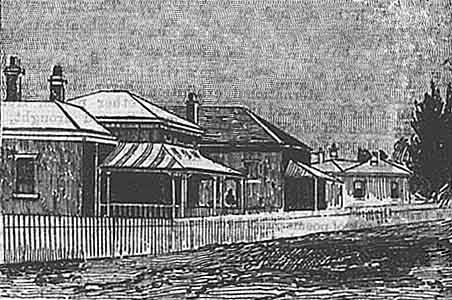
Telegraph Office. Image: Australian Town and Country Journal,
Sat 10 Jul 1886, p. 79. Reproduction: Peter de Waal
The town, or borough of Narrandera, is situated on the north bank of the Murrumbidgee, sixty miles by rail from the Junee junction, being three hundred and fifty from Sydney, and about the same distance from Melbourne. The railway line forks at Narrandera, continuing in the one direction, a trifle to the northward of west of Hay, one hundred and seven miles; and in the other, southward sixty-five miles to Jerilderie, crossing the Murrumbidgee about a mile below Narrandera on the handsome iron bridge shown in our engraving. The town is prettily situated on a pine and honeysuckle ridge near the bank of the river, the population, as shown by a recent borough census being nearly 1400. Amongst the most noticeable buildings is the hospital, a fine commodious structure of brick equal to the wants of the district (which is a very healthy one) for some time to come. The building has only recently been completed, the external improvements being still unfinished. It has been erected at a cost of about £2500, of which over £1500 has been subscribed in the district, the balance being Government subsidy, but a long-promised unconditional grand is still withheld, for reasons which apparently are not well understood by the residents, and not likely to be until the next general election. There are fifteen hotels and public-houses, two banks, a sawmill; English, Roman Catholic, and Presbyterian churches; five general stores, and numerous representatives of individual trades. There are also a public school and a Catholic school, each with a large muster roll; a mechanics’ institute, and last, though by no means least in importance, a local paper, The Argus, well supported and held in good estimation, owned and managed by a gentleman whose journalistic reputation has been established for many years throughout the colony as well as in Murrumbidgee district. Among the numerous fine buildings either recently finished or in course of erection, may be mentioned the new offices of Messrs H Manning, King, and Co, the leading stock and station agents in this portion of the electorate. As shown in the illustration, this is a substantial two-storey brick building. It is located in Larmer-street, with every convenience for carrying on the rapidly increasing business of the firm, which compelled them to remove from the old quarters in which they have transacted business for the past four years. These offices, although already occupied, are not yet out of the contractor’s hands, but will be completed before the event of the year—the annual races—which take place this week, and reports of which we hope to supply in another part of this issue. The Narrandera races are a centre of attraction over a large area of country. A good season seems to be all that is really wanting to restore the usually brisk business prosperity of the town and district, but there is just one other item asked for, and strangely enough one that to the casual visitor would present itself last on the list of requirements for a such a peaceful and orderly community. Nevertheless, a gaol has become a necessity, and with much show of reason, for as all prisoners are committed for trial at Wagga, business people who may, unfortunately for themselves, get mixed up with any case in which committal is probable, prefer the philosophical solace that it is better to bear the ills they have than travel sixty miles for others they know not of, and that a first loss at Narrandera is more to be desired than another and a larger one to be incurred in spending time and money to go farther and fare worse. But taken all round, the residents in Narrandera have much to be thankful for, and amongst other items the pleasing fact that up to the present point in their history their place is undisturbed, their rest unbroken, and their tempers unruffled by the advent of a Salvation Army.
~ ~ ~ ~ ~
Australian Town and Country Journal, Sat 10 Oct 1896 2
NARRANDERA.
———
A THRIVING RIVERINA TOWN.
———
Among the numerous thriving towns of the Riverina, Narrandera occupies a leading place, largely by reason of its convenient situation, being the principal crossing place on the Murrumbidgee for stock travelling from Queensland to Wagga, Albury, and Melbourne. It is approached by rail from the main southern line between Sydney and Albury, and is 348 miles distant from the former and 160 miles from the latter, the line branching off at Junee Junction, and traversing an extensive tract of comparatively level country, utilised chiefly for pastoral purposes, but asserted to be rich in agricultural capability, excellent cereal crops being raised in places. From Narrandera the line is continued to Jerilderie, 65 miles distant, and thence to Berrigan, crossing the Murrumbidgee by means of a massive lattice-girder bridge, one of the most substantial structures of its kind in New South Wales.
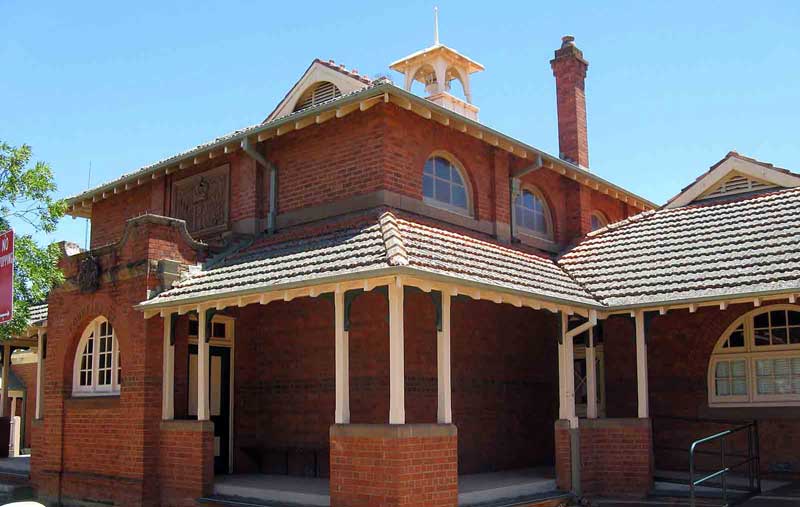
The township is picturesquely situated on undulating ground near the river, and, like most Australian centres of rural population, possesses thoroughfares of considerable width, several being lined with shade trees. In the early days of Australian settlement the planting of shade trees in the main streets of country towns was regarded with indifference; but when it was found that, under suitable conditions, the trees throve luxuriantly, affording a welcome shelter from the heat and dust of summer, they began to make their appearance even in the most remote townships, giving a picturesque touch to the rudest and most unlovely localities. There are nearly sixteen miles of streets and roads in the municipal boundaries of Narrandera, the whole of which are kept in good repair considering the heavy nature of the traffic at times. Among the public buildings the Anglican Church of St Thomas, Roman Catholic Church of St Bridget, and the churches belonging to the Wesleyan and Presbyterian bodies occupy a conspicuous place. The Church of England is a large and tastefully structure, and is illustrated upon our page of views. The Postal and Telegraph Offices are neatly built, but at the present time scarcely afford the necessary accommodation for the large increase of business now transacted. The courthouse, lands office, and police station and quarters form a line of buildings in the main thoroughfare. There is a fine public hall in the town, also a mechanics’ institute and public library and reading-room. The public school, of which Mr WG Heath is the energetic master, stands on elevated ground, occupying a site of about five acres, well planted with shade trees, one of the practical results of “arbor day” instituted by the present Minister for Lands when at the head of the Public Instruction Department. Most of the trees have been planted some years, and are well grown. There are about 300 children enrolled, the average attendance being 216. There is also a Roman Catholic school, in addition to two admirably conducted private schools. The Commercial and AJS Banks are both substantial and ornamental buildings. The Bank of New South Wales is also represented by a branch.
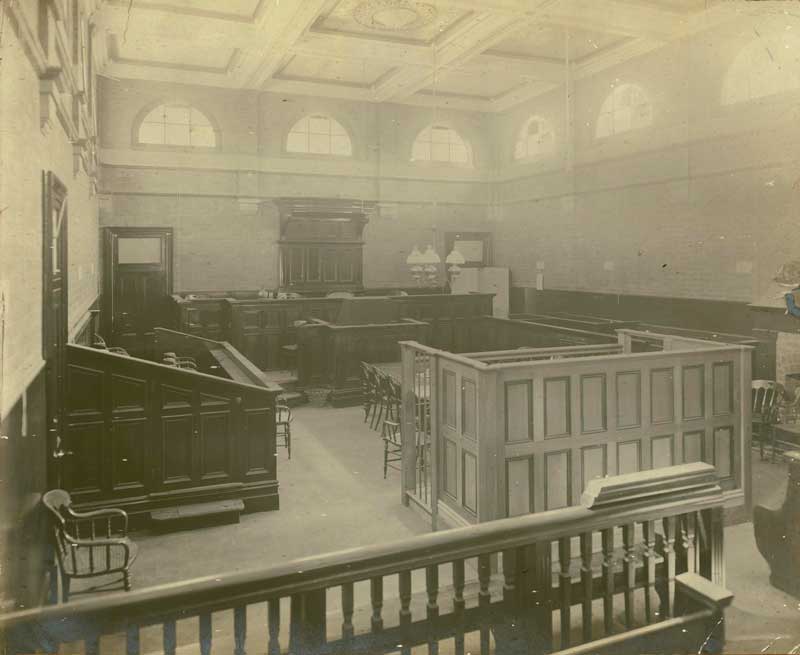
Photo ID: SRNSW 4346_a020_a020000134.jpg
The Narrandera District Hospital enjoys a widely spread reputation for efficiency and good management. It is a nicely situated, well constructed building, with a neat garden in front. The internal arrangements are based on the best and most improved models, and replete with every convenience. There are three ordinary wards and one special ward with twenty beds, four of which are for females. At the rear of the building is a large yard, also a spacious kitchen garden. Adjoining the matron’s quarters is the dispensary. Dr Watt is the medical officer in charge, Mrs EL Guille being the matron, and adding to her multifarious duties those of dispenser. Mrs Guille has seen a considerable amount of active service, and was matron at the Coast Hospital, Little Bay, near Sydney. She subsequently took charge of the Goulburn Hospital, where she remained for about five years, during which period the disastrous Cootamundra railway accident took place. Among those rendering service to the sufferers Mrs Guille was very prominent by her unwearying activity and attention, her good service being duly recognised by the hospital committee, who presented her with a medal. After leaving Goulburn Mrs Guille was employed by the Technical College Branch of the Public Instruction Department as a teacher of sick nursing in the home; four of her pupils pasing [sic] the examination with honors, and two being placed in the first grade. She was equally successful in the Brisbane Technical College, attending also several private schools in the Queensland metropolis.
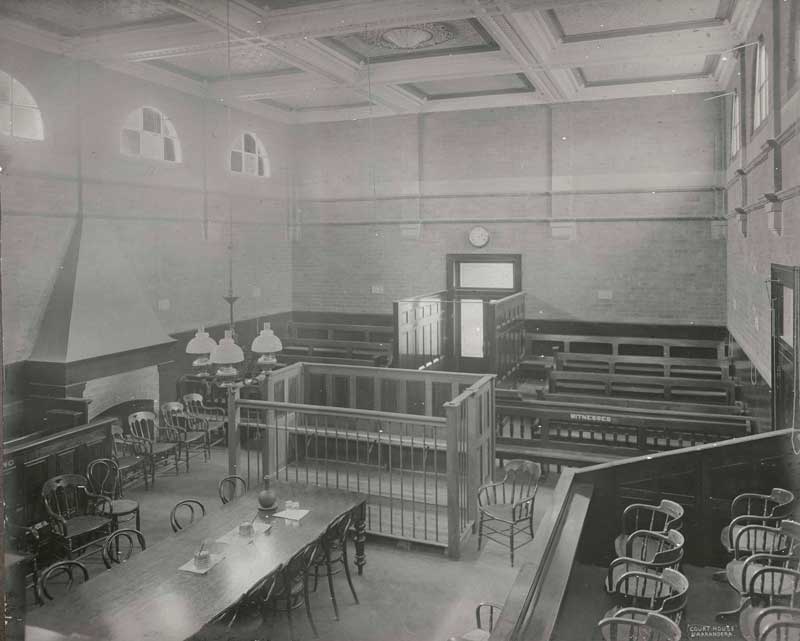
Photo ID: SRNSW 4346_ a020_ a020000081.jpg
There is a fine recreation ground of about ten acres, suitable laid out and fenced in, and having a large oval in the centre for cricket, football, and other pastimes. The racecourse, which is under the management of the Narrandera Turf Club, is some little distance from the township. It is admirably located and arranged, and upon it is a commodious grandstand, offices, paddock, and other accessories. The attractiveness of the surroundings is being still further enhanced by a number of shade trees that have been planted. The August meeting in each year is generally largely attended, the various events being well contested. The grounds of the Narrandera Pastoral and Agricultural Society are also situated a short distance from the town, and are judiciously arranged, occupying a good position with all necessary accommodation. A view of the grounds during the recent show is given; and is from a photograph by Mr CT Dugdale, of Narrandera.
Returning to the township, the abundance of good hotel accommodation speedily becomes apparent, the principal hostelries being the Royal, the Royal Mail, and the Criterion. There are several large stores also, the leading businesses being those carried on by A Jacobs, Richards and Company, C Dyring, FS Hodge, and G Jerrom. Mr Jacobs’s premises, situated in the main street, are of considerable extent, and all classes of goods usually found in a large general store are to be seen attractively displayed in great variety. Messrs Richards and Company and C Dyring likewise make a fine show, and do an extensive business in the town and district. Among the various industrial establishments may be mentioned the Narrandera Roller Flour Mill, which has been established on the newest and most approved principles, and may be regarded as typical of the progress of cereal cultivation in the Riverina. The owners, Messrs Wise Brothers, have also a large mill at Jerilderie, and their Pyramid brand of flour is not only well known throughout the surrounding district, but also over the whole of the colony. The Narrandera mill can turn out eight bags of flour per hour, or nearly 100 tons per week. It was erected about six years ago, that at Jerilderie dating from 1884, the grain used being that grown in the district. The other local industries are woolscouring, brickmaking, brewing, etc, also carriage manufacture, which is most efficiently represented by the Narrandera Carriage and Waggon Company, whose newly-erected works we illustrate. It has been said that we depend too much upon outside capital and enterprise to develop our resources, but at Narrandera we find a practical refutation of this. Mr FWP Rudd and Mr WR Wilson, both of Australian birth, and possessed of go-ahead progressiveness, conceived the idea of benefiting both themselves and the farming community of the Riverina by supplying farming implements and farm requisites at much lower prices, and upon more favorable terms, than have existed heretofore. With this object in view, they have launched at Narrandera the Johnston Harvester Company, of which Mr Frank Rudd is president and Mr WR Wilson is secretary, to supply the district with “Bonnie” reapers and binders, made by the Johnston Harvester Company, of Batavia, New York, who have a world-wide reputation. Mowing machines, harvesters, strippers, waggons, buggies, sulkies, rabbit poisoning machines, and all requisites pertaining to those occupied in farming, will be supplied. The company have erected new buildings on the property heretofore occupied by the Narrandera Carriage and Waggon Company, which is now merged in with the new company, whose capital is ample to carry out the project. Its effort will be directed to supplying farmers with high-grade implements at reasonable rates. The new buildings have a frontage of 150ft, and occupy one of the most commanding sites in Narrandera. The Wilson steel frame sulky, patented by Mr WR Wilson, is one of the special products of this company, and their new phosphorised [sic] pollard distributors has been received with a great deal of favor. In addition to the industries named there are meat chilling works, and Narrandera is likely to form one of the principal centres of the chilled meat business, for which it possesses exceptional facilities, as killing and chilling operations can be conducted on a most extensive scale.
The town has a good water supply, the water being pumped up from the river into an elevated tank situated on a rise overlooking the railway station. Broad flats, covered with water in times of flood, separate the township from the river, and across these runs a long approach to the fine bridge which enables communication to be maintained with the other side of the stream, and is much used by travelling stock. The population of the borough is over 2000, and of the district fully 3000. About thirty-eight miles from the township is the aboriginal station of Warangesda, occupying an area of about 600 acres, and under Government supervision. Two local papers are published in Narrandera, viz, the Narrandera “Argus” and the Narrandera “Ensign,” each ably edited, and enjoying a good circulation.
~ ~ ~ ~ ~
Evening News, Tue 20 Nov 1900 3
NARRANDERA NOTES.
————
…
The new post office and telegraph buildings are almost completed, and arrangements are being made by the local officials for the transference of business to them on Saturday next. The present buildings will be converted temporarily into office for the CPS and lands agents, also as a courthouse during the erection of new courthouse an offices.
~ ~ ~ ~ ~
Evening News, Mon 6 May 1901 4
NARRANDERA NOTES.
————
…
Hocking Brothers, contractors for the erection of a new courthouse, are in town, arranging to commence operations.
1 Australian Town and Country Journal, Sat 10 Jul 1886, p. 28.
2 Australian Town and Country Journal, Sat 10 Oct 1896, p. 30. Emphasis added.
3 Evening News, (Sydney, NSW), Tue 20 Nov 1900, p. 7. Emphasis added.
4 Evening News, (Sydney, NSW), Mon 6 May 1901, p. 7.