Clarence and Richmond Examiner and New England Advertiser, Sat 28 Jul 1888 1
PUBLIC WORKS PROPOSALS.
On Tuesday, MR SUTHERLAND moved a number of resolutions to submit the following works to the Parliamentary Standing Committee on Public Works all of which were agreed to:—Circular Quay improvements, £120,000; Wooloomooloo [sic] Bay improvements, £42,000; Pott’s Hill reservoir, £120,000; Sydney harbour, £30,000; bridge over spit, Middle harbour, £62,000; new Central Police Court, £30,000; laying second pipe between Pott’s Hill and Crown street, £165,000; Clarence River improvements, £50,000; sewerage Manly, £24,000; sewerage, North Shore, £77,052; sewerage, western suburbs, £830,304; improvements, Richmond River, £50,000; harbour improvements, Newcastle, £112,000.
~ ~ ~ ~ ~
The Sydney Morning Herald, Thu 4 Oct 1888 2
THE NEW CENTRAL POLICE COURT.
———◦———
Yesterday morning the business of the Central Police Court was transacted for the first time in the building formerly known as the Oddfellows’ Hall, Castlereagh-street, near Goulburn-street. The Charge Court, which is situated on the ground floor, is cool and cheerful, the lighting is satisfactory, and there seems to be a sufficient amount of room for the accommodation of the public. The Summons Court, however, is far from convenient, being situated on the first floor, and is approached by a rather angular passage; and the courtroom, when reached, is not satisfactory in the way of accommodation. Before beginning the business of the day the new temporary premises were formally opened by Mr Johnson, SM. There were also present Mr Delohery, DSM, and Mr A Frazer, Under-Secretary of Justice. Mr Johnson referred to the fact that they were assembled there for the first time. They could depend more on having a certain amount of comfort than in the old building. The new court was not as commodious as it might be, perhaps, but at all events it was the only arrangement that could be made until the new courts were finished. It was certainly cleaner than the old place. He trusted that they should continue to carry on the business of the court as harmoniously as had been the case in the past. Mr Williamson, on behalf of the legal profession, expressed his pleasure at seeing the alteration which had been made in the arrangements for transacting the business of the courts. For many years past it had been often suggested that some change was necessary and desirable, but unfortunately the Government then in power did not seem to take any cognisance whatever of the necessity of any new arrangement. The present Minister for Justice deserved the thanks of the public for what had taken place. It, was, perhaps to be regretted that more property was not included in the temporary buildings, in order to give greater accommodation to the public. The arrangements upstairs were not very convenient. Something would have to be done in that direction. However, they had a right to offer their sincere thanks to the Minister of Justice and to recognise the energetic manner in which the Under-Secretary (Mr Frazer) had carried out his wishes.
~ ~ ~ ~ ~
Evening News, Wed 10 Aug 1892 3
NEW CENTRAL POLICE COURTS.
————
THE “LIGHTING UP.”
————
In response to an invitation by the contractors a visit of inspection was made last night by a number of well-known gentlemen to the new Central Police Court and police offices in Liverpool-street. The company included the Minister for Justice (Mr RE O’Connor), the Acting-Colonial Secretary (Mr FB Suttor), Mr Acting-Justice Murray, the Principal Under-Secretary (Mr Critchett Walker, CMG), the Under-secretary for Justice Mr Fraser), Captain Fisher and Mr C Delohery, SMs; Mr Giles, DSM, the Government architect (Mr WL Vernon), the Inspector-General of Police (Mr Fosbery), and the Superintendent (Mr Reid), the Superintendent of Fire Brigades (Mr Bear), and Mr McNevin. After the visitors had made a thorough inspection of the building, an adjournment was made for refreshments.
Mr RE O’Connor pledged “The Contractors.” In doing so he remarked that everyone who had been through the building must recognise that a structure more suitable for the purposes for which it had been designed could not possibly have been erected. His friend, Mr Fosbery, who had a special knowledge of these matters, not only here but in other countries, had assured him that nothing to compare with the new premises existed in the civilised world. Those of them who remembered the condition of things not long back, not only in connection with the police courts, but the police offices which had had to be put up with for so many years, would recognise the immense advance which had been made in this building. And that advance concerned as much the part of the building where the administration of justice was carried on as it did the part where casual criminals had to be dealt with in the course of the year. The chief feature about the latter part of the building was the reasonable humanity which had been exhibited in carrying it out. Of course they might carry that humanity to the extent of a fad, but still there was a reasonable amount which could be exercised towards those unfortunate criminals, some of whom were not responsible for the offences which they had committed. A large amount of thought, a large amount of experience, a large amount of knowledge, a large amount of humanity had been brought together in designing and carrying on the work to its successful completion. As regarded the contractors and the Government architect there had been an exceptional record. The building had been finished in the style that they all could see very much under the contract time—about three months, he believed. Such a record in a large contract of that sort it would be difficult to eclipse. The relations between the contractors and the Government officials had throughout been of the most amicable character possible. He had to congratulate the gentlemen who presided over the administration of justice on the magnificent building, or what he might call the palace of justice, which had been created for them. He had to earn his living in a very much inferior court. (Laughter.) If the Supreme Court judges saw the building in which the stipendiary magistrates were in future to preside it would fill them with envy. (Renewed laughter.) He hoped that some day the Government would be able to give the Supreme Court judges as good a place in which to transact their portion of the business of the State. (Cheers.)
Mr EJ PHIPPARD made a brief acknowledgement of the toast on behalf of the contractors.
MR SUTTOR gave “The Government Architect and the Officers Under Him,” which was duly responded to by Mr Vernon and others.
The new court is to be open for business on September 1.
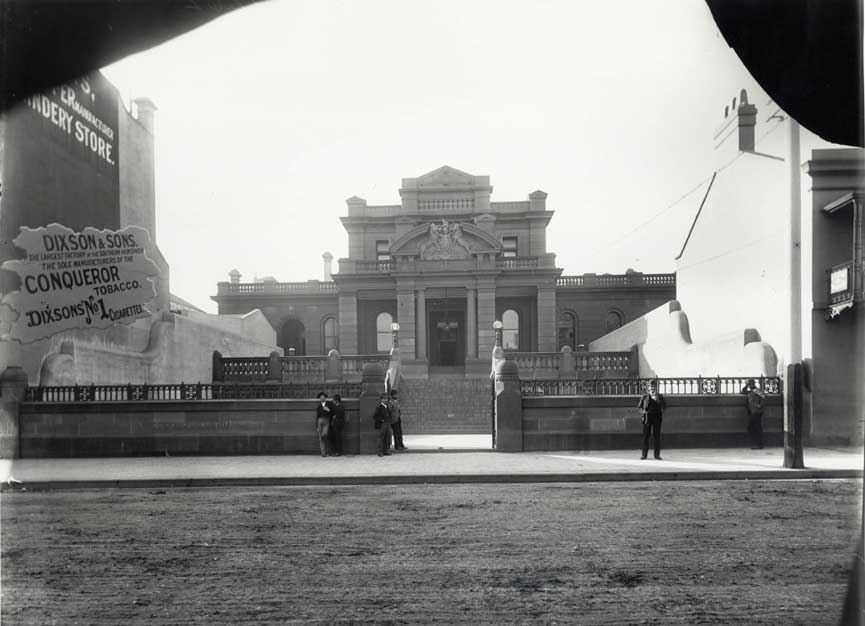
Photo ID: SRNSW 4481_a026_000512.jpg
The following is a description of the building: The front to Liverpool-street consists of a solid stone wall, with an ornamental wrought-iron crest-gates of special design, and a pair of heavy iron gates of the same pattern. Passing through the main entrance gates, the courthouse building is approached by a wide flight of circular stone steps, bounded on both sides by a handsome moulded balustrade. These steps, together with the bascourse of the main front, are composed of the finest quality of blue trachyte from the quarries of F Raward and Company, Bowral, making an almost everlasting stair, and at the same time forming a pleasing contrast to the rich brown color of the freestone above. The centre portion of the building stands out from the flanks, forming a bold portico, with large circular columns supporting the main arms. On each side of the portico extend the two flanks, with side entrance, doorways, &c, surmounted by a heavy cornice and elaborate balustrade, the whole forming a very imposing front. The stone for this work has been procured from the contractors’ own quarry at Waverley. The enterprise displayed by Messrs Phippard Brothers in opening up and introducing this stone marks a new departure in the building trade of Sydney, as hitherto all the stone for our principal buildings has been procured from Pyrmont, the high cost of which has considerably curtailed the use of stone as a building material. The internal arrangements of the courtrooms and offices have been specially well carried out, the whole of the three courtrooms and long or public rooms being entered from a spacious hall, the floor of which, together with the whole of the corridors, is paved diagonally with black and white marble tiles. The courtrooms are without doubt the finest in the colonies, being very elaborately fitted with a polished cedar dado round all the walls, with a raised dais and richly carved canopy, supported on bold cantilevers, and finished with a richly carved and emblazoned coat of arms. There is also the usual accommodation for clerks, sergeants, witnesses, reporters, &c. The walls above the dado are finished in white Keen’s cement, with mouldings and enrichments, and the ceilings are panelled and grained in ornamental zinc work. Special attention has also been paid to the lighting and ventilation. On either side of the courtrooms are placed the magistrates’ rooms, three in number, with a private entrance from George-street, the CPS room, clerks’, witnesses’, and solicitors’ rooms, while along the front flank are offices for the superintendent of police and small debts. Immediately behind the courthouse building and extending back to Union-lane is the cell accommodation for all classes of prisoners, from the helpless drunk to the violent lunatic, for whom there is a specially prepared padded cell. The cells throughout are lined with white enamelled bricks in the walls and ceilings, and the floors are of patent asphaltum. The frontage to Union-lane has been carried up three storeys to form a barracks, where there is accommodation for upwards of 60 men, with kitchen, messroom, reading and smoking rooms, bathrooms, and large airy dormitories, approached from the courtyard by iron stairs and iron balconies, carried round at each floor; below these on the ground floor are placed the stables, buggy shed, &c. To the right of the main building is a large courtyard paved with asphaltum blocks which will be used for drilling and training the police. Until a few weeks ago this courtyard was covered with temporary sheds containing the machinery required for making the joinery and iron work used in the building, the whole of which was manufactured on the ground by the contractors, Messrs Phippard Brothers, under their own personal supervision. After viewing these premises it seems almost incredible that the whole of the work should have been carried out within the short space of 16 months, which leaves two months of the contract time still in hand. The whole of these works have been designed and carried out under the supervision of Mr Rumsey, Assistant Government Architect, and the superintendence of the practical part of the work has been entrusted to Mr James Kay, assisted by Mr WHK Roberts. The whole work has been constructed and finished in a thoroughly first-class manner, and reflects credit both on the contractor and the officers of the department connected with it. The total cost of the construction of the buildings has been about £50,000.
~ ~ ~ ~ ~
The Sydney Morning Herald, Wed 10 Aug 1892 4
THE NEW CENTRAL POLICE
COURTS.
———◦———
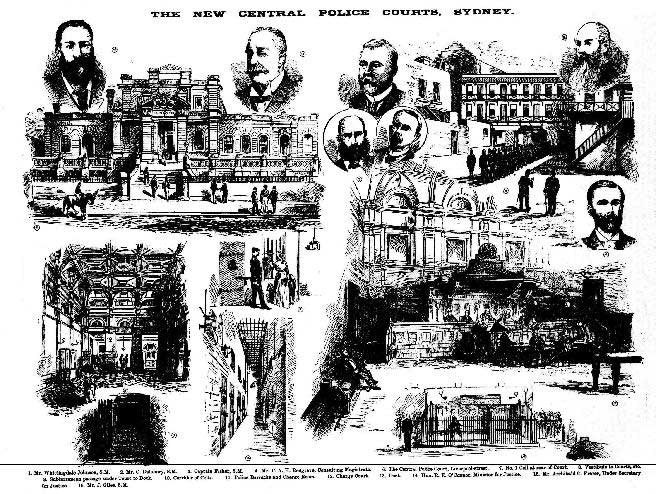
Minister for Justice, above right, Mr Archibald C Fraser, Under Secretary for
Justice. Image: Illustrated Sydney News, Sat 29 Oct 1892, p.17.
Reproduction: Peter de Waal.
The ceremony of “lighting up” or formally handing over to the Government the new Central Police Courts, which have just been completed in Liverpool-street, took place last evening. Among the large number of persons who accepted the invitation of the contractors (Messrs Phippard Brothers) to inspect the buildings were Mr RE O’Connor (Minister for Justice), Mr Suttor (Acting Colonial Secretary), Mr Fraser (Under-Secretary for Justice), Mr Acting Judge Murray, Mr E Fosbery (Inspector-General of Police), Captain AM Fisher, SM, Mr C Delohery, SM, Mr J Giles, DSM, Mr Read (Superintendent of Police), Mr Bear (Superintendent of Fire Brigades), Mr Vernon (Government Architect, Mr Roberts, jun, and Mr Levien, MLA. The courts, offices, station, cells, and police barracks were inspected by those present and the unanimous opinion appeared to be that the contractors had executed their work in a thoroughly first-class manner.
After the inspection of the premises the company assembled in one of the offices, where refreshments had been prepared.
Mr RE O’CONNOR said that he had one duty to perform, and that was to propose the “Health of the Contractors, Messrs Phippard Brothers”. (Applause.) Everyone who had had the opportunity of looking over the structure must have come to the conclusion that it was very suitable for the purpose for which it had been designed and constructed. Mr Fosbery, who had a special knowledge of these matters, not only here, but in other countries, had assured him that there was nothing to compare with these buildings as police courts and buildings in any part of the civilised world. (Applause.) There were those present who would remember the buildings that not very long since they had had to put up with for so many years, and they would recognised the immense advance which had been made by the erection of those buildings. He did not only refer to that portion of the buildings which had to do with the administration of justice, but also to that part of the structure for the accommodation of the unfortunate casual criminals who had daily to be dealt with, and the humane treatment of this class of unfortunate persons had not been overlooked. One might carry humanitarian ideas of that kind to the extent of a fad, but at the same time it was only just that a reasonable amount of humanity should be extended to these criminals. He thought that they all recognised that in the designing of a building of that sort a large amount of thought, a large amount of experience, a large amount of intelligence, and a large amount of humanity had been brought together. As to the carrying of it out, both as regarded the contractors and the Colonial Architect, there was, he thought, an exceptional record. It had been constructed three months under contract time. (Applause.) He thought that that was a record in a large contract of that sort, which it would be very difficult to eclipse. In addition to this the work had gone on between the contractor and the architect in a very amicable manner. In short it meant that the contractors had done their work expeditiously and faithfully. They might also congratulate the gentlemen who would have to administer justice in these courts, which he might almost call a palace of justice. He had to earn his living in a court much inferior to those buildings. When the Judges saw these courts they would no doubt envy the stipendiary magistrates. He hoped that some day they might be able to give them a better building. (Applause.)
Mr ES PHIPPARD, one of the contractors, responded. He thanked them for their kind acceptance of the invitation to inspect the building and for the cordial manner in which they had drunk the toast. They had carried out the work conscientiously and quietly, and, he was pleased to say, with much satisfaction to all concerned. The greater part of the credit, however, was due, he thought, to the Government Architect. If they had not been looked after quite so well the job might not have been so well done. (Laughter.) They had endeavoured to do the work as honestly and faithfully as possible, and hoped that they had succeeded in that direction.
Mr SUTTOR (Acting Colonial Secretary) proposed “The health of the Government officers who supervised the work,” coupling with it the name of Mr Vernon. He had inspected the buildings, and was so much pleased with them that he felt that rather than be a casual Minister of the Crown, he would like to be a permanent stipendiary magistrate. (Laughter.)
The toast was acknowledged by Mr Vernon and Mr Rumsey, and the company shortly afterwards dispersed.
The following is a description of the building:—The front to Liverpool-street consists of a solid stone wall, with an ornamental wrought-iron cresting of special design, and a pair of heavy iron gates of the same pattern. Passing through the main entrance gates, the courthouse building is approached by a wide flight of circular stone steps, bounded on both sides by a handsome moulded balustrade. These steps, together with the bascourse of the main front, are composed of the finest quality of blue trachytes from the quarries of F Raward and Co, Bowral, making an almost everlasting stair, and at the same time forming a pleasing contrast to the rich brown colour of the freestone above. The centre portion of the building stands out from the flanks, forming a bold portico, with large circular columns supporting the main pediment and richly-carved royal coat of arms. On each side of the portico extend the two flanks, with side entrance, doorways, &c, surrounded by a heavy cornice and elaborate balustrade, the whole forming a very imposing front. The stone for this work has been procured from the contractors’ own quarry at Waverley. The enterprise displayed by Messrs Phippard Bros in opening up and introducing this stone marks a new departure in the building trade of Sydney, as hitherto all the stone for our principal buildings has been procured from Pyrmont, the high cost of which has considerably curtailed the use of stone as a building material. The internal arrangements of the courtrooms and offices have been specially well carried out, the whole of the three courtrooms and long or public room being entered from a spacious central hall, the floor of which, together with the whole of the corridors, is paved diagonally with black and white marble tiles. The courtrooms are without doubt the finest in the colonies, being very elaborately fitted with a polished cedar dado round all the walls, with a raised dais and richly-carved canopy, supported on bold cantilever, and finished with a richly-carved and emblazoned coat of arms. There is also the usual accommodation for clerks, sergeants, witnesses, reporters, &c. The walls above the dado are finished in white Keen’s cement, with mouldings and enrichments, and the ceilings are panelled and grained in ornamental zinc work. Special attention has also been paid to the lighting and ventilation. On either side of the court rooms are placed the magistrates’ rooms, three in number, with a private entrance from George-street, the CPS room, clerks’, witnesses’, and solicitors’ rooms, while along the front flank are offices for the superintendent of police and small debts. Immediately behind the courthouse buildings and extending back to Union-lane is the cell range, where there is provided special accommodation for all classes of prisoners, from the helpless drunk to the violent lunatic, for whom there is a specially prepared padded cell. Cells throughout are lined with white enamelled bricks in the walls and ceilings, and the floors of patent ashphaltum [sic]. The frontage to Union-lane has been carried up three storeys to form a barracks, where there is accommodation for upwards of 60 men, with a kitchen, messroom, reading and smoking rooms, bathrooms, and large airy dormitories, approached from the courtyard by iron stairs and iron balconies, carried round at each floor; below these on the ground floor are placed the stables, buggy shed, &c. To the right of the main building is a large courtyard paved with asphaltum blocks, which will be used for drilling and training the police. Until a few weeks ago this courtyard was covered with temporary sheds containing the machinery required for making the joinery and iron work used in the building, the whole of which was manufactured on the ground by the contractors, Messrs Phippard Brothers, under their own personal supervision. After viewing these premises it seems almost incredible that the whole of the work should have been carried out within the short space of 16 months, which leaves two months of the contract time still in hand. The whole of these works have been designed and carried out under the supervision of Mr Rumsey, Assistant Government Architect, and the superintendence of the practical part of the work has been entrusted to Mr James Kay, assisted by Mr WHK Roberts. The whole work has been constructed and finished in a thoroughly first-class manner, and reflects credit both on the contractor and the officers of the department connected with it. The total cost of the construction of the buildings has been about £50,000.
~ ~ ~ ~ ~
The Maitland Mercury and Hunter River General Advertiser, Thu 11 Aug 1892 5
NEWS FROM YESTERDAY’S SYDNEY
PAPERS.
————
…
The new Central Police Court, in Liverpool-street, which has just been completed at a cost of about £50,000, was formally taken over by the Government on Tuesday night.
~ ~ ~ ~ ~
Evening News, Wed 31 Aug 1892 6
CENTRAL POLICE COURT.
————
The central police business will be transacted on and after to-morrow (Thursday) morning in the new courthouse in Liverpool-street. Soon after he charge court was opened in the old building in Castlereagh-street to-day Mr C Bull, solicitor, remarked, “It is said all round the place, your Worship, that this is the day of judgment, the last day here,”
“Yes,” replied his Worship, Mr C Delohery, SM, “so it is.”
~ ~ ~ ~ ~
Evening News, Thu 1 Sep 1892 7
CENTRAL POLICE COURT.
————
THE NEW BUILDING OPENED.
————
The new Central Police Court in Liverpool-street was opened this morning. Some time before 10 o’clock, the hour for opening, there was a good attendance of solicitors and others. Mr H Roberts, deposition clerk, was in his box in good time, armed with the charge sheets and information papers, ready for the fray. The prisoners were put into the dock just before 10 o’clock, and, as usual at the old court, represent both sexes and all ages.
Captain Fisher, SM, Mr C Delohery, SM, and Mr J Giles, DSM, took their seats exactly at 10 am.
Captain Fisher said that, as senior stipendiary magistrate, it was his duty to declare the court open for the transaction of business..
Mr W Roberts, senior, and Mr Vardy having briefly referred to the new building and complimented the bench.
Captain Fisher remarked that work would have to be commenced, and he, with Mr J Giles, DSM, left the bench. The ordinary business of the day was then commenced, Mr C Delohery, SM, presiding. The only drawback at present noticed in the new court is that the witness-box is too near the bench, rendering it almost a matter of impossibility for the reporters at times to hear what the witnesses say.
1 Clarence and Richmond Examiner and New England Advertiser, Sat 28 Jul 1888, p. 5. Emphasis added.
2 The Sydney Morning Herald, Thu 4 Oct 1888, p. 3.
3 Evening News, (Sydney, NSW), Wed 10 Aug 1892, p. 3.
4 The Sydney Morning Herald, Wed 10 Aug 1892, p. 6.
5 The Maitland Mercury and Hunter River General Advertiser, Thu 11 Aug 1892, p. 4.
6 Evening News, (Sydney, NSW), Wed 31 Aug 1892, p. 5.
7 Evening News, (Sydney, NSW), Thu 1 Sep 1892, p. 4.