Illustrated Sydney News, Sat 10 Nov 1877 1
OUR SUPPLEMENT.
WE give, as a supplement to this issue, a lithographic drawing of the interesting old town and district of Parramatta.
Next to Sydney, Parramatta is the oldest town of this continent, Governor Phillip having fixed upon the site soon after forming the settlement at the head of Sydney Cove, in 1788. Attracted by the general suitability of the soil for agriculture, he removed about eighty people to the land of the river, and there formed the township of Rose Hill, the name being subsequently changed to Parramatta—the native name of the river and district.
It was here the first grain was grown, and here the first garden was planted; and this is the district which has since attained world-wide fame as producing in such abundance that excellent fruit, the orange. Indeed, the orange plantations of Parramatta may be said to be quite phenomenal, not alone in their extent, but in their marvellous productiveness, and the uniformly good quality of their fruit. To those who have not seen the orange growing in a congenial home, or who may but have seen it under the rude culture of some of the continental growers, a visit to the celebrated estate of Mr Pye, of Rocky Hall, is not likely to be soon forgotten. Here may be seen growing every variety of the orange and lemon, and the other members of the citrus family, from the tiny cumquat to the gigantic shaddock; and, as illustrative of the capability of the climate, and the vast range of fruit-yielding trees that may be grown to advantage hereabouts, we may mention that, in close proximity to the orange, may be seen the apple, pear, and plum, of Northern latitudes; the peace, apricot, and nectarine, of the East; the loquat, of Japan, and almost every fruit-yielding shrub or tree, growing in the wildest luxuriance. the peace, apricot, and nectarine, of the East; the loquat, of Japan, and almost every fruit-yielding shrub or tree, growing in the wildest luxuriance. It is a great treat to catch Mr Pye on some leisure day, and, in a pleasant stroll
“Through leagues of garden flushed with fruit,”
hear from him the life history of some of the special trees in his grove—how this one tree yielded upwards of four hundred dozens of fruit in a season; how that group of trees were planted fifty years ago, and still, like their proprietor, seem ruddy with health. O, it must be glorious to be the owner of an orchard which, as a lad, one has helped to plant, and grow old in tending! And then there is the supreme satisfaction of knowing that the industry has grown to be one of vast commercial importance; for one has only to look at the piles of caes of this fruit awaiting shipment at the Sydney wharves, to realise how great an element of wealth this product has become.
In addition to this industry, Parramatta has long been famed for the manufacture of woollen fabrics, “Sydney tweed” having, for many years, been deservedly popular. The factories of Messrs John French and Son, and of Mr Alfred French, of which we give sketches in the margin of the picture, turn out a large quantity of work, and employ a considerable number of hands. The manufacture of leather too, has long been a feature of Parramatta trade.
News, Sat 10 Nov 1877, p.1 supplement. Reproduction: Peter de Waal
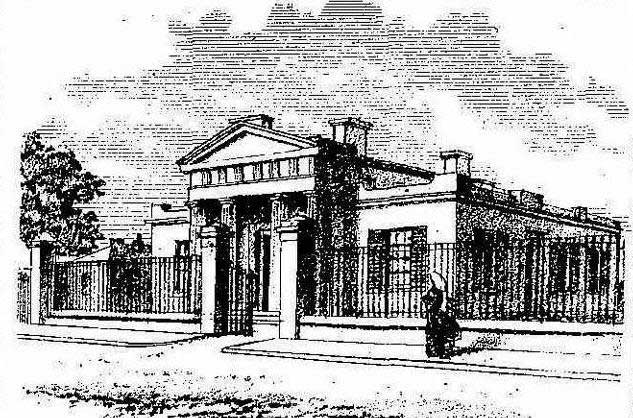
For many years the large but somewhat antiquated building to be seen in the margin of our picture, and known as “Government House,” was the country residence of the governors of the colony, it, however, no longer serves this purpose, and the reserve is devoted to the public as park and recreation ground.
It was ast Parramatta that Lady Mary Fitzroy lost her life by a carriage accident. This lady had endeared herself to all classes of people, poor and rich, and her death was in many ways deplorable, and was bewailed as a great loss to the colony. She may truly be said to have exhibited in her person all the best characteristics of an English gentlewoman. A good story is told of her in relation to her domestic qualities. A Sydney tradesman waited at Government House early one morning for orders, and seeing a neatly-dressed lady bustling about at such an early hour, concerning herself with the domestic arrangements of the household, he fancied she must be the housekeeper, and, thinking to secure the lion’s share of the business of Government House, he slipped into her hand a £5 note, evidently in that spirit of gratitude for the past which Dr Johnson was apt to define as a “lively hope of favours to come.” It is said Lady Mary accepted the gift, but presented it to some charitable institution.
Parramatta is well supplied with places of worship, the Church of England being represented by St John’s and All Saints’, the Roman Catholic, Presbyterian, Wesleyan, Independent, and Baptist, having each a substantially-built place of worship. There are also public schools of great capacity. The court-house is a neat structure in the main street, a view of which is shown. The town is supplied with gas, but as yet lacks the necessary adjunct, a regular water supply.
The town has a very creditable display of trade premises, some, indeed, being of very substantial character, as will be seen by a glance at our picture.
Parramatta has an interest, too, of rather a painful nature, for here are situate the penitentiary and the asylum for the insane, both buildings of very large dimensions, and dating far back into the earliest history of the colony. Both were erected by the enforced industry of a class which, as Barrington—himself one of their class—says.
“Left their country for their country’s good.”
Altogether, Parramatta has about it an air of progress, and of late years the district seems to have become more and more the resort of the Sydney tradesman, who here builds his suburban home, plants his orange and lemon trees, and literally “sits under his own vine and fig-tree.”
The town is situated about fifteen miles from Sydney, and may be reached by the old turnpike road, by rail, and by steamers, which ply regularly up the river. The scenery on the banks of the river is very charming, and no pleasanter day can be spent than in a trip by water to Parramatta, nd a visit to the interesting gardens and orchards of the district.
The railway station is conveniently to the town; it is a neat structure, presenting rather a busy aspect on the arrival and departure of the morning and evening trains; and, during the orange harvest, there is an air of bustle and commerce about the scene.
~ ~ ~ ~ ~
Windsor and Richmond Gazette, Sat 29 Dec 1894 2
Thu 19 Sep 1889, p. 23. Reproduction: Peter de Waal
NOTES.
———
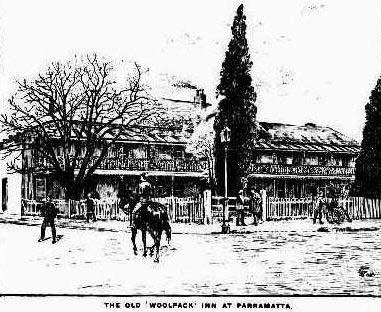
“Cumberland Times” gives the following, but omits to state that a Parkes Government was responsible for it:—Eight years ago the New South Wales Government bought the site of the old Woolpack Hotel, Parramatta, for £8000, as a location for a courthouse. Simultaneously with the purchase they sold the property now used as a courthouse and lockup for £10,000 to the Commercial Bank of Sydney. Since that time the Government have paid the bank a yearly rental for the courthouse corner of £650, while the £8000 purchase has been lying idle. We are in error when we say it has been altogether idle; for an important part of the allotment has been made a present of to a combination of friendly societies, who show their skill in self-helpfulness by helping themselves through political influence to property which belongs to the public. For courthouse purposes another property was bought in close proximity to the railway station—the most unsuitable of all conceivable positions—for £1750. That, like the site of the old Woolpack, has been lying idle for over 10 years. The interest for £9750 has to be added to the yearly rent of £650 annually paid to the Commercial Bank for the rent of the Parramatta courthouse before we can arrive at the nett cost to the community of the administration of justice in Parramatta. At six and a half per cent, which is the rent to the Commercial Bank for the courthouse, we have £631 5s added to £650, or a total of £1281 5s a year for houseroom in Parramatta for dispensing justice in the Historic Brough. Most people will say the money is worth it.
~ ~ ~ ~ ~
The Cumberland Argus and Fruitgrowers’ Advocate, Sat 28 Nov 1896 3
THE NEW COURTHOUSE.
———:○:———
THE OFFICIAL OPENING.
————
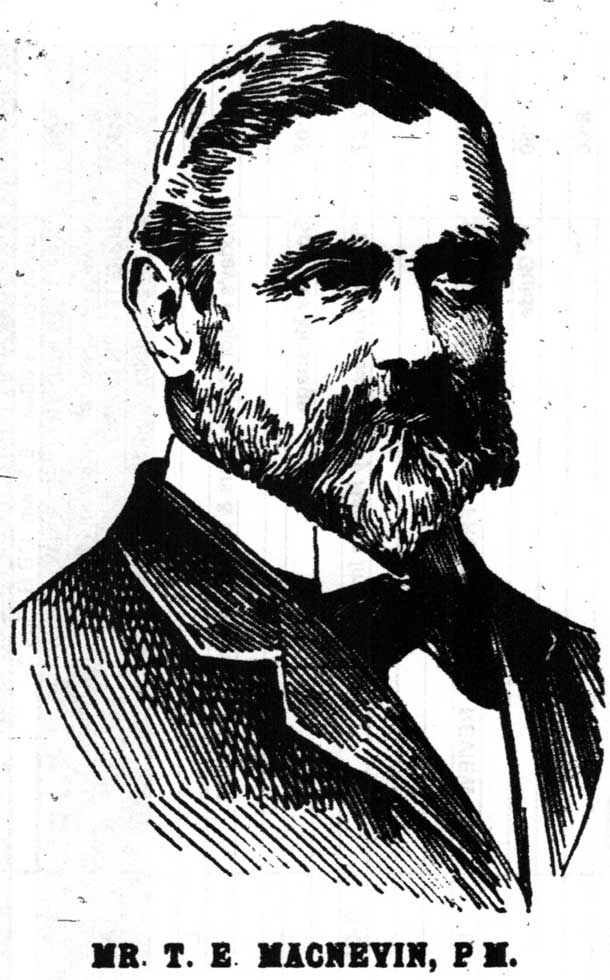
The official opening of the new Courthouse took place at noon on Wednesday, and the ceremony was a very quiet one. Mr TE MacNevin presided, and Mr Maybury, the sheriff, and Alderman Taylor sat with him on the Bench. There were also present:—The Hon Geo Thornton, MLC, and the following J’sP:—Messrs DD
Henderson, JW Withers, WK Gibbons, T Taylor, HT Jones, GT Hunt, SJ Pearson, F Ellison, WH Windsor, Jas Purser, Jas Spurway, GW Pearce, EH Pearce, FC Cox, FHG Rogers, F Beames, S Murphy and PA Pearce. The legal profession was represented by Messrs JE Bowden, W Jhonson, EK Bowden, W Manning, FW Todhunter and HE McIntosh. The police were represented by Inspector Latimer and Sergeant Banks, and in the portion of the Court allotted to the public there was a fair crowd.
Reproduction: Peter de Waal
Mr TE MacNevin, who was cordially received, announced that he had received apologies for non-attendance from Mr T Barnett, Governor of the Parramatta Gaol, and the following Justices:—J Whitworth, G Coates, J Taylor, CJ Byrnes, S Goold, John Purser, Oliver Saunders and Mills. He had also received an apology from Mr Vernon, the Government Architect.
Mr MacNevin then said: It is with very great regret that I have to announce that, in consequence of circumstances that have transpired since the Minster for Justice accepted the invitation, he has intimated to me that he has been unable to be present to perform the official ceremony of opening the new Court House. I regret this the more because his presence here to-day would have given that eclat to the proceedings which the old historic borough is justly entitled to expect. In the absence of the Minister, and by the unanimous wish of my brother magistrates, the duty of formally opening the building has devolved upon me in my position as Police Magistrate of the town, and I can assure you that I am fully sensible of the honor conferred upon me. It is a matter of sincere congratulation that Parramatta, after the long patience it has exhibited, has obtained a Courthouse of which it may well be proud, especially as regards this beautiful court-room which I will assert, for handsome design and comfort, is second to none in the colony. I think it reflects great credit on the Government Architect who designed it and and [sic] the contractor who so faithfully carried out the designs. There are some people who think that the opening of a Courthouse should be conducted without any ceremony (hear, hear) as it is an existing evidence of our fallen humanity (hear, hear) and the chief object the punishment of offenders against the law. I do not share that gloomy view myself. I think it is in itself a very useful object lesson—a standing menace to crime and an evidence of the material prosperity of the district. We might as well object with the same reason to building churches with spires as to the erection of a handsome building such as you are now possessed of, designed to uphold to us respect for the majesty of the law, upon which the constitution of society is based. (Applause). It is a well-known fact that the ambition of every district is to become possessed of a handsome public building for the administration of justice, and to be able to point with pride to the Courthouse as one of their public institutions. I cannot at this juncture refrain from expressing my great regret that this demonstration was not of a wider character. (Hear, hear). Considering the length of time that the Courthouse has been agitated for, I am sorry that it has been delegated to us as Magistrates to conduct the opening proceedings. I am fully sensible of the honor of being the first Police Magistrate to preside in the new Courthouse, and I hope that the members of the legal profession will bear with the Bench until it becomes accustomed to the grand surroundings after being in the old Courthouse. (Laughter). I have now very great pleasure, at the wish of my brother Magistrates, in formally declaring this Courthouse open for the transaction of public business. (Loud applause).
The Hon George Thornton, MLC, said: I have been factored by my brother magistrates with the high honor of proposing a vote of thanks to our very worth PM to-day and I do so with very much pleasure. Though only a young man (laughter) I happen to be the oldest magistrate (laughter), and that is why I have been asked to propose this vote of thanks. I do so most cheerfully—it is a pleasurable duty. I regard it as a most fortunate thing for Parramatta that a gentleman of such ability has been chosen to administer the law in Parramatta. (Hear, hear). I have had a great deal to do with magistrates in the colony I consider that the appointment is a very judicious one. (Applause). I hope that he will long continue to carry out his duties successfully. (Hear, hear). I cannot help saying that I am very much pained to hear that there has been a mishap and one that is not at all creditable to the parties concerned. (Hear, hear). A moment’s consideration would have shown Mr Gould, who is a native of Parramatta, that even if it were only that he was a native of the town he should have been here. I regret that he should have let small political incidents influence his decision in refusing to come. It ought to have occurred to him and to the one who influenced him that if we had invited one we would have to have invited everybody. If the member for the district of Parramatta is entitled to be here, many others are also entitled to be here. We might name many others, but where could we stop? I remembered once in Parramatta when I gave a fancy dress ball. I made arrangements for a hall that would contain 1800 but through influences that were brought to bear I had to invite 2500. (Laughter). And there are many people so small-minded that they pass me by in the street to-day because I did not invite them to that ball. (Laughter). If I lived to be a hundred years old and had an income of £100,000 a year I should never get up another fancy dress ball. (Laughter). I feel extremely sorry that the mishap has occurred, and I have great pleasure in moving this resolution. (Applause).
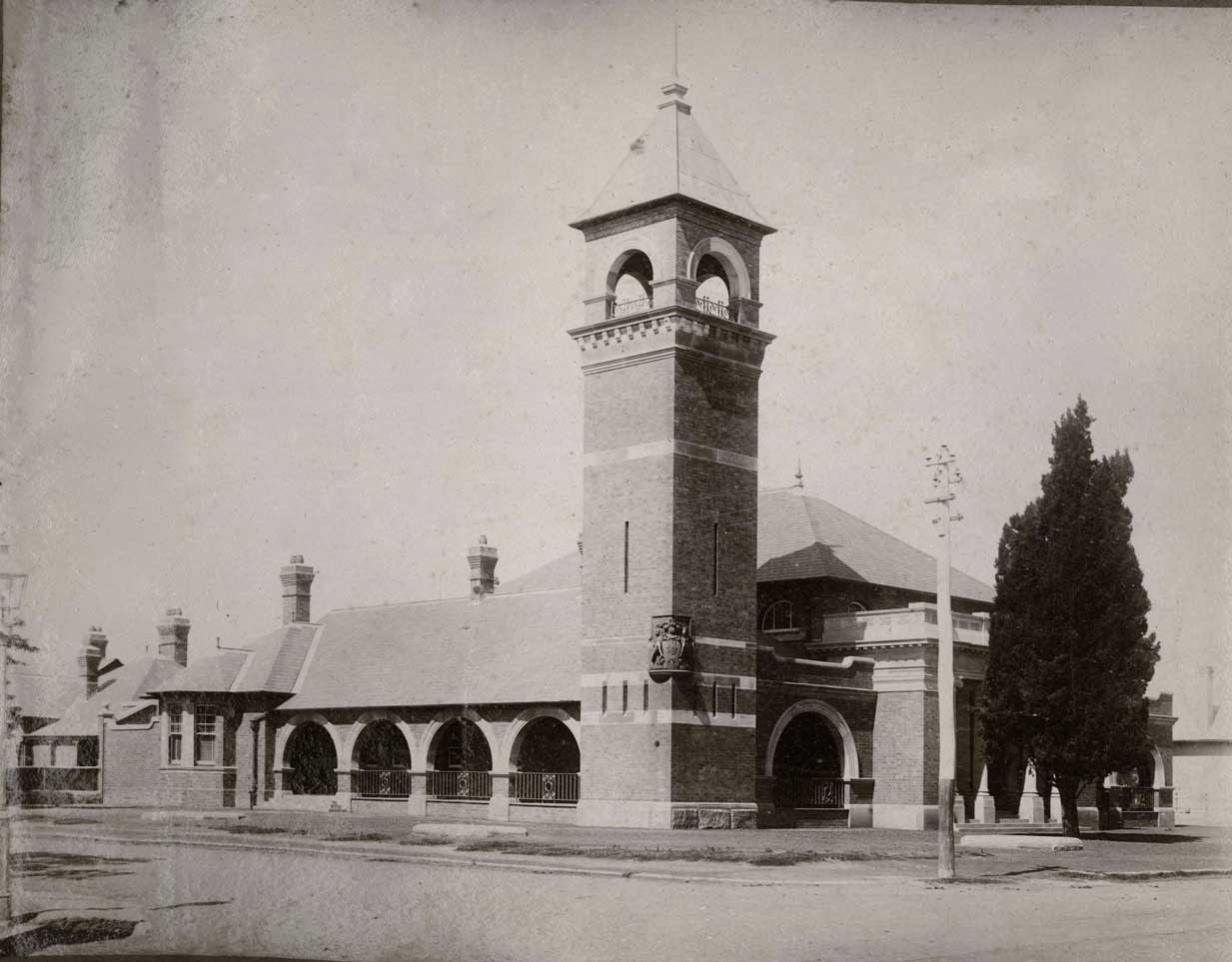
Photo ID: SRNSW 4346_ a020_a020000003.jpg
Mr Hugh Taylor, JP, seconded the resolution. He said: “I can assure you that it gives me great pleasure to be here to-day. It was in 1875 that a movement was first started by me to have the prison wall in front of the old Courthouse taken down, and that would have been done had not the Government for some reason or other thought better of it. From that day up till now there was never a day but what I was agitating and annoying them for a courthouse. I remember taking two contractors down to look at the plans of the Courthouse. The money had to be voted on the loan estimates, but before they came on I was turned out. (Laughter). It gave me very great pleasure when, after 16 years’ hard fighting, the Government purchased this site and sold the old Courthouse, which will be used for a much better purpose before long, and built this Courthouse, which cost £13,000. I have a letter from the Commercial Bank with reference to the purchase of the old Courthouse, but I thought it better perhaps not to read it. It gives me, as I said before, great pleasure to be here, but I should have liked to see something different altogether from this to celebrate the opening of the new Courthouse. I should have liked to see not only the magistrates here to entertain the Minister, but I should have liked all the leading men of Parramatta to be entertained. A public meeting was called by the Mayor to get the public opinion, but it was only responded to by 13 person. There was not reason now for any one to be dissatisfied that 45 or 46 magistrates of the town and district met and came to the decision to entertain the Minister, the Colonial Architect and the Sheriff. Have we not a right to spend our own money as we like? If we had invited the member for Parramatta we would have had to invite Mr Smailes of Granville and Mr Garrard of Sherbrooke and so on. This Court house does not belong to Parramatta alone but to Central Cumberland, and if they invited one, all the members should be there. I could tell you the reason of the bungle to-day if I liked. For myself I should have liked to see the contractor here and I should have liked to see all the labourers who have been working on the building all through here. They should all have had some little entertainment by the Parramatta people. I see here they will open a courthouse in Maitland in a few days. The ratepayers are going to have a day’s jolly amusement for all the people in Maitland. We are drifting away to a state of things in Parramatta—which was once the talk of the country for the handsome way they did these things—were drifting away and will soon be a “sleepy hollow.” Nothing is done to liven up the people. I agree with every word my young friend Mr Thornton (laughter) has said about the insult offered to Parramatta by the Minister for Justice. He had a right to come up here by himself. (Hear, hear). A very high honor was conferred upon him in inviting him to be here to-day and he should not have taken any side winds at all. If the member for Parramatta attended the meeting at the Town Hall he would have been here. I am very sorry he is not here. I have very much pleasure in seconding the resolution.
Mr JE Bowden, the oldest solicitors in the town, was received with much cheering and said:—It is only proper as a member of the profession I should say a few words of congratulation on this occasion. I have had more experience of the old courthouse than any person present, with the exception of my young friend Mr Taylor (laughter). I have practised there for 21 years, and at an early period of my practice there used to be much talk about the necessity for a new courthouse. I have grown old while it has been talked about and now it has been established. I rejoice to see a perfect building like this, and I think we are to be congratulated that this building has been opened at so early a period of Mr MacNevin’s connection with this district. In fact we have got a brand new PM and brand new courthouse (laughter). I wish you, and my brother members of the profession also wish you, hearty congratulations on this occasion, and hope that you will live long with us. I regret the non-attendance of the Minister for Justice, but he has been worthily represented by yourself. He has chosen to consider that under certain circumstances it is not his duty to be here. That need not affect us. I support the resolution with great pleasure.
The motion was carried with hearty acclamation, and the Hon G Thornton conveyed it in an appropriate speech to Mr MacNevin.
Mr MacNevin said: I feel quite overwhelmed at the compliment you have tendered me on this occasion, and find it difficult indeed to express my gratification for and appreciation of the honor you have conferred upon me. I am not an experienced speaker but I return you my heartfelt thanks for the honor you have done me. I hope the 30 years’ experience I have had in the Department of Justice will facilitate the performance of my duties among you. No one appreciated more than I do the proud position I occupy to-day, and I again thank you heartily.
Mr H Taylor referred to the presence that day of the sheriff fo [sic] New South Wales (Mr Maybury), briefly moved a vote of thanks to him for his presence.
Mr JW Withers seconded the vote, which was carried by acclamation.
In responding Mr Maybury said he thanked them very much for the kind way they had received him, and the vote of thanks they had passed. He regarded the vote as quite unnecessary, as he came there as a part of his duty. He took that opportunity of complimenting them on becoming possessed of such a temple of Justice in their midst. He complimented the architect on the excellence of his design, and the contractor on the skilful way he had executed it. They were asked there to assist in taking over this new-born child of grace and beauty, and it was a consolation that the new PM would be a good foster-father to the child, and help to preserve its beauty, and extend its usefulness. As Sheriff, the conveniences for jurors interested him. He came there with a great deal of pleasure, and regretted the absence of the Minister.
Reproduction: Peter de Waal
The proceedings terminated with three cheers for the Queen, and one for the Magistrate.
The Justices and some member of the profession discussed an enjoyable luncheon subsequently.
————
THE NEW BUILDINGS.
————
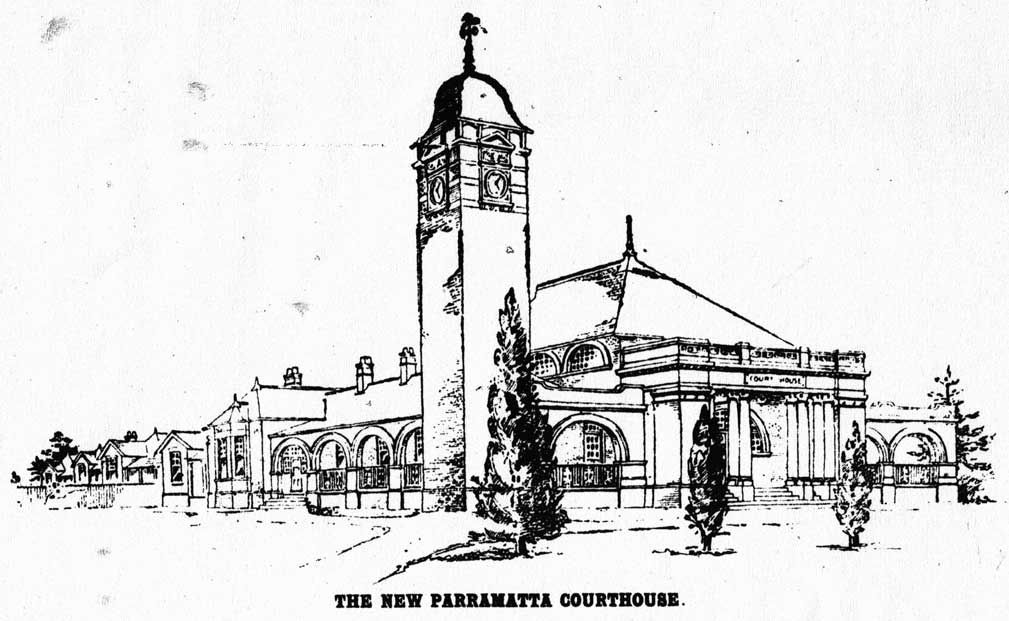
The above view of the New Court House is from a drawing supplied by the Government Architect’s Department. It is correct in every detail except as regards the clock and the weathercock—neither of which desirable things has yet been erected—and the number of the trees.
The architect was Mr WL Vernon, Government Architect, with Mr Edwin Drew as assistant architect and Mr EH Rumsey as clerk of works.
The contractor Mr JH Threadgill, who is to be congratulated on the excellent performance of his work, has kindly furnished us with particulars of the building, from which we have compiled the following description taking the block from the Marsden-street side.
THE LOCK-UP BUILDINGS.
Facing Marsden-street and running back to the eastern boundary of the site, are the lock-up buildings, comprising charge-room 26 x 14 with charge-dock, and strong-room in one corner. Passing from the charge-room on the left we enter the inspector’s office 13 x 14. A roomy passage leads from the charge-room into the padded cell, which is really a most comfortable looking room (for those who appreciate padded cells) 12 x 12. Opposite this there is the sergeant’s office 13 x 14. Leaving the passage we enter to prisoner’s exercise yard, with massive iron bars as a cool arrangement in the way of a ceiling or roof. In this yard are three cells, 13 x 7, and two cells, 13 x 12, all lined with specially made glazed bricks, and having very formidable looking iron doors on every side. Going back to the charge-room, we open a door which separated the lock-up from the lock-up keeper’s cottage. This cottage contains living room, 16 x 12, three bedrooms, 11 x 12, and kitchen (with cooking-range and wash-up sink), 13 x 13; verandahs back and front, with hall right through; at the back, pantry, laundry with copper and fixed tubs, and drying-yard, also bathroom. Back again to the charge-room and there is a passage to the constables’ barracks. Crossing a tar-paved yard with verandahs, we find the mess kitchen, 20 x 20, with range to cook for 40 men, two large boiling-coppers, wash-up sink, etc. Adjoining is a large store-room 20 x 9. Near here is the library or smoking-room, 26 x 20, on either side of which are large, well ventilated dormitories, each 30 x 20, and a box-room 20 x 9. Running the whole length of these rooms is a shady verandah 100ft long by 8ft wide. Throughout the buildings at intervals are lavatories, bathrooms with cast-iron baths, and, in fact, every modern convenience, not forgetting a fire-place (with marble mantel-piece) in every room. Gas and water are laid on everywhere, and every provision has been made in the shape of large taps and hose in the event of a fire breaking out. The strict privacy of each cottage is perfectly secured.
Stables.
The stables consist of a long range of brick buildings containing stabling for five horses, coach-house, forage-room, mounted constable’s room, 18 x 12, two bathrooms and other conveniences.
INSPECTOR'S COTTAGE.
The Inspector’s cottage is built of brick with slate roof. It contains drawing room 18 x14, dining room 12 x 15, a large bedroom 13 x 14, and three other bedrooms. The kitchen is a fine room 12 x 12, with large range of [sic] sink. There is a nice bathroom, a pantry, and wide verandahs run on the front, side and back. There is also a laundry, with fixed tubes, copper etc, and asphalted footpaths. This cottage struck us as being finished in a very superior style, the panelled ceilings and decorations of the main rooms being a pleasing feature.
SERGEANT'S COTTAGE.
This is a five-roomed cottage containing hall, sitting room 15 x 12, bedroom 14 x 12, two other rooms 11 x 12, and kitchen 13 x 12, including bathroom, pantry and laundry, fitted up as in the Inspector’s cottage. There is a wide verandah back and front.
THE COURTHOUSE BUILDINGS.
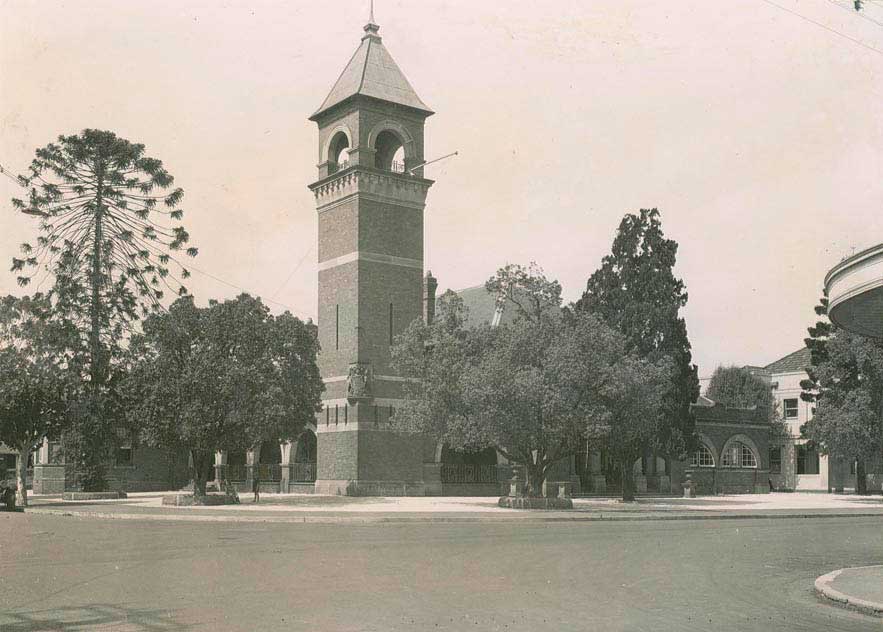
Photo ID: SRNSW 12932-a012-a012X2443000149.jpg
These buildings from a large block, having three frontages. The design is a free adaptation of the Classic, with a feeling of French Classic in the Ionic portico. The outside walling is of double pressed, plum coloured bricks, laid in blue mortar, and the dressings are of local freestone. This forms a very pleasing contrast, especially when it is noted that the whole is capped with a purple slate roof. The tower, rising 70 feet skywards, is the architectural feature of the design, it being embellished with a spiritedly carved coat of arms upon the outer corner, and finished with a copper roof. The portico too, with carved stone front, with its handsome Ionic columns of capitals, shading as it does an entrance door both bold and symmetrical. Leading from the porch—which is paved with black and white Sicilian marble tiles—are two fine verandahs running from the front to either side, and paved with red and buff tiles.
THE COURT ROOM.
Forms the centre of the building, being 50 x 30 and 22 feet from floor to ceiling. At the northern end is a richly carved canopy, under which is a fine coat of arms, and the raised dais for the bench. Under the Bench is the associate’s box, reporters’ box, and witness’ box. On the east side is the jury box, and on the west side a box for the jury in waiting. There are also seats and desks for the Inspector and Sergeant, the dock being a conspicuous feature in the centre. At the south end is the well arranged lobby and floor and seating space for the public, this being railed off by an ornamental railing.
On either side of the Court room are very massive but artistic fire places with gas pipes, these being built as part of the building. Being constructed of rosewood, with black marble sides and fender, with a peacock blue tiling inside, they certainly add beauty as well as utility to the room. Looking upward we see a beautifully designed cedar-paneled [sic] ceiling, supported by richly carved cedar trusses in pairs, these resting upon a delicately outlined moulded and dentilled cornice. The walls are finished with Keene’s cement, the lower portion forming a dado of harmonious green devices. The room is lighted by 15 semi-circular stained glass windows, each containing a heraldic shield of different design, and each window made to open with a simple but ingenious arrangement.
ACCOMMODATION FOR BENCH, BAR,
AND PUBLIC.
The west wing contains a judge’s room, 14 x 14 with bay window; police magistrate’s room, 15 x 14; inspector’s room, 15 x 14, and witnesses’ room, 14 x 16. Each of these rooms has marble mantel pieces and fire places. On the east wing we come across the chamber magistrate’s room, 13 x 14, and a room in which people, having business with him, will be courteously entertained by the CPS. This room is 40 x 14 and is furnished with counters. The back wing contains the Crown Prosecutor’s room 10 x 14; sheriff’s room, 12 x 14; barristers’ room, 12 x 14, and these rooms also have mantel pieces and fireplaces. The provision for the comfort of jurors shows a good advance on old days. The jury’s retiring room on the back wing measures 19 x 20, and has a lavatory attached. In case of a jury being locked up there is a dormitory, 19 x 30, for the use of the good men and true, who are giving up their time to the service of the country. And the winter is shorn of much of its terror by the fact that fireplaces are provided here, as they are in every room of the building.
The yards in the rear are asphalted, and here are to be found offices containing every modern convenience.
The caretaker’s cottage adjoins the Courthouse block and contains four good rooms.
The Marsden-street frontage will be enclosed by a stone wall and ornamental fence, with five gates to each entrance.
I may be mentioned that the original plans contained no provision for a tower, but Mr O’Reilly felt that the buildings, without this, would be dwarfed into insignificance by the Woolpack Hotel on the other side of George-street. Upon his urgent representations to this effect the tower was added.
———◦———
THE OLD COURTHOUSES.
————
THE OLD GAOL.
————
SOME NOABLE NAMES.
————
Mr John Taylor, drawing on his wonderful memory, was kind enough to give a representative of the Argus who waited upon him, the following interesting narrative concerning the administration of justice in olden days.
On the site in Macquarie-street where now is situated the private residence of Mrs Harriet Holland, there once stood the first place used as a Court of Justice in Parramatta. All business was transacted in a cottage there, which lay some feet below the level of the street, and was approached by stone steps which led down to a garden and thence to the house. The cottage belonged to and was in charge of Mrs Hum. The officiating police-magistrate was Dr Douglas, who was noted for the severity he displayed in dispensing the laws of the land. Mr Innes (Inspector of Police), and Messrs Palmer, McLeod and Barlow also helped to administer the law, as did also Captain Brooks and other military officers.
A celebrated case heard in this primitive court of justice was that of Oakes v. Beale. The case was determined by Judge Baron Field (Charles Lamb’s friend) who was sent up by the Governor to investigate the matter. No police uniform was worn in those days, the officers being allowed to wear any private clothing they preferred. John Thorne was the chief constable, and Samuel Horn the senior-constable. Both officers were subsequently granted lands for bravery, and hence the present sites of Hornsby and Thornleigh derived their name. The local prison then stood upon the space where now is Alfred Square, the stocks being erected in front, and the watch-house opposite, near where now stands the Congregational Schoolroom.
The next place used as a courthouse was a building which stood at the rear of Mr DD Henderson’s grocery establishment. Mr Wright became police magistrate and was succeeded by Mr Campbell, whose residence was a Government building opposite the Emu Hotel, George-street. Among the magistrates in those days were Messrs John Macarthur, HH Macarthur, (the first parliamentary representative of the district and father of the late Rev G Macarthur, Headmaster of The King’s School), Dr Harris (of Harris Park), Dr Foster of Brush Farm, Mr Blaxland of Newington, Mr D’Arcy Wentworth of Toongabbie, William Lawson of Prospect, Mr Sutton of Baulkham Hills, Major Lockyer of Ermington, Mr Blaxland of Ryde, Major Darvall and Captain Moffatt. Mr Orr was the acting CPS. The Court of Requests (now our Small Debts Court) was held by a commissioner. Among prominent solicitors were Messrs Lewthwaite Armstead.
The foundation stone of what is now looked upon and called
THE OLD COURTHOUSE.
was laid in 1838 by the police magistrate, Mr Campbell. The only two gentlemen now living who attended that ceremony are the Hon John Lackey and Mr John Taylor. Both gentlemen were then boarders with the Rev John Eyres, who considered it a most important occasion and took them to see it. At the laying of the stone Mr Campbell deposited beneath it a bottle containing a shilling and a memo with the name of the Governor and the date written thereon. The Courthouse was built by Messrs Howison and Payten, Government contractors, all the stone, of which the splendid pillars in the front are an example, being obtained from the Government quarry, near the Hospital for the Insane. The site of the old Courthouse was formerly a house and paddock, where Woods, the then town-crier resided, who wore a long frock coat with lace trimmings, and carried a long staff with a tin crown. Forty-six years after the laying of the foundation stone, tenders were called for extending the depth of the Courthouse. Mr Taylor then informed the contractor of the bottle containing the memo and shilling placed beneath the foundation stone by Mr Campbell, which was recovered and re-deposited in the spot where it now lies.
Mr Campbell was succeeded as police-magistrate by Captain Brooks, after him coming Captain Elliott, Mr Hardie, the present Judge Forbes and Mr Darvall. Then there was a lapse of some years, no police-magistrate officiating, the business being conducted by the town magistrates, prominent among whom were Messrs James Byrnes, Andrew McDougall, William Acres, Hon J Lackey, Mr Kenyon, Crook, Samuel Lyons, Captain Fairclough, Neil Stewart, and Mr Lawson. Mr George Langley succeeded Mr Orr as CPS. Then Mr Weaver, Mr AO Grant came after, and then again Mr Langley, who occupied the office up to the time of the late Mr George Wickham.
The late Hon George Robert Nicholls, William Charles Wentworth, Dr Wardley, Chief Justice Martin, and other distinguished men have pleaded celebrated cases in the old Courthouse, the most famous being a riot case over the building of a dam where now stands the Gasworks Bridge, in which the contending parties were Mr John Macarthur and Mr J Raine. The former won his case.
————
INTERESTING REMINISCENCES.
————
A representative of the Argus had an interview the other day with one of the oldest residents of Parramatta, and gleaned a lot of interesting information about the Police Office of old days.
“The first Police Office I remember dated some 70 years back, and was a building now standing in Church-street, immediately behind Mr Henderson’s grocery shop. There it is now,” continued our friend, “as it was in the olden time. I had a look at it on Saturday. When I knew it as a boy it stood alone, and Parramatta was very different then. It was surrounded by a garden. Dr Harris, the owner of the Ultimo Estate, and a relative of the family of Harris’ now living in Sydney, was Superintendent of the Police at this time, and he lived on the place now called Harris Park. That was his residence. His nephew was ex Mayor Harris of Sydney. Two aldermen of Sydney at the present time are descendants of Dr Harris.
“The site of the old courthouse as we know it to-day (the building just vacated) was formerly occupied by a man named Wood, who was town-crier of Parramatta, and who went about the town with a stick with a crown on it and used to make the public announcements, always prefacing the latter with the old-fashioned ‘Oh yes! oh yes!’ that is over 50 years ago.
“The Parramatta Gaol was situated on the north side of the river close to where the Baths are now. It was a large building of the usual style in vogue. The worst-class of prisoners used to be brought up from Sydney to serve a certain time in that old gaol and to work on the roads, and other prisoners whom they displaced were distributed about the country or assigned out to private service.
“For many years Parramatta was under the control of a Commandant, a sort of petty governor, who had almost absolute power. The Rev Samuel Marsden was one of the principal magistrates, but Dr Henry Grattan Douglas was the head authority in Parramatta for many years, and other magistrates were D’Arcy Wentworth (father of the great William Charles Wentworth, the Australian Patriot) who lived in a fine old-fashioned cottage which stood where the Parramatta Railway Station is to-day, and the present railway premises and the vicinity were all his property. He was for some time police magistrate in Parramatta. Nelson Lawson was another magistrate. Then there was David Johnson, of George’s Hall, and Hannibal Macarthur, who lived on the Vineyard, on the Parramatta River, on the present site of Subiaco Convent. That was formerly the homestead of the family of John Macarthur, who, it will be remembered, introduced the first sheep into the colony. He was another notable magistrate and there were others.
“The site of the present Courthouse was once occupied by the most comfortable and the best furnished hotels in Australia. It was the Woolpack, and was kept at the time I speak of by Andrew Nash. Yes, it was the ideal of an old English hostelry, with the perfect quiet and comfort of a gentleman’s home.
“Parramatta was a great palace for racing in the olden time. Leading men of the colony used to constitute the committee of the race-club. There were the Wentworths, the Lawsons, the Icelys, Sir John Jamieson (whose farm servant Sir Henry Parkes was shortly after his arrival in Australia), the Badgerys, the Baylys and a lot of others, the leading gentry of the colony. Mr Nash’s old Woolpack Inn, which stood where the present court house stands was their rendezvous during the race-time, and a most enjoyable carnival it was too. I knew people who came from Sydney to the Old Woolpack and made it a house of perfect comfort and enjoyment. It stood, as many of the present generation will remember, in the middle of a very large garden, and had good stabling and first class service, after the style of one of the best found English hostelries. There is no hotel in the country like it now-a-days, although there was at that time a similar hotel—though not so large, yet equally comfortable,—on the site where the Commercial Bank stands now in George-street. At the Woolpack the mail coach from Sydney to Windsor, via Parramatta, used to call.”
HOW THE OLD COURTHOUSE WAS
IMPROVED.
————
Mr G Peters, in reply to an Argus representative, confirmed the statement that Messrs James Howison and Nat Payten were the builders of the old Courthouse. The contract was one of measurement and was carried out by convict labor which was assigned to them.
“In 1863,” continued Mr Peters, “I took a contract for additions to the Courthouse. The work was the heightening of the wall of the enclosure at the back and the building of lock-up-keeper’s quarters. Previous to that the lock-up-keeper had no quarters there. A great deal of alteration was made to the roof, and there were alterations of a general character. About £800 was laid out.
“While the work was going on in 1863 the the [sic] foundation stone was taken up and in it was found a bottle containing two or three kinds of small coin, a copy of the ‘Sydney Morning Herald,’ and a document showing that when it was laid Mr Campbell was PM and Mr Lewis Colonial Architect. The stone was put in another place, and the bottle re-sealed and put back with it. It had been found necessary to take it up to go on with the alterations.
“About fourteen years ago myself and Mr Herbert Coates put another storey on the lock-up keeper’s quarters, I had the stonework and Mr Coates the woodwork. We also built the lock-up, as up to that time all offenders arrested were placed in the cells. The cells were also altered at the same time, and the court room made some fifteen feet longer and new rooms were put up at the back.
“I think about £3000 has been spent in additions and alterations of an extensive character since 1863. Mr Langley was PM then, and he went off to Forbes. Then there was, as you know, a long interval without a police magistrate till Mr Giles came. In ‘63 Sergeant Kelly was the chief of the Parramatta police. He died something over 20 years ago, and was buried with military honors from the old barracks near the station. Sergeant Bremner succeeded him. Old Mickey O’Connor used to be a well known police identity in those days. He was a blustering meddlesome officer.
“Mr Dawson was Colonial Architect in 1863, and Mr James Barnett (who came to the country at the same time as I did) was the Colonial Architect on the second job I spoke of, about 14 years ago.
“I think the old building, simple as it looks, is preferable in design to the new one. The arches of the latter are to low for the width, and with the roof so squatty, the building is more like a great barn than anything else.”
———◦———
NOTES OF HISTORY.
————
Parramatta was one of the first sixteen courts of petty sessions proclaimed in the colony in November, 1832.
The site of the old Courthouse was surveyed in 1838 and reserved for Police Court purposes. In July of the same year a contract was accepted for the erection of a Courthouse.
On April 23, 1863, plans for additions to the Courthouse were signed by George Peters, now of Ross-street, Parramatta, his sureties being John Hilt and Henry Tucker Jones.
Further large additions were made by George and Herbert Coates in 1874, the sureties being Robert A Ritchie and Joshua Ardill.
In 1882 further additions were made by Herbert Coates, his sureties being DD Henderson and G Coates.
In 1885 a site for a new Courthouse was purchased by the Government, fronting Fitzwilliam and Church streets.
In 1887, on the suggestion of Sir Henry Parkes, the Government purchased the old Woolpack site.
In 1895 the money for the new Courthouse was placed on the loan estimates on the representations of the member, Mr O’Reilly.
The old watch house stood where the present Congregational Hall (old public school) stands.
The old gaol stood opposite, above in the middle of what is now Prince Alfred Park. The gaol was surrounded by a wall, outside of which, and fronting Church-street was a row of stocks—frequently full (and overflowing with language). Many persons were hanged inside the gaol.
The old Police Court was (and the building now is) at the rear of Mr Henderson’s fine emporium. The toe-line of the ancient drunk is at present a repository for the very best brands of whisky. Another injustice to fate.
~ ~ ~ ~ ~
The Sydney Morning Herald, Wed 2 Dec 1896 4
NEW COURTHOUSE AT
PARRAMATTA.
———◦———
Parramatta has always been a notable place for its strong and healthy local spirit, so that the opening of a new courthouse last Wednesday was naturally a progressive sign, full of interest for the good people of the town. Moreover, this was the fulfilment of a really “long-felt want,” for the old courthouse was dreadfully ramshackle, inconvenient, dirty, and otherwise unsuitable. The system of making “additions” from time to time to the main building had been resorted to since 1863, a room being added to here and quarters there, with the natural result that a good deal of money was spent without corresponding result. In 1887 the Parkes Government purchased the site of the famous Woolpack Inn; but it was not till 1895 that the money was actually placed on the estimates. Since then the work has been steadily proceeded with under the direction of the Government Architect, Mr WL Vernon, whose work seems to have given general satisfaction to all those who may be supposed to be specially interested in the internal economy of a courthouse—the magistrates, clerks, police; even prisoners ought to feel grateful for the large roomy dock. Judged from the lay point of order the building is certainly a very handsome one, with its lofty clock tower, its broad entrances and porticos on ionic pillars, its stone steps and coloured brick and freestone walls. Indeed, if the old court was something of an eyesore, the new one is, if anything, too luxurious for its purpose, one would think. The tower is 70ft in height, and it is adorned with some very creditable carvings, whilst the copper roof gives it a light, bright, and graceful appearance. Later a clock will be placed in position and some other embellishments will make the spire a feature of the town. The three porches are paved with black and white tesselated [sic] tiles, and the long verandahs which flank the building on either side, and which will keep it cool in the summer, are floored with red tiles, a pretty and refreshing contrast to the white freestone of the main building. Altogether the building cost some £14,000, and the contractor, Mr JH Threadgill, may be congratulated on the excellence of his undertaking.
It was realised that the new building ought to be on such a scale that there would be no necessity to constantly tinker and patch it to enable it to meet exigencies. With this end in view the plans were drawn so as to permit of all the contingent offices of a law court to be included about the ground at disposal. This has been done, with the result that the establishment is, so to speak, thoroughly self-contained. There is ample space available for lockup accommodation, roomy offices for the officials have been provided, there are good and well-fitted-up barracks for the constables, with library, smoking-room, &c, a pretty cottage for the inspector, another for the sergeant, and stables. The main court itself is a very fine room, and no pains have been spared to make it adaptable to the purposes it will be put to. It is lofty and spacious, being 50ft by 30ft, and 22ft from floor to ceiling. The bench at the far end is overhung by a carved canopy, whose artistic embellishments exceed those of any similar work in the Supreme Courts of the colony. Indeed, throughout the fittings of this fine room one cannot fail to observe that somewhat unusual expense and care have been gone to, considering the nature of the place. But the contractors have gone on the principle that it is as easy to make a room seem artistic as hideous, and in this respect they have certainly succeeded. The place is really a work of art, and should it ever fall out that a student of Ruskin comes to stand in the dock it will at least be a solace to his cultured soul to look upwards and contemplate the grained cedar supports to the roof, the chaste mouldings and cornices, the delicate panellings, and the harmonious shading of the walls. The block marble and rosewood casings of the gaspipes which line the wall at the side of the dais will also bring balm; indeed, if one may say so, there is something almost “too utterly utter” about the dados that aesthetically adorn the lower walls. The lighting arrangements have been planned with admirable forethought. A number of windows, of the shape of a half-moon, have been let in high up in the walls, and these are all of stained glass, each one bearing a pretty design. Seating accommodation for the public has been looked after, and the accommodation for the press, barristers, police is all specially good. At the left of the court there is a wing which contains rooms for the Judge, police, magistrate, inspector, jurors, witnesses, &c. the accommodation for the jurors is particularly worthy of mention, especially when we remember how juries are wont to complain of enforced detention at Darlinghurst. Their ordinary retiring-room is an airy and spacious apartment, and the architect, with a forethought that almost amounts to prescience, has remembered that jurors occasionally wish to wash their hands. Accordingly, he has fitted the necessary apparatus in a corner of the room. Then, for the occasions when juries have to be locked up, there is a roomy dormitory and a fireplace. The accommodation provided for prisoners is plain and strong, but wholesome. The cells are airy and properly tiled, and the ventilation and sanitary necessities have been thoroughly attended. There is also a good exercise yard. It would occupy too much space to describe in detail to cottages for the police and the other rooms in the new Court-house. It is sufficient to say that the whole building seems to be the most complete one of its kind in the colony.
1 Illustrated Sydney News, Sat 10 Nov 1877, p. 6, p. 1 supplement. Emphasis added.
2 Windsor and Richmond Gazette, Sat 29 Dec 1894, p. 7.
3 The Cumberland Argus and Fruitgrowers’ Advocate (Parramatta), Sat 28 Nov 1896, p. 13.
4 The Sydney Morning Herald, Wed 2 Dec 1896, p. 7.